

Official CBSE Assignments for Class 12 Chemistry
Access comprehensive school assignments for Unit 3 Chemical Kinetics using the CBSE Class 12 Chemistry Chemical Kinetics Assignment Set 01. Designed to align with the 2026-27 CBSE academic guidelines, these practice sets help Class 12 Chemistry students reinforce core concepts and improve their problem-solving accuracy.
Solved Practice Assignments for Chemistry
View or download the dedicated CBSE Class 12 Chemistry Chemical Kinetics Assignment Set 01 resource below. Engaging with these assignments under focused study conditions ensures continuous academic progress and mastery of the 2026-27 curriculum.
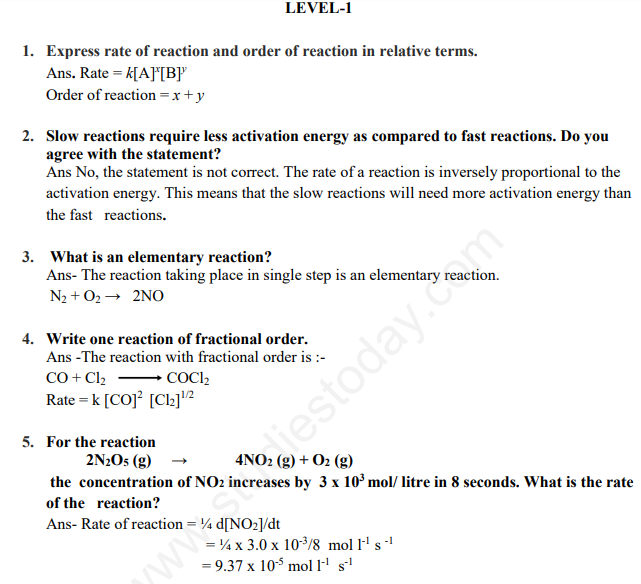
Answer: One gram of pulverized wood has more surface area and therefore, it burns faster than 1 gram of wood.
7. What is meant by effective collision ?
Answer: The collision that leads to the formation of product molecule is called effective collision
8. Explain the term activated complex .
Answer: It is defined as intermediate compound between reactants and products which is highly unstable ,has the highest energy and readily changes into product
9. Define pseudo unimolecular reaction . Give two examples .
Answer: The reaction which is bimolecular but its order is one is called pseudo unimolecular reaction ,
e.g. CH3COOC2H5+H2O in presence of H+ → CH3COOH+C2H5OH
The rate law expression is, rate = k [A]1/3 .[B]2
What is the order of the reaction?
Answer: Order of the reaction = 1/3 + 2 = 7/2
LEVEL -2
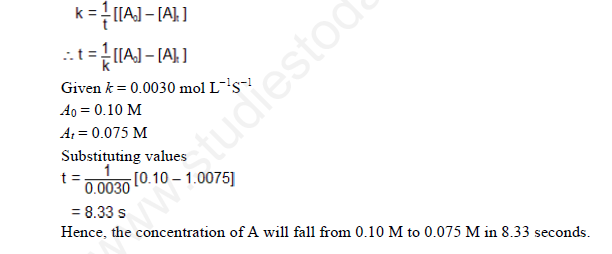
1. The rate constant for a reaction of zero order in A is 0.0030 mol L−1 s−1. How long will it take for the initial concentration of A to fall from 0.10 M to 0.075 M?
Answer: For a first order reaction,
Question. The rate constant of first order reaction is 3 × 10⁻⁶ per second. The initial concentration is 0.10 M.
The initial rate is:
(a) 3 × 10⁻⁷ mol/litre/sec
(b) 3 × 10⁻⁸ mol/litre/sec
(c) 3 × 10⁻⁵ mol/litre/sec
(d) 3 × 10⁻⁸ mol/litre/sec
Question. The half-life of a substance in a certain enzymecatalysed reaction is 138 s. The time required for the concentration of the substance to fall from 1.28 mg L–1 to 0.04 mg L–1 is
(a) 414 s
(b) 552 s
(c) 690 s
(d) 276 s
Question. Half-life period of a first order reaction is 1386 seconds. The specific rate constant of the reaction is
(a) 0.5 × 10⁻² s–1
(b) 0.5 × 10⁻³ s–1
(c) 5.0 × 10⁻² s–1
(d) 5.0 × 10⁻³ s–1
Question. The activation energy for a simple chemical reaction A ⇌ B is Ea in forward direction. The activation energy for reverse reaction
(a) is negative of Ea
(b) is always less than Ea
(c) can be less than or more than Ea
(d) is always double of Ea.
Question. When a biochemical reaction is carried out in laboratory, outside the human body in absence of enzyme, then rate of reaction obtained is 10–6 times, the activation energy of reaction in the presence of enzyme is
(a) 6/RT
(b) P is required
(c) different from Ea obtained in laboratory
(d) can’t say anything.
Question. Which of the following statement is true for the reaction, H2 + Br2 →2HBr . The rate law is [ H2 ][ Br2 ]1/ 2 dx/dt=k
(a) order of reaction is 1.5
(b) molecularity of the reaction is 2
(c) by increasing the concentration of Br2 four times the rate of reaction is doubled
(d) all the above are correct.
Question. In a reaction, A + B → product, rate is doubled when the concentration of B is doubled, and rate increases by a factor of 8 when the concentration of both the reactants (A and B) are doubled, rate law for the reaction can be written as
(a) rate = k[A][B]2
(b) rate = k[A]2[B]2
(c) rate = k[A][B]
(d) rate = k[A]2[B]
Question. For the reaction : H2 Cl2 →sunlight 2HCl the order of reaction is
(a) 0
(b) 2
(c) 1
(d) 3
Question. The rate of a first order reaction is 1.5 × 10⁻² mol L–1 min–1 at 0.5 M concentration of the reactant. The half-life of the reaction is
(a) 0.383 min
(b) 23.1 min
(c) 8.73 min
(d) 7.53 min
Question. Activation energy of a chemical reaction can be determined by
(a) evaluating rate constants at two different temperatures
(b) evaluating velocities of reaction at two different temperatures
(c) evaluating rate constant at standard temperature
(d) changing concentration of reactants.
Free study material for Chemistry
Download Practice Assignments: Class 12 Chemistry Unit 3 Chemical Kinetics
Revision Assignment: Unit 3 Chemical Kinetics (CBSE)
Review targeted chapter assignments for Class 12 Chemistry Unit 3 Chemical Kinetics. Built according to official CBSE guidelines, these downloadable problem sets help students build accuracy and prepare effectively for school tests.
Why Practice Class 12 Chemistry Assignments?
- Curriculum Standards: Assignments match modern CBSE sample formats to ensure relevant preparation.
- Thorough Revision: Detailed problem sets reinforce core concepts and eliminate conceptual weak spots.
- Execution Speed: Timed practice with assignment sets sharpens overall response timing.
Steps to Complete Unit 3 Chemical Kinetics Assignments Successfully
- Initial Reading: Begin by reading the NCERT book for Class 12 Chemistry to build a baseline understanding.
- Independent Testing: Attempt assignment questions unassisted, then verify work using provided answer keys.
- Supplementary Aids: Leverage revision notes and worksheets whenever you encounter difficult topics.
FAQs
You can download free PDF assignments for Class 12 Chemistry Unit 3 Chemical Kinetics from StudiesToday.com. These practice sheets have been updated for the 2026-27 session covering all concepts from latest NCERT textbook.
Yes, our teachers have given solutions for all questions in the Class 12 Chemistry Unit 3 Chemical Kinetics assignments. This will help you to understand step-by-step methodology to get full marks in school tests and exams.
Yes. These assignments are designed as per the latest CBSE syllabus for 2026. We have included huge variety of question formats such as MCQs, Case-study based questions and important diagram-based problems found in Unit 3 Chemical Kinetics.
Practicing topicw wise assignments will help Class 12 students understand every sub-topic of Unit 3 Chemical Kinetics. Daily practice will improve speed, accuracy and answering competency-based questions.
Yes, all printable assignments for Class 12 Chemistry Unit 3 Chemical Kinetics are available for free download in mobile-friendly PDF format.