

School Assignments for Class 12 Chemistry: Unit 7 Alcohols, Phenols And Ethers
Access comprehensive school assignments for Unit 7 Alcohols, Phenols And Ethers using the CBSE Class 12 Chemistry Alcohols Phenols and Ethers Assignment. Designed to align with the 2026-27 CBSE academic guidelines, these practice sets help Class 12 Chemistry students reinforce core concepts and improve their problem-solving accuracy.
Practice Class 12 Chemistry Assignments: Unit 7 Alcohols, Phenols And Ethers
Access the complete assignment PDF for Class 12 Chemistry below. Regular practice with these targeted academic tasks builds familiarity with standard question patterns and helps secure higher marks in final school evaluations.
Question. Acetone on treatment with CH3 −Mg − I and on further hydrolysis gives:
a. Isopropyl alcohol
b. Primary alcohol
c. Acetic acid
d. 2-methyl 2-propanol
Answer : D
Question. Acetyl bromide reacts with excess of CH3 MgI followed by treatment with a saturated solution of NH4 Cl gives:
a. 2-methyl-2-propanol
b. Acetamide
c. Acetone
d. Acetyl iodide
Answer : A
Question. Methyl alcohol can be distinguished from ethyl alcohol using:
a. Fehling solution
b. Schiff's reagent
c. Sodium hydroxide and iodine
d. Phthalein fusion test
Answer : C
Question. Which gas is eliminated in fermentation?
a. O2
b. CO2
c. N2
d. H2
Answer : B
Question. In the reaction alkali Ar −OH + Rx alkali→ A, A is:
a. An aldehyde
b. An aryl chloride
c. An ether
d. A ketone
Answer : C
Question. The compound formed when ethyl bromide is heated with dry silver oxide is:
a. Dimethyl ether
b. Diethyl ether
c. Methyl alcohol
d. Ethyl alcohol
Answer : B
Question. The reagent used for the preparation of higher ether from halogenated ethers is:
a. conc. H2SO4
b. Sodium alkoxide
c. Dry silver oxide
d. Grignard reagent
Answer : D
Question. For phenol, which of the following statements is correct?
a. It is insoluble in water?
b. It has lower melting point compared to aromatic hydrocarbons of comparable molecular weight
c. It has higher boiling point than toluene
d. It does not show acidic property
Answer : C
Question. Commercially methanol is prepared by:
a. Reduction of CO in presence of ZnO.Cr2O3
b. Methane reacts with water vapours at 900°C in presence of Ni catalyst
c. Reduction of HCHO by LiAlH4
d. Reduction of HCHO by aqueous NaOH
Answer : A
Question.  the above sequence X can be:
a. H2 / Ni
b. 4 NaBH
c. K2Cr2O7 /H+
d. Both a.and b.
Answer : B
Question. Methylphenyl ether can be obtained by reacting:
a. Phenolate ions and methyl iodide
b. Methoxide ions and bromobenzene
c. Methanol and phenol
d. Bromo benzene and methyl bromide
Answer : A
Question. In which case methyl-t-butyl ether is formed?
a. (C2H3)3 CONa + CH3Cl
b. (CH3)3 CONa + CH3Cl
c. (CHH3)3 CONa + C2H5Cl
d. (CH3)3 CONa + CH3Cl
Answer : B
Question. Read the following statements carefully:
a. A secondary alcohol on oxidation gives a ketone
b. Ethanol reacts with conc. H2SO4 at 180°C to yield ethylene
c. Methanol reacts with iodine and sodium hydroxide to give a yellow precipitate of iodoform
d. Hydrogen gas is liberated when sodium is added to alcohol. Select the correct statements from the above set:
a. A, B
b. C, D
c. A, B, D
d. A, C, D
Answer : C
Question. Final product formed on reduction of glycerol by hydroiodic acid is:
a. Propane
b. Propanoic acid
c. Propene
d. Propyne
Answer : C
Question. Which of the following explains the viscous nature of glycerol?
a. Covalent bonds
b. Hydrogen bonds
c. Vander Wall's forces
d. Ionic forces
Answer : B
Question. From Williamson’s synthesis preparation of which of following is possible?
a. Only symmetrical ethers
b. Only symmetrical ethers
c. Both types
d. None of these
Answer : C
Question. What is obtained when chlorine is passed in boiling toluene and product is hydrolysed?
a. o-Cresol
b. p-Cresol
c. 2, 4-Dihydroxytoluene
d. Benzyl alcohol
Answer : D
Question. The reagent used for the dehydration of an alcohol is:
a. Phosphorus pentachloride
b. Calcium chloride
c. Aluminium oxide
d. Sodium chloride
Answer : C
Question. The alcohol that produces turbidity immediately with ZnCl2 + conc. HCl at room temperature:
a. 1-hydroxybutane
b. 2-hydroxybutane
c. 2-hydroxy-2-methylpropane
d. 1-hydroxy-2-methylpropane
Answer : C
Question. The alcohol which easily reacts with conc. HCl is?
a. CH3 −CHOH −CH2 −CH3
b. (CH3)3 − C −OH
c. CH3 − CH −CH2 −CH2 −OH
d. (CH3)3 −CH−CH2OH
Answer : B
Question. A compound that easily undergoes bromination is:
a. Phenol
b. Toluene
c. Benzene
d. Benzoic acid
Answer : A
Question. Which of the following methods is/are not the industrial methods to prepare methanol?
a. catalytic reduction of carbon monoxide in presence of ZnO − Cr2O3
b. reacting methane with steam at 900°C with a Ni catalyst
c. reducing formaldehyde with lithium aluminium hydride
d. reacting formaldehyde with aqueous sodium hydroxide solution
Answer : B, C, D
Question. Which of the following reagent (s) or test (s), can be used to distinguish 2 methyl propanol and 2-methyl propanol – 2?
a. I2 / NaOH
b. HCl/anhyd. ZnCI2
c. Victor-Meyer test
d. oxidation with Cu at 573 K
Answer : B, C, D
Question. When rectified spirit and benzene are distilled together, the first fraction obtained is?
a. A ternary azeotrope
b. Absolute alcohol
c. A binary azeotrope
d. Denatured spirit
Answer : A
Question. Which of the following is most acidic?
a. Phenol
b. Benzyl alcohol
c. m-chlorophenol
d. Cyclohexanol
Answer : C
Question. Which is not correct?
a. Phenol is more acidic than acetic acid
b. Ethanol is less acidic than phenol
c. Ethanol has lower boiling point than ethane
d. Ethyne is a non-linear molecule
Answer : A
Question. Glycerol is used in the manufacture of:
a. Dynamite
b. Varnish
c. Paints
d. Soft drinks
Answer : A
Question. Alcoholic fermentation is brought about by the action of:
a. CO2
b. O2
c. Invertase
d. Yeast
Answer : D
Question. In order to make alcohol undrinkable pyridine and methanol are added to it. The resulting alcohol is called:
a. Power alcohol
b. Proof spirit
c. Denatured spirit
d. Poison alcohol
Answer : C
Question. Main constituent of dynamite is:
a. Nitrobenzene
b. Nitroglycerine
c. Picric acid
d. TNT
Answer : B
Question. The Bouveault-Blanc reduction involves:
a. C2H5OH/ Na
b. LiAlH4
c. C2H5MgX−
d. Zn / HCl
Answer : A
Question. Which is used as antifreeze?
a. Glycol
b. Ethyl alcohol
c. Water
d. Methanol
Answer : A
Question. Alkenes convert into alcohols by:
a. Hydrolysis by dil. H2SO4
b. Hydration of alkene by alkaline KMnO4
c. Hydrolysis by water vapours and conc. H2SO4
d. Hydration of alkene by aqueous KOH
Answer : B, C
Question. The following ether, when treated with HI produces:

Answer : A, D
Question. Which of the following reactions can be used to prepare methyl phenyl ether?
a. reacting sodium phenoxide with methyl chloride
b. reacting phenol with diazomethane (CH2 N2 )
c. reacting sodium methoxide with chlorobenzene
d. reacting C6H5 OMgCl with chloromethane
Answer : A, B
Question. Carbinol is:
a. C2H5OH
b. CH3OH
c. (CH3)2 CHOH
d. CH3CH2CH(OH)CH3
Answer : B
Question. Structure of compound X is:

Than which of the following statements are correct?
a. X have two stereoisomers
b. All stereomers of X have the same melting point
c. X reaction with SOCl2 followed by alcoholic KOH product E which containing 8π bonds
d. None of these
Answer : A, B, C
Question. An organic compound X of molecular formula C4H10O undergoes oxidation to give a compound Y of molecular formula C4H8O2 .X could be:
a. CH3CH2CH2CHH2OH
b. CH3CH2CH(OH)CH3
c. (CH3)2 CHCH2OH
d. (CH3)3 COH
Answer : A, C
Question. Phenol has higher pka value than:
a. acetic acid
b. p-methoxy phenol
c. p-nitrophenol
d. ethanol
Answer : A, C
Question. Wood spirit is known as:
a. Methanol
b. Ethanol
c. Acetone
d. Benzene
Answer : A

Answer : Since the lone pair on the N-atom remains in conjugation with the benzene ring and is unavailable for donation. The basic character of methylamine is enhanced due to +I effect of –CH3 group.
9 Aniline does not undergo Friedel Crafts reaction.
Answer : Aniline is basic and reacts with anhyd. AlCl3 to form a salt which deactivates 6the benzene ring towards electrophilic substitution.
10 During esterification, water must be removed as soon as it is formed. H+
Answer : RCOOH + R’OH RCOOR’ + H2O If the by-product is not removed, it will cause backward reaction. The ester formed will breakdown giving poor yield.
LEVEL-2 QUESTIONS
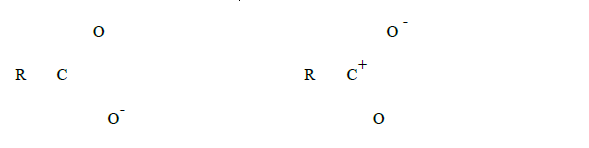
Q1) Although phenoxide ion hasmore no. of resonating structures than carboxylate ion , even though carboxylic acid is a stronger acid why ?
Answer : The phenoxide ion has non equivalent resonance structures in which–vecharge is at less electronegativeC atom and +ve charge as at more electronegative O-atom.
Incarboxylate ion –ve charge is delocalized on two electronegative O-atoms hence resonance is more effective and a stronger acid.
Answer : As Carboxylic acid forms a dimer due towhich their surface area incresesand forms strong intermolecular H-bondingIthaving more boiling point than alcohols.
Q.3 There are two-NH2groupin semicarbazide. However only one is involved in formation of semicarbazones. Why?
Answer : NH2-CO – NH – NH2
Dueto resonance one NH2groupundergoes or involved in resonance and hence can’t participate in the formation of semicarhazone.
N+H2=CO- – NH – NH2
Longpair of NH2group isnotinvolved inresonance and is available for nucleophillic attack
Q.4 Why does solubility decreases with increasing molecular mass in carboxyticacid?
Answer : Because ofincrease in alkyl chain length which is hydrophobic in nature. Hencesolubility decreases.
Q.5 Why are aldehydesare more reactive than ketones when undergo nucleophillic addition reaction?
Answer : (a) + I effect:- The alkyl group in Ketones due totheir e-releasing character decrease the +ve charge on C-Atom and thus reduce its reactivity. (b) Steric hinderance:- Due to sterichinderance i

Free study material for Chemistry
Chapter Assignment & Practice Material for Class 12 Chemistry Unit 7 Alcohols, Phenols And Ethers
Chapter Practice Questions for Class 12 Chemistry
Explore reliable practice questions for Unit 7 Alcohols, Phenols And Ethers tailored for Class 12 learners. Use these structured worksheets to evaluate preparedness and strengthen core problem-solving skills.
Key Advantages of Solving Unit 7 Alcohols, Phenols And Ethers Assignments
- Syllabus Compliance: Sets reflect current CBSE evaluation criteria and official marking frameworks.
- Multi-Format Practice: Includes varied problem types designed to deepen comprehension across all sub-topics.
- Time Management: Routine practice optimizes pacing to finish school examinations comfortably within schedule.
How to Approach Chemistry Unit 7 Alcohols, Phenols And Ethers Assignments
- Initial Reading: Begin by reading the NCERT book for Class 12 Chemistry to build a baseline understanding.
- Independent Testing: Attempt assignment questions unassisted, then verify work using provided answer keys.
- Supplementary Aids: Leverage revision notes and worksheets whenever you encounter difficult topics.
FAQs
You can download free PDF assignments for Class 12 Chemistry Unit 7 Alcohols, Phenols And Ethers from StudiesToday.com. These practice sheets have been updated for the 2026-27 session covering all concepts from latest NCERT textbook.
Yes, our teachers have given solutions for all questions in the Class 12 Chemistry Unit 7 Alcohols, Phenols And Ethers assignments. This will help you to understand step-by-step methodology to get full marks in school tests and exams.
Yes. These assignments are designed as per the latest CBSE syllabus for 2026. We have included huge variety of question formats such as MCQs, Case-study based questions and important diagram-based problems found in Unit 7 Alcohols, Phenols And Ethers.
Practicing topicw wise assignments will help Class 12 students understand every sub-topic of Unit 7 Alcohols, Phenols And Ethers. Daily practice will improve speed, accuracy and answering competency-based questions.
Yes, all printable assignments for Class 12 Chemistry Unit 7 Alcohols, Phenols And Ethers are available for free download in mobile-friendly PDF format.