

Download CBSE Class 12 Chemistry Assignments
Access comprehensive school assignments for Unit 6 Haloalkanes and Haloarenes using the CBSE Class 12 Chemistry Halo Alkanes and Halo arenes Questions. Designed to align with the 2026-27 CBSE academic guidelines, these practice sets help Class 12 Chemistry students reinforce core concepts and improve their problem-solving accuracy.
Access CBSE School Assignments and Answers
Access the complete assignment PDF for Class 12 Chemistry below. Regular practice with these targeted academic tasks builds familiarity with standard question patterns and helps secure higher marks in final school evaluations.
SHORT ANSWER TYPE QUESTIONS
Question. Haloalkanes react with KCN to form alkyl cyanides as main product while AgCN forms isocyanides as the chief product. Explain.
Answer. KCN is predominantly ionic and provides cyanide ions in solution. Both carbon and nitrogen atoms are in a position to donate electron pairs. The attack takes place mainly through carbon atom since C—C bond is more stable than C—N bond.
However, AgCN is mainly covalent in nature and nitrogen is free to donate electron pair forming isocyanides as the main product.
Question. Grignard reagents should be prepared under anhydrous conditions. Why?
Answer. Grignard reagents are highly reactive and react with any source of proton to give hydrocarbons.
RMgX + H2O → RH + Mg(OH)X It is therefore necessary to avoid even traces of moisture from a Grignard reagent
Question. What are chiral and achiral molecules
Answer. The objects which are non- superimposable on their mirror image are said to be chiral and this property is known as chirality.
The objects, which are, superimposable on their mirror images are called achiral
Question. What do you mean by racemic mixture and racemization?
Answer. A mixture containing two enantiomers in equal proportions is known as racemic mixture.
It will have zero optical rotation, as the rotation due to one isomer will be cancelled by the rotation due to the other isomer.
The process of conversion of enantiomers into a racemic mixture is known as racemisation
Question. Cl is an electron withdrawing group but it is ortho, para- directing in electrophilic aromatic substitution reactions. Why?
Answer. • Chlorine withdraws electrons through inductive effect and releases electrons through resonance.
• Through inductive effect, chlorine destabilizes the intermediate carbocation and through resonance, halogen tends to stabilize the carbocation and the effect is more pronounced at ortho- and para- positions.
• The resonance effect tends to oppose the inductive effect for the attack at ortho- and para- positions and hence makes the deactivation less for ortho- and para- attack.
• Reactivity is thus controlled by the stronger inductive effect and orientation is controlled by resonance effect.
CASE BASED QUESTIONS
Read the following passage and answer the questions given below.
SN1 reactions are generally carried out in presence of protic solvents. Like acetic acid. The reaction between a tertiary alkyl halide and nucleophile follows the first order kinetics. The rate of reaction depends on the concentration of alkyl halide .it occurs in two steps. In first step step C-X bond undergoes cleavage to form carbocation, it is then attacked by nucleophile in second step which is very fast. The energy needed for breaking C-X bond is obtained through solvation of halide ion with proton of protic solvent. Greater the stability of carbocation, Greater will be its ease of formation and faster will be its rate of reaction. In the case of optically active alkyl halide SN1 reaction is accompanied by Racemisation. The carbocation formed in step one is sp2 hybridised. Which is triagonal planar. The attack of nucleophile may be accomplished from either side to give a mixture of products.
Question. Assertion: SN2 reaction takes place in presence of protic solvent.
Reason: The energy is released by the solvation of halide ion with proton.
Answer. D
Question. Assertion. The rate of SN1 reaction depends only on the concentration of alkyl halide.
Reason: Formation of carbocation is slow step and slow step determines the rate of reaction.
Answer. A
Question. Assertion: Tertiary alkyl halides reacts faster in SN1 reaction
Reason. Tertiary carbocations are more stable and formed at faster rate.
Answer. A
Question. Assertion: During SN1 reaction of an optically active alkyl halide Racemisation takes place
Reason. Racemic mixture consists of equal amount of dextro and leavo isomer.
Answer. B
Question. Assertion: Attack of nucleophile to carbon of carbocation takes place through either side forming two isomers with opposite configuration.
Reason: Carbocation is sp3 hybridised and have triogonal planar geometry
Answer. C
Question. Assertion: - In SN1 reaction second step is very fast and reversible.
Reason: - The carbocation formed is highly unstable and highly reactive.
Answer. D
OR
Read the passage given below and answer the following questions: Nucleophilic substitution reactions are of two types; substitution nucleophilic bimolecular (SN2) and substitution nucleophilic unimolecular (SN1) depending on molecules taking part in determining the rate of reaction. Reactivity of alkyl halide towards SN1 and SN2 reactions depends on various factors such as steric hindrance, stability of intermediate or transition state and polarity of solvent. SN2 reaction mechanism is favoured mostly by primary alkyl halide then secondary and then tertiary. This order is reversed in case of SN1 reactions.
The following questions are multiple choice questions. Choose the most appropriate Answer.
Question. Which of the following is most reactive towards nucleophilic substitution reaction?
(a) C6H5Cl
(b) CH2=CHCl
(c) ClCH2CH=CH2
(d) CH3CH=CHCl
Answer. C
Question. Isopropyl chloride undergoes hydrolysis by
(a) SN1 mechanism
(b) SN2mechanism
(c) SN1 and SN2mechanism
(d) neither SN1 and SN2 mechanism
Answer. C
Question. The most reactive nucleophile among the following is
(a) CH3O-
(b) C6H5O-
(c) (CH3)2CHO-
(d) (CH3)3CO-
Answer. A
Question. Tertiary alkyl halides are practically inert to substitution by SN2mechanism because of
(a) insolubility
(b) instability
(c) inductive effect
(d) stearic hindrance.
Answer. D
Question. Account for the following :
(a) The dipole moment of chlorobenzene is lower than that of cyclohexyl chloride.
(b) Alkyl halides, though polar, are immiscible with water.
(c) Grignard’s reagents should be prepared under anhydrous conditions.
Answer. (a) Electron pairs of Cl atom are in conjugation with n electrons of the benzene ring so C-Cl bond in chlorobenzene acquires some double bond character while C-Cl bond in cyclohexyl chloride is a pure single bond. C – Cl bond in chlorobenzene is shorter than in cyclohexyl chloride. Since dipole moment is a product of charge and distance, so chlorobenzene has lower dipole moment than cyclohexyl chloride.
(b) Alkyl halides are polar molecules, therefore, their molecules are held together by dipole-dipole attraction. The molecules of H2O are held together by H-bonds. Since the new forces of attraction between water and alkyl halide molecules are weaker than the forces of attraction already existing between alkyl halide- alkyl halide molecules and water- water molecules, therefore, alkyl halides are immiscible with water.
(c) Grignard’s reagents are very reactive. They react with alcohol, water, amines etc. to form corresponding hydrocarbon. R-MgX + HOH → RH + Mg(OH)X Therefore, Grignard’s reagents must be prepared under anhydrous conditions
Question. Give reasons : (a) n-Butyl bromide has higher boiling point than f-butyl bromide
(b) Racemic mixture is optically inactive.
(c) The presence of nitro group (-NO2) at o/p positions increases the reactivity of haloarenes towards nucleophilic substitution reactions.
Answer.
(a) n-Butyl bromide has higher boiling point than f-butyl bromide because it has larger surface area hence have more Van der Waals’ forces.
(b) Rotation due to one enantiomer is cancelled by another enantiomer.
(c) The presence of nitro group (-NO2) at ortho and para positions withdraws the electron density’ from benzene ring and thus facilitating the attack of nucleophile.
Question. a) Account for the following : (i) Electrophilic substitution reactions in haloarenes occur slowly.
(ii) Haloalkanes, though polar, are insoluble in water.
(b) Arrange the following compounds in increasing order of reactivity towards SN2 displacement: 2-Bromo-2-Methylbutane, 1-Bromopentane, 2-Bromopentane
Answer. (a) (i) Due to -I effect of halogen atom, it withdraws electrons from the benzene ring and thus ring gets deactivated.
(ii) They fail to form hydrogen bonds with water. More energy is required to break hydrogen bonds in water and less energy is released when new attractions are set up.
(b) 2-Bromo-2-Methylbutane < 2-Bromopentane < 1-Bromopentane
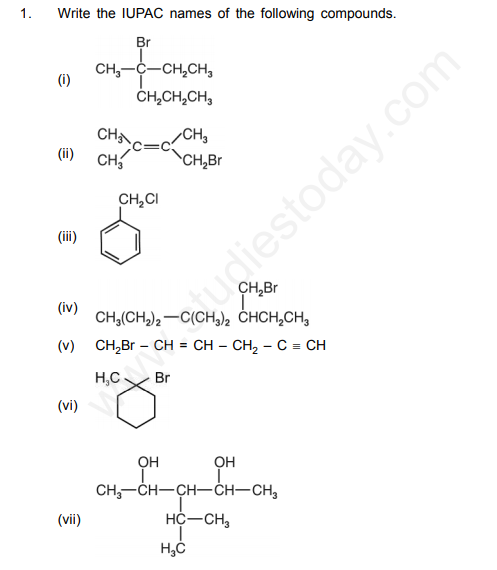
(ix) (CCl3)3 CCl
2. Write the structure of following halogen compounds
(i) 2-chloro-3-methylpentane
(ii) 2-(2-chlorophenyl)-1-iodooctane
(iii) 1-bromo-4-sec-butyl-2–methylebenzene.
(iv) p-bromotoluene.
(v) chlorophenylmethane
3. Arrange the following in the increasing order of properly indicated :
(i) bromomethane, chloromethane, dichloromethane. (Increasing order of boiling points).
(ii) 1-chloropropane, isopropyl chloride, 1-chlorobutane (Increasing order of boiling point)
(iii) dichloromethane, chloroform, carbon terachloride. (Increasing order of dipole moment.
(iv) CH3F, CH3Cl, CH3Br, CH3l (Increasing reactivity towards nucleophilic substitution and increasing order of dipole moment)
(v) o,m.p-dichlorobenzenes (Increasing order of melting points).
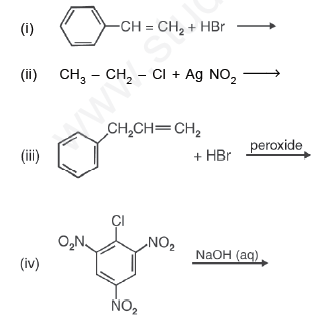
4. Complete the following reactions
Please refer to the link below for CBSE Class 12 Chemistry Halo Alkanes and Halo arenes Questions
Free study material for Chemistry
CBSE Class 12 Chemistry Assignments for Unit 6 Haloalkanes and Haloarenes
Chapter Practice Questions for Class 12 Chemistry
Explore reliable practice questions for Unit 6 Haloalkanes and Haloarenes tailored for Class 12 learners. Use these structured worksheets to evaluate preparedness and strengthen core problem-solving skills.
Key Advantages of Solving Unit 6 Haloalkanes and Haloarenes Assignments
- Exam Alignment: Questions strictly follow contemporary CBSE sample papers and grading schemes.
- Comprehensive Coverage: Features objective drills, case studies, and structured descriptive problems for Unit 6 Haloalkanes and Haloarenes.
- Pacing & Precision: Regular problem-solving builds critical calculation speed and test-taking accuracy.
Steps to Complete Unit 6 Haloalkanes and Haloarenes Assignments Successfully
- Concept Foundation: Review the NCERT book for Class 12 Chemistry thoroughly before diving into assignment tasks.
- Self-Evaluation: Solve exercises independently before inspecting professional answer guides.
- Progress Monitoring: Note down complex formulas or concepts, clearing them up using available online practice aids.
FAQs
You can download free PDF assignments for Class 12 Chemistry Unit 6 Haloalkanes and Haloarenes from StudiesToday.com. These practice sheets have been updated for the 2026-27 session covering all concepts from latest NCERT textbook.
Yes, our teachers have given solutions for all questions in the Class 12 Chemistry Unit 6 Haloalkanes and Haloarenes assignments. This will help you to understand step-by-step methodology to get full marks in school tests and exams.
Yes. These assignments are designed as per the latest CBSE syllabus for 2026. We have included huge variety of question formats such as MCQs, Case-study based questions and important diagram-based problems found in Unit 6 Haloalkanes and Haloarenes.
Practicing topicw wise assignments will help Class 12 students understand every sub-topic of Unit 6 Haloalkanes and Haloarenes. Daily practice will improve speed, accuracy and answering competency-based questions.
Yes, all printable assignments for Class 12 Chemistry Unit 6 Haloalkanes and Haloarenes are available for free download in mobile-friendly PDF format.