

Class 12 Chemistry Practice Assignments: CBSE Class 12 Chemistry Chemistry in Everyday Life Questions
Explore structured practice materials through the CBSE Class 12 Chemistry Chemistry in Everyday Life Questions. Tailored for Class 12 learners, utilizing these Chemistry assignments ensures thorough preparation and strengthens foundational knowledge before final CBSE evaluations.
Download Unit 16 Chemistry In Everyday Life Assignment PDF with Solutions
Access the complete assignment PDF for Class 12 Chemistry below. Regular practice with these targeted academic tasks builds familiarity with standard question patterns and helps secure higher marks in final school evaluations.
Question: A biological response is produced by drugs when it interacts with
a) micromolecular targets
b) macromolecular targets
c) any type of molecules
d) micromolecules as well as macromolecules
Answer: b
Question: Drugs can be classified on the basis of
a) pharmacological effect
b) molecular target
c) chemical structure
d) All of the above
Answer: d
Question: The site, apart from active site, at which the binding of drug to the enzyme takes place is called
a) activator site
b) regular site
c) allosteric site
d) All of these
Answer: c
Question: Receptors are selective in nature because it binds to
a) all type of chemical messengers.
b) a particular type of chemical messenger
c) cell membrane
d) All of the above
Answer: b
Question: The receptor proteins are embedded in the
a) DNA
b) cell membrane
c) cytoplasm
d) RNA
Answer: b
Question: Which of the following is a function of antagonist?
a) Mimic the natural messenger
b) It mimics the receptor
c) It binds to receptor site and inhibits its function
d) All of the above
Answer: c
Question: Drug which is used in controlling depression as well as hypertension is
a) penicillin
b) tetracycline
c) salvarsan
d) equanil
Answer: d
Question: In the stomach, histamine stimulates the secretion of pepsin and
a) sulphuric acid and hydrochloric acid
b) sulphuric acid
c) hydrochloric acid
d) sodium hydroxide
Answer: c
Question: Which of the following is a function of enzyme?
a) It holds the substrate for a chemical reaction
b) It provides functional groups
c) Both (a) and (b)
d) None of the above
Answer: c
Question: Artificial sweetener which is stable under cold conditions only is
a) saccharin
b) sucralose
c) aspartame
d) alitame
Answer: c
Question: Noradrenaline is a/an
a) antidepressant
b) antihistamine
c) neurotransmitter
d) antacid
Answer: c
Question: Which of the following are the derivatives of barbituric acid?
a) Veronal and amytal
b) Nembutal and luminal
c) Both (a) and (b)
d) Neither (a) nor (b)
Answer: c
Question: Use of chemicals for therapeutic effect is known as
a) physiotherapy
b) radiotherapy
c) chemotherapy
d) endotherapy
Answer: c
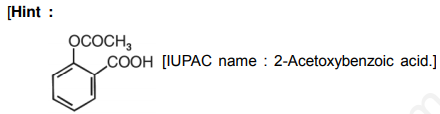
Question: The IUPAC name of aspirin is
a) o-acetyl salicylic acid
b) phenyl salicylate
c) acetyl salicylate
d) methyl salicylic acid
Answer: a
Question: Drugs, iproniazid and phenelzine belong to class of
a) depressant drugs
b) antidepressant drugs
c) antibiotics
d) antiseptic
Answer: b
Question: Which of the following drug inhibits the synthesis of prostaglandins?
a) Paracetamol
b) Aspirin
c) Codeine
d) Valium
Answer: b
Question: Which of the following is an arsenic containing drug?
a) Penicillin
b) Equanil
c) Salvarsan
d) Chloramphenicol
Answer: c
Question: Which of the following analgesics are called opiates?
a) Morphine
b) Codeine
c) Both (a) and (b)
d) Aspirin
Answer: a
Question: Which of the following is an anionic detergent?
a) Sodium lauryl sulphate
b) Cetyltrimethyl ammonium bromide
c) Glyceryl oleate
d) Sodium stearate
Answer: a
Question: Among the following, the narrow spectrum antibiotic is
a) ampicillin
b) amoxycillin
c) chloramphenicol
d) penicillin G
Answer: d
Question: Which of the following antibiotics is supposed to be toxic towards certain strains of cancer cells?
a) Vancomycin
b) Dysidazirine
c) Ofloxacin
d) Penicillin G
Answer: b
Question: Which of the following is an example of synthetic progesterone derivative?
a) Novestrol
b) Chloroxylenol
c) Norethindrone
d) Terpineol
Answer: c
Question: Food preservatives prevent spoilage of food due to microbial growth. The most commonly used preservative is
a) C6H5 COONa
b) table salt
c) vegetable oils
d) All of the above
Answer: d
Question: Which type of detergent is formed when stearic acid reacts with polyethylene glycol?
a) cationic detergents
b) non-ionic detergents
c) anionic detergents
d) None of the above
Answer: b
Points to Remember
1. A drug is a chemical agent which affects human metabolism and provides cure from ailment. If taken in doses higher than recommended, these may have poisonous effect.
2. Use of chemicals for therapeutic effect is called chemotherapy.
3. Drugs usually interact with biological macromolecules such as carbohydrates, proteins, lipids and nucleic acids. These are called target molecules.
4. Drugs are designed to interact with specific targets so that these have the least chance of affecting other targets. This minimises the side effects and localises the action of the drug.
5. Drugs like analgesics, antibiotics, antiseptics, disinfectants, antacids and tranquilizers have specific pharmacological functions.
6. Antifertility drugs are used to control population. These contain a mixture of synthetic estrogen and progesterone derivatives.
7. Chemicals are added to food for preservation, enhancing their appeal and adding nutritive value in them.
8. Artificial sweetening agents like aspartame, saccharin etc. are of great value to diabetic persons and people who need to control their calories.
9. These days detergents are much in vogue and get preference over soaps because they work even in hard water.
10. Synthetic detergents are classified into three main categories namely anionic, cationic and non- ionic.
11. Detergents with straight chain of hydrocarbons are preferred over branched chain as the latter are non-biodegradable and consequently cause environmental pollution.
12. The unbranched hydrocarbon side chains of the detergent molecule are prone to attack by bacteria, so the detergents are bio-degradable and pollution is prevented.
Free study material for Chemistry
Unit 16 Chemistry In Everyday Life Printable Assignments & Solutions for Class 12 Chemistry
Revision Assignment: Unit 16 Chemistry In Everyday Life (CBSE)
Review targeted chapter assignments for Class 12 Chemistry Unit 16 Chemistry In Everyday Life. Built according to official CBSE guidelines, these downloadable problem sets help students build accuracy and prepare effectively for school tests.
Why Practice Class 12 Chemistry Assignments?
- Exam Alignment: Questions strictly follow contemporary CBSE sample papers and grading schemes.
- Comprehensive Coverage: Features objective drills, case studies, and structured descriptive problems for Unit 16 Chemistry In Everyday Life.
- Pacing & Precision: Regular problem-solving builds critical calculation speed and test-taking accuracy.
Steps to Complete Unit 16 Chemistry In Everyday Life Assignments Successfully
- Initial Reading: Begin by reading the NCERT book for Class 12 Chemistry to build a baseline understanding.
- Independent Testing: Attempt assignment questions unassisted, then verify work using provided answer keys.
- Supplementary Aids: Leverage revision notes and worksheets whenever you encounter difficult topics.
FAQs
You can download free PDF assignments for Class 12 Chemistry Unit 16 Chemistry In Everyday Life from StudiesToday.com. These practice sheets have been updated for the 2026-27 session covering all concepts from latest NCERT textbook.
Yes, our teachers have given solutions for all questions in the Class 12 Chemistry Unit 16 Chemistry In Everyday Life assignments. This will help you to understand step-by-step methodology to get full marks in school tests and exams.
Yes. These assignments are designed as per the latest CBSE syllabus for 2026. We have included huge variety of question formats such as MCQs, Case-study based questions and important diagram-based problems found in Unit 16 Chemistry In Everyday Life.
Practicing topicw wise assignments will help Class 12 students understand every sub-topic of Unit 16 Chemistry In Everyday Life. Daily practice will improve speed, accuracy and answering competency-based questions.
Yes, all printable assignments for Class 12 Chemistry Unit 16 Chemistry In Everyday Life are available for free download in mobile-friendly PDF format.