

School Assignments for Class 12 Chemistry: Unit 10 Biomolecules
Explore structured practice materials through the CBSE Class 12 Chemistry Biomolecules Notes and Questions. Tailored for Class 12 learners, utilizing these Chemistry assignments ensures thorough preparation and strengthens foundational knowledge before final CBSE evaluations.
Practice Class 12 Chemistry Assignments: Unit 10 Biomolecules
View or download the dedicated CBSE Class 12 Chemistry Biomolecules Notes and Questions resource below. Engaging with these assignments under focused study conditions ensures continuous academic progress and mastery of the 2026-27 curriculum.
Bio molecule
Gist Of The Chapter
1.Carbohydrates- These are optically active polyhydroxy aldehydes or ketones due to presence of chiral `C’ or the compounds which produce these on hydrolysis except dihydroxy acetone is not optically active.
2. Classification-
(i) Monosaccharide’s – Those carbohydrates which cannot get hydrolysed e.g. glucose ,fructose, galactose etc.
(ii) Oligosaccharides- Those carbohydrates which give to or more monosaccharide’s on hydrolysis e.g. sucrose on hydrolysis gives glucose and fructose. Raffinose on hydrolysis gives glucose, fructose and galactose.
(iii) Polysaccharides- Those carbohydrates which on hydrolysis give large number of monosaccharide’s hydrolysis.eg starch, cellulose, glycogen.
3. Sugar-
(i) Reducing Sugars- Those which reduce Fehling’s or Tollen’s reagent. They have free aldehydic groups, eg , glucose, fructose , galactose
(ii) Non Reducing Sugars- Those which do not reduce Fehling’s or Tollen’s reagent. They do not have free functional group ,e.g., sucrose
4. Glucose- It is a monosaccharide’s with molecular formula C6H12O6
5. Preparation
(i) From Sucrose
C12H22O11 + H2O -------> C6H12O6 + C6H12O6 ( Only from sucrose)
(ii)From Starch
(C6H10O5)n + nH2O -------> C12H22011 + H20 ------> 2C6H12O6
6.Structure
(i)Fischer structure –
CHO — [CHOH] — CH2OH
[+] Glucose has `D’ configuration as shown
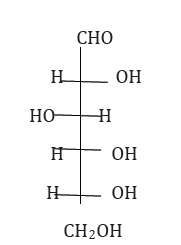
`D’ means —OHgroup on first chiral `C’ from the bottom is on right hand and + means it is dextro rotator, i.e, it rotates plane polarized light towards right.
(ii) Cyclic Structure OF Glucose: the straight chain is unable to explain the following reactions.
(a) It does not give the 2, 4‐DNP test, Schiff’s Test and does not form the hydrogensulphide product with NaHSO3 .
(b) The pentacetate of glucose does not react with NH2OH, indicating the absence of free aldehydic group.
(iii) Glucose exist in 2 different crystalline forms α and β forms. These are called anomers. They differ in optical rotation, they also differ in melting point.
Anomers are isomers which have a different configuration across C‐1 (first chiral ‘C’ atom).
7. Glycosidic Linkage:The linkage between two monosaccharide units through oxygen is called the glycosidic linkage.
Free study material for Chemistry
Chapter Assignment & Practice Material for Class 12 Chemistry Unit 10 Biomolecules
Class 12 Chemistry Unit 10 Biomolecules Printable Assignments
Explore reliable practice questions for Unit 10 Biomolecules tailored for Class 12 learners. Use these structured worksheets to evaluate preparedness and strengthen core problem-solving skills.
Key Advantages of Solving Unit 10 Biomolecules Assignments
- Curriculum Standards: Assignments match modern CBSE sample formats to ensure relevant preparation.
- Thorough Revision: Detailed problem sets reinforce core concepts and eliminate conceptual weak spots.
- Execution Speed: Timed practice with assignment sets sharpens overall response timing.
Effective Strategy for Class 12 Chemistry Assignments
- Initial Reading: Begin by reading the NCERT book for Class 12 Chemistry to build a baseline understanding.
- Independent Testing: Attempt assignment questions unassisted, then verify work using provided answer keys.
- Supplementary Aids: Leverage revision notes and worksheets whenever you encounter difficult topics.
FAQs
You can download free PDF assignments for Class 12 Chemistry Unit 10 Biomolecules from StudiesToday.com. These practice sheets have been updated for the 2026-27 session covering all concepts from latest NCERT textbook.
Yes, our teachers have given solutions for all questions in the Class 12 Chemistry Unit 10 Biomolecules assignments. This will help you to understand step-by-step methodology to get full marks in school tests and exams.
Yes. These assignments are designed as per the latest CBSE syllabus for 2026. We have included huge variety of question formats such as MCQs, Case-study based questions and important diagram-based problems found in Unit 10 Biomolecules.
Practicing topicw wise assignments will help Class 12 students understand every sub-topic of Unit 10 Biomolecules. Daily practice will improve speed, accuracy and answering competency-based questions.
Yes, all printable assignments for Class 12 Chemistry Unit 10 Biomolecules are available for free download in mobile-friendly PDF format.