

Class 12 Chemistry Practice Assignments: CBSE Class 12 Chemistry The d and f Block Elements Questions
Access comprehensive school assignments for Unit 4 The d- and f-Block Elements using the CBSE Class 12 Chemistry The d and f Block Elements Questions. Designed to align with the 2026-27 CBSE academic guidelines, these practice sets help Class 12 Chemistry students reinforce core concepts and improve their problem-solving accuracy.
Download Unit 4 The d- and f-Block Elements Assignment PDF with Solutions
Navigate directly to the solved Chemistry assignments using the digital viewer below. Each practice set includes detailed step-by-step solutions, allowing students to instantly cross-check their work and identify areas requiring further revision.
Electronic Configuration of Transition Metal/Ions
The d-block element is called transition metal if it has partly filled d-orbitals in the ground state as well as in its oxidised state.
The general electronic configuration of transition metal is (n–1) d1–10ns1–2. Exceptions in electronic configuration are due to (a) very little engery difference between (n–1) d and ns orbitals and (b) extra stability of half filled and completely filled orbitals in case of Cr and Cu in 3d series.
Cr : Is2 2s2 2p6, 3s2 3p6 4s1 3d5
Cu : Is2 2s2 2p6, 3s2 3p6 4s1 3d10
To write the electronic configuration of Mn+, the electrons are first removed from ns orbital and then from (n - 1) d orbitals of neutral, atom (if required). For example, the electronic configuration of Cu+, Cu2+ and Cr3+ are respectively 3d10 4s°, 3d9 4s° and 3d3 4s°.
The following questions can be answered with the help of above.
(i) Scandium (Z = 21) is a transition element but zinc (Z = 30) is not.
(ii) Copper (Z = 29) and silver (Z = 47) both have fully filled d-orbitals i.e., (n - 1) d10. why are these elements are regarded as transition elements?
(iii) Which of the d-block elements are not regarded as transition elements?
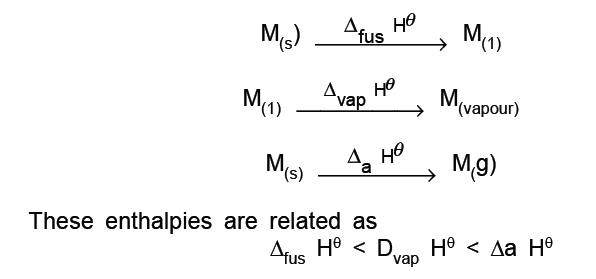
UNDERSTANDING Δfus Hθ ‚ Δvap Hθ ‚ AND Δa Hθ
In transition metals unpaired (n - l)d electrons as well as ns electrons take part in interatomic bonding. Larger the number of unpaired (n - 1) d electrons, the
stronger is the interatomic bonding and large amount of energy is required to overcome the interatomic interaction.
Question. Amongst TiF62–, CoF63–, Cu2Cl2 and NiCl42–, whichare the colourless species? (Atomic number of Ti =22, Co = 27, Cu = 29, Ni = 28)
(a) CoF63– and NiCl42–
(b) TiF62– and Cu2Cl2
(c) Cu2Cl2 and NiCl42–
(d) TiF62– and CoF63–
Answer B
Question. Which of the statements is not true?
(a) On passing H2S through acidified K2Cr2O7 solution, a milky colour is observed.
(b) Na2Cr2O7 is preferred over K2Cr2O7 in volumetric analysis.
(c) K2Cr2O7 solution in acidic medium is orange.
(d) K2Cr2O7 solution becomes yellow on increasing the pH beyond 7.
Answer B
Question. K2Cr2O7 on heating with aqueous NaOH gives
(a) Cr2O72–
(b) Cr(OH)2
(c) CrO42–
(d) Cr(OH)3
Answer C
Question. KMnO4 reacts with oxalic acid according to the equation
2MnO4 – + 5C2O42– + 16H+ 2Mn2+ + 10CO2 + 8H2O
Here 20 mL of 0.1 M KMnO4 is equivalent to
(a) 50 mL of 0.5 M C2H2O4
(b) 20 mL of 0.1 M C2H2O4
(c) 20 mL of 0.5 M C2H2O4
(d) 50 mL of 0.1 M C2H2O4
Answer D
Question. Which of the following processes does not involve oxidation of iron?
(a) Formation of Fe(CO)5 from Fe.
(b) Liberation of H2 from steam by iron at high temperature.
(c) Rusting of iron sheets.
(d) Decolourisation of blue CuSO4 solution by iron.
Question. Which of the following statements about the interstitial compounds is incorrect?
(a) They are much harder than the pure metal.
(b) They have higher melting points than the pure metal.
(c) They retain metallic conductivity.
(d) They are chemically reactive.
Question. Identify the alloy containing a non-metal as a constituent in it.
(a) Invar
(b) Steel
(c) Bell metal
(d) Bronze
Question. The catalytic activity of transition metals and their compounds is ascribed mainly to
(a) their magnetic behaviour
(b) their unfilled d-orbitals
(c) their ability to adopt variable oxidation states
(d) their chemical reactivity.
Question. Which one of the following does not correctly represent the correct order of the property indicated against it?
(a) Ti < V < Cr < Mn; increasing number of oxidation states
(b) Ti3+ < V3+ < Cr3+ < Mn3+ : increasing magnetic moment
(c) Ti < V < Cr < Mn : increasing melting points
(d) Ti < V < Mn < Cr : increasing 2nd ionization enthalpy
Question. Four successive members of the first series of the transition metals are listed below. For which one of them the standard potential (E°M2+/M) value has a positive sign?
(a) Co (Z = 27)
(b) Ni (Z = 28)
(c) Cu (Z = 29)
(d) Fe (Z = 26)
Question. For the four successive transition elements (Cr, Mn,Fe and Co), the stability of +2 oxidation state will be there in which of the following order?
(a) Mn > Fe > Cr > Co
(b) Fe > Mn > Co > Cr
(c) Co > Mn > Fe > Cr
(d) Cr > Mn > Co > Fe
(At. nos. Cr = 24, Mn = 25, Fe = 26, Co = 27)
Question. Which of the following ions will exhibit colour in aqueous solutions?
(a) La3+ (Z = 57)
(b) Ti3+ (Z = 22)
(c) Lu3+ (Z = 71)
(d) Sc3+ (Z = 21)
Question. Which of the following pairs has the same size?
(a) Fe2+, Ni2+
(b) Zr4+, Ti4+
(c) Zr4+, Hf4+
(d) Zn2+, Hf4+
Question. Which one of the elements with the following outer orbital configurations may exhibit the largest number of oxidation states?
(a) 3d54s1
(b) 3d54s2
(c) 3d24s2
(d) 3d34s2
Question. The correct order of decreasing second ionisation enthalpy of Ti(22), V(23), Cr(24) and Mn(25) is
(a) Mn > Cr > Ti > V
(b) Ti > V > Cr > Mn
(c) Cr > Mn > V > Ti
(d) V > Mn > Cr > Ti
Question. In which of the following pairs are both the ions coloured in aqueous solution?
(At. no. : Sc = 21, Ti = 22, Ni = 28, Cu = 29,Co = 27)
(a) Ni2+, Cu+
(b) Ni2+, Ti3+
(c) Sc3+, Ti3+
(d) Sc3+, Co2+
Question. Four successive members of the first row transition elements are listed below with their atomic numbers.
Which one of them is expected to have the highest third ionisation enthalpy?
(a) Vanadium (Z = 23)
(b) Chromium (Z = 24)
(c) Manganese (Z = 25)
(d) Iron (Z = 26)
Question. The aqueous solution containing which one of the following ions will be colourless?
(Atomic number : Sc = 21, Fe = 26,Ti = 22, Mn = 25)
(a) Sc3+
(b) Fe2+
(c) Ti3+
(d) Mn2+
Question. Which one of the following characteristics of the transition metals is associated with their catalytic activity?
(a) High enthalpy of atomization
(b) Paramagnetic behaviour
(c) Colour of hydrated ions
(d) Variable oxidation states
Question. The basic character of the transition metal monoxides follows the order
(Atomic no’s. Ti = 22, V = 23, Cr = 24, Fe = 26)
(a) VO > CrO > TiO > FeO
(b) CrO > VO > FeO > TiO
(c) TiO > FeO > VO > CrO
(d) TiO > VO > CrO > FeO
Question. Which of the following shows maximum number of oxidation states?
(a) Cr
(b) Fe
(c) Mn
(d) V
Please refer to the link below for CBSE Class 12 Chemistry The d and f Block Elements Questions
Free study material for Chemistry
Chapter Assignment & Practice Material for Class 12 Chemistry Unit 4 The d- and f-Block Elements
Revision Assignment: Unit 4 The d- and f-Block Elements (CBSE)
Explore reliable practice questions for Unit 4 The d- and f-Block Elements tailored for Class 12 learners. Use these structured worksheets to evaluate preparedness and strengthen core problem-solving skills.
Maximize Exam Scores with Chapter Practice Sets
- Syllabus Compliance: Sets reflect current CBSE evaluation criteria and official marking frameworks.
- Multi-Format Practice: Includes varied problem types designed to deepen comprehension across all sub-topics.
- Time Management: Routine practice optimizes pacing to finish school examinations comfortably within schedule.
How to Approach Chemistry Unit 4 The d- and f-Block Elements Assignments
- Initial Reading: Begin by reading the NCERT book for Class 12 Chemistry to build a baseline understanding.
- Independent Testing: Attempt assignment questions unassisted, then verify work using provided answer keys.
- Supplementary Aids: Leverage revision notes and worksheets whenever you encounter difficult topics.
FAQs
You can download free PDF assignments for Class 12 Chemistry Unit 4 The d- and f-Block Elements from StudiesToday.com. These practice sheets have been updated for the 2026-27 session covering all concepts from latest NCERT textbook.
Yes, our teachers have given solutions for all questions in the Class 12 Chemistry Unit 4 The d- and f-Block Elements assignments. This will help you to understand step-by-step methodology to get full marks in school tests and exams.
Yes. These assignments are designed as per the latest CBSE syllabus for 2026. We have included huge variety of question formats such as MCQs, Case-study based questions and important diagram-based problems found in Unit 4 The d- and f-Block Elements.
Practicing topicw wise assignments will help Class 12 students understand every sub-topic of Unit 4 The d- and f-Block Elements. Daily practice will improve speed, accuracy and answering competency-based questions.
Yes, all printable assignments for Class 12 Chemistry Unit 4 The d- and f-Block Elements are available for free download in mobile-friendly PDF format.