

Class 12 Chemistry Practice Assignments: CBSE Class 12 Chemistry Aldehydes Ketons Carboxylic Acids Questions
Access comprehensive school assignments for Unit 8 Aldehydes, Ketones And Carboxylic Acids using the CBSE Class 12 Chemistry Aldehydes Ketons Carboxylic Acids Questions. Designed to align with the 2026-27 CBSE academic guidelines, these practice sets help Class 12 Chemistry students reinforce core concepts and improve their problem-solving accuracy.
Download Unit 8 Aldehydes, Ketones And Carboxylic Acids Assignment PDF with Solutions
View or download the dedicated CBSE Class 12 Chemistry Aldehydes Ketons Carboxylic Acids Questions resource below. Engaging with these assignments under focused study conditions ensures continuous academic progress and mastery of the 2026-27 curriculum.
Question: Carbonyl compounds are the constituents of
(a) fabrics
(b) flavouring
(c) plastics and drugs
(d) All of these
Answer: d
Question: The bond angle and structure of carbonyl compounds respectively are
(a) 120° and trigonal planar
(b) 109°28' and tetrahedral
(c) 120° and tetrahedral
(d) 109°28' and trigonal planar
Answer: a
Question: Which of the following substrates give the same product on the reduction with DIBAL-H?
(a) CH3 — (CH2)9— CN and CH3(CH2)9 — COOH
(b) CH3 — (CH2)9— CN3and CH3(CH2)9 — COOC2H5
(c) CH3 — (CH2)9 — COOH and CH3 (CH2)9 — CHO
(d) CH3 (CH2)9 —COOH and CH3(CH2)9 COOC2H5
Answer: b
Question: The name of simplest aromatic aldehyde carrying the aldehyde group on a benzene ring is/are
(a) carbaldehyde
(b) benzene carbaldehyde
(c) benzaldehyde
(d) Both (b) and (c)
Answer: d
Question: The most suitable reagent for the conversion of R—CH2—OH→R—CHO is
(a) KMnO4
(b) K2Cr2O7
(c) H2SO4
(d) PCC (pyridinium chlorochromate)
Answer: d
Question: The compounds methanal, ethanal and propanone are miscible with water because they form
(a) van der Waals’ forces with water
(b) ‘H’-bonding with water
(c) dipole-dipole bond with water
(d) ion-dipole bond with water
Answer: b
Question: Name the product formed during the decarboxylation of malonic acid.
(a) Acetic acid
(b) Ethanone
(c) Propanone
(d) Formic acid
Answer: a
Question: Identify the example in which nucleophilic addition followed by elimination reaction occur respectively in the carbonyl compound.
(a) Addition of Grignard reagent
(b) Addition of sodium sulphide
(c) Addition of HCN
(d) Addition of NH3
Answer: d
Question: Alcohol vapours are passed over which of the following catalysts to give aldehydes and ketones?
(a) S or Pd
(b) Ag or Cu
(c) F or Cl
(d) Li or K
Answer: b
Question: Which of the following compounds produces an orange-red precipitate with 2, 4-DNP reagent?
(a) Acetamide
(b) Dimethyl ether
(c) Butanone
(d) Propylbutanoate
Answer: c
Question: Some higher members of aliphatic carboxylic acids known as fatty acids occur in natural fats as esters of glycerol. How many C-atoms do they contain?
(a) C12-C18
(b) C10-C15
(c) C5-C10
(d) C20-C30
Answer: a
Question: Select the acid(s) which cannot be prepared by Grignard reagent?
(a) Acetic acid
(b) Succinic acid
(c) Formic acid
(d) All of these
Answer: a
Question: On heating an aldehyde with Fehling’s reagent, a reddish brown precipitate is obtained due to the formation of
(a) CuO
(b) Cu2O
(c) CuSO4
(d) Cu2++O−H
Answer: b
Question: Carboxylic acids have higher boiling points than aldehydes, ketones and even alcohols of comparable molecular mass. It is due to
(a) more extensive association of carboxylic acid via van der Waals’ force of attraction
(b) formation of carboxylate ion
(c) formation of intramolecular H-bonding
(d) formation of intermolecular H-bonding
Answer: d
Question: Which of the following reagents is/are used for the conversion of ethanoic acid to ethanoic anhydride?
(a) SOCl2,Δ
(b) PCl3,Δ
(c) P2O5,Δ
(d) All of these
Answer: c
Question: Diborane easily reduce the functional group such as
(a) acid
(b) ester
(c) nitro
(d) halo
Answer: a
Question: What is the common name of 2-methylpropanoic acid?
(a) Adipic acid
(b) Crotonic acid
(c) Isobutyric acid
(d) Acrylic acid
Answer: c
Question: Aromatic carboxylic acids do not undergo Friedel-Crafts reaction because
(a) carboxyl group acts as an activating and meta-directing group
(b) carboxyl group act as a deactivating and ortho and para directing group
(c) carboxyl group act as an activating and ortho-directing group
(d) carboxyl group acts as deactivating and the catalyst
Answer: b
Question: Which of the following acid is used in rubber, textile, dyeing, leather and electroplating industries?
(a) Hexanedioic acid
(b) Ethanoic acid
(c) Methanoic acid
(d) Sodium benzoate
Answer: c
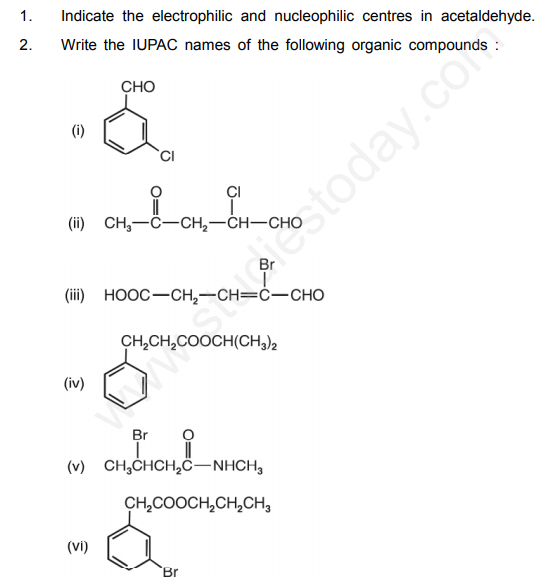
(i) Rosenmund reduction reaction
(ii) Stephen reaction
(iii) Etard reaction
(iv) Gatterman-Koch reaction
(v) Aldol condensation
(vi) Cross aldol condensation
(vii) Cannizzaro reaction
(viii) Decarboxylation reaction
(ix) Kolbe’s reaction
(x) Hell-Volhard-Zelinsky reaction
(xi) Clemmensen reduction
(xii) Wolff-Kishner reduction
(xii) Haloform reaction.
4. How will you convert :
(i) Isopropyl chloride to 2-methylpropionaldehyde.
(ii) benzene to benzaldehyde
(iii) benzoic acid to acetophenone
(iv) propene to propanal
(v) butanoic acid to 2-hydroxybutanoic acid
(vi) benzoic acid to m-nitrobenzyl alcohol
(vii) propanol to propene
(viii) propanol to butan-2-one.
(ix) methyl magnesium bromide to ethanoic acid
(x) benzoic acid to benzyl chloride
(xi) acetone to chloroform
(xii) acetylene to acetic acid
(xiii) formaldehyde to propanol
(xiv) acetophenone to 2-phenylbutan-2-ol
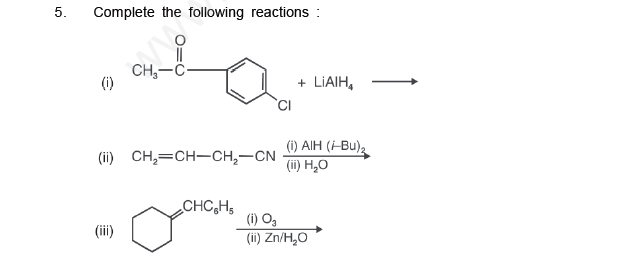
Free study material for Chemistry
CBSE Class 12 Chemistry Assignments for Unit 8 Aldehydes, Ketones And Carboxylic Acids
Chapter Practice Questions for Class 12 Chemistry
Explore reliable practice questions for Unit 8 Aldehydes, Ketones And Carboxylic Acids tailored for Class 12 learners. Use these structured worksheets to evaluate preparedness and strengthen core problem-solving skills.
Key Advantages of Solving Unit 8 Aldehydes, Ketones And Carboxylic Acids Assignments
- Curriculum Standards: Assignments match modern CBSE sample formats to ensure relevant preparation.
- Thorough Revision: Detailed problem sets reinforce core concepts and eliminate conceptual weak spots.
- Execution Speed: Timed practice with assignment sets sharpens overall response timing.
Steps to Complete Unit 8 Aldehydes, Ketones And Carboxylic Acids Assignments Successfully
- Initial Reading: Begin by reading the NCERT book for Class 12 Chemistry to build a baseline understanding.
- Independent Testing: Attempt assignment questions unassisted, then verify work using provided answer keys.
- Supplementary Aids: Leverage revision notes and worksheets whenever you encounter difficult topics.
FAQs
You can download free PDF assignments for Class 12 Chemistry Unit 8 Aldehydes, Ketones And Carboxylic Acids from StudiesToday.com. These practice sheets have been updated for the 2026-27 session covering all concepts from latest NCERT textbook.
Yes, our teachers have given solutions for all questions in the Class 12 Chemistry Unit 8 Aldehydes, Ketones And Carboxylic Acids assignments. This will help you to understand step-by-step methodology to get full marks in school tests and exams.
Yes. These assignments are designed as per the latest CBSE syllabus for 2026. We have included huge variety of question formats such as MCQs, Case-study based questions and important diagram-based problems found in Unit 8 Aldehydes, Ketones And Carboxylic Acids.
Practicing topicw wise assignments will help Class 12 students understand every sub-topic of Unit 8 Aldehydes, Ketones And Carboxylic Acids. Daily practice will improve speed, accuracy and answering competency-based questions.
Yes, all printable assignments for Class 12 Chemistry Unit 8 Aldehydes, Ketones And Carboxylic Acids are available for free download in mobile-friendly PDF format.