

Advanced Study Material for Class 12 Chemistry: Unit 5 Surface Chemistry
Review targeted academic resources with the CBSE Class 12 Chemistry Surface Chemistry Chapter Summary. Built according to official CBSE standards for the 2026-27 term, these downloadable Class 12 Chemistry study materials support effective daily practice and deeper conceptual understanding for Unit 5 Surface Chemistry.
Practice Class 12 Chemistry Resources: Unit 5 Surface Chemistry
View or download the dedicated CBSE Class 12 Chemistry Surface Chemistry Chapter Summary resource below. Engaging with these advanced study guides under focused conditions ensures continuous academic progress and mastery of the 2026-27 curriculum for Unit 5 Surface Chemistry.
CBSE Class 12 Physics Atoms & Nuclei chapter notes and important questions. There are many more useful educational material which the students can download in pdf format and use them for studies. Study material like concept maps, important and sure shot question banks, quick to learn flash cards, flow charts, mind maps, teacher notes, important formulas, past examinations question bank, important concepts taught by teachers. Students can download these useful educational material free and use them to get better marks in examinations. Also refer to other worksheets for the same chapter and other subjects too. Use them for better understanding of the subjects.
SURFACE CHEMISTRY (CHAPTER SUMMARY)
SURFACE CHEMISTRY
Some of the most important chemicals are produced industrially by means of reactions that occur on the surfaces of solid catalysts.
OBJECTIVES
After studying this unit, a student should be able to:
- describe interfacial phenomena and their significance;
- define adsorption and classify it into physical and chemical adsorption;
- explain the mechanism of adsorption;
- explain the factors controlling adsorption from gases and solutions on solids;
- explain adsorption results on the basis of the Freundlich adsorption isotherm;
- appreciate the role of catalysts in industry;
- enumerate the nature of the colloidal state;
- describe the preparation, properties and purification of colloids;
- classify emulsions and describe their preparation and properties;
- describe the phenomenon of gel formation;
- list the uses of colloids.
Planning
| Period | Content to be covered |
|---|---|
| 1 | describe interfacial phenomenon and its significance; define adsorption and classify it into physical and chemical adsorption; explain mechanism of adsorption; explain the factors controlling adsorption from gases and solutions on solids; explain adsorption results on the basis of Freundlich adsorption isotherms |
| 2 | Test, 10 M, 30 Minutes |
| 2 | appreciate the role of catalysts in industry; enumerate the nature of colloidal state; describe preparation and purification of colloids |
| 3 | describe properties of colloids; classify emulsions and describe their preparation and properties; describe the phenomenon of gel formation; list the uses of colloids |
| 4 | Unit Test |
ADSORPTION
Demonstration: in a solution of an organic dye, say methylene blue, when activated charcoal is added and the solution is well shaken, the filtrate turns colourless. The dye molecules accumulate on the surface of the charcoal. Similarly, silica gel is placed in the packets of electronic goods because water molecules get adsorbed on the surface of the gel.
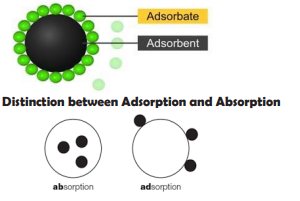
There are several examples which reveal that the surface of a solid has the tendency to attract and retain the molecules of the phase with which it comes into contact. These molecules remain only at the surface and do not go deeper into the bulk. The accumulation of molecular species at the surface rather than in the bulk of a solid or liquid is termed adsorption. The molecular species or substance which concentrates or accumulates at the surface is termed the adsorbate, and the material on the surface of which the adsorption takes place is called the adsorbent.
Distinction between adsorption and absorption
In adsorption, the substance is concentrated only at the surface and does not penetrate through the surface to the bulk of the adsorbent, while in absorption the substance is uniformly distributed throughout the bulk of the solid.
Examples: (i) When a chalk stick is dipped in ink, the surface retains the colour of the ink due to adsorption of coloured molecules, while the solvent of the ink goes deeper into the stick due to absorption. On breaking the chalk stick, it is found to be white from inside. (ii) Water vapours are absorbed by anhydrous calcium chloride but adsorbed by silica gel.
The term sorption is used when both adsorption and absorption take place simultaneously.
Mechanism of adsorption
Adsorption arises due to the presence of unbalanced or residual attractive forces at the surface of the adsorbent. These forces are responsible for attracting the adsorbate particles to the surface of the adsorbent. The extent of adsorption (\(x/m\)) increases with the increase of surface area per unit mass of the adsorbent at a given temperature and pressure.
\(\Delta H\) of adsorption is always negative. When a gas is adsorbed, the freedom of movement of its molecules becomes restricted. Consequently, \(\Delta S\) is negative. For a process to be spontaneous, at constant temperature and pressure, \(\Delta G\) must be negative. We know \(\Delta G=\Delta H-T\Delta S\). \(\Delta G\) can be negative only if \(\Delta H\) has a sufficiently high negative value, as \(-T\Delta S\) is positive.
Conclusion: adsorption occurs at low temperature (when the magnitude of \(\Delta H\) is greater than that of \(T\Delta S\)). As the adsorption proceeds, \(\Delta H\) becomes less and less negative, ultimately \(\Delta H\) becomes equal to \(T\Delta S\) and \(\Delta G\) becomes zero. At this state equilibrium is attained.
Types of adsorption
If the accumulation of gas on the surface of a solid occurs on account of weak van der Waals' forces, the adsorption is termed physical adsorption or physisorption. When the gas molecules or atoms are held to the solid surface by chemical bonds, the adsorption is termed chemical adsorption or chemisorption. The chemical bonds may be covalent or ionic in nature.
Characteristics of physisorption:
- Lack of specificity.
- Nature of adsorbate: easily liquefiable gases (i.e. with higher critical temperatures) are readily adsorbed, as van der Waals' forces are stronger near the critical temperatures.
- Reversible nature: solid + gas \(\rightleftharpoons\) gas/solid + heat.
- The extent of adsorption increases with the increase of surface area of the adsorbent.
- Enthalpy of adsorption is low (20-40 kJ mol\(^{-1}\)).
Which gas, SO2 (critical temperature 630 K), CH4 (critical temperature 190 K) or H2 (critical temperature 33 K), shall be adsorbed more by 1 g of activated charcoal?
Answer: SO2.
Easily liquefiable gases (higher critical temperature) are adsorbed more readily because their van der Waals' forces are stronger. SO2 has the highest critical temperature, so it is adsorbed the most; H2 is adsorbed the least.
Characteristics of chemisorption:
- Chemisorption is highly specific; it occurs only if there is some possibility of chemical bonding between adsorbent and adsorbate. Example: oxygen is adsorbed on metals by virtue of oxide formation, and hydrogen is adsorbed by transition metals due to hydride formation.
- Chemisorption is irreversible in nature.
- Chemisorption is also an exothermic process.
- Like most chemical changes, chemisorption increases with a rise of temperature.
- Usually high pressure is also favourable for chemisorption.
- Like physical adsorption, chemisorption also increases with an increase of surface area of the adsorbent.
- Enthalpy of chemisorption is high (80-240 kJ mol\(^{-1}\)) as it involves chemical bond formation.
Physisorption of a gas adsorbed at low temperature may change into chemisorption at a high temperature.
Assignment: Write four differences between chemisorption and physisorption.
Adsorption isobar
The graph of the variation in the amount of gas adsorbed by the adsorbent with temperature at constant pressure is termed an adsorption isobar.
Adsorption isotherms
The graph of the variation in the amount of gas adsorbed by the adsorbent with pressure at constant temperature is termed an adsorption isotherm.
Freundlich isotherm explains the behaviour of adsorption in an approximate manner. For the adsorption of a gas on a solid it is expressed as
\[\frac{x}{m}=k\,p^{1/n}\qquad(n>1),\qquad\text{or}\qquad \log\frac{x}{m}=\log k+\frac{1}{n}\log p\]
where \(x\) is the mass of the gas adsorbed on mass \(m\) of the adsorbent at pressure \(p\), and \(k\) and \(n\) are constants which depend on the adsorbent and the gas at a particular temperature. At low pressure \(x/m\propto p\), at intermediate pressure \(x/m\propto p^{1/n}\), and at high pressure \(x/m\propto p^{0}\) (it becomes independent of pressure).
The experimental isotherms always seem to approach saturation at high pressure. This cannot be explained by the Freundlich isotherm. Thus, it fails at high pressure.
CAT
- Adsorption isotherm: https://www.youtube.com/watch?v=rP2tQDAOSC0
- Adsorption and Absorption: https://www.youtube.com/watch?v=djIzXvwIz5U
Adsorption from solution phase
The following observations have been made in the case of adsorption from the solution phase:
- The extent of adsorption decreases with an increase in temperature.
- The extent of adsorption increases with an increase of surface area of the adsorbent.
- The extent of adsorption depends on the concentration of the solute in solution.
- The extent of adsorption depends on the nature of the adsorbent and the adsorbate.
Freundlich's equation describes the behaviour of adsorption from solution by the equation
\[\frac{x}{m}=k\,C^{1/n}\]
Applications of adsorption
- Production of high vacuum: the remaining traces of air can be adsorbed by charcoal from a vessel evacuated by a vacuum pump to give a very high vacuum.
- Gas mask (a device which consists of activated charcoal or a mixture of adsorbents) is usually used for breathing in coal mines to adsorb poisonous gases.
- Silica and aluminium gels are used as adsorbents for removing moisture and controlling humidity.
- Removal of colouring matter from solutions using animal charcoal.
- As heterogeneous catalyst: manufacture of ammonia using iron (Fe) as a catalyst, manufacture of H2SO4 by the contact process and use of finely divided nickel in the hydrogenation of oils are examples of heterogeneous catalysis.
- Due to the difference in degree of adsorption of gases by charcoal, a mixture of noble gases can be separated by adsorption on coconut charcoal at different temperatures.
- A number of drugs are used to kill germs by getting adsorbed on them.
- In the froth flotation process.
- Adsorption indicators.
- Chromatographic analysis.
ASSIGNMENTS
- Write any two characteristics of chemisorption.
- Why does physisorption decrease with the increase of temperature?
- Why are powdered substances more effective adsorbents than their crystalline forms?
CATALYSIS
Catalysis: substances which accelerate the rate of a chemical reaction and themselves remain chemically and quantitatively unchanged after the reaction are known as catalysts, and the phenomenon is known as catalysis. Example:
Non-catalysed reaction: 2KClO3 →653-873 K 2KCl + 3O2
Catalysed reaction: 2KClO3 →MnO2, 473-633 K 2KCl + 3O2
Introduction demonstration (decomposition of hydrogen peroxide): watch the video https://www.youtube.com/watch?v=UTfMrx7275w. The reaction taking place is the decomposition of hydrogen peroxide: H2O2 →KI H2O + 1/2 O2. The role of KI is that it catalyses (speeds up) the rate of decomposition of H2O2. Today we discuss the role of adsorption in catalysis.
Promoters and poisons: promoters are substances that enhance the activity of a catalyst, while poisons decrease the activity of a catalyst. Example: in Haber's process for the manufacture of ammonia, molybdenum (Mo) acts as a promoter for the iron (Fe) catalyst.
N2(g) + 3H2(g) →Fe, Mo as promoter 2NH3(g)
Homogeneous and heterogeneous catalysis
When the reactants and the catalyst are in the same phase (i.e. liquid or gas), the process is said to be homogeneous catalysis. The catalytic process in which the reactants and the catalyst are in different phases is known as heterogeneous catalysis.
Examples of homogeneous catalysis:
Video clip: https://www.youtube.com/watch?v=FSdBB1vBDKY
- 2SO2(g) + O2(g) →NO(g) 2SO3(g)
- Hydrolysis of an ester.
- Hydrolysis of sugar.
Examples of heterogeneous catalysis:
- 2SO2(g) + O2(g) →Pt(s) 2SO3(g)
- N2(g) + 3H2(g) →Fe, Mo 2NH3(g)
- 4NH3(g) + 5O2(g) →Pt(s) 4NO(g) + 6H2O(g)
Adsorption theory of heterogeneous catalysis
Show the following clip: https://www.youtube.com/watch?v=CjMwTA597Og
The reactants in the gaseous state or in solutions are adsorbed on the surface of the solid catalyst. The increase in concentration of the reactants on the surface increases the rate of reaction. Adsorption being an exothermic process, the heat of adsorption is utilised in enhancing the rate of the reaction. The mechanism involves five steps:
- Diffusion of reactants to the surface of the catalyst.
- Adsorption of reactant molecules on the surface of the catalyst.
- Occurrence of the chemical reaction on the catalyst's surface through formation of an intermediate.
- Desorption of reaction products from the catalyst surface, and thereby making the surface available again for more reaction to occur.
- Diffusion of reaction products away from the catalyst's surface.
The surface of the catalyst, unlike the inner part of the bulk, has free valencies which provide the seat for chemical forces of attraction.
Important features of solid catalysts
| (a) Activity | (b) Selectivity |
|---|---|
| The ability of the catalyst to enhance the rate of the reaction. | The ability of the catalyst to direct a reaction to yield a particular product selectively, when under the same reaction conditions many products are possible. |
| CO(g) + 3H2(g) →Ni CH4(g) + H2O(g) CO(g) + 2H2(g) →Cu/ZnO-Cr2O3 CH3OH(g) CO(g) + H2(g) →Cu HCHO(g) |
Shape-selective catalysis by zeolites
The catalytic reaction that depends upon the pore structure of the catalyst and the size of the reactant and product molecules is called shape-selective catalysis. Example: zeolites are good shape-selective catalysts because of their honeycomb-like structures.
Nature of zeolites: they are microporous aluminosilicates with a three-dimensional network of Al-O-Si framework. The reactions taking place in zeolites depend upon the size and shape of reactant and product molecules as well as upon the pores and cavities of the zeolites.
ZSM-5 is a zeolite sieve with molecular porosity 5. Use: it is used as a catalyst in the petrochemical industry to convert alcohols directly into gasoline (petrol) by dehydrating them to give a mixture of hydrocarbons.
Enzyme catalysis
Enzymes are protein molecules of high molecular mass and are very effective biological catalysts. Examples:
- The invertase enzyme converts cane sugar into glucose and fructose. The process is called inversion.
- The zymase enzyme converts glucose into ethyl alcohol and carbon dioxide.
- The diastase enzyme converts starch into maltose.
- The maltase enzyme converts maltose into glucose.
- Decomposition of urea into ammonia and carbon dioxide is catalysed by the enzyme urease.
- In the stomach, the pepsin enzyme converts proteins into peptides, while in the intestine, the pancreatic trypsin converts proteins into amino acids by hydrolysis.
- Conversion of milk into curd is brought about by the lactobacilli enzyme present in curd.
Characteristics of enzyme catalysis:
- Most highly efficient: one molecule of an enzyme can transform a very large number of reactant molecules (about a million) per second.
- Highly specific nature: each enzyme catalyses a particular reaction only, and no other.
- Highly active under optimum temperature: the optimum temperature range for enzymatic activity is 298-310 K. The human body temperature, 310 K, is suited for enzyme-catalysed reactions.
- Highly active under optimum pH (between pH 5-7).
- Increasing activity in the presence of activators and co-enzymes: a small amount of a substance such as a metal ion (Na+, Mn2+, Co2+, Cu2+) or a co-enzyme (a vitamin-derived molecule) increases the activity of an enzyme.
- Influence of inhibitors and poisons: inhibitors and poisons attach to the active sites of enzymes and reduce or destroy their catalytic activity.
Mechanism of enzyme catalysis: the enzyme-catalysed reactions proceed in two steps (the substrate fits into the active site of the enzyme like a key in a lock).
Step 1: binding of the enzyme to the substrate to form an activated complex: E + S ⇌ ES
Step 2: decomposition of the activated complex to form the product: ES → E + P
COLLOIDS
A colloid is a heterogeneous system in which one substance is dispersed (dispersed phase) as very fine particles in another substance called the dispersion medium. The particle size is in the range of 1-1000 nm.
Introduction: show the following video clip: https://www.youtube.com/watch?v=l_Pj5_MWSSA
Teacher: Give more examples of colloids.
Students' response: students cite many examples of colloids.
Differences between true solution, suspension and colloids: see the video https://www.youtube.com/watch?v=LhFRsGq6KjY. Students compare the three types of mixtures with examples such as salt solution, muddy water and milk.
Classification of colloids
Classification based on the physical state of the dispersed phase and dispersion medium
| Dispersed phase | Dispersion medium | Type of colloid | Example |
|---|---|---|---|
| Solid | Solid | Solid sol | Coloured glasses, gem stones |
| Solid | Liquid | Sol | Paints, cell fluids |
| Solid | Gas | Aerosol | Smoke, dust |
| Liquid | Solid | Gel | Cheese, butter, jellies |
| Liquid | Liquid | Emulsion | Milk, hair cream |
| Liquid | Gas | Aerosol | Fog, mist, cloud |
| Gas | Solid | Solid sol | Pumice stone, foam rubber |
| Gas | Liquid | Foam | Froth, whipped cream, soap lather |
Classification based on the nature of interaction between the dispersed phase and the dispersion medium: (i) lyophilic colloids and (ii) lyophobic colloids.
Lyophilic colloids: the word "lyophilic" means liquid-loving.
- They can be formed directly by mixing substances like gum, gelatine, starch, rubber, etc. with a suitable liquid (the dispersion medium).
- These are reversible sols.
- These sols are quite stable and cannot be easily coagulated.
Lyophobic colloids: the word "lyophobic" means liquid-hating.
- These colloidal sols can be prepared only by special methods; such sols are called lyophobic sols.
- These sols are readily precipitated (or coagulated) on the addition of small amounts of electrolytes, by heating or by shaking, and hence are not stable.
- These are irreversible sols; once precipitated, they do not give back the colloidal sol by simple addition of the dispersion medium.
- Lyophobic sols need stabilising agents for their preservation.
Classification based on the type of particles of the dispersed phase
- Multimolecular colloids: on dissolution, a large number of atoms or smaller molecules of a substance aggregate together to form species having size in the colloidal range (1-1000 nm). Examples: gold sol, sulphur sol.
- Macromolecular colloids: macromolecules in suitable solvents form solutions in which the size of the macromolecules is in the colloidal range. These colloids are quite stable. Examples: starch, cellulose, proteins, enzymes; polythene, nylon, polystyrene, synthetic rubber, etc. in a suitable dispersion medium.
- Associated colloids (micelles): there are some substances which at low concentrations behave as normal strong electrolytes, but at higher concentrations exhibit colloidal behaviour due to the formation of aggregates. The aggregated particles thus formed are called micelles. These are also known as associated colloids. The formation of micelles takes place only above a particular temperature called the Kraft temperature (Tk) and above a particular concentration called the critical micelle concentration (CMC). On dilution, these colloids revert back to individual ions. Example: surface active agents such as soaps and synthetic detergents belong to this class.
Mechanism of micelle formation: at low concentrations of soap the stearate ions are arranged on the surface of the water, with their hydrocarbon tails away from the water. At the critical micelle concentration the stearate ions arrange themselves inside the bulk of the water as an ionic micelle, with the hydrocarbon tails pointing inwards and the \(\text{COO}^-\) heads pointing outwards towards the water.
https://www.youtube.com/watch?v=Nxkjn-XhgE0
(a) Arrangement of stearate ions on the surface of water at low concentrations of soap. (b) Arrangement of stearate ions inside the bulk of water (ionic micelle) at critical micelle concentration of soap.
Cleansing action of soaps: the grease on cloth is surrounded by the stearate ions, whose hydrocarbon tails dissolve in the grease droplet and whose ionic heads point towards the water. The grease droplet surrounded by stearate ions is a micelle, which is pulled into the water and washed away.
Chemistry of soap & Emulsification: https://www.youtube.com/watch?v=ZMhyD-wUPjo
Quiz questions
One of the following substances that belongs to a colloid system is: A. Milk; B. Tap water; C. Vinegar; D. Blood
Answer: D (Blood), as given in the source key. (Milk is also a colloid.)
Dispersed phase and dispersing medium of smoke are: A. Solid in liquid; B. Liquid in solid; C. Solid in gas; D. Gas in solid
Answer: C. Solid in gas.
Margarine is a colloid system of: A. Foam; B. Emulsion; C. Aerosol; D. Solid emulsion
Answer: B. Emulsion.
Which of the following would be a colloid where both phases are liquids? A. whipped cream; B. milk; C. butter; D. cheese
Answer: B. Milk.
Which of the following is a heterogeneous mixture? A. Blood; B. Motor oil; C. Air; D. Table sugar
Answer: A. Blood.
PREPARATION OF COLLOIDS
Show the following video clip: https://www.youtube.com/watch?v=l_Pj5_MWSSA
(a) Chemical methods: colloidal dispersions can be prepared by chemical reactions leading to formation of molecules by double decomposition, oxidation, reduction or hydrolysis. The molecules produced then aggregate leading to the formation of sols.
As2O3 + 3H2S →double decomposition As2S3(sol) + 3H2O
SO2 + 2H2S →oxidation 3S(sol) + 2H2O
2AuCl3 + 3HCHO + 3H2O →reduction 2Au(sol) + 3HCOOH + 6HCl
FeCl3 + 3H2O →hydrolysis Fe(OH)3(sol) + 3HCl
(b) Electrical disintegration or Bredig's arc method: an electric arc is struck between metal electrodes immersed in the dispersion medium (for example, in a cooled solvent containing a stabilising agent). The intense heat of the arc vaporises the metal and the vapours condense to form particles of colloidal size. (This is used for preparing sols of metals such as gold, silver and platinum.)
Clip: https://www.youtube.com/watch?v=getKcN4tfwk
(c) Peptization: peptization may be defined as the process of converting a precipitate into a colloidal sol by shaking it with the dispersion medium in the presence of a small amount of an electrolyte. The electrolyte used for this purpose is called the peptizing agent. This method is applied, generally, to convert a freshly prepared precipitate into a colloidal sol.
PURIFICATION OF COLLOIDAL SOLUTIONS
The process used for reducing the amount of impurities to a requisite minimum is known as purification of the colloidal solution. It is carried out by the following methods:
- Dialysis: a process of removing a dissolved substance from a colloidal solution by means of diffusion through a suitable membrane (the dialysing membrane). The small ions and molecules pass through the membrane while the colloidal particles do not.
- Electro-dialysis: ordinarily, the process of dialysis is quite slow. It can be made faster by applying an electric field if the dissolved substance in the impure colloidal solution is only an electrolyte. The process is then named electrodialysis.
- Ultrafiltration: the process of separating the colloidal particles from the solvent and soluble solutes present in the colloidal solution by specially prepared filters, which are permeable to all substances except the colloidal particles. Colloidal particles can pass through ordinary filter paper because the pores are too large. However, the pores of filter paper can be reduced in size by impregnating it with collodion solution to stop the flow of colloidal particles. The usual collodion is a 4% solution of nitrocellulose in a mixture of alcohol and ether. An ultra-filter paper may be prepared by soaking the filter paper in a collodion solution, hardening by formaldehyde and then finally drying it. Thus, by using ultra-filter paper, the colloidal particles are separated from the rest of the materials. Ultrafiltration is a slow process. To speed up the process, pressure or suction is applied. The colloidal particles left on the ultra-filter paper are then stirred with fresh dispersion medium (solvent) to get a pure colloidal solution.
Electro-dialysis apparatus.
PROPERTIES OF COLLOIDAL SOLUTIONS
- Colligative properties: colloidal particles being bigger aggregates, the number of particles in a colloidal solution is comparatively small as compared to a true solution.
- Tyndall effect: this effect was first observed by Faraday and later studied in detail by Tyndall and is termed the Tyndall effect. The bright cone of light is called the Tyndall cone. The Tyndall effect is due to the fact that colloidal particles scatter light in all directions in space. This scattering of light illuminates the path of the beam in the colloidal dispersion. A true solution does not scatter light, while a colloidal sol does. The Tyndall effect is observed only when the following two conditions are satisfied: (i) the diameter of the dispersed particles is not much smaller than the wavelength of the light used; and (ii) the refractive indices of the dispersed phase and the dispersion medium differ greatly in magnitude.
- Colour: the colour of a colloidal solution depends on the wavelength of light scattered by the dispersed particles. The wavelength of light further depends on the size and nature of the particles. The colour of a colloidal solution also changes with the manner in which the observer receives the light. For example, a mixture of milk and water appears blue when viewed by reflected light and red when viewed by transmitted light. The finest gold sol is red in colour; as the size of particles increases, it appears purple, then blue and finally golden.
- Brownian movement: when colloidal solutions are viewed under a powerful ultra-microscope, the colloidal particles appear to be in a state of continuous zig-zag motion all over the field of view. This motion was first observed by the British botanist Robert Brown, and is known as Brownian movement. This motion is independent of the nature of the colloid but depends on the size of the particles and the viscosity of the solution. Smaller the size and lesser the viscosity, faster is the motion. Reason: the Brownian movement has been explained to be due to the unbalanced bombardment of the particles by the molecules of the dispersion medium. The Brownian movement has a stirring effect which does not permit the particles to settle and thus is responsible for the stability of sols.
- Charge on colloidal particles: colloidal particles always carry an electric charge. The nature of this charge is the same on all the particles in a given colloidal solution and may be either positive or negative. Reason: the charge on the sol particles is due to one or more reasons, viz. due to electron capture by sol particles during electro-dispersion of metals, due to preferential adsorption of ions from solution and/or due to the formation of an electrical double layer. The potential difference between the fixed layer and the diffused layer of opposite charges is called the electrokinetic potential or zeta potential.
- Electrophoresis: when an electric potential is applied across two platinum electrodes dipping in a colloidal solution, the colloidal particles move towards one or the other electrode. The movement of colloidal particles under an applied electric potential is called electrophoresis. Positively charged particles move towards the cathode while negatively charged particles move towards the anode. When electrophoresis is prevented by some suitable means, it is observed that the dispersion medium begins to move in an electric field. This phenomenon is termed electro-osmosis.
- Coagulation or precipitation: the process of settling of colloidal particles is called coagulation or precipitation of the sol. It can be carried out in the following ways: (i) by electrophoresis; (ii) by mixing two oppositely charged sols in almost equal proportions (for example, mixing of hydrated ferric oxide (+ve sol) and arsenious sulphide (\(-\)ve sol) brings them down in the precipitated form; this type of coagulation is called mutual coagulation); (iii) by boiling, which reduces the charge on the particles and ultimately leads to settling down in the form of a precipitate; (iv) by persistent dialysis; (v) by addition of electrolytes: when an excess of an electrolyte is added, the colloidal particles are precipitated. The reason is that colloids interact with ions carrying charge opposite to that present on themselves. This causes neutralisation leading to their coagulation. The ion responsible for neutralisation of the charge on the particles is called the coagulating ion. A negative ion causes the precipitation of a positively charged sol and vice versa.
| Positively charged sols | Negatively charged sols |
|---|---|
| Hydrated metallic oxides, e.g. Al2O3.xH2O, CrO3.xH2O and Fe2O3.xH2O, etc. | Metals, e.g. copper, silver, gold sols |
| Basic dye stuffs, e.g. methylene blue sol | Metallic sulphides, e.g. As2S3, CdS sols |
| Haemoglobin (blood) | Acid dye stuffs, e.g. eosin, Congo red sols |
| Oxides, e.g. TiO2 sol | Sols of starch, gum, gelatin, clay, charcoal, etc. |
Hardy-Schulze rule: the greater the valence of the flocculating ion added, the greater is its power to cause precipitation. In the coagulation of a negative sol, the flocculating power is in the order: Al3+ > Ba2+ > Na+. Similarly, in the coagulation of a positive sol, the flocculating power is in the order: [Fe(CN)6]4− > PO43− > SO42− > Cl−.
Coagulation of lyophilic sols: when solvents such as alcohol and acetone are added to hydrophilic sols, dehydration of the dispersed phase takes place. Under this condition, a small quantity of an electrolyte can bring about coagulation.
Protection of colloids: lyophilic colloids have a unique property of protecting lyophobic colloids. When a lyophilic sol is added to a lyophobic sol, the lyophilic particles form a layer around the lyophobic particles and thus protect the latter from electrolytes. Lyophilic colloids used for this purpose are called protective colloids.
HOME WORK ASSIGNMENT
- Explain what is observed (i) when a beam of light is passed through a colloidal sol. (ii) an electrolyte, NaCl is added to hydrated ferric oxide sol. (iii) electric current is passed through a colloidal sol?
- Explain the following terms: (i) Electrophoresis (ii) Coagulation (iii) Dialysis (iv) Tyndall effect.
LIST OF SOME VIDEO CLIPS:
| S.No. | Topic & link |
|---|---|
| 1 | Preparation of Colloids by Chemical Methods https://www.youtube.com/watch?v=ODrJ3Az90YM |
| 2 | Preparation of Colloids by Peptization https://www.youtube.com/watch?v=luQxTHY4eLE |
| 3 | Preparation of Colloids by Electrical Disintegration https://www.youtube.com/watch?v=grtGzyY9gWo |
| 4 | Purification of Colloidal Solutions https://www.youtube.com/watch?v=NSDE1mVErVg |
| 5 | Brownian Motion https://www.youtube.com/watch?v=hy-clLi8gHg |
EMULSIONS
An emulsion is a liquid-liquid colloidal system, i.e. the dispersion of finely divided droplets in another liquid. If a mixture of two immiscible or partially miscible liquids is shaken, a coarse dispersion of one liquid in the other is obtained, which is called an emulsion.
Show the following video clip: https://www.youtube.com/watch?v=bC_czAL24zY
Types of emulsions:
- Oil dispersed in water (O/W type), e.g. milk, in which liquid fat is dispersed in water.
- Water dispersed in oil (W/O type), e.g. vanishing cream, in which oil acts as the dispersion medium.
Emulsifying agent: for stabilisation of an emulsion, a third component called the emulsifying agent is usually added. The emulsifying agent forms an interfacial film between the suspended particles and the medium. The principal emulsifying agents for O/W emulsions are proteins, gums, natural and synthetic soaps, etc., and for W/O emulsions, heavy metal salts of fatty acids, long chain alcohols, lampblack, etc.
Characteristics of emulsions:
- Emulsions can be diluted with any amount of the dispersion medium.
- The dispersed liquid, when mixed, forms a separate layer.
- The droplets in emulsions are often negatively charged and can be precipitated by electrolytes.
- They also show Brownian movement and the Tyndall effect.
- Emulsions can be broken into constituent liquids by heating, freezing, centrifuging, etc.
COLLOIDS AROUND US
- Blue colour of the sky: the dust particles and water droplets suspended in the air scatter the blue light of the sun more than the other colours.
- Fog, mist and rain: fog and mist are colloidal dispersions of tiny water droplets in air (aerosols).
- Food articles: milk, butter, halwa, ice creams, fruit juices, etc.
- Blood: it is a colloidal solution of an albuminoid substance. The styptic action of alum and ferric chloride solution is due to coagulation of blood, forming a clot which stops further bleeding.
- Soils: fertile soils are colloidal in nature, in which humus acts as a protective colloid.
- Formation of delta: river water is a colloidal solution of clay. Sea water contains a number of electrolytes. When river water meets the sea water, the electrolytes present in sea water coagulate the colloidal solution of clay, resulting in its deposition with the formation of a delta.
APPLICATIONS OF COLLOIDS
Colloids are widely used in industry. Following are some examples:
- Electrical precipitation of smoke: smoke particles are charged; when the smoke is passed through a chamber containing oppositely charged plates at a high voltage, the particles are neutralised and settle on the plates (Cottrell precipitator).
- Purification of drinking water: the water obtained from natural sources often contains suspended impurities. Alum is added to such water to coagulate the suspended impurities and make the water fit for drinking purposes.
- Medicines: Argyrol is a silver sol used as an eye lotion. Colloidal antimony is used in curing kala-azar. Colloidal gold is used for intramuscular injection. Milk of magnesia, an emulsion, is used for stomach disorders. Colloidal medicines are more effective because they have a large surface area and are therefore easily assimilated.
- Tanning: animal hides are colloidal in nature. When a hide, which has positively charged particles, is soaked in tannin, which contains negatively charged colloidal particles, mutual coagulation takes place. This results in the hardening of leather. This process is termed tanning. Chromium salts are also used in place of tannin.
- Cleansing action of soaps and detergents (see micelle formation above).
- Photographic plates and films are prepared by coating an emulsion of the light-sensitive AgBr in gelatin over glass plates or celluloid films.
- Latex is a colloidal solution of rubber particles which are negatively charged. Rubber is obtained by coagulation of latex.
- Industrial products: paints, inks, synthetic plastics, rubber, graphite lubricants, cement, etc. are all colloidal solutions.
HOME WORK ASSIGNMENTS
Q.1 What are emulsions? What are their different types? Give example of each type.
Q.2 How do emulsifiers stabilise emulsion? Name two emulsifiers.
Q.3 Action of soap is due to emulsification and micelle formation. Comment.
Q.4 Give four uses of emulsions.
Electrical precipitation of smoke; purification of drinking water (alum coagulates the mud).
PRACTICE QUESTIONS AND ANSWERS
Distinguish between the meaning of the terms adsorption and absorption. Give one example of each.
Answer: In adsorption the substance is concentrated only at the surface and does not enter the bulk; in absorption the substance is distributed uniformly throughout the bulk.
Example of adsorption: water vapour on silica gel (or a dye on charcoal). Example of absorption: water vapour taken in by anhydrous calcium chloride.
Give a reason why a finely divided substance is more effective as an adsorbent. (Also: why are powdered substances more effective adsorbents than their crystalline forms?)
Answer: Because a finely divided (powdered) substance has a much larger surface area per unit mass, so more unbalanced surface forces are available to hold adsorbate particles.
Why is adsorption always exothermic?
Answer: When a gas is adsorbed, its molecules lose freedom of movement, so \(\Delta S\) is negative. For adsorption to be spontaneous \(\Delta G=\Delta H-T\Delta S\) must be negative, which is possible only if \(\Delta H\) is negative (and large enough). Hence adsorption is exothermic.
Write four factors which influence the adsorption of a gas on a solid.
Answer: (i) Nature of the gas (easily liquefiable gases with higher critical temperatures are adsorbed more); (ii) surface area of the adsorbent (more area, more adsorption); (iii) temperature (physisorption falls and chemisorption usually rises with temperature); (iv) pressure of the gas (adsorption increases with pressure).
Write the effect of pressure and temperature on the adsorption of gases on solids.
Answer: Pressure: at constant temperature, the extent of adsorption increases with pressure, quickly at first and then more slowly until it reaches saturation at high pressure. Temperature: physisorption decreases with a rise in temperature (it is exothermic and the weak forces break), while chemisorption increases with temperature at first (as it needs activation energy) and then falls at still higher temperature.
Write four (or six) differences between physisorption and chemisorption.
Answer: See the table below.
| Physisorption | Chemisorption |
|---|---|
| Held by weak van der Waals' forces | Held by chemical bonds (covalent or ionic) |
| Lack of specificity: any gas is adsorbed on any solid, more so if easily liquefiable | Highly specific: occurs only if chemical bonding between adsorbent and adsorbate is possible |
| Reversible | Irreversible |
| Enthalpy of adsorption is low (20-40 kJ mol\(^{-1}\)) | Enthalpy of adsorption is high (80-240 kJ mol\(^{-1}\)) |
| Decreases with rise in temperature; occurs at low temperature | Increases with rise in temperature (at first) |
| Easily liquefiable gases (high critical temperature) are adsorbed more readily | Depends on the possibility of bond formation, not on liquefiability |
What is an adsorption isotherm? Describe the Freundlich adsorption isotherm.
Answer: An adsorption isotherm is the graph of the variation in the amount of gas adsorbed by the adsorbent with pressure at constant temperature. The Freundlich isotherm is \(\dfrac{x}{m}=kp^{1/n}\) (\(n>1\)), i.e. \(\log\dfrac{x}{m}=\log k+\dfrac{1}{n}\log p\), where \(x\) is the mass of gas adsorbed on mass \(m\) of adsorbent at pressure \(p\), and \(k\), \(n\) are constants for the given adsorbent and gas at a given temperature.
A plot of \(\log(x/m)\) against \(\log p\) is a straight line with slope \(1/n\) and intercept \(\log k\). The isotherm explains adsorption approximately: it fails at high pressure, where the experimental curve reaches saturation.
Which of the graphs, A or B, represents the adsorption isotherm for physisorption and chemisorption? (The graphs plot \(x/m\) against temperature at constant pressure, so they are adsorption isobars.)
Answer: Graph A (steady fall with temperature) represents physisorption; graph B (rise and then fall) represents chemisorption.
Why does physisorption decrease with an increase of temperature?
Answer: Physisorption is exothermic and reversible; by Le Chatelier's principle a rise in temperature shifts the equilibrium towards desorption. Also, the weak van der Waals' forces cannot hold the molecules at higher temperature.
Write any two characteristics of chemisorption.
Answer: (i) It is highly specific. (ii) It is irreversible, and its enthalpy is high (80-240 kJ mol\(^{-1}\)).
Why is it necessary to remove CO when ammonia is obtained by Haber's process?
Answer: CO acts as a poison for the iron catalyst: it is strongly adsorbed on the catalyst surface and blocks the active sites, so the catalyst loses its activity.
Why is ester hydrolysis slow in the beginning and becomes faster after some time?
Answer: The reaction produces an acid (for example acetic acid), which gives H+ ions. These H+ ions act as a catalyst for the hydrolysis, so the rate increases as more acid is formed (autocatalysis).
What is the role of desorption in the process of catalysis?
Answer: Desorption removes the product molecules from the catalyst surface, making the surface free again so that fresh reactant molecules can be adsorbed. Without desorption the surface would remain covered and the reaction would stop.
Give four examples of heterogeneous catalysis.
Answer: (i) Manufacture of ammonia (Haber's process) with Fe catalyst; (ii) contact process for H2SO4 with Pt or V2O5 catalyst; (iii) hydrogenation of oils with finely divided Ni; (iv) oxidation of ammonia to NO (Ostwald process) with Pt.
What do you mean by activity and selectivity of catalysts?
Answer: Activity is the ability of a catalyst to increase the rate of a reaction. Selectivity is the ability of a catalyst to direct a reaction to give a particular product when many products are possible under the same conditions. Example: with H2 and CO, Ni gives CH4, Cu/ZnO-Cr2O3 gives CH3OH and Cu gives HCHO.
What is shape-selective catalysis? Give one example.
Answer: A catalytic reaction that depends on the pore structure of the catalyst and on the size of the reactant and product molecules is called shape-selective catalysis. Example: zeolites such as ZSM-5.
What is ZSM-5? What is its use?
Answer: ZSM-5 is a zeolite (molecular sieve) catalyst with very small pores. It is used in the petrochemical industry to convert alcohols directly into gasoline (petrol) by dehydrating them to a mixture of hydrocarbons.
How are colloidal solutions classified on the basis of the physical states of the dispersed phase and dispersion medium?
Answer: Into eight types (see the classification table above): solid sol, sol, aerosol (solid in gas), gel, emulsion, aerosol (liquid in gas), solid sol (gas in solid) and foam.
What are lyophilic and lyophobic sols? Give one example of each type. Why are hydrophobic sols easily coagulated?
Answer: Lyophilic (liquid-loving) sols are formed directly by mixing the substance with the liquid; they are stable and reversible; example: starch or gelatin in water. Lyophobic (liquid-hating) sols need special methods of preparation; they are unstable and irreversible; example: gold sol or As2S3 sol.
Hydrophobic sols have no affinity for water and are stabilised only by the charge on their particles. A small amount of an electrolyte neutralises this charge, so the particles join together and settle (coagulate).
What is the difference between multimolecular and macromolecular colloids? Give one example of each. How are associated colloids different from these two types of colloids?
Answer: In a multimolecular colloid, many atoms or small molecules aggregate to form particles of colloidal size (example: gold sol, sulphur sol). In a macromolecular colloid, the molecules themselves are so large that they are of colloidal size (example: starch, proteins). Associated colloids (micelles) behave as normal strong electrolytes at low concentration but form aggregates (micelles) above the Kraft temperature and the critical micelle concentration (example: soap solution).
What are enzymes? Write in brief the mechanism of enzyme catalysis.
Answer: Enzymes are protein molecules of high molecular mass which act as highly efficient biological catalysts.
Mechanism: step 1, the enzyme (E) binds the substrate (S) to form an activated complex: E + S \(\rightleftharpoons\) ES. Step 2, the complex decomposes to give the product (P) and the free enzyme: ES \(\rightarrow\) E + P.
Explain what is observed (i) when a beam of light is passed through a colloidal sol; (ii) when an electrolyte, NaCl, is added to hydrated ferric oxide sol; (iii) when an electric current is passed through a colloidal sol.
Answer: (i) The path of the beam becomes visible as a bright cone (Tyndall effect) because the colloidal particles scatter light. (ii) The hydrated ferric oxide sol is positively charged; the Cl- ions neutralise the charge, so the sol coagulates and a reddish-brown precipitate settles. (iii) The colloidal particles move towards the oppositely charged electrode (electrophoresis); a positive sol moves to the cathode and a negative sol to the anode.
Explain the following terms: (i) electrophoresis; (ii) coagulation; (iii) dialysis; (iv) Tyndall effect.
Answer: (i) Electrophoresis is the movement of colloidal particles under an applied electric potential. (ii) Coagulation is the settling (precipitation) of colloidal particles from a sol. (iii) Dialysis is the removal of a dissolved substance from a colloidal solution by diffusion through a suitable membrane. (iv) The Tyndall effect is the scattering of light by colloidal particles, which makes the path of a light beam visible in a colloidal sol.
What are emulsions? What are their different types? Give an example of each type.
Answer: An emulsion is a liquid-liquid colloidal system, in which finely divided droplets of one liquid are dispersed in another liquid. Types: oil in water (O/W), e.g. milk; water in oil (W/O), e.g. vanishing cream.
How do emulsifiers stabilise an emulsion? Name two emulsifiers.
Answer: An emulsifier forms an interfacial film between the dispersed droplets and the dispersion medium, which keeps the droplets from joining together. Examples: soaps and proteins (for O/W emulsions); heavy metal salts of fatty acids and long chain alcohols (for W/O emulsions).
The action of soap is due to emulsification and micelle formation. Comment.
Answer: A soap molecule has a long hydrocarbon (non-polar) tail and an ionic (polar) head. The tails dissolve in the grease (emulsification) and the ionic heads stay in the water, so the grease droplet gets surrounded by soap ions as a micelle, which is carried away by water. Micelle formation in water takes place above the critical micelle concentration.
Give four uses of emulsions.
Answer: (i) Milk and other food items are emulsions; (ii) milk of magnesia, an emulsion, is used for stomach disorders; (iii) vanishing cream and other cosmetics are emulsions; (iv) photographic plates and films are coated with an emulsion of AgBr in gelatin.
MOCK TEST - CLASS XII, UNIT 5: SURFACE CHEMISTRY (MM: 25, Time: 40 min)
| Q.No | Question | M |
|---|---|---|
| 1 | What is ZSM-5? What is its use? | 1 |
| 2 | What is shape selective catalysis? Give one example. | 1 |
| 3 | Define 'Electrophoresis'. | 1 |
| 4 | Write four differences between physisorption and chemisorption? | 2 |
| 5 | Define the following terms: i. adsorption isotherm ii. Adsorption isobar. | 2 |
| 6 | Distinguish between the meaning of the terms adsorption and absorption. Give one example of each. Why is adsorption always exothermic? | 2 |
| 7 | What are emulsions? What are their different types? Give example of each type. | 2 |
| 8 | What do you mean by activity and selectivity of catalysts? | 2 |
| 9 | What are lyophilic and lyophobic sols? Give one example of each type. Why are hydrophobic sols easily coagulated? | 3 |
| 10 | What is the difference between multimolecular and macromolecular colloids? Give one example of each. How are associated colloids different from these two types of colloids? | 3 |
| 11 | Explain what is observed (i) when a beam of light is passed through a colloidal sol. (ii) an electrolyte, NaCl is added to hydrated ferric oxide sol. (iii) electric current is passed through a colloidal sol? | 3 |
| 12 | Explain the following terms: (i) Coagulation (ii) Dialysis (iii) Tyndall effect. | 3 |
II.Why does the solution become colourless?
(Students Response- the molecules of the dye, accumulate on the surface of charcoal,Teachers Role-Introduce the term adsorption)
Free study material for Chemistry
Free CBSE Study Guides: Class 12 Chemistry Unit 5 Surface Chemistry
Essential Notes for Class 12 Chemistry
Review targeted study resources for Unit 5 Surface Chemistry tailored for Class 12 learners. Utilizing these structured notes and quick-revision tools ensures complete alignment with current CBSE evaluation standards.
Verified Solutions for Class 12 Chemistry
Each resource draws directly from authorized textbooks to maintain academic accuracy. Evaluating solved examples allows Class 12 students to master the formal presentation and answer-writing standards expected in upcoming school exams.
Enhance Accuracy with Online Tests
For peak performance in upcoming evaluations, integrate official Chemistry sample papers directly into your study schedule. Follow up your revision by attempting online MCQ tests for Unit 5 Surface Chemistry to refine calculation speed and precision.
FAQs
Our advanced study package for Unit 5 Surface Chemistry includes detailed concepts, diagrams, Mind Maps, and explanation of complex topics to ensure Class 12 students learn as per syllabus for 2026 exams.
The Mind Maps provided for Unit 5 Surface Chemistry act as visual anchors which will help faster recall during high-pressure exams.
Yes, teachers use our Class 12 Chemistry resources for lesson planning as they are in simple language and have lot of solved examples.
Yes, You can download the complete, mobile-friendly PDF of the Chemistry Unit 5 Surface Chemistry advanced resources for free.
Yes, our subject matter experts have updated the Unit 5 Surface Chemistry material to align with the rationalized NCERT textbooks and have removed deleted topics and added new competency-based questions.