

Official CBSE Study Materials for Class 12 Chemistry
Explore structured advanced study materials through the CBSE Class 12 Chemistry Alcohols Phenols Ethers Questions Answers. Tailored for Class 12 learners, utilizing these Chemistry resources ensures thorough preparation and strengthens foundational knowledge before final CBSE evaluations.
Advanced Resources for Chemistry
Access the complete useful resource PDF for Class 12 Chemistry below. Regular practice with these targeted academic notes builds familiarity with complex topics and helps secure higher marks in final school evaluations.
CBSE Class 12 Chemistry Alcohols Phenols Ethers Questions Answers. There are many more useful educational material which the students can download in pdf format and use them for studies. Study material like concept maps, important and sure shot question banks, quick to learn flash cards, flow charts, mind maps, teacher notes, important formulas, past examinations question bank, important concepts taught by teachers. Students can download these useful educational material free and use them to get better marks in examinations. Also refer to other worksheets for the same chapter and other subjects too. Use them for better understanding of the subjects.
ALCOHOLS, PHENOLS AND ETHERS.
Q.1 Give the IUPAC name of the following.
CH3-C (CH3) =CH-CH2OH
Ans:-3-Methyl But-2-en 1-ol
Q.2 Phenols are much more acidic than alcohols. Why
Ans:-Phenoxide ion is more resonance stabilised than alkoxide ion.
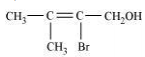
Q.3 Give the IUPAC name of the following compound:
Solution :
2 − Bromo-3-methyl-but-2-enol.
Q.4 What happen when phenol is treated with excess of bromine(aq).
Ans:- It gives 2,4,6-tribromo phenol.
Q.5 Write chemical equation Williamson synthesis.
Ans:- R-X+R- O- Na --------- R-O-R + NaCl
Q.6 Mention one uses of methanol.
Ans:– (i) As a denaturant for ethanol
Q.7 The boiling point of ethanol is higher than that methoxy methane.
Ans:-Ethanol has inter molecular hydrogen bonding, methoxymehane does not have H-bonding.
Q.8 Name a substance that can be used as an antiseptic as well as a disinfectant.
Ans:-Phenol can be used as an antiseptic as well as a disinfectant. 0.1% Soln of phenol is used as an antisepticn & 1% Soln of phenol is used as a disinfectant.
Q.9 Write the IUPAC name.
(CH3)3 C-OH
Ans:- 2-methylpropan-2-ol
Q.10 What is Nucleophiles.
Ans:- The species which has high electrons density.
Q.11 Which catalyst are used in Friedel craft reaction?
Ans:- Anh.AlCl3.
Q.12 Write a test to distinguish between primary, secondary and alcohols?
Ans:- Lucas test.
Q.13 Write the IUPAC name of CH3OH?
Ans:- Methanol.
Q.14 Write the IUPAC name of CH3-O-CH3?
Ans:- Methoxy methane.
Q.15.Write the IUPAC name of CH3 CH2-O-CH3?
Ans:- Methoxy ethane.
Short answers questions (2marks)
Q.1 Phenols are as a smaller dipole moment than methanol.
Ans:- Due to electron with drawning nature of ph-group-O bond is less polar.in case of methanol methyl group is electron releasing group So C-O bond is more polar.
Q.2 Explain why Phenol do not undergo substitution of OH group like alcohol.
Ans:-C-O bond in phenol has some double bond characters due to resonance an hence cannot be easily replaced by Nu. In contrast the C-O bond in alcohol is pure single bond an hence can be easily released by Nu.
Q.3 Give a test to distinguish between phenol and Benzyl alcohol.
Ans:- Phenols give violet colour with ferric chloride while benzyl alcohol does not give this coloure.
Q.4 Give a test to distinguish ethanol and phenol.
Ans:- phenol turns blue litmus red,but Ethanol donot have effect on litmus paper.
Q.5Write theWilliamson synthesis reaction
Ans:- R-X +R-ONa----------R-O-R +NaX
3marks questions
Q.1 Write the reaction of phenol with Zn.
Ans:- ph-OH +Zn-----------------------C6H6 +ZnO
Q.2 (i) Explain the mechanism of Addition of Grignard’s reagent to the carbonyl group of a compound forming an adduct followed by hydrolysis.
(ii) Explain the mechanism of Acid catalysed dehydration of an alcohol forming an alkene.
(iii) Explain the mechanism of Acid catalysed hydration of an alkene forming an alcohol.
Ans:- (i) Grignard’s reagent is an alkyl magnesium halide. The alkyl group has a partial negative charge, whereas the magnesium group has a partial positive charge. The alkyl group attacks the carbon of the carbonyl group to form an addition compound.
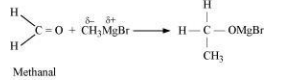
Grignard’s reagent acts as a nucleophilic agent & attacks electrophilic carbon atoms to yield a carbon − carbon bond. The addition to the nucleophile is an irreversible process due to the high pka value of the alkyl group.

(ii) When heated with concentrated sulphuric acid, phosphoric acid or boric acid, alcohols undergo dehydration to form alkenes. The mechanism of this reaction involves the protonation of alcohol, followed by loss of a water molecule & a proton.
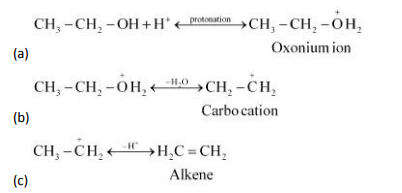
During the dehydration of alcohol, the intermediate carbocation may undergo re-arrangement, resulting in the formation of a stable carbocation.
(iii) Some reactive alkenes like 2 − methyl propene undergo direct hydration in the presence of mineral acids which act as catalysts. The addition of water to the double bond takes place in accordance with Markonikoff’s rule.
Please click the link below to download CBSE Class 12 Chemistry Alcohols Phenols Ethers Questions Answers.
Free study material for Chemistry
Useful Resources and Notes for Class 12 Chemistry Unit 7 Alcohols, Phenols and Ethers
Essential Notes for Class 12 Chemistry
Access comprehensive study material for Unit 7 Alcohols, Phenols and Ethers, including revision notes, concept maps, and high-probability questions. These resources are designed in alignment with the latest 2026 CBSE syllabus for Class 12 Chemistry to support effective exam preparation.
Verified Solutions for Class 12 Chemistry
Built using official NCERT guidelines for Class 12 Chemistry, these materials provide reliable academic support. Integrating past examination questions and step-by-step solutions helps students understand official CBSE grading criteria.
Enhance Accuracy with Online Tests
Maximize your grade potential by utilizing Class 12 Chemistry practice papers in tandem with these structured notes. All printable assignments and interactive mock tests on our platform are updated for the 2026 session and available free of charge.
FAQs
Our advanced study package for Unit 7 Alcohols, Phenols and Ethers includes detailed concepts, diagrams, Mind Maps, and explanation of complex topics to ensure Class 12 students learn as per syllabus for 2026 exams.
The Mind Maps provided for Unit 7 Alcohols, Phenols and Ethers act as visual anchors which will help faster recall during high-pressure exams.
Yes, teachers use our Class 12 Chemistry resources for lesson planning as they are in simple language and have lot of solved examples.
Yes, You can download the complete, mobile-friendly PDF of the Chemistry Unit 7 Alcohols, Phenols and Ethers advanced resources for free.
Yes, our subject matter experts have updated the Unit 7 Alcohols, Phenols and Ethers material to align with the rationalized NCERT textbooks and have removed deleted topics and added new competency-based questions.