

Class 12 Chemistry Study Guide: CBSE Class 12 Chemistry Biomolecules Questions Answers
Review targeted academic resources with the CBSE Class 12 Chemistry Biomolecules Questions Answers. Built according to official CBSE standards for the 2026-27 term, these downloadable Class 12 Chemistry study materials support effective daily practice and deeper conceptual understanding for Unit 10 Biomolecules.
Download Unit 10 Biomolecules Study Material PDF
Navigate directly to the advanced Chemistry study materials using the digital viewer below. Each resource pack includes detailed conceptual summaries and solved practice questions, allowing students to instantly reinforce their learning.
CBSE Class 12 Chemistry Biomolecules Questions Answers. There are many more useful educational material which the students can download in pdf format and use them for studies. Study material like concept maps, important and sure shot question banks, quick to learn flash cards, flow charts, mind maps, teacher notes, important formulas, past examinations question bank, important concepts taught by teachers. Students can download these useful educational material free and use them to get better marks in examinations. Also refer to other worksheets for the same chapter and other subjects too. Use them for better understanding of the subjects.
Biomolecules
SECTION -A
1. Name the sugar present in milk.
A: Lactose,
2. How many monosaccharide units are present in it?
A: two monosaccharide units are present.
3.What are such oligosaccharides called?
A: Such oligosaccharides are called disaccharides
4. How do you explain the presence of all the six carbon atoms in glucose in a Straight chain?
A: On prolonged heating with HI, glucose gives n-hexane.
3. Name the linkage connecting monosaccharide units in polysaccharides.
A: Glycosidic linkage.
4. Under what conditions glucose is converted to gluconic and saccharic acid?
A: Glucose is converted to gluconic acid by bromine water and to saccharic acid by conc. HNO3.
5. Which sugar is called invert sugar?
A: Sucrose.
6. During curdling of milk, what happens to sugar present in it?
A: It converts into Lactic acid.
7. Monosaccharide contain carbonyl group hence are classified, as aldose or ketose. The number of carbon atoms present in the monosaccharide molecule are also considered for classification. In which class of monosaccharide will you place fructose?
A: Fructose is a ketohexose.
8. The letters ‘D’ or ‘L’ before the name of a stereoisomer of a compound indicate the correlation of configuration of that particular stereoisomer. This refers to their relation with one of the isomers of glyceraldehyde. Predict whether the following compound has ‘D’ or ‘L’configuration.
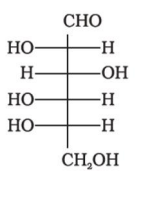
A: ‘L’ configuration
9. What are constituents of Starch?
A: Amylose and Amylopectin
10. What D N A & R N A Stand for?
A: Deoxy ribonucleic acid and Ribonucleic acid.
11. What are Zwitter ions?
A: A Zwitter ion is a dipolar ion formed by neutralization of acidic and basic centers present within the molecule.
12. .What is non reducing sugar? Give example.
A: The groups like CHO, - C= O, which are not freely available in the molecule do not answer tollens or Fehling’s test are called non reducing sugar. E.g. maltose and lactose
13. Define mutarotation? Give example.
A: The anomers of glucose i.e. alpha and beta are having specific rotation of + 1110and + 19.20 respectively. The mixtures of these two have a rotation of +52.40. this is called a mutarotation.
14. Amino acids are amphoteric in behavior? Explain.
A: they form zwitter ion (dipolar ion) and behave as neutral molecule at pH 7(isoelectric point).
SECTION –B
1. Define native state and denaturation of protein. What happens when?
a. Protein is cooled to zero degree C?
b. Protein is heated to 800 C
A: protein in the native state has definite configuration and biological activity. The higher structure of protein is affected without disturbing the primary structure is called denaturation.
a. no change
b. the coagulation of the protein takes place.
2. Which forces are responsible for stability of alpha Helix of protein? Why it is called 3.613 helix?
A: H-bonding. It has 3.6 amino acids in one single turn, and a 13 member ring is formed by H bonding.
3. What are essential amino acids? Give example and what happens when it is polymerized?
A: amino acids required by the body and cannot be synthesized in our body are called essential amino acids. e.g. Lysine. When it is polymerized polypeptide chains are formed.
4. Glucose and sucrose are soluble in water but Cyclohexane and benzene are not soluble. Why?
A : Glucose and sucrose form H bonding with water
5.(i) Write the sequence of base on mRNA molecule synthesized on the following strand of DNA:
TATCTACCTGGA
A: AUAGAUGGACCU
(ii)Name a powerful antioxidant which is a water soluble vitamin.
A: Vitamin C
SECTION- C
1. (i)Protein found in a biological system with a unique three-dimensional structureand biological activity is called a native protein. When a protein in its native form,is subjected to a physical change like change in temperature or a chemical changelike, change in pH, denaturation of protein takes place. Explain the cause.
Ans: A(i) Due to physical or chemical change, hydrogen bonds in proteins are disturbed, globules unfold and helix gets uncoiled therefore protein loses its biological activity. This is called denaturation of proteins.
Please click the link below to download CBSE Class 12 Chemistry Biomolecules Questions Answers.
Free study material for Chemistry
CBSE Class 12 Chemistry Study Material: Unit 10 Biomolecules
Comprehensive Study Resources for Unit 10 Biomolecules
Review targeted study resources for Unit 10 Biomolecules tailored for Class 12 learners. Utilizing these structured notes and quick-revision tools ensures complete alignment with current CBSE evaluation standards.
Understanding Marking Schemes
Each resource draws directly from authorized textbooks to maintain academic accuracy. Evaluating solved examples allows Class 12 students to master the formal presentation and answer-writing standards expected in upcoming school exams.
Complete Revision for Chemistry
Maximize your grade potential by utilizing Class 12 Chemistry practice papers in tandem with these structured notes. All printable assignments and interactive mock tests on our platform are updated for the 2026 session and available free of charge.
FAQs
Our advanced study package for Unit 10 Biomolecules includes detailed concepts, diagrams, Mind Maps, and explanation of complex topics to ensure Class 12 students learn as per syllabus for 2026 exams.
The Mind Maps provided for Unit 10 Biomolecules act as visual anchors which will help faster recall during high-pressure exams.
Yes, teachers use our Class 12 Chemistry resources for lesson planning as they are in simple language and have lot of solved examples.
Yes, You can download the complete, mobile-friendly PDF of the Chemistry Unit 10 Biomolecules advanced resources for free.
Yes, our subject matter experts have updated the Unit 10 Biomolecules material to align with the rationalized NCERT textbooks and have removed deleted topics and added new competency-based questions.