

Advanced Study Material for Class 12 Chemistry: Unit 6 Haloalkanes and Haloarenes
Review targeted academic resources with the CBSE Class 12 Chemistry Haloalkanes Haloarenes Summary. Built according to official CBSE standards for the 2026-27 term, these downloadable Class 12 Chemistry study materials support effective daily practice and deeper conceptual understanding for Unit 6 Haloalkanes and Haloarenes.
Practice Class 12 Chemistry Resources: Unit 6 Haloalkanes and Haloarenes
Navigate directly to the advanced Chemistry study materials using the digital viewer below. Each resource pack includes detailed conceptual summaries and solved practice questions, allowing students to instantly reinforce their learning.
CBSE Class 12 Chemistry Haloalkanes Haloarenes Summary. There are many more useful educational material which the students can download in pdf format and use them for studies. Study material like concept maps, important and sure shot question banks, quick to learn flash cards, flow charts, mind maps, teacher notes, important formulas, past examinations question bank, important concepts taught by teachers. Students can download these useful educational material free and use them to get better marks in examinations. Also refer to other worksheets for the same chapter and other subjects too. Use them for better understanding of the subjects.
HALOALKANES
INTORDUCTION:
The replacement of hydrogen atom(s) in a hydrocarbon, aliphatic or aromatic, by halogen atom(s) results in the formation of –alkyl halide (haloalkane) and aryl halide (haloarene), respectively. Haloalkanes contain halogen atom(s) attached to the sp3 hybridised carbon atom of an alkyl group whereas haloarenes contain halogen atom(s) attached to sp2 hybridised carbon atom(s) of an aryl group.
Many Halogen containing organic compounds are clinically useful & find wide applications in industry as well as in day-to-day life.
Examples: 1. Chlorine containing antibiotic, chloramphenicol, produced by soil microorganisms is effective for the treatment of typhoid fever.
2. Our body produces iodine containing hormone, thyroxine, the deficiency of which causes a disease called goiter.
3. Chloroquine is used for the treatment of malaria;
4. Halothane is used as an anaesthetic during surgery.
5. Certain fully fluorinated compounds are being considered as potential blood substitutes in surgery.
6. Haloalkanes are used as solvents for relatively non-polar compounds and as starting materials for the synthesis of wide range of organic compounds.
CLASSIFICATION
1.On the Basis of Number of Halogen Atoms-mono, di, or polyhalogen (tri-,tetra-, etc.) compounds depending on whether they contain 1, 2 or more halogen atoms in their structures.
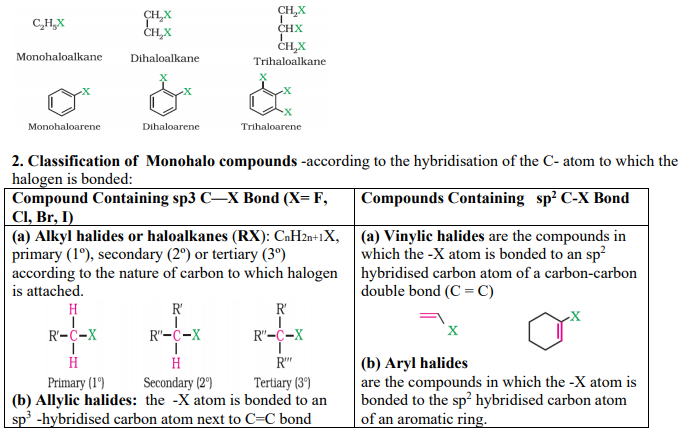
NOMENCLATURE
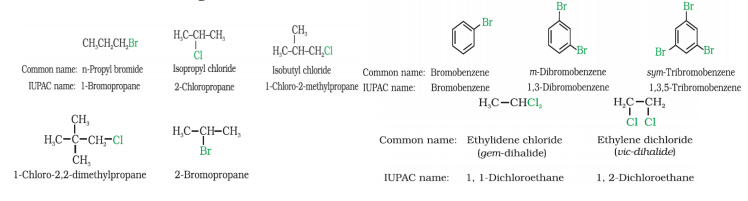
1. The common name of alkyl halide =name of the alkyl group followed by the halide (i.e. Alkyl halide)
2. IUPAC name of Alkyl halide = halo substituted hydrocarbons (i.e. Haloalkane)
3. Haloarenes are the common as well as IUPAC names of aryl halides. For dihalogen derivatives, the prefixes o-, m-, p- are used in common system but in IUPAC system, the numerals 1,2; 1,3 and 1,4 are used.
4. The dihalogen derivatives having same type of halogen atoms on the same carbon are known as geminal dihalides and assigned common name alkylidene halides or alkylidene dihalides. The dihalogen derivatives having same type of halogen atoms on adjusant carbon atoms are known as vicinal dihalides and assigned common name alkylene halides or alkylene dihalides.Nature of C-X Bond
Remember:
1. Polarity affects the physical properties like b.pt., physical state etc. More polar compounds have higher boiling points. That is why B.Pt. of Haloalkanes > B.Pt. of hydrocarbons of comparable molecular mass.
2. Since the size of halogen atom increases as we go down the group in the periodic table, consequently for the same alkyl group boiling points of alkyl halides decrease in the order: RI> RBr> RCl> RF
3. The C atom bears a +δ charge whereas the halogen atom bears a -δ charge. Therefore haloalkanes undergoes nucleophilic substitution reaction, elimination reaction, reaction with metals, reduction.
Please click the link below to download CBSE Class 12 Chemistry Haloalkanes Haloarenes Summary.
Free study material for Chemistry
Useful Resources and Notes for Class 12 Chemistry Unit 6 Haloalkanes and Haloarenes
Essential Notes for Class 12 Chemistry
Access comprehensive study material for Unit 6 Haloalkanes and Haloarenes, including revision notes, concept maps, and high-probability questions. These resources are designed in alignment with the latest 2026 CBSE syllabus for Class 12 Chemistry to support effective exam preparation.
Verified Solutions for Class 12 Chemistry
Built using official NCERT guidelines for Class 12 Chemistry, these materials provide reliable academic support. Integrating past examination questions and step-by-step solutions helps students understand official CBSE grading criteria.
Enhance Accuracy with Online Tests
Maximize your grade potential by utilizing Class 12 Chemistry practice papers in tandem with these structured notes. All printable assignments and interactive mock tests on our platform are updated for the 2026 session and available free of charge.
FAQs
Our advanced study package for Unit 6 Haloalkanes and Haloarenes includes detailed concepts, diagrams, Mind Maps, and explanation of complex topics to ensure Class 12 students learn as per syllabus for 2026 exams.
The Mind Maps provided for Unit 6 Haloalkanes and Haloarenes act as visual anchors which will help faster recall during high-pressure exams.
Yes, teachers use our Class 12 Chemistry resources for lesson planning as they are in simple language and have lot of solved examples.
Yes, You can download the complete, mobile-friendly PDF of the Chemistry Unit 6 Haloalkanes and Haloarenes advanced resources for free.
Yes, our subject matter experts have updated the Unit 6 Haloalkanes and Haloarenes material to align with the rationalized NCERT textbooks and have removed deleted topics and added new competency-based questions.