

Class 12 Chemistry Study Guide: CBSE Class 12 Chemistry Concept Map All chapters
Review targeted academic resources with the CBSE Class 12 Chemistry Concept Map All chapters. Built according to official CBSE standards for the 2026-27 term, these downloadable Class 12 Chemistry study materials support effective daily practice and deeper conceptual understanding for Concept Map.
Download Concept Map Study Material PDF
Access the complete useful resource PDF for Class 12 Chemistry below. Regular practice with these targeted academic notes builds familiarity with complex topics and helps secure higher marks in final school evaluations.
CBSE Class 12 Chemistry Concept Map All chapters. Please refer to the examination notes which you can use for preparing and revising for exams. These notes will help you to revise the concepts quickly and get good marks.
These Class 12 Chemistry concept maps bring the whole course onto a few pages: salt analysis of anions and cations, nitrogen compounds and diazonium chemistry, haloalkanes, alcohols, carboxylic acids, aldehydes and ketones, colloids, the oxygen family, d and f block elements, polymers, chemistry in everyday life and proteins. Use them for quick revision before the CBSE board exam.
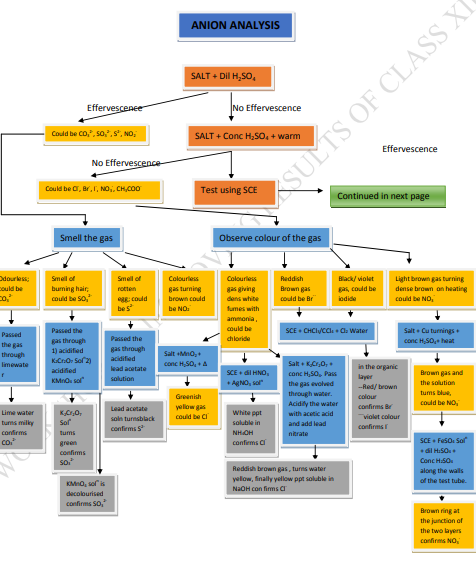
ANION ANALYSIS
Salt + dil H2SO4 → Effervescence: could be CO32-, SO32-, S2-, NO2-
Salt + dil H2SO4 → No effervescence: could be Cl-, Br-, I-, NO3-, CH3COO-; then salt + conc H2SO4 + warm. If there is no effervescence, test using SCE (see next section).
Effervescence with dil H2SO4: smell the gas
1. Odourless gas, could be CO32- → pass the gas through limewater → limewater turns milky: confirms CO32-
2. Smell of burning hair, could be SO32- → pass the gas through (1) acidified K2Cr2O7 solution: turns green, confirms SO32-; (2) acidified KMnO4 solution: KMnO4 is decolourised, confirms SO32-
3. Smell of rotten egg, could be S2- → pass the gas through acidified lead acetate solution → lead acetate solution turns black: confirms S2-
4. Colourless gas turning brown, could be NO2-
No effervescence with dil H2SO4: salt + conc H2SO4 + warm, observe the colour of the gas
1. Colourless gas giving dense white fumes with ammonia, could be Cl-. Confirmation: SCE + dil HNO3 + AgNO3 solution → white ppt soluble in NH4OH confirms Cl-. Also, salt + MnO2 + conc H2SO4 + Δ → greenish yellow gas, could be Cl-. Chromyl chloride test: salt + K2Cr2O7 + conc H2SO4; pass the gas evolved through water, acidify the water with acetic acid and add lead nitrate. Reddish brown gas turns water yellow, finally a yellow ppt soluble in NaOH confirms Cl-.
2. Reddish brown gas, could be Br-. Confirmation: SCE + CHCl3/CCl4 + Cl2 water → red/brown colour in the organic layer confirms Br-.
3. Black/violet gas, could be iodide. Confirmation: SCE + CHCl3/CCl4 + Cl2 water → violet colour in the organic layer confirms I-.
4. Light brown gas turning dense brown on heating, could be NO3-. Confirmation: salt + Cu turnings + conc H2SO4 + heat → brown gas and the solution turns blue, could be NO3-. Brown ring test: SCE + FeSO4 solution + dil H2SO4, then conc H2SO4 along the walls of the test tube → brown ring at the junction of the two layers confirms NO3-.
SALTS THAT DO NOT GIVE EFFERVESCENCE WITH dil H2SO4 / conc H2SO4
Preparation of SCE, i.e. sodium carbonate extract: salt + same quantity of Na2CO3 + water, boil and filter. The filtrate is called SCE.
| Test | Observation and conclusion |
|---|---|
| SCE + dil HCl + BaCl2 solution | White ppt insoluble in conc HCl confirms SO42- |
| SCE + dil HNO3 + ammonium molybdate | Canary yellow ppt confirms PO43- |
ANALYSIS OF CATIONS
Original salt solution + dil HCl.
1. White ppt, could be Pb2+. Dissolve in hot water to get a colourless solution, could be Pb2+. Divide into two parts. Add K2CrO4: yellow ppt soluble in NaOH solution confirms Pb2+. Add KI: yellow ppt soluble in hot water, which reappears on cooling as golden yellow spangles, confirms Pb2+.
2. No ppt → pass H2S. Black ppt, could be Pb2+/Cu2+. Dissolve in minimum quantity of 50% HNO3; a colourless solution could be Pb2+ (tested as in 1), a blue solution could be Cu2+. Divide into three parts: add NH4OH → deep blue colouration; add potassium ferrocyanide → chocolate brown ppt, confirms Cu2+; add KI → dirty white ppt.
3. No ppt with H2S → boil off H2S, add dil HNO3 + NH4Cl solution + NH4OH. A ppt could be Fe3+, Al3+, Mn2+: gelatinous brown could be Fe3+; gelatinous white could be Al3+. Dissolve the ppt in minimum amount of HCl.
4. Fe3+: divide into two parts. Add potassium ferrocyanide solution → deep blue colour. Add potassium sulphocyanide solution → blood red colour. Fe3+ confirmed.
5. Al3+: add NaOH solution and a drop of litmus → blue lake floating in a colourless background confirms Al3+.
6. No ppt with NH4OH → pass H2S through the above solution. Black ppt could be Co2+ and Ni2+. Dissolve the ppt in minimum amount of aqua regia and evaporate to dryness. Blue residue could be Co2+; yellow residue could be Ni2+.
7. White ppt could be Zn2+. Dissolve in dil HCl and add NaOH solution: white ppt soluble in excess of NaOH confirms Zn2+.
8. No ppt → boil off H2S, add Na2CO3 solution. White ppt could be Ca2+, Ba2+, Sr2+. Dissolve the ppt in minimum quantity of acetic acid and divide into three parts.
9. Add K2CrO4 solution: yellow ppt soluble in NaOH could be Ba2+; green colour on flame test confirms Ba2+.
10. Add ammonium acetate: no ppt. Add ammonium carbonate: white ppt could be Sr2+; red colour on flame test confirms Sr2+.
11. If there is no ppt with ammonium acetate or K2CrO4, add ammonium carbonate: white ppt could be Ca2+; brick red on flame test confirms Ca2+.
12. Individual tests are done for Na+, K+, Mg2+, NH4+.
ORGANIC CHEMISTRY: COMPOUNDS CONTAINING NITROGEN
Amines
N is sp3 hybridised. Classified as 1°, 2° and 3° depending on the number of H atoms replaced by alkyl or aryl groups in NH3.
Common name: alkyl amines. IUPAC names: alkane amines and aryl amines.
Physical properties
Lower aliphatic amines are soluble in water (H bonding). Solubility is inversely proportional to molecular mass. Aromatic amines are insoluble in water.
BP of amines: 1° > 2° > 3° amines. BP is proportional to intermolecular H bonding. Acids > Alcohols > Amines > Hydrocarbons.
Chemical properties
Basicity 2° > 3° > 1° (in aqueous phase). Ethanamine > NH3 > Aniline. EDG → increase basicity. EWG → decrease basicity.
With alkyl halides: alkylation.
1° and 2° amines react with acid chlorides, acid anhydrides and esters by nucleophilic substitution.
Carbylamine reaction: 1° amines on heating with CHCl3 and KOH form isocyanides with an obnoxious smell.
1° aliphatic amines + NaNO2 + HCl → alcohol. 1° aromatic amines + NaNO2 + HCl → diazonium salts.
1° and 2° amines + C6H5SO2Cl (Hinsberg reagent) → sulphonamide.
Electrophilic substitution occurs at the o- and p- positions.
1° and 2° amines + RMgX → alkanes.
Cyanides
Common name: alkyl cyanides. IUPAC name: alkane nitriles.
Physical: lower members are liquids while higher members are solids. Solubility in water decreases as the number of C atoms increases. Soluble in organic solvents. Due to dipolar association BP is higher than hydrocarbons.
Chemical
Hydrolysis: RCN → RCOOH
RCN (LiAlH4 or Na + C2H5OH) → RCH2OH
RCN (SnCl2/HCl + H2O) → RCHO (Stephen's reaction)
RCN + NH3 → R-C(=NH)-NH2
Diazonium salts
IUPAC name: alkyl diazonium salt; aryl diazonium salt.
Physical: alkyl salts are more soluble than aryl salts. Readily soluble in water, but benzene diazonium fluoroborate is insoluble in water. Soluble in solution and decomposes in the dry state.
Chemical: displacement of N2
ArN2+X- + CuCl/HCl → ArCl; CuBr/HBr → ArBr; CuCN/KCN → ArCN (Sandmeyer reaction)
Cu/HCl → ArCl; Cu/HBr → ArBr (Gattermann reaction)
KI → ArI
HBF4/Δ → ArF (via ArN2BF4, then Δ)
H2O/Δ → ArOH
H3PO2 + H2O → ArH; CH3CH2OH → ArH
Diazo group is retained (coupling reactions): colourless diazonium salts form brightly coloured azo compounds Ar-N=N-Ar.
Nitrites
IUPAC name: alkyl nitrites. They contain the -O-N=O group and are isomeric to nitroalkanes.
R-O-N=O + Sn/HCl → ROH + NH2OH
R-O-N=O + H2O/H+ → ROH + HNO2
Nitro compounds
IUPAC name: nitroalkanes.
Physical: colourless and pleasant smelling liquids. Less soluble in water but soluble in organic solvents. High boiling point. High dipole moment.
Chemical
Reduction: RNO2 + Sn/HCl → R-NH2; Zn/NH4Cl → R-NH-OH
Hydrolysis: RCH2NO2 + H2O (HCl) → R-COOH; 2R2CHNO2 (HCl) → 2R2CO
Halogenation: RCH2NO2 + Br2/NaOH → dibromo derivative; R2CHNO2 + Br2/NaOH → monobromo derivative; R3CNO2 + Br2/NaOH → no reaction
Isocyanides
Common name: alkyl isocyanides. IUPAC name: alkyl carbylamines.
Physical: highly poisonous and obnoxious smelling liquid. BP lower than cyanides. Insoluble in water.
Chemical
Hydrolysis: R-NC + H3O+ → RNH2 (primary amines)
Reduction: R-NC + LiAlH4 → RNHCH3 (secondary amines)
R-NC + HgO → R-NCO + Hg (alkyl isocyanate)
R-NC (Δ/250°C) → RCN (isomerisation)
BENZENEDIAZONIUM CHLORIDE
Diazotisation: C6H5NH2 + HNO2 (NaNO2 + HCl) → C6H5N2+Cl- (benzenediazonium chloride) + NaCl + H2O. Benzenediazonium chloride is stable due to resonance.
H3PO2/H2O → benzene + N2 + H3PO3 + HCl
CH3CH2OH → benzene + N2 + CH3CHO + HCl
CuCl/HCl → chlorobenzene + N2
CuBr/HBr → bromobenzene + N2
CuCN/KCN → benzonitrile + N2
Cu/HCl → chlorobenzene + N2 + CuCl
KI → iodobenzene + N2 + KCl
HBF4 → C6H5N2+BF4-; Δ → fluorobenzene + N2 + BF3
H2O → phenol + N2 + HCl
HBF4, then NaNO2/Cu, Δ → nitrobenzene + N2 + NaBF4
Coupling with phenol (HO-) → p-hydroxyazobenzene (orange dye)
Coupling with aniline → p-aminoazobenzene (yellow dye)
The diazonium ion, being a weak electrophile, can couple with a strongly activated aromatic system.
Coupling does not occur in strongly acidic medium: aniline is protonated to anilinium ion (less activated aromatic system).
In strongly alkaline medium, the concentration of the diazonium ion (which acts as the electrophile) decreases (diazonium ion is converted to the diazotate), and the coupling reaction does not occur.
[Figure: Reaction map of benzenediazonium chloride at the centre with all products listed above, drawn with benzene rings]
CHARACTERS OF AMINES
| Property | Order |
|---|---|
| Basic strength in gaseous phase | Et3N > Et2NH > EtNH2 > NH3 |
| Basic strength in aqueous phase | Et2NH > EtNH2 > NH3 > PhNH2 |
| Basic strength | p-Toluidine > Aniline > p-Nitroaniline |
| pKb value | PhNH2 > PhNHCH3 > EtNH2 > Et2NH |
| Solubility | EtNH2 > Et2NH > PhNH2 |
| Basic strength | Et2NH > CH3NH2 > PhNMe2 > PhNH2 |
| Boiling point | EtOH > EtNH2 > Et2NH |
| Basic strength in aqueous medium (ethyl series) | (C2H5)2NH (2°) > (C2H5)3N (3°) > C2H5NH2 (1°) > NH3 |
| Basic strength in aqueous medium (methyl series) | (CH3)2NH (2°) > CH3NH2 (1°) > (CH3)3N (3°) > NH3 |
CONTROLLED BROMINATION AND NITRATION OF ANILINE
Controlled bromination: aniline + (CH3CO)2O (pyridine) → N-phenylethanamide (acetanilide) → Br2/CH3COOH → p-bromoacetanilide → OH-/H+ → p-bromoaniline
Controlled nitration: aniline + (CH3CO)2O (pyridine) → acetanilide → HNO3, H2SO4, 288 K → p-nitroacetanilide → OH-/H+ → p-nitroaniline
CONVERSIONS
Aliphatic conversions: stepping up the series
R-OH (alcohol) → HX, anhydrous ZnCl2 → R-X (alkyl halide) → alc. KCN → R-CN (nitrile) → LiAlH4 (reduction) → R-CH2NH2 (primary amine)
R-CH2NH2 → HNO2 (NaNO2 and HCl) → R-CH2OH (primary alcohol)
R-CN → hydrolysis, H3O+ → RCOOH (carboxylic acid) → LiAlH4, H3O+ → R-CH2OH (primary alcohol)
R-CH2OH → oxidation → RCOOH
Hydrocarbon → X2/UV → R-X (alkyl halide)
Aliphatic conversions: stepping down the series
RCOOH (carboxylic acid) → NH3, Δ → RCONH2 (acid amide) → Br2/KOH → R-NH2 (amine) → HNO2 (NaNO2 and HCl) → R-OH (primary alcohol) → HX, anhydrous ZnCl2 → R-X (alkyl halide)
R-CH2-X (alkyl halide) → aqueous KOH → R-CH2-OH (primary alcohol) → alkaline KMnO4 → RCOOH
Aromatic conversions: when the functional group contains carbon atom
Chlorobenzene → NaOH, 623 K, 300 atm, then H+ → phenol → Zn dust → benzene → CH3Cl, anhydrous AlCl3 → toluene → alkaline KMnO4 → benzoic acid (HOOC-C6H5) → SOCl2 → benzoyl chloride (ClOC-C6H5) → H2/Pd, BaSO4, S, boiling xylene → benzaldehyde (OHC-C6H5)
Aromatic conversions: when the functional group does not contain carbon atom
Benzene → conc. HNO3, H2SO4, 333 K → nitrobenzene → Sn/HCl → aniline → NaNO2/HCl → benzenediazonium chloride
Benzenediazonium chloride → warm H2O → phenol → Zn dust → benzene
Benzenediazonium chloride → H3PO2/H2O → benzene
Benzenediazonium chloride → KI → iodobenzene; CuCl/HCl → chlorobenzene; CuBr/HBr → bromobenzene
Benzenediazonium chloride → HBF4 → benzenediazonium tetrafluoroborate → Δ → fluorobenzene; NaNO2, Cu, Δ → nitrobenzene
CONCEPT MAP: COLLOIDS
Classification of colloids
Based on particles of dispersed phase: i) multimolecular, ii) macromolecular, iii) associated
Based on nature of interaction: i) lyophilic, ii) lyophobic
Based on physical state: i) solid in solid, ii) liquid in solid, iii) gas in solid, iv) solid in liquid, v) liquid in liquid, vi) gas in liquid, vii) solid in gas, viii) liquid in gas
Preparation of colloids
Chemical method
Bredig's arc method
Peptisation
Properties of colloids
Tyndall effect
Brownian motion
Electrophoresis
Colligative properties
Charge on colloidal particle
Colour
Coagulation
Purification
Dialysis
Electrodialysis
Ultrafiltration
CONCEPT MAP: CLASSIFICATION OF HALOALKANES (CHAPTER 10)
On the basis of the number of halogen atoms: monohalo derivative, dihalo derivative (CH2X-CH2X), trihalo derivative (CHX3, haloforms)
On the basis of hybridisation of the carbon atom: compounds in which halogen is bonded to sp3 hybridised C (e.g. CH3CH2CH2-X); allylic halides (e.g. CH2=CH-CH2-X); vinylic halides (CH2=CH-X)
On the basis of 1°, 2° and 3° carbon atoms: primary haloalkane (CH3-CH2-X); secondary haloalkane (CH3-CH(X)-CH3); tertiary haloalkane ((CH3)3C-X)
[Figure: Flow chart of classification of haloalkanes; parts of two boxes at the left edge of the source page are cut off]
PREPARATION OF HALOALKANES
From alcohols: R-OH + HX (ZnCl2) → RX + H2O
From hydrocarbons: CH3CH2CH2CH3 + Cl2 (UV) → CH3CH2CH2CH2Cl + CH3CH2CH(Cl)CH3
From alkenes: CH2=CH2 + HX → CH3CH2-X
By halide exchange: Finkelstein reaction: RX + NaI → RI + NaX (X = Cl, Br). Swarts reaction: RX + AgF → RF + AgX
Nucleophilic substitution of haloalkanes
R-X + KOH (aq.) → R-OH + KX
R-X + NaOR → R-O-R + NaX
R-X + KCN (alc) → R-CN + KX
R-X + AgCN → R-NC + AgX
R-X + KNO2 → R-O-N=O
UNIT 11: ALCOHOLS, PHENOLS AND ETHERS: CHEMICAL PROPERTIES OF ALCOHOLS
Reactions involving the cleavage of O-H bond: with metals, 2ROH + 2Na → 2RONa + H2; esterification, RCOOH + R'OH → RCOOR' + H2O
Reactions involving the cleavage of C-O bond: with HX, ROH + HX → RX + H2O; with PCl5, ROH + PCl5 → RCl + POCl3 + HCl
Reactions involving the alkyl group as well as the OH group: dehydration, oxidation and dehydrogenation
Dehydration (order of ease 3° > 2° > 1°): CH3CH2OH + H2SO4, 443 K → CH2=CH2 + H2O
Oxidation: CH3CH2OH + K2Cr2O7 + H2SO4 → CH3CHO; further [O] → CH3COOH
Dehydrogenation: RCH2OH (573 K, Cu) → RCHO + H2
UNIT 12: TEST FOR CARBOXYLIC ACIDS
| Test | Observation |
|---|---|
| Litmus test | Turns blue litmus to red |
| NaHCO3 test | Brisk effervescence of CO2 is evolved |
| Ester formation test | Fruity smell of ester |
Classification of carboxylic acids
| Type | Number of -COOH groups | Example |
|---|---|---|
| Monocarboxylic acids | 1 -COOH group | CH3COOH |
| Dicarboxylic acids | 2 -COOH groups | HOOC-CH2-CH2-COOH |
| Tricarboxylic acids | 3 -COOH groups | HOOC-CH2-CH(COOH)-CH2-COOH |
CHEMICAL PROPERTIES OF ALDEHYDES AND KETONES
Nucleophilic addition reactions: 1. by HCN, 2. by NaHSO3, 3. by RMgX, 4. by NH3
Reduction
Oxidation
OXYGEN FAMILY
General electronic configuration: ns2 np4. Members: 1. Oxygen (O), 2. Sulphur (S), 3. Selenium (Se), 4. Tellurium (Te), 5. Polonium (Po)
Anomalous behaviour: points of difference of the first member of the group with other group members: exceptionally small atomic and ionic size; absence of d-orbitals in the valence shell; high ionisation energy and high electronegativity.
O2 molecule is paramagnetic due to the presence of two unpaired electrons in anti-bonding M.O.
Ozone, O3, is a powerful oxidizing agent, because it can give nascent oxygen [O].
It is also called the chalcogen family because most copper minerals contain either oxygen or sulphur.
Oxygen shows -2 oxidation state except OF2 (+2), O2F2 (+1) and peroxides (-1).
Hydrides of the oxygen family: H2O, H2S, H2Se, H2Te
| Property | Order |
|---|---|
| Bond dissociation energy | H2O > H2S > H2Se > H2Te |
| Thermal stability | H2O > H2S > H2Se > H2Te |
| Reducing nature | H2O < H2S < H2Se < H2Te |
| B.p./M.p. | H2O > H2S < H2Se < H2Te |
| Bond angle | H2O > H2S > H2Se > H2Te |
CONCEPT MAP: d AND f BLOCK ELEMENTS
d-block elements
Physical properties: 1. variation in M.P.; 2. variation in atomic and ionic size; 3. ionisation enthalpies; 4. oxidation state variation; 5. trends in standard electrode potentials; 6. trends in stability of higher oxidation states.
Special properties: 1. variable oxidation states; 2. coloured ions; 3. catalytic properties; 4. complex formation; 5. alloy formation; 6. interstitial compounds; 7. paramagnetism.
Some important compounds: KMnO4 (preparation, structure and its properties); K2Cr2O7 (preparation, structure and its properties).
f-block elements
| Lanthanides | Actinides | |
|---|---|---|
| Series | 4f series (Cerium to Lutetium) | 5f series (Thorium to Lawrencium) |
| Common oxidation state | +3 | +3 |
| Other oxidation states | In +2 state: reductant; in +4 state: oxidant | Extra oxidation states +5, +6, +7 |
| Contraction | Lanthanoid contraction: regular decrease of atomic size / ion size | Actinoid contraction: regular decrease of atomic size / ion size |
| Other | Misch metall (alloy of lanthanoids) contains 95% Ln and 5% Fe | Most are radioactive |
POLYMERS IN ONE PAGE
| Type | Polymer | Monomer | Uses | Remark |
|---|---|---|---|---|
| Condensation polymer + homopolymer | Nylon 6 | Caprolactam | Fibre, plastic, tyre cords | Thermoplastic |
| Condensation polymer + copolymer | Nylon 66 | HMDA, adipic acid | Stockings, shirts, ropes | |
| Condensation polymer + copolymer | Terylene (Dacron) | Ethylene glycol, terephthalic acid | Fabrics | |
| Condensation polymer + copolymer | Glyptal | Ethylene glycol, phthalic acid | Paints, binding materials | |
| Condensation polymer + copolymer | PHBV | 3-Hydroxybutanoic acid, 3-hydroxypentanoic acid | Packaging in medical industry | Biodegradable aliphatic polyester |
| Condensation polymer + copolymer | Nylon 2-Nylon 6 | Glycine and aminocaproic acid | Biodegradable polymer | |
| Condensation polymer + copolymer | Bakelite | Phenol, formaldehyde | Electric switch and switch board | Thermosetting polymer |
| Condensation polymer + copolymer | Melamine formaldehyde resin | Melamine, formaldehyde | Unbreakable crockery | Thermosetting polymer |
| Addition polymer + homopolymer | Polythene | Ethene | Pipes, electrical insulators, toys | Thermoplastics |
| Addition polymer + homopolymer | Polystyrene | Styrene | Combs, plastic handle, toys | Thermoplastics |
| Addition polymer + homopolymer | Polypropene | Propene | Carry bags, plastic goods | Thermoplastics |
| Addition polymer + homopolymer | PVC | Vinyl chloride | Raincoat, electrical insulators | Thermoplastics |
| Addition polymer + homopolymer | PAN (Orlon) | Acrylonitrile | Fabrics | Thermoplastics |
| Addition polymer + homopolymer | PTFE (Teflon) | Tetrafluoroethene | Non-stick utensils | Thermoplastics |
| Addition polymer + copolymer | Natural rubber | Isoprene | Football bladder | |
| Addition polymer + copolymer | BUNA-S | Buta-1,3-diene, styrene | Tyre cords | |
| Addition polymer + copolymer | BUNA-N | Buta-1,3-diene, acrylonitrile | Water storage tank |
Classification as elastomer, fibre, thermoplastic and thermosetting polymer
| Polymer | Classification type |
|---|---|
| Natural rubber, BUNA-S, BUNA-N | Elastomer |
| Nylon 6, Nylon 66, Terylene (Dacron) | Fibre |
| Polystyrene, polypropene, PVC, PAN (Orlon), PTFE (Teflon), Glyptal, PHBV, Nylon 2-Nylon 6, polythene | Thermoplastic |
| Bakelite, melamine formaldehyde resin | Thermosetting polymer |
CHEMISTRY IN EVERYDAY LIFE IN ONE PAGE
Therapeutic action of different drugs. Note: all the medicines should be taken under strict medical supervision.
| Drugs | Action | Example |
|---|---|---|
| Analgesics | Pain killer | Aspirin, Analgin, Anacin |
| Analgesics (narcotic) | Produces unconsciousness | Opium, heroin, codeine, morphine |
| Antibiotics: i) bacteriostatic (streptomycin), ii) bactericidal (penicillin) | Produced by micro-organisms; can inhibit the growth of or kill other micro-organisms. | Penicillin G (narrow spectrum); streptomycin, ampicillin, amoxicillin, chloramphenicol, vancomycin, ofloxacin (broad spectrum) |
| Antiseptics | Prevent the growth of micro-organisms or kill them but are not harmful to living tissues. | Dettol (chloroxylenol + terpineol), bithionol (in soap), tincture iodine, 0.2% phenol, boric acid, ethanol, Soframycin, furamycin |
| Disinfectants | Kill micro-organisms, not safe for living tissues. Used for toilets, floors, instruments. | 1% phenol, chlorine (Cl2), sulphur dioxide (SO2) |
| Antacids | Reduce or neutralise the acidity. | NaHCO3, Al(OH)3 gel, MgCO3, Mg(OH)2, AlPO4 |
| Antihistamines | Reduce release of acid. Also used to treat allergy. | Cimetidine (Tegamet), ranitidine (Zantac); brompheniramine (Dimetapp), terfenadine (Seldane) |
| Tranquilizers | Reduce mental anxiety, stress, emotional disturbance (sleeping pill). | Valium, Serotonin, Veronal, Equanil, Amytal, Nembutal, Luminal, Seconal |
| Antipyretics | Reduce body temperature. | Aspirin, paracetamol, analgin, phenacetin |
| Antifertility drugs | Steroids used to control pregnancy. | Norethindrone, ethynylestradiol (Novestrol) |
Chemicals in food
| Type | Examples |
|---|---|
| Sweetening agent | Saccharin, aspartame (for cold foods), alitame, sucralose (stable at cooking temperature) |
| Food preservative | Salt, sugar, vegetable oils, sodium benzoate |
Cleansing agents
| Type | Chemical | Remark |
|---|---|---|
| Soap | Na/K salt of long chain fatty acids | Does not work in hard water because with Ca and Mg salts soap produces insoluble scum |
| Anionic detergent | Sodium laurylsulphate | Used in household work and in tooth paste |
| Cationic detergent | Cetyltrimethylammonium bromide | Hair conditioner, germicidal properties |
| Non-ionic detergent | Ester of stearic acid and polyethylene glycol | Liquid dishwashing |
Detergents with highly branched hydrocarbon parts are non-biodegradable and hence water pollutants, so branching is minimised, which makes them degradable and prevents pollution.
CONCEPT MAP: BIOMOLECULES (PROTEINS)
Proteins are all the polymers of α-amino acids connected to each other by peptide bond or peptide linkage.
Classification based on molecular structure: 1. Fibrous: insoluble in water, polypeptide chains run parallel, held by H bonds and disulphide bonds. Ex: keratin. 2. Globular: chains of polypeptides coil around to give a spherical shape. Ex: insulin.
Structure: Primary: sequence of amino acids. Secondary: shape due to H-bonding. Tertiary: overall folding of the secondary structure. Quaternary: special arrangement of subunits with respect to each other.
Essential amino acids: which cannot be made in the body, to be supplied through diet. Non-essential: can be synthesised by the body.
α-Helix: formed due to intramolecular H-bonds between the C=O of one amino acid residue and the N-H of the 4th amino acid residue in the chain. Ex: keratin in hair and myosin in muscles.
β-Pleated structure: peptide chains laid side by side, held together by intermolecular H-bonding, resembles pleated folds of drapery. Ex: silk protein.
Denaturation: due to coagulation the native shape of the protein is destroyed and biological activity is lost; 2° and 3° structures are destroyed, 1° is intact.
Free study material for Chemistry
Chemistry Class 12 Exam Resources: Concept Map
Comprehensive Study Resources for Concept Map
Access comprehensive study material for Concept Map, including revision notes, concept maps, and high-probability questions. These resources are designed in alignment with the latest 2026 CBSE syllabus for Class 12 Chemistry to support effective exam preparation.
Understanding Marking Schemes
Designed around the official curriculum, these study guides guarantee standard compliance. Reviewing step-by-step solutions clarifies complex sub-topics within Concept Map and demystifies standard marking schemes for Chemistry evaluations.
Complete Revision for Chemistry
For peak performance in upcoming evaluations, integrate official Chemistry sample papers directly into your study schedule. Follow up your revision by attempting online MCQ tests for Concept Map to refine calculation speed and precision.
FAQs
Our advanced study package for Concept Map includes detailed concepts, diagrams, Mind Maps, and explanation of complex topics to ensure Class 12 students learn as per syllabus for 2026 exams.
The Mind Maps provided for Concept Map act as visual anchors which will help faster recall during high-pressure exams.
Yes, teachers use our Class 12 Chemistry resources for lesson planning as they are in simple language and have lot of solved examples.
Yes, You can download the complete, mobile-friendly PDF of the Chemistry Concept Map advanced resources for free.
Yes, our subject matter experts have updated the Concept Map material to align with the rationalized NCERT textbooks and have removed deleted topics and added new competency-based questions.