

Download CBSE Class 12 Chemistry Useful Resources
Review targeted academic resources with the CBSE Class 12 Chemistry Atoms Exams Notes. Built according to official CBSE standards for the 2026-27 term, these downloadable Class 12 Chemistry study materials support effective daily practice and deeper conceptual understanding for Atoms.
Access CBSE Study Guides and Summaries
View or download the dedicated CBSE Class 12 Chemistry Atoms Exams Notes resource below. Engaging with these advanced study guides under focused conditions ensures continuous academic progress and mastery of the 2026-27 curriculum for Atoms.
CBSE Class 12 Chemistry Atoms Exams Notes. Please refer to the examination notes which you can use for preparing and revising for exams. These notes will help you to revise the concepts quickly and get good marks.
1.ALPHA PARTICLE SCATTERING EXPERIMENT
Thomson’s Atom Model
*J. J. Thomson presented an atomic model in which positive charge is distributed uniformly in a small spherical space of atom and electrons are embedded inside it like the seeds of watermelon embedded in its pulp. The model was called watermelon model or plum pudding model.
*The magnitude of positive charge was taken equal to the total negative charge of electrons to explain the electrical neutrality of atom.
*The model failed to explain the emission of discrete wavelengths from atoms. Also such a model of atom cannot form a stable structure.
Geiger–Masden Experiment
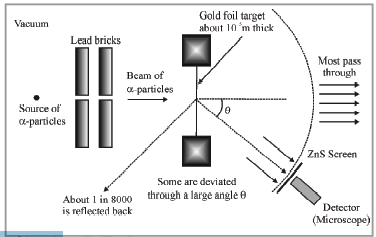
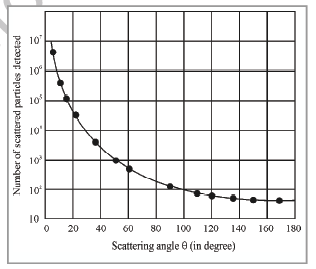
Geiger and Masden used a bismuth source, placed inside a thick block of lead in order to get a-particles. The particles having energy of 5.5 MeV coming out of a slit in the block were scattered when incident on a thin foil of gold of thickness 2.1´10–7 m. Scintillations were observed on a screen of zinc sulphide mounted on a (detector) microscope. The whole arrangement was enclosed in a cylinder having thick walls.The cylinder was mounted on a thickdisc which could be rotated. The source and foil were kept steady on the base but could be rotated around the microscope. Each a-particle striking the screen created a bright spot in it. By counting the bright spots formed, the number of a-particles striking in a given time interval can be decided.The graph shows the number of a-particles scattered at different angles in a given time interval. The number of a-particles scattered is about 105 at 15°and about 80 at 150°. (Dots indicate experimental values and the continuous line was obtained theoretically by Rutherford).
Rutherford’s Calculations
*An a-particle can undergo only one scattering while passing through the thin foil.
*An atom of Gold remains almost stationary during the collision as it is about 50 times heavier than the a-particle.
*Most of the a-particles pass through the foil without deviation. Of the scattered particles, most of them do so at small angles. It indicates that the atom contains a lot of empty space.
*A few a-particles are scattered at large angles. Further, a very less number of particles are reflected back. This suggests the total positive charge and total mass of the atom to be concentrated in a very small central region of the atom, which he called the nucleus.
Please click on below link to download pdf file for CBSE Class 12 Chemistry Atoms Exams Notes.
Free study material for Chemistry
Free CBSE Study Guides: Class 12 Chemistry Atoms
Core Study Kit: Class 12 Chemistry Atoms
Explore essential learning tools for Class 12 Chemistry Atoms. This curated collection features in-depth notes and targeted practice questions built around the active 2026 curriculum to streamline your daily revision.
NCERT-Aligned Solutions for Atoms
Built using official NCERT guidelines for Class 12 Chemistry, these materials provide reliable academic support. Integrating past examination questions and step-by-step solutions helps students understand official CBSE grading criteria.
Next Steps in Your Exam Preparation
For peak performance in upcoming evaluations, integrate official Chemistry sample papers directly into your study schedule. Follow up your revision by attempting online MCQ tests for Atoms to refine calculation speed and precision.
FAQs
Our advanced study package for Atoms includes detailed concepts, diagrams, Mind Maps, and explanation of complex topics to ensure Class 12 students learn as per syllabus for 2026 exams.
The Mind Maps provided for Atoms act as visual anchors which will help faster recall during high-pressure exams.
Yes, teachers use our Class 12 Chemistry resources for lesson planning as they are in simple language and have lot of solved examples.
Yes, You can download the complete, mobile-friendly PDF of the Chemistry Atoms advanced resources for free.
Yes, our subject matter experts have updated the Atoms material to align with the rationalized NCERT textbooks and have removed deleted topics and added new competency-based questions.