

Official CBSE Study Materials for Class 12 Chemistry
Explore structured advanced study materials through the CBSE Class 12 Chemistry Basic Concepts of Chemistry Revision Cards. Tailored for Class 12 learners, utilizing these Chemistry resources ensures thorough preparation and strengthens foundational knowledge before final CBSE evaluations.
Advanced Resources for Chemistry
View or download the dedicated CBSE Class 12 Chemistry Basic Concepts of Chemistry Revision Cards resource below. Engaging with these advanced study guides under focused conditions ensures continuous academic progress and mastery of the 2026-27 curriculum for Revision Cards.
CBSE Class 12 Chemistry Basic Concepts of Chemistry Revision Cards. There are many more useful educational material which the students can download in pdf format and use them for studies. Study material like concept maps, important and sure shot question banks, quick to learn flash cards, flow charts, mind maps, teacher notes, important formulas, past examinations question bank, important concepts taught by teachers. Students can download these useful educational material free and use them to get better marks in examinations. Also refer to other worksheets for the same chapter and other subjects too. Use them for better understanding of the subjects.
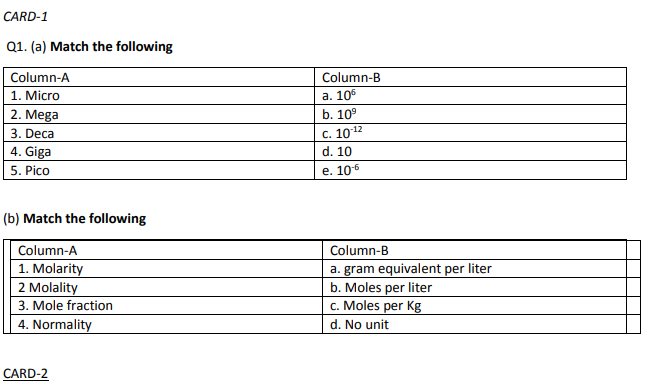
Q2. Fill in the blanks :
a) No. of significant figure in 0.0025 is ------------
b) The rounded up value of 20.058 up to 4 significant figure is -----------
c) Sum of mole fraction of all the components present in solution ------------
d) Unit of molarity is -----------
e) Out of molarity and molality,-------------- changes with temperature.
f) Mass of one mole of a substance in gram is called………………………….
g) One mole of any gas at S T P occupies………………………………………………
h) Simplest whole number ratio of various atoms present in one molecule of a compound is called……………………………………………….
i) Number of atoms present in 5 u of He is ……………………………………
j) Number of mole of CO2 present in 4.4g of CO2 is …………………………………….
CARD-3
1. In 3 moles of ethane, calculate the No. of moles of carbon atoms
2. What is the mass of one amu in gram?
3. What is the SI unit of pressure?
4. What is the empirical formula of Benzene?
5. What is the equivalent mass of sulphuric acid?
6. One gram of Hydrogen reacts with 9 gram of Oxygen to form water. Which one is the limiting reagent?
7. What is the mass of one molecule of CO2?
8. What is the mass of one atom of Sodium?
9. What is the relation between molar mass and vapor density?
10. 10 volumes of Hydrogen gas react with 5 volume of Oxygen gas, how many volumes of water vapor will be produced?
CARD-4
1. A solution is prepared by adding 2 g. of a substance to 18 g of water. Calculate the mass percentage of the solute.
2. Calculate molarity of NaOH in the solution prepared by dissolving its 4 g in enough water to form 250 ml of the solution.
3. Calculate the number of mole, molecule and atoms present in 62 g of Phosphorous. (P4)
4. The density of 3 M solution of NaCl is 1.25 g mL–1. Calculate molality of the solution.
5. Calculate the amount of carbon dioxide that could be produced when
a. 1 mole of carbon is burnt in air
b. 1 mole of carbon is burnt in 16 g of dioxygen
c. 2 moles of carbon are burnt in 16 g of dioxygen.
6. How are 0.50 moles Na2CO3 and 0.50 M Na 2CO3 different?
7. Find the amount of oxalic acid required to prepare 100 ml of M/20 oxalic acid solution?
CARD-5
State whether TRUE OR, FALSE :
1. An element contains particles of only one type which may be atoms or molecules.(T/F)
2. 1 mol of any substance is equal to 6.022 × 10 23 number of the respective particles or entities.(T/F)
3. The no. of moles of any solute present in one liter of solution is called molality.(T/F)
4. Molarity is a better term to express the concentration of a solution .(T/F)
5.1(M) aqueous solution of a solute is more concentrated than 1(m) of the same solute.(T/F)
Please click the link below to download CBSE Class 12 Chemistry Basic Concepts of Chemistry Revision Cards.
Free study material for Chemistry
Free CBSE Study Guides: Class 12 Chemistry Revision Cards
Comprehensive Study Resources for Revision Cards
Review targeted study resources for Revision Cards tailored for Class 12 learners. Utilizing these structured notes and quick-revision tools ensures complete alignment with current CBSE evaluation standards.
Understanding Marking Schemes
Built using official NCERT guidelines for Class 12 Chemistry, these materials provide reliable academic support. Integrating past examination questions and step-by-step solutions helps students understand official CBSE grading criteria.
Complete Revision for Chemistry
Wrap up your chapter revision by testing your knowledge against standard objective question formats. Explore our full library of free, up-to-date sample papers and online assessments to secure top grades in your CBSE examinations.
FAQs
Our advanced study package for Revision Cards includes detailed concepts, diagrams, Mind Maps, and explanation of complex topics to ensure Class 12 students learn as per syllabus for 2026 exams.
The Mind Maps provided for Revision Cards act as visual anchors which will help faster recall during high-pressure exams.
Yes, teachers use our Class 12 Chemistry resources for lesson planning as they are in simple language and have lot of solved examples.
Yes, You can download the complete, mobile-friendly PDF of the Chemistry Revision Cards advanced resources for free.
Yes, our subject matter experts have updated the Revision Cards material to align with the rationalized NCERT textbooks and have removed deleted topics and added new competency-based questions.