

Official CBSE Study Materials for Class 12 Chemistry
Review targeted academic resources with the CBSE Class 12 Chemistry Solution Exam Notes. Built according to official CBSE standards for the 2026-27 term, these downloadable Class 12 Chemistry study materials support effective daily practice and deeper conceptual understanding for Unit 1 Solutions.
Advanced Resources for Chemistry
Navigate directly to the advanced Chemistry study materials using the digital viewer below. Each resource pack includes detailed conceptual summaries and solved practice questions, allowing students to instantly reinforce their learning.
CBSE Class 12 Chemistry Solution Exam Notes. Please refer to the examination notes which you can use for preparing and revising for exams. These notes will help you to revise the concepts quickly and get good marks.
A solution may be defined as a Homogeneous mixtures of a single phase containing one or more of the chemical species dispersed on a molecular scale.
SOLUTE AND SOLVENT
(a) The component whose physical state is same as that of resulting solution is called as Solvent and the other component whose physical state changes is termed as Solute. e.g. In a homogenous mixture of Na(s) and Hg(l) resulting in the formation of NaHg(s), Na(s) is considered as solvent and Hg(l) is termed as Solute which is contrary to the common belief that liquids are solvents.;
(b) When both components are having the same phase as that of that the resulting solution and the relative amount of one substance in a solution is much greater than that of the other, the substance present in greater amount is generally regarded as the solvent.
METHODS OF EXPRESSING CONCENTRATIONS OF SOLUTIONS
The concentration of solutions are generally expressed in the following ways: Solute: designated as ‘b’ Solvent: designated as ‘a’
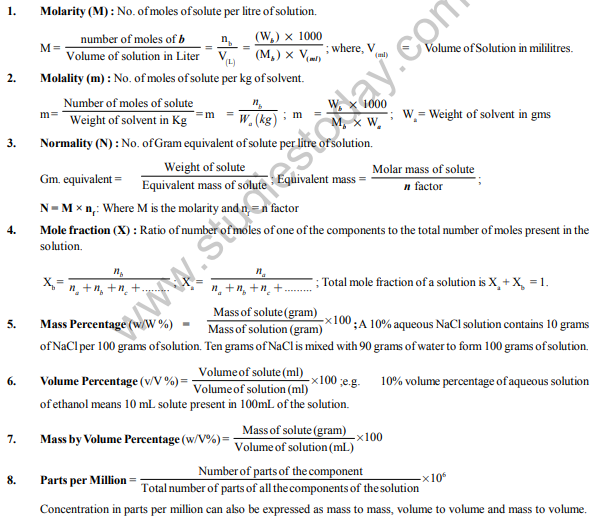
Please click on below link to download pdf file for CBSE Class 12 Chemistry Solution Exam Notes.
Free study material for Chemistry
CBSE Class 12 Chemistry Study Material: Unit 1 Solutions
Core Study Kit: Class 12 Chemistry Unit 1 Solutions
Explore essential learning tools for Class 12 Chemistry Unit 1 Solutions. This curated collection features in-depth notes and targeted practice questions built around the active 2026 curriculum to streamline your daily revision.
NCERT-Aligned Solutions for Unit 1 Solutions
Designed around the official curriculum, these study guides guarantee standard compliance. Reviewing step-by-step solutions clarifies complex sub-topics within Unit 1 Solutions and demystifies standard marking schemes for Chemistry evaluations.
Next Steps in Your Exam Preparation
Maximize your grade potential by utilizing Class 12 Chemistry practice papers in tandem with these structured notes. All printable assignments and interactive mock tests on our platform are updated for the 2026 session and available free of charge.
FAQs
Our advanced study package for Unit 1 Solutions includes detailed concepts, diagrams, Mind Maps, and explanation of complex topics to ensure Class 12 students learn as per syllabus for 2026 exams.
The Mind Maps provided for Unit 1 Solutions act as visual anchors which will help faster recall during high-pressure exams.
Yes, teachers use our Class 12 Chemistry resources for lesson planning as they are in simple language and have lot of solved examples.
Yes, You can download the complete, mobile-friendly PDF of the Chemistry Unit 1 Solutions advanced resources for free.
Yes, our subject matter experts have updated the Unit 1 Solutions material to align with the rationalized NCERT textbooks and have removed deleted topics and added new competency-based questions.