

Class 12 Chemistry Study Guide: Class 12 Chemistry Practicals Analysis Of Organic Compound Salicylic Acid
Access comprehensive study materials and useful resources for Organic Compound Salicylic Acid using the Class 12 Chemistry Practicals Analysis Of Organic Compound Salicylic Acid. Designed to align with the 2026-27 CBSE academic guidelines, these advanced resources help Class 12 Chemistry students reinforce core concepts beyond standard textbooks.
Download Organic Compound Salicylic Acid Study Material PDF
View or download the dedicated Class 12 Chemistry Practicals Analysis Of Organic Compound Salicylic Acid resource below. Engaging with these advanced study guides under focused conditions ensures continuous academic progress and mastery of the 2026-27 curriculum for Organic Compound Salicylic Acid.
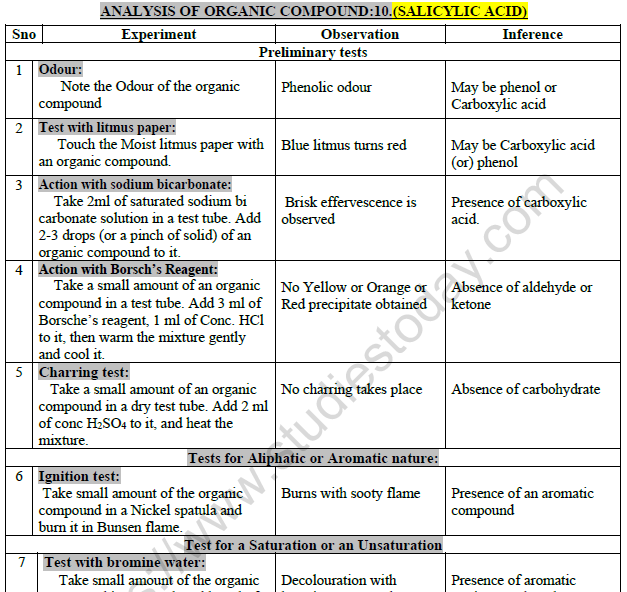
1. Tabulate the systematic qualitative analysis table for the systematic identification of the given organic compound (Salicylic Acid), covering preliminary tests, tests for aliphatic or aromatic nature, and tests for saturation or unsaturation as shown in the laboratory records.
Answer:
Systematic Analysis of Salicylic Acid
| S.No. | Experiment | Observation | Inference |
|---|---|---|---|
| 1 | Odour: Note the Odour of the organic compound. | Phenolic odour | May be phenol or Carboxylic acid |
| 2 | Test with litmus paper: Touch the Moist litmus paper with an organic compound. | Blue litmus turns red | May be Carboxylic acid (or) phenol |
| 3 | Action with sodium bicarbonate: Take 2ml of saturated sodium bicarbonate solution in a test tube. Add 2-3 drops (or a pinch of solid) of an organic compound to it. | Brisk effervescence is observed | Presence of carboxylic acid. |
| 4 | Action with Borsch's Reagent: Take a small amount of an organic compound in a test tube. Add 3 ml of Borsche's reagent, 1 ml of Conc. HCl to it, then warm the mixture gently and cool it. | No Yellow or Orange or Red precipitate obtained | Absence of aldehyde or ketone |
| 5 | Charring test: Take a small amount of an organic compound in a dry test tube. Add 2 ml of conc H2SO4 to it, and heat the mixture. | No charring takes place | Absence of carbohydrate |
| 6 | Ignition test: Take small amount of the organic compound in a Nickel spatula and burn it in Bunsen flame. | Burns with sooty flame | Presence of an aromatic compound |
| 7 | Test with bromine water: Take small amount of the organic compound in a test tube add 2 ml of distilled water to dissolve it. To this solution add few drops of bromine water and shake it well. | Decolouration with bromine water and formation of white precipitate | Presence of aromatic Amine or Phenol or Salicylic acid |
| 8 | Test with KMnO4 solution: Take small amount of organic compound in test tube add 2 ml of distilled water to dissolve it and few drops of very dil alkaline KMnO4 solution and shake it well. | No decolouration takes place | Substance is saturated |
Teacher's Note:
a) Systematic identification requires systematic grouping from preliminary tests to functional group confirmation.
b) Salicylic acid contains both phenolic and carboxylic acid functional groups.
c) Brisk effervescence with sodium bicarbonate confirms the carboxylic acid moiety.
d) Sooty flame during the ignition test indicates high carbon content typical of aromatic rings.
TEST FOR SELECTED ORGANIC FUNCTIONAL GROUP
TEST FOR PHENOL AND CARBOXYLIC ACID: [5 Marks]
Answer:
| Experiment | Observation | Inference |
|---|---|---|
| 1. Neutral FeCl3 test: Take 1 ml of FeCl3 solution in a dry test tube. Add 2 - 3 drops or pinch of organic compound to it. If no colouration occurs add 3-4 drops of alcohol | Violet colouration is seen | Presence of phenol |
| 2. Esterification reaction: Take 1 ml or a pinch of an organic compound in a clean test tube. Add 1 ml of ethyl alcohol and 4 - 5 drops of Conc. H2SO4 to it. Heat the reaction mixture strongly about 5 minutes. Then pour the mixture into beaker containing dil. Na2CO3 solution and note the smell. | A pleasant fruity odour is noted. | Presence of carboxylic group |
Report:
The given organic compound contains :
(i) Aromatic
(ii) Saturated
(iii) Phenol and Carboxylic acid functional group
So, The given organic compound is Salicylic acid.
Teacher's Note:
a) Phenols react with neutral FeCl3 to form colored coordination complexes, typically violet or green.
b) Carboxylic acids react with alcohols in the presence of concentrated H2SO4 to form sweet-smelling esters.
c) Always use clean and dry test tubes, especially for the ferric chloride test to avoid false results.
d) Salicylic acid contains both a phenolic -OH group and a carboxylic -COOH group on a benzene ring.
Free study material for Chemistry
Free CBSE Study Guides: Class 12 Chemistry Organic Compound Salicylic Acid
Essential Notes for Class 12 Chemistry
Access comprehensive study material for Organic Compound Salicylic Acid, including revision notes, concept maps, and high-probability questions. These resources are designed in alignment with the latest 2026 CBSE syllabus for Class 12 Chemistry to support effective exam preparation.
Verified Solutions for Class 12 Chemistry
Built using official NCERT guidelines for Class 12 Chemistry, these materials provide reliable academic support. Integrating past examination questions and step-by-step solutions helps students understand official CBSE grading criteria.
Enhance Accuracy with Online Tests
For peak performance in upcoming evaluations, integrate official Chemistry sample papers directly into your study schedule. Follow up your revision by attempting online MCQ tests for Organic Compound Salicylic Acid to refine calculation speed and precision.
FAQs
Our advanced study package for Organic Compound Salicylic Acid includes detailed concepts, diagrams, Mind Maps, and explanation of complex topics to ensure Class 12 students learn as per syllabus for 2026 exams.
The Mind Maps provided for Organic Compound Salicylic Acid act as visual anchors which will help faster recall during high-pressure exams.
Yes, teachers use our Class 12 Chemistry resources for lesson planning as they are in simple language and have lot of solved examples.
Yes, You can download the complete, mobile-friendly PDF of the Chemistry Organic Compound Salicylic Acid advanced resources for free.
Yes, our subject matter experts have updated the Organic Compound Salicylic Acid material to align with the rationalized NCERT textbooks and have removed deleted topics and added new competency-based questions.