

Advanced Study Material for Class 12 Chemistry: Unit 8 Aldehydes, Ketones and Carboxylic Acids
Explore structured advanced study materials through the CBSE Class 12 Chemistry Aldehyde Ketones and Carboxylic. Tailored for Class 12 learners, utilizing these Chemistry resources ensures thorough preparation and strengthens foundational knowledge before final CBSE evaluations.
Practice Class 12 Chemistry Resources: Unit 8 Aldehydes, Ketones and Carboxylic Acids
View or download the dedicated CBSE Class 12 Chemistry Aldehyde Ketones and Carboxylic resource below. Engaging with these advanced study guides under focused conditions ensures continuous academic progress and mastery of the 2026-27 curriculum for Unit 8 Aldehydes, Ketones and Carboxylic Acids.
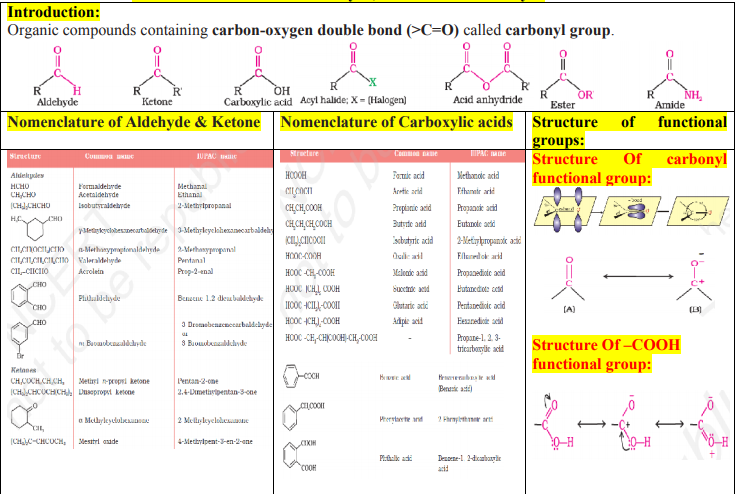
This Class 12 Chemistry summary covers Unit 12 Aldehydes, Ketones and Carboxylic Acids. It gives the structure of the carbonyl and carboxyl groups, nomenclature tables, the methods of preparation of aldehydes, ketones and carboxylic acids, and their chemical reactions: nucleophilic addition, reduction, oxidation, aldol condensation, Cannizzaro reaction, acidity, esterification, decarboxylation, Hell-Volhard-Zelinsky reaction and ring substitution.
SUMMARY OF Unit 12: Aldehyde, Ketones and Carboxylic - PART 1
Introduction:
Organic compounds containing carbon-oxygen double bond (>C=O) called carbonyl group.
[Figure: General structures of carbonyl compounds, each with a C=O group: Aldehyde R-CHO (R and H on carbon); Ketone R-CO-R'; Carboxylic acid R-COOH; Acyl halide R-CO-X, X = (Halogen); Acid anhydride R-CO-O-CO-R'; Ester R-COOR'; Amide R-CONH2]
Nomenclature of Aldehyde and Ketone
| Structure | Common name | IUPAC name |
|---|---|---|
| Aldehydes | ||
| HCHO | Formaldehyde | Methanal |
| CH3CHO | Acetaldehyde | Ethanal |
| (CH3)2CHCHO | Isobutyraldehyde | 2-Methylpropanal |
| Cyclohexane ring with CH3 and CHO groups at positions 1 and 3 | γ-Methylcyclohexanecarbaldehyde | 3-Methylcyclohexanecarbaldehyde |
| CH3CH(OCH3)CHO | α-Methoxypropionaldehyde | 2-Methoxypropanal |
| CH3CH2CH2CH2CHO | Valeraldehyde | Pentanal |
| CH2=CHCHO | Acrolein | Prop-2-enal |
| Benzene ring with two CHO groups on adjacent carbons | Phthaldehyde | Benzene 1,2 dicarbaldehyde |
| Benzene ring with CHO and Br at positions 1 and 3 | m-Bromobenzaldehyde | 3-Bromobenzenecarbaldehyde or 3-Bromobenzaldehyde |
| Ketones | ||
| CH3COCH2CH2CH3 | Methyl n-propyl ketone | Pentan-2-one |
| (CH3)2CHCOCH(CH3)2 | Diisopropyl ketone | 2,4-Dimethylpentan-3-one |
| Cyclohexanone ring with a CH3 on the carbon next to C=O | α-Methylcyclohexanone | 2-Methylcyclohexanone |
| (CH3)2C=CHCOCH3 | Mesityl oxide | 4-Methylpent-3-en-2-one |
Nomenclature of Carboxylic acids
| Structure | Common name | IUPAC name |
|---|---|---|
| HCOOH | Formic acid | Methanoic acid |
| CH3COOH | Acetic acid | Ethanoic acid |
| CH3CH2COOH | Propionic acid | Propanoic acid |
| CH3CH2CH2COOH | Butyric acid | Butanoic acid |
| (CH3)2CHCOOH | Isobutyric acid | 2-Methylpropanoic acid |
| HOOC-COOH | Oxalic acid | Ethanedioic acid |
| HOOC-CH2-COOH | Malonic acid | Propanedioic acid |
| HOOC-(CH2)2-COOH | Succinic acid | Butanedioic acid |
| HOOC-(CH2)3-COOH | Glutaric acid | Pentanedioic acid |
| HOOC-(CH2)4-COOH | Adipic acid | Hexanedioic acid |
| HOOC-CH2-CH(COOH)-CH2-COOH | - | Propane-1, 2, 3-tricarboxylic acid |
| C6H5-COOH (benzene ring with COOH) | Benzoic acid | Benzenecarboxylic acid (Benzoic acid) |
| C6H5-CH2COOH | Phenylacetic acid | 2-Phenylethanoic acid |
| Benzene ring with two COOH groups on adjacent carbons | Phthalic acid | Benzene-1, 2-dicarboxylic acid |
Structure of functional groups:
Structure Of carbonyl functional group:
[Figure: Orbital picture of the carbonyl group - a planar σ-bond framework of the carbon with its three substituents and a π-bond formed by the sideways overlap of p orbitals above and below the plane of the C and O atoms. Below it, the resonance structures: (A) C=O, with a double bond, and (B) C+-O-, joined by a double-headed arrow]
Structure Of -COOH functional group:
[Figure: Three resonance structures of the -COOH group joined by double-headed arrows: the first with C=O and C-O-H (with curved arrows showing movement of electrons), the second with C+, O- and :O-H, and the third with C-O- and a positively charged O+-H]
Preparation of aldehydes and Ketones:
1. By oxidation of alcohols:
RCH2OH → (Oxidation) R-CHO (Aldehyde) → R-COOH (Carboxylic acid)
R-CH(OH)-R' (Sec-alcohol) → (CrO3) R-CO-R' (Ketone)
2. By dehydrogenation of Alcohols:
RCH2OH → (Cu, 573 K) RCHO
R-CH(OH)-R' → (Cu, 573 K) R-CO-R'
CH3-C(CH3)(OH)-CH3 → (Cu, 573 K) CH3-C(CH3)=CH2
3. By ozonolysis of Alkenes:
>C=C< + O3 / Zn + H2O → >C=O + O=C<
4. By hydration of alkynes:
Ethyne + H2O → (Hg2+, H2SO4) CH3-CHO (Ethanal)
Propyne + H2O → (Hg2+, H2SO4) CH3-CO-CH3 (Propanone)
(Ethyne gives an aldehyde; other alkynes give ketones.)
Preparation of Ketones:
1. From acyl chlorides:
2 R-Mg-X + CdCl2 → R2Cd + 2Mg(X)Cl
2 R'-CO-Cl + R2Cd → 2 R'-CO-R + CdCl2
2. From nitriles:
CH3-CH2-C≡N + C6H5MgBr → (ether) CH3CH2-C(=NMgBr)-C6H5 → (H3O+) C6H5-CO-C2H5 (Propiophenone, 1-Phenylpropanone)
3. Friedel-Crafts acylation reaction:
Benzene + Ar/R-CO-Cl → (Anhyd. AlCl3) Ar/R-CO-C6H5 (a ketone in which the benzene ring is joined to the C=O)
Preparation of Aldehydes
1. From acyl chloride - Rosenmund reduction:
Benzoyl chloride (C6H5COCl) → (H2, Pd-BaSO4) Benzaldehyde (C6H5CHO)
2. From nitriles (Stephen Reaction):
RCN + SnCl2 + HCl → RCH=NH → (H3O+) RCHO
This reaction is called Stephen reaction.
3. From hydrocarbons:
i. By oxidation of methylbenzene -
a. use of chromyl chloride (CrO2Cl2):
Toluene + CrO2Cl2 → (CS2) Chromium complex, C6H5CH(OCrOHCl2)2 → (H3O+) Benzaldehyde
This reaction is called Etard reaction.
b. use of chromic oxide (CrO3):
Toluene + CrO3 + (CH3CO)2O → (273-283 K) C6H5CH(OCOCH3)2 → (H3O+, Δ) Benzaldehyde
ii. By side chain chlorination followed by hydrolysis:
Toluene → (Cl2/hν) Benzal chloride (C6H5CHCl2) → (H2O, 373 K) Benzaldehyde
iii. By Gatterman-Koch reaction:
Benzene → (CO, HCl; Anhyd. AlCl3/CuCl) Benzaldehyde
Preparation of Carboxylic Acids:
1. From primary alcohols and aldehydes -
RCH2OH → (Oxidation) R-CHO (Aldehyde) → R-COOH (Carboxylic acid)
2. From alkylbenzenes by oxidation:
C6H5-CH2CH2CH3 → (KMnO4-KOH, Δ) C6H5-COOK → (H3O+) Benzoic acid (C6H5COOH)
3. From nitriles and amides:
R-CN → (H+ or OH-, H2O) R-CONH2 → (H+ or OH-, Δ) RCOOH
4. From Grignard reagents:
R-Mg-X + O=C=O → (Dry ether) R-C(=O)-OMgX → (H3O+) RCOOH
5. From acyl halides and anhydrides:
RCOCl → (H2O) RCOOH + Cl-
RCOCl → (OH-/H2O) RCOO- + Cl- → (H3O+) RCOOH
6. From esters:
Ethyl benzoate (C6H5COOC2H5) + H2O ⇌ (H3O+) Benzoic acid (C6H5COOH) + C2H5OH
SUMMARY OF Unit 12: Aldehyde, Ketones and Carboxylic - PART 2
Chemical Reactions of aldehydes and ketones
1. Nucleophilic addition reactions:
[Figure: Mechanism of nucleophilic addition. A planar carbonyl carbon with substituents a and b, C=O with partial charges δ+ and δ-, is attacked by Nu- to give a Tetrahedral intermediate with O-; with H+ (fast, step 2) this gives the Addition product containing C(Nu)(OH)]
(a) Addition of hydrogen cyanide (HCN): Formation of Cyanohydrin
HCN + OH- ⇌ :CN- + H2O
>C=O + :CN- ⇌ Tetrahedral intermediate (>C(O-)(CN)) → (H+) Cyanohydrin (>C(OH)(CN))
(b) Sodium hydrogensulphite adds to aldehydes and ketones to form the addition products
>C=O + NaHSO3 ⇌ >C(OH)(SO3Na) (addition product, formed through proton transfer)
(c) Addition of alcohols:
R-CHO + R'OH (HCl gas) ⇌ Hemiacetal, R-CH(OH)(OR') → (R'OH, H+) Acetal, R-CH(OR')2 + H2O
Ketones react with ethylene glycol to form cyclic products known as ethylene glycol ketals.
>C=O + HOCH2CH2OH ⇌ (HCl gas, dil. HCl) Ethylene glycol ketal (a five-membered ring with two O atoms joined by CH2-CH2) + H2O
(d) Addition of Grignard reagents:
HCHO + RMgX → RCH2OMgX → (H2O) RCH2OH + Mg(OH)X
RCHO + R'MgX → R-CH(R')-OMgX → (H2O) R-CH(R')-OH + Mg(OH)X
RCOR + R'MgX → R-C(R)(R')-OMgX → (H2O) R-C(R)(R')-OH + Mg(OH)X
(d) Addition of ammonia and its derivatives:
>C=O + H2N-Z ⇌ [>C(OH)(NHZ)] → >C=N-Z + H2O
Z = Alkyl, aryl, OH, NH2, C6H5NH, NHCONH2
| Z | Reagent name | Carbonyl derivative | Product name |
|---|---|---|---|
| -H | Ammonia | >C=NH | Imine |
| -R | Amine | >C=NR | Substituted imine (Schiff's base) |
| -OH | Hydroxylamine | >C=N-OH | Oxime |
| -NH2 | Hydrazine | >C=N-NH2 | Hydrazone |
| -NH-C6H5 | Phenylhydrazine | >C=N-NH-C6H5 | Phenylhydrazone |
| -NH-C6H3(NO2)2 (2,4-dinitrophenyl) | 2,4-Dinitrophenylhydrazine | >C=N-NH-C6H3(NO2)2 | 2,4-Dinitrophenylhydrazone |
| -NH-CO-NH2 | Semicarbazide | >C=N-NH-CO-NH2 | Semicarbazone |
2,4-DNP derivatives are yellow, orange or red solids, useful for characterisation of aldehydes and ketones.
2. Reduction:
(i) Reduction to alcohols:
RCHO + H2 → (Pd) RCH2OH
RCOR' → (NaBH4) R-CH(OH)-R'
(ii) Reduction to hydrocarbons:
a. Clemmensen reduction: >C=O → (Zn-Hg, HCl) >CH2 + H2O
b. Wolff-Kishner reduction: >C=O → (NH2NH2, -H2O) >C=NNH2 → (KOH/ethylene glycol, heat) >CH2 + N2
3. Oxidation: by (i) KMnO4/Acidic (ii) K2Cr2O7/Acidic
R-CHO → ([O]) R-COOH
R-CH2-CO-CH2-R' → ([O]) R-COOH + R'-CH2COOH (By cleavage of C1-C2 bond) and R-CH2COOH + R'-COOH (By cleavage of C2-C3 bond)
Oxidation by mild oxidizing agent - Tollens' test:
RCHO + 2[Ag(NH3)2]+ + 3 OH- → RCOO- + 2Ag + 2H2O + 4NH3
Oxidation by mild oxidizing agent - Fehling's test:
R-CHO + 2Cu2+ + 5OH- → RCOO- + Cu2O + 3H2O (Red-brown ppt)
(iii) Oxidation of methyl ketone by haloform reaction:
R-CO-CH3 → (NaOX) R-COONa + CHX3 (X = Cl, Br, I)
(CH3)2C=CH-CO-CH3 → (NaOCl) (CH3)2C=CH-COONa + CHCl3
4. Reactions due to α-hydrogen:
(i) Aldol Condensation:
2 CH3-CHO (Ethanal) ⇌ (dil. NaOH) CH3-CH(OH)-CH2-CHO (3-Hydroxybutanal, Aldol) → (Δ, -H2O) CH3-CH=CH-CHO (But-2-enal, aldol condensation product)
2 CH3-CO-CH3 (Propanone) ⇌ (Ba(OH)2) CH3-C(OH)(CH3)-CH2-CO-CH3 (4-Hydroxy-4-methylpentan-2-one, Ketol) → (Δ, -H2O) (CH3)2C=CH-CO-CH3 (4-Methylpent-3-en-2-one, aldol condensation product)
(ii) Cross aldol Condensation:
CH3CHO + CH3CH2CHO → (1. NaOH, 2. Δ) CH3-CH=CH-CHO (But-2-enal) + CH3CH2-CH=C(CH3)-CHO (2-Methylpent-2-enal) - from two molecules of ethanal and from two molecules of propanal: simple or self aldol products
+ CH3-CH=C(CH3)-CHO (2-Methylbut-2-enal) + CH3CH2-CH=CH-CHO (Pent-2-enal) - from one molecule of ethanal and one molecule of propanal: cross aldol products
5. Other reactions:
(i) Cannizzaro reaction:
HCHO + HCHO + Conc. KOH → (Δ) CH3OH (Methanol) + HCOOK (Potassium formate)
(ii) Electrophilic substitution reaction:
Benzaldehyde → (HNO3/H2SO4, 273-283 K) m-Nitrobenzaldehyde
Chemical Reactions of carboxylic acid
1. Reaction involving cleavage of O-H bond, Acidity of Carboxylic acid:
Carboxylic acids dissociate to give resonance stabilised carboxylate anions and hydronium ion -
R-COOH + H2O ⇌ H3O+ + [R-COO- ↔ R-COO- (resonance forms)] = R-C(O-)=O
Electron withdrawing group (EWG) stabilises the carboxylate anion and strengthens the acid. Electron donating group (EDG) destabilises the carboxylate anion and weakens the acid.
The effect of the following groups in increasing acidity order is: Ph < I < Br < Cl < F < CN < NO2 < CF3
Thus, the following acids are arranged in order of increasing acidity (based on pKa values):
CF3COOH > CCl3COOH > CHCl2COOH > NO2CH2COOH > NC-CH2COOH > FCH2COOH > ClCH2COOH > BrCH2COOH > HCOOH > ClCH2CH2COOH > C6H5COOH > C6H5CH2COOH > CH3COOH > CH3CH2COOH
The presence of electron withdrawing group on the phenyl of aromatic carboxylic acid increases their acidity while electron donating groups decrease their acidity.
4-Methoxybenzoic acid (pKa = 4.46); Benzoic acid (pKa = 4.19); 4-Nitrobenzoic acid (pKa = 3.41)
2. Reaction involving cleavage of O-H bond:
i. Formation of anhydride:
Ethanoic acid + Ethanoic acid → (H+, Δ or P2O5, Δ) Ethanoic anhydride, CH3-CO-O-CO-CH3
ii. Esterification:
RCOOH + R'OH ⇌ (H+) RCOOR' + H2O
iii. Reaction with PCl3, PCl5, SOCl2:
RCOOH + PCl5 → RCOCl + POCl3 + HCl
3RCOOH + PCl3 → 3RCOCl + H3PO3
RCOOH + SOCl2 → RCOCl + SO2 + HCl
iv. Reaction with ammonia:
CH3COOH + NH3 ⇌ CH3COO-NH4+ (Ammonium acetate) → (Δ, -H2O) CH3CONH2 (Acetamide)
3. Reactions Involving -COOH Group:
i. Reduction:
R-COOH → (i) LiAlH4/ether or B2H6, (ii) H3O+) R-CH2OH
ii. Decarboxylation:
R-COONa → (NaOH and CaO, Heat) R-H + Na2CO3
4. Substitution Reaction in the Hydrocarbon Part:
i. Halogenation, Hell-Volhard-Zelensky reaction:
R-CH2-COOH → ((i) X2/Red phosphorus, (ii) H2O) R-CH(X)-COOH, X = Cl, Br (α-Halocarboxylic acid)
ii. Ring substitution:
Benzoic acid → (Br2/FeBr3) m-Bromobenzoic acid
Benzoic acid → (Conc. HNO3 + Conc. H2SO4) m-Nitrobenzoic acid
Free study material for Chemistry
Free CBSE Study Guides: Class 12 Chemistry Unit 8 Aldehydes, Ketones and Carboxylic Acids
Essential Notes for Class 12 Chemistry
Access comprehensive study material for Unit 8 Aldehydes, Ketones and Carboxylic Acids, including revision notes, concept maps, and high-probability questions. These resources are designed in alignment with the latest 2026 CBSE syllabus for Class 12 Chemistry to support effective exam preparation.
Verified Solutions for Class 12 Chemistry
Built using official NCERT guidelines for Class 12 Chemistry, these materials provide reliable academic support. Integrating past examination questions and step-by-step solutions helps students understand official CBSE grading criteria.
Enhance Accuracy with Online Tests
Maximize your grade potential by utilizing Class 12 Chemistry practice papers in tandem with these structured notes. All printable assignments and interactive mock tests on our platform are updated for the 2026 session and available free of charge.
FAQs
Our advanced study package for Unit 8 Aldehydes, Ketones and Carboxylic Acids includes detailed concepts, diagrams, Mind Maps, and explanation of complex topics to ensure Class 12 students learn as per syllabus for 2026 exams.
The Mind Maps provided for Unit 8 Aldehydes, Ketones and Carboxylic Acids act as visual anchors which will help faster recall during high-pressure exams.
Yes, teachers use our Class 12 Chemistry resources for lesson planning as they are in simple language and have lot of solved examples.
Yes, You can download the complete, mobile-friendly PDF of the Chemistry Unit 8 Aldehydes, Ketones and Carboxylic Acids advanced resources for free.
Yes, our subject matter experts have updated the Unit 8 Aldehydes, Ketones and Carboxylic Acids material to align with the rationalized NCERT textbooks and have removed deleted topics and added new competency-based questions.