

Official CBSE Study Materials for Class 12 Chemistry
Explore structured advanced study materials through the Class 12 Chemistry Practicals Analysis Of Organic Compound For General Procedure. Tailored for Class 12 learners, utilizing these Chemistry resources ensures thorough preparation and strengthens foundational knowledge before final CBSE evaluations.
Advanced Resources for Chemistry
View or download the dedicated Class 12 Chemistry Practicals Analysis Of Organic Compound For General Procedure resource below. Engaging with these advanced study guides under focused conditions ensures continuous academic progress and mastery of the 2026-27 curriculum for Organic Compound For General Procedure.
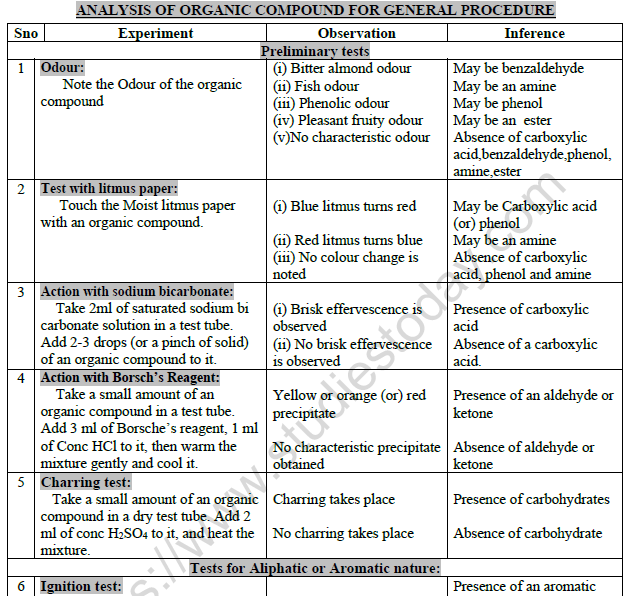
ANALYSIS OF ORGANIC COMPOUND FOR GENERAL PROCEDURE
Question 1. State the experimental procedure, observation, and inference for the preliminary odour test in the analysis of an organic compound. [1 Mark]
Answer:
| Experiment | Observation | Inference |
|---|---|---|
| Note the Odour of the organic compound | (i) Bitter almond odour (ii) Fish odour (iii) Phenolic odour (iv) Pleasant fruity odour (v) No characteristic odour | May be benzaldehyde May be an amine May be phenol May be an ester Absence of carboxylic acid, benzaldehyde, phenol, amine, ester |
Teacher's Note:
a) Odour gives a preliminary clue regarding the functional group present.
b) Phenolic and fruity odours point towards specific homologous series.
Question 2. Describe the litmus paper test used in the preliminary analysis of organic compounds. [1 Mark]
Answer:
| Experiment | Observation | Inference |
|---|---|---|
| Touch the Moist litmus paper with an organic compound. | (i) Blue litmus turns red (ii) Red litmus turns blue (iii) No colour change is noted | May be Carboxylic acid (or) phenol May be an amine Absence of carboxylic acid, phenol and amine |
Teacher's Note:
a) Moist litmus paper helps determine the acidic or basic nature of the organic compound.
b) Carboxylic acids and phenols show acidic character.
Question 3. Outline the sodium bicarbonate test for identifying carboxylic acids. [1 Mark]
Answer:
| Experiment | Observation | Inference |
|---|---|---|
| Take 2ml of saturated sodium bicarbonate solution in a test tube. Add 2-3 drops (or a pinch of solid) of an organic compound to it. | (i) Brisk effervescence is observed (ii) No brisk effervescence is observed | Presence of carboxylic acid Absence of a carboxylic acid. |
Teacher's Note:
a) Brisk effervescence is due to the evolution of carbon dioxide gas.
b) This test distinguishes carboxylic acids from phenols.
Question 4. Explain the action of Borsch's Reagent on an organic compound. [1 Mark]
Answer:
| Experiment | Observation | Inference |
|---|---|---|
| Take a small amount of an organic compound in a test tube. Add 3 ml of Borsche's reagent, 1 ml of Conc HCl to it, then warm the mixture gently and cool it. | Yellow or orange (or) red precipitate No characteristic precipitate obtained | Presence of an aldehyde or ketone Absence of aldehyde or ketone |
Teacher's Note:
a) Borsch's reagent is 2,4-dinitrophenylhydrazine (2,4-DNP).
b) Formation of a coloured precipitate confirms carbonyl compounds.
Question 5. Give the experimental details for the charring test. [1 Mark]
Answer:
| Experiment | Observation | Inference |
|---|---|---|
| Take a small amount of an organic compound in a dry test tube. Add 2 ml of conc H2SO4 to it, and heat the mixture. | Charring takes place No charring takes place | Presence of carbohydrates Absence of carbohydrate |
Teacher's Note:
a) Concentrated sulfuric acid acts as a dehydrating agent.
b) Charring indicates the elimination of water from carbohydrate molecules.
Question 6. How is the ignition test performed to distinguish between aliphatic and aromatic compounds? [1 Mark]
Answer:
| Experiment | Observation | Inference |
|---|---|---|
| Take small amount of the organic compound in a Nickel spatula and burn it in Bunsen flame. | Burns with sooty flame Burns with non sooty flame | Presence of an aromatic compound Presence of an aliphatic compound |
Teacher's Note:
a) High carbon percentage in aromatic rings causes incomplete combustion leading to soot.
b) Aliphatic compounds generally burn with a clean, non-sooty flame.
Question 7. Describe the test for unsaturation using bromine water. [1 Mark]
Answer:
| Experiment | Observation | Inference |
|---|---|---|
| Take small amount of the organic compound in a test tube add 2 ml of distilled water to dissolve it. To this solution add few drops of bromine water and shake it well. | (i) Orange Yellow Bromine water decolourised | Substance is Unsaturated. |
Teacher's Note:
a) Decolourisation confirms the addition of bromine across double or triple bonds.
b) This is a standard test for alkenes and alkynes.
8. Test with KMnO4 solution: [2 Marks]
Take small amount of organic compound in test tube add water to dissolve it and few drops of very dil KMnO4 solution and shaken well
| Observation | Inference |
|---|---|
| (ii) decolouration with formation of white precipitate | Presence of aromatic amines or phenol |
| (iii) No decolouration takes place | Substance is saturated |
Answer:
1. The KMnO4 test is used to detect unsaturation or specific functional groups like aromatic amines and phenols.
2. Decolouration with a white precipitate indicates aromatic amines or phenol, whereas no decolouration shows a saturated compound.
Teacher's Note:
a) Potassium permanganate is a strong oxidizing agent that gets reduced by unsaturated bonds and oxidizable functional groups.
b) Always use very dilute KMnO4 solution to clearly observe the colour change without masking the precipitate.
Test for selected organic functional group
Test for aldehydes:
1. TEST FOR ALDEHYDE
Tollen's reagent test: [2 Marks]
Take 2 ml of Tollen's regent in a clean dry test tube. Add 3-4 drops of an organic compound to it, and warm the mixture on a water bath for about 2 minutes.
| Observation | Inference |
|---|---|
| Shining silver is formed. | Presence of an aldehyde |
Answer:
1. Tollen's reagent is ammoniacal silver nitrate solution.
2. Formation of a shining silver mirror on the inner walls of the test tube confirms the presence of an aldehyde group.
Teacher's Note:
a) The test tube must be thoroughly cleaned with nitric acid and rinsed with distilled water to obtain a clear silver mirror.
b) Tollen's reagent should be freshly prepared to avoid the formation of explosive silver fulminate.
2. Fehling's test: [2 Marks]
Take 1 ml each of Fehling's solution A and B are taken in a test tube. Add 4-5 drops of an organic compound (or 0.5g of solid) to it, and warm the mixture on a water bath for about 5 minutes.
| Observation | Inference |
|---|---|
| Red precipitate is formed. | Presence of an aldehyde. |
Answer:
1. Fehling's solution A is aqueous copper sulphate and Fehling's solution B is alkaline sodium potassium tartrate.
2. A red precipitate of cuprous oxide is formed when warmed with an aliphatic aldehyde.
Teacher's Note:
a) Aromatic aldehydes generally do not respond to Fehling's test.
b) Equal volumes of solutions A and B must be mixed before adding to the organic compound.
3. TEST FOR PHENOL
Neutral FeCl3 test: [2 Marks]
Take 1 ml of FeCl3 solution in a dry test tube. Add 2 - 3 drops or pinch of organic compound to it. If no colouration occurs add 3-4 drops of alcohol
| Observation | Inference |
|---|---|
| Violet colouration is seen | Presence of phenol |
| Violet - Blue colouration is seen | Presence of \(\alpha\)-naphthol |
| Green colouration is seen | Presence of \(\beta\)-naphthol |
Answer:
1. Phenols react with neutral ferric chloride to form colored coordination complexes.
2. The specific characteristic color observed distinguishes between simple phenols and naphthols.
Teacher's Note:
a) The ferric chloride solution used must be neutral; acidic solutions suppress complex formation.
b) Alcohol is added as a cosolvent if the organic compound is insoluble directly in water.
4. TEST FOR CARBOXYLIC ACID
Esterification reaction: [2 Marks]
Take 1 ml or a pinch of an organic compound in a clean test tube. Add 1 ml of ethyl alcohol and 4 - 5 drops of Conc. H2SO4 to it.Heat the reaction mixture strongly about 5 minutes. Then pour the mixture in to beaker containing dil.Na2CO3 solution and note the smell.
| Observation | Inference |
|---|---|
| A pleasant fruity odour is noted. | Presence of carboxylic group |
Answer:
1. Carboxylic acids react with alcohols in the presence of concentrated sulphuric acid to form sweet-smelling esters.
2. The sodium carbonate solution neutralizes unreacted acid and makes the fruity smell of the ester more prominent.
Teacher's Note:
a) Concentrated H2SO4 acts as both a catalyst and a dehydrating agent.
b) Heating should be done gently or on a water bath to avoid vigorous spurting.
5. TEST FOR KETONE
Legal's test: [2 Marks]
A small amount of the organic substance is taken in a test tube. Add 1 ml of sodium nitro prusside solution and 1 ml of sodium hydroxide solution is added in dropwise.
| Observation | Inference |
|---|---|
| Red colouration. | Presence of ketone |
Answer:
1. Methyl ketones react with sodium nitroprusside in alkaline medium to give a red or blood-red coloration.
2. The appearance of red color confirms the presence of a ketonic group having an active methylene group.
Teacher's Note:
a) Sodium hydroxide must be added dropwise to maintain the appropriate alkalinity.
b) This test is specific for compounds containing a \(\text{-CH}_2\text{CO-}\) group.
6. TEST FOR AMINES: Dye test: Take A small amount of an organic substance in a clean test tube, add 2 ml of HCl to dissolve it. Add few crystals of NaNO2, and cool the mixture in ice bath then add 2 ml of ice cold solution of \(\beta\)-naphthol in NaOH [2 Marks]
Answer:
1. Observation: Scarlet red dye is obtained.
2. Inference: Presence of aromatic primary amine.
Teacher's Note:
a) Primary aromatic amines undergo diazotization with nitrous acid followed by coupling with \(\beta\)-naphthol.
b) Ensure the reaction mixture is maintained at ice-cold temperatures to prevent the decomposition of the diazonium salt.
7. TEST FOR DIAMIDE: Biuret test: Take a small amount of an organic compound in a test tube. Heat strongly and then allow to cool. Dissolve the residue with 2 ml of water. To this solution add 1 ml of dil. CuSO4 and few drops of 10% NaOH solution drop by drop [2 Marks]
Answer:
1. Observation: Violet colour is appeared.
2. Inference: Presence of a diamide.
Teacher's Note:
a) Urea and similar diamides on strong heating lose ammonia to form biuret.
b) Add copper sulfate carefully to avoid excess reagent masking the characteristic violet coordination complex.
8. TEST FOR CARBOHYDRATES: Molisch’s test: Take A small amount of an organic compound in a test tube. It is dissolved in 2 ml of water. Add 3-4 drops of \(\alpha\)-naphthol to it. Then add conc. H2SO4 in sides of the test tube [2 Marks]
Answer:
1. Observation: Violet or purple ring is formed at the junction of the two liquid.
2. Inference: Presence of carbohydrate.
Teacher's Note:
a) Concentrated sulfuric acid dehydrates carbohydrates to form furfural derivatives.
b) Pour sulfuric acid slowly down the side of the test tube to form a distinct layer without mixing.
9. OSAZONE TEST: Take A small amount of an organic compound in a test tube. Add 1 ml of phenylhydrazine solution and heat the mixture for about 5 minutes on boiling water bath [2 Marks]
Answer:
1. Observation: Yellow crystals are obtained.
2. Inference: Presence of carbohydrate.
Teacher's Note:
a) Reducing sugars react with excess phenylhydrazine to form characteristic osazone crystals.
b) Maintain a constant temperature using a boiling water bath for uniform crystal formation.
Report: Complete the given organic compound test report format [2 Marks]
The given organic compound contains ;
(i) Aromatic / Aliphatic
(ii) Unsaturated / Saturated
(iii) functional group
So, The given organic compound is ______ .
Answer:
1. The given organic compound contains specific structural features determined through systematic functional group analysis.
2. Fill in the blanks based on experimental results: (i) Aromatic or Aliphatic, (ii) Unsaturated or Saturated, (iii) specific functional group name, and conclude with the identified name of the compound.
Teacher's Note:
a) Summarizes the cumulative findings of preliminary and confirmatory tests.
b) Ensure all blanks match the observations recorded in the practical notebook.
Free study material for Chemistry
Free CBSE Study Guides: Class 12 Chemistry Organic Compound For General Procedure
Comprehensive Study Resources for Organic Compound For General Procedure
Explore essential learning tools for Class 12 Chemistry Organic Compound For General Procedure. This curated collection features in-depth notes and targeted practice questions built around the active 2026 curriculum to streamline your daily revision.
Understanding Marking Schemes
Each resource draws directly from authorized textbooks to maintain academic accuracy. Evaluating solved examples allows Class 12 students to master the formal presentation and answer-writing standards expected in upcoming school exams.
Complete Revision for Chemistry
Maximize your grade potential by utilizing Class 12 Chemistry practice papers in tandem with these structured notes. All printable assignments and interactive mock tests on our platform are updated for the 2026 session and available free of charge.
FAQs
Our advanced study package for Organic Compound For General Procedure includes detailed concepts, diagrams, Mind Maps, and explanation of complex topics to ensure Class 12 students learn as per syllabus for 2026 exams.
The Mind Maps provided for Organic Compound For General Procedure act as visual anchors which will help faster recall during high-pressure exams.
Yes, teachers use our Class 12 Chemistry resources for lesson planning as they are in simple language and have lot of solved examples.
Yes, You can download the complete, mobile-friendly PDF of the Chemistry Organic Compound For General Procedure advanced resources for free.
Yes, our subject matter experts have updated the Organic Compound For General Procedure material to align with the rationalized NCERT textbooks and have removed deleted topics and added new competency-based questions.