

Download CBSE Class 12 Chemistry Useful Resources
Explore structured advanced study materials through the CBSE Class 12 Chemistry Haloalkane Haloarenes Exam Notes. Tailored for Class 12 learners, utilizing these Chemistry resources ensures thorough preparation and strengthens foundational knowledge before final CBSE evaluations.
Access CBSE Study Guides and Summaries
Navigate directly to the advanced Chemistry study materials using the digital viewer below. Each resource pack includes detailed conceptual summaries and solved practice questions, allowing students to instantly reinforce their learning.
CBSE Class 12 Chemistry Haloalkane Haloarenes Exam Notes. Please refer to the examination notes which you can use for preparing and revising for exams. These notes will help you to revise the concepts quickly and get good marks.

Ans. (a) & (c) With four different alkyl group.
These Class 12 Chemistry exam notes on Chapter 4, Haloalkanes and Haloarenes, cover important reasoning questions, SN1 and SN2 mechanisms with a comparison table, the name reactions (Sandmeyer, Finkelstein, Swarts, Wurtz, Friedel-Crafts, Wurtz-Fittig and Fittig) and solved conversions with reagents and products.
Topics Covered
1. Reasonings
2. IUPAC naming
3. Mechanisms
4. Name reactions
5. Conversions
REASONINGS
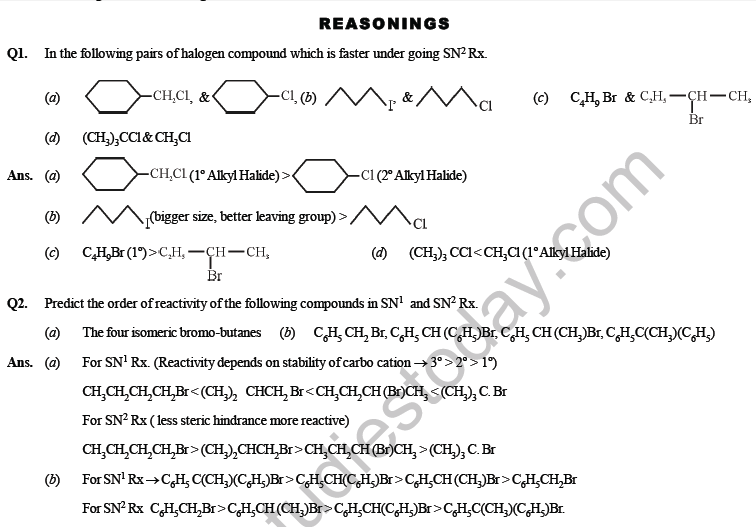
Q1. In the following pairs of halogen compounds, which undergoes the SN2 reaction faster?
(a) Cyclohexylmethyl chloride (C6H11CH2Cl) and chlorocyclohexane
(b) The iodo compound and the chloro compound of the same alkyl chain
(c) C4H9Br and C2H5CH(Br)CH3
(d) (CH3)3CCl and CH3Cl
[Figure: Structures for Q1(a) and (b) are skeletal drawings. In (a) a cyclohexane ring carries CH2Cl, and a second ring carries Cl directly. In (b) a zigzag carbon chain carries I, and a second zigzag chain carries Cl.]
Ans. (a) Cyclohexylmethyl chloride (1° alkyl halide) > chlorocyclohexane (2° alkyl halide)
(b) The iodo compound (bigger size, better leaving group) > the chloro compound
(c) C4H9Br (1°) > C2H5CH(Br)CH3
(d) (CH3)3CCl < CH3Cl (1° alkyl halide)
Q2. Predict the order of reactivity of the following compounds in SN1 and SN2 reactions.
(a) The four isomeric bromobutanes
(b) C6H5CH2Br, C6H5CH(C6H5)Br, C6H5CH(CH3)Br, C6H5C(CH3)(C6H5)Br
Ans. (a) For the SN1 reaction (reactivity depends on stability of the carbocation: 3° > 2° > 1°):
CH3CH2CH2CH2Br < (CH3)2CHCH2Br < CH3CH2CH(Br)CH3 < (CH3)3C-Br
For the SN2 reaction (less steric hindrance, more reactive):
CH3CH2CH2CH2Br > (CH3)2CHCH2Br > CH3CH2CH(Br)CH3 > (CH3)3C-Br
(b) For the SN1 reaction: C6H5C(CH3)(C6H5)Br > C6H5CH(C6H5)Br > C6H5CH(CH3)Br > C6H5CH2Br
For the SN2 reaction: C6H5CH2Br > C6H5CH(CH3)Br > C6H5CH(C6H5)Br > C6H5C(CH3)(C6H5)Br
Q3. Identify the chiral and achiral molecules in each of the following pairs.
(a) CH3-CH(OH)Br with H, CH3, OH and Br on the central carbon
(b) CH3-CBr2H with H, CH3, Br and Br on the central carbon
(c) CH3-CH(OH)-CH2-CH2-CH3 (OH on the second carbon)
(d) CH3CH2-CH(OH)-CH2CH3 (OH on the middle carbon)
Ans. (a) and (c) are chiral, because the carbon carries four different groups.
Q4. Although chlorine is an electron withdrawing group, it is ortho-para directing in electrophilic aromatic substitution reactions. Why?
Ans. Chlorine shows the -I effect, which destabilises the intermediate carbocation, but the +R effect of Cl stabilises the intermediate carbocation. The reactivity is controlled by the stronger -I effect, while the orientation is controlled by the weaker resonance effect.
Q5. Haloalkanes react with KCN to form RCN but with AgCN form RNC. Why?
Ans. CN is an ambident group (it can be attached from both ends). KCN is ionic, so the reaction occurs through carbon, since C-C bonds are stronger. AgCN is covalent, so only the nitrogen electron pair is available for bond formation.
Q6. RCl is hydrolysed to ROH slowly, but the reaction is rapid if a catalytic amount of KI is added to the reaction mixture. Why?
Ans. I- is a stronger nucleophile, so it replaces Cl to form RI. RI is then hydrolysed more readily to give ROH, because I- is a better leaving group than Cl-.
Q7. Haloalkanes give nucleophilic substitution while haloarenes give electrophilic substitution reactions.
Ans. Haloalkanes are more polar than haloarenes, so their carbon has more positive character and they give nucleophilic substitution. Haloarenes have a benzene ring which shows resonance, so they give electrophilic substitution due to the -I effect and +R effect.
Q8. Why is sulphuric acid not used during the reaction of alcohols with KI?
Ans. Sulphuric acid oxidises KI to I2.
Q9. Arrange on the basis of increasing boiling point.
(a) Bromomethane, bromoform, chloromethane, dibromomethane
(b) 1-Chloropropane, isopropyl chloride, 1-chlorobutane
Ans. (a) Chloromethane < bromomethane < dibromomethane < bromoform (boiling point increases with molecular weight)
(b) Isopropyl chloride (branched) < 1-chloropropane < 1-chlorobutane (more branching means less surface area and a lower boiling point)
Q10. Which of the following has the highest dipole moment: CH3Cl, CH2Cl2, CCl4?
[Figure: Three tetrahedral structures with bond dipole arrows pointing towards Cl: CH2Cl2 (two Cl, two H), CHCl3 (three Cl, one H) and CCl4 (four Cl), joined by greater than signs. The printed order is CH2Cl2 > CHCl3 > CCl4.]
Ans. The dipole moment decreases as the number of chlorine atoms increases, because the bond dipoles partly cancel: CH3Cl (1.87 D) > CH2Cl2 (1.60 D) > CHCl3 (1.04 D) > CCl4 (zero, symmetrical). Of the three compounds asked, CH3Cl has the highest dipole moment. The printed order CH2Cl2 > CHCl3 > CCl4 is correct for those three compounds.
Q11. The dipole moment of chlorobenzene is lower than that of cyclohexyl chloride.
Ans. The cyclohexyl group is an electron donating group, so it increases the electron density at the Cl atom and makes the bond more polar. In chlorobenzene the benzene ring acts as an electron withdrawing, resonating ring, so its dipole moment is lower.
Q12. Alkyl halides, though polar, are not soluble in water.
Ans. Alkyl halides cannot form hydrogen bonds with water molecules.
Q13. RMgX should be prepared under anhydrous conditions.
Ans. RMgX is very reactive and reacts with moisture present in the apparatus or in the starting material.
Q14. Out of C6H5CH2Cl and C6H5CHClC6H5, which is easily hydrolysed by aqueous KOH?
Ans. C6H5CHClC6H5 is a 2° alkyl halide and is more reactive under the SN1 reaction. Under the SN2 reaction the 1° alkyl halide (C6H5CH2Cl) is hydrolysed more easily.
Q15. p-Dichlorobenzene has a higher melting point and lower solubility than o-dichlorobenzene.
Ans. p-Dichlorobenzene has a symmetrical structure, so its melting point is high and its solubility is low.
Q16. Why is SOCl2 used for the preparation of alkyl halides from ROH?
Ans. On reaction between SOCl2 and ROH, we get RCl along with HCl(g) and SO2(g), which escape as gases, so the product is easily obtained pure.
Q17. Arrange the following in order of increasing ease of nucleophilic substitution reaction: 4-nitrochlorobenzene, chlorobenzene, 2,4,6-trinitrochlorobenzene, 2,4-dinitrochlorobenzene.
Ans. Chlorobenzene < 4-nitrochlorobenzene < 2,4-dinitrochlorobenzene < 2,4,6-trinitrochlorobenzene. Equivalently, 2,4,6-trinitrochlorobenzene > 2,4-dinitrochlorobenzene > 4-nitrochlorobenzene > chlorobenzene in ease of reaction.
Further questions listed in the handout:
- Among the aromatic compounds having molecular formula C7H7Cl, how many isomers are possible? Write structures and names.
- Identify all the possible monochloro structural isomers that would be expected to form on free radical chlorination of (CH3)2CHCH2CH3.
- Differentiate between (a) chiral and achiral, (b) retention and inversion.
Q18. What are enantiomers and a racemic mixture?
Q19. Allyl chloride is hydrolysed more readily than n-propyl chloride. Vinyl chloride is hydrolysed more slowly than ethyl chloride.
Q20. Explain: the reaction between an alkyl halide and aqueous KOH yields an alcohol, but with alcoholic KOH it yields alkenes.
Q21. Which one is the better nucleophile, Br- or I-?
Q22. Among the isomeric alkanes of molecular formula C5H12, identify the one that on photochemical chlorination yields (i) a single monochloride, (ii) three isomeric monochlorides, (iii) four isomeric monochlorides. Uses of freon 12, DDT, carbon tetrachloride and iodoform.
MECHANISMS
SN2 Mechanism:
-OH + CH3-Cl → [HO---CH3---Cl]- (transition state, the HO and Cl placed on opposite sides of carbon, with the three H atoms in one plane) → HO-CH3 + Cl-
[Figure: Hydroxide attacks the carbon of CH3Cl from the side opposite to Cl. The central transition state is shown in square brackets with dotted bonds from carbon to OH and to Cl, and the product CH3OH shows the three H atoms flipped over (inversion).]
SN1 Mechanism:
Step 1 (slow): (CH3)3CBr ⇌ (CH3)3C+ + Br-
Step 2 (fast): (CH3)3C+ + -OH → (CH3)3COH
COMPARISON OF SN2 AND SN1 REACTIONS
| Sr. No. | Factors | SN2 Reactions | SN1 Reactions |
|---|---|---|---|
| 1 | Number of steps | One: R:L + Nu → R:Nu + L | Two: 1. R:L → R+ + :L (slow); 2. R+ + Nu- → R:Nu (fast) |
| 2 | Reaction rate and order | Second order: Rate ∝ [Substrate][Nucleophile] or Rate = k2[RL][:Nu] | First order: Rate ∝ [Substrate] or Rate = k1[RL] |
| 3 | Molecularity | Bimolecular | Unimolecular |
| 4 | TS of slow step | :Nuδ- --- C --- Lδ- | :Nu --- Cδ+ --- Lδ- --- Nu: |
| 5 | Reacting nucleophile | The carbon of the substrate is attacked by the nucleophile, exclusively from the back side. | The nucleophile can attack the carbon of the substrate from both sides. However, the attack from the back side predominates. |
| 6 | Stereochemistry | Complete inversion of configuration takes place. | Inversion and retention take place. |
| 7 | Reactivity order of alkyl halides | Methyl > 1° > 2° > 3° halides. (I > Br > Cl > F) | 3° > 2° > 1° > methyl halides. (I > Br > Cl > F) |
| 8 | Rearrangement | No rearranged product is formed (except for allylic). | Rearranged products can be formed. |
| 9 | Nature of nucleophiles | Favoured by strong and high concentration of nucleophiles. | Favoured by mild and low concentration of nucleophiles. |
| 10 | Polarity | Favoured by solvents of low polarity. | Favoured by solvents of high polarity. |
| 11 | Reaction rate determining factor | By steric hindrance. | By electronic factor (stability of R+). |
| 12 | Catalysis | Not catalysed by any catalyst (phase transfer). | Catalysed by Lewis and Bronsted acids, e.g., aq. AlCl3, ZnCl2 and strong HA. |
MECHANISM OF THE REACTION nBuBr + KCN (EtOH-H2O) → nBuCN
K+CN- + CH3-CH2-CH2-CH2-Br → CH3-CH2-CH2-CH2-CN + KBr
(n-Butyl bromide gives n-Butyl cyanide)
[Figure: Curved arrow from the CN- ion to the carbon bearing Br (carrying δ+), and a second curved arrow from the C-Br bond to the Br atom (carrying δ-).]
NAME REACTIONS
1. Sandmeyer's Reaction:
Benzenediazonium halide (C6H5N2+X-) with Cu2X2 → halobenzene (C6H5X) + N2
2. Finkelstein Reaction:
RX + NaI → RI + NaX (solvent - acetone)
3. Swarts Reaction:
CH3Br + AgF → CH3F + AgBr
4. Wurtz Reaction:
RX + 2Na + RX → R-R + 2NaX
5. Friedel-Crafts Reaction:
Alkylation: chlorobenzene + CH3Cl with anhydrous AlCl3 → 1-chloro-2-methylbenzene (minor) + 1-chloro-4-methylbenzene (major)
Acylation: chlorobenzene + CH3COCl with anhydrous AlCl3 → 2-chloroacetophenone (minor) + 4-chloroacetophenone (major)
6. Wurtz-Fittig Reaction:
Aryl halide (C6H5X) + Na + RX, in ether → C6H5R + NaX
7. Fittig Reaction:
Aryl halide (C6H5X) + Na + RX (aryl halide), in ether → biphenyl + 2NaX
CONVERSIONS
Q1. Identify A, B, C, D, E, R and R1 in the following:
(i) Bromocyclohexane + Mg, dry ether → A; A with H2O → B
(ii) R-Br + Mg, dry ether → C; C with D2O → CH3CHDCH3
(iii) (CH3)3C-C(CH3)3 (2,2,3,3-tetramethylbutane) is obtained from R1-X with Na/ether; R1-X + Mg → D; D with H2O → E
Ans. (i) Bromocyclohexane + Mg (dry ether) → cyclohexylmagnesium bromide (A); on reaction with H2O this gives cyclohexane (B) + Mg(OH)Br.
(ii) Since D of D2O gets attached to the carbon atom to which MgBr is attached, C is CH3CH(MgBr)CH3 (isopropylmagnesium bromide). Therefore the compound R-Br is CH3CHBrCH3 (2-bromopropane).
CH3CHBrCH3 + Mg (dry ether) → CH3CH(MgBr)CH3 (C); with D2O → CH3CHDCH3
(iii) The halide R1-X is (CH3)3C-X (tert-butyl halide). Therefore compound D is (CH3)3C-MgBr (tert-butylmagnesium bromide), and E is (CH3)3CH (isobutane).
Q2. How will you bring about the following conversions?
(i) Ethanol to but-1-yne
(ii) Ethane to bromoethene
(iii) Propene to 1-nitropropane
(iv) Toluene to benzyl alcohol
(v) Propene to propyne
(vi) Ethanol to ethyl fluoride
(vii) Bromomethane to propanone
(viii) But-1-ene to but-2-ene
(ix) 1-Chlorobutane to n-octane
(x) Benzene to biphenyl
Ans. (i) CH3CH2OH (ethanol) → CH3CH2Cl (chloroethane) + SO2 + HCl, using SOCl2, pyridine
HC≡CH + NaNH2 → HC≡C-Na+ (liq. NH3)
CH3CH2-Cl + HC≡C-Na+ → CH3CH2C≡CH (but-1-yne) + NaCl
(ii) CH3-CH3 (ethane) → CH3-CH2Br (bromoethane) + HBr, using Br2/UV light or heat
CH3CH2Br → CH2=CH2 + HBr, using KOH (alc.), heat
CH2=CH2 → BrCH2-CH2Br (vic-dibromide), using Br2/CCl4
BrCH2-CH2Br → CH2=CHBr (bromoethene), using KOH (alc.), heat
(iii) CH3-CH=CH2 (propene) + HBr, peroxide → CH3-CH2-CH2Br (1-bromopropane)
CH3CH2CH2Br + AgNO2 → AgBr + CH3-CH2-CH2NO2 (1-nitropropane)
(iv) Do yourself.
(v) CH3-CH=CH2 (propene) → CH3-CHBr-CH2Br (1,2-dibromopropane), using Br2/CCl4
CH3-CHBr-CH2Br → CH3-C≡CH (propyne), using NaNH2, liq. NH3
(vi) CH3-CH2-OH (ethanol) → CH3-CH2-Cl (chloroethane), using PCl5 (by-products POCl3 and HCl)
CH3-CH2-Cl + AgF → CH3-CH2-F (ethyl fluoride)
(vii) CH3-Br (bromomethane) + KCN (alc.) → CH3-CN (acetonitrile)
CH3-CN + CH3MgBr → (CH3)2C=NMgBr
(CH3)2C=NMgBr, on hydrolysis with H3O+ → CH3-CO-CH3 (propanone)
(viii) CH3CH2CH=CH2 (but-1-ene) + HBr (Markovnikov addition) → CH3CH2CHBrCH3 (2-bromobutane)
2-Bromobutane, with KOH (alc.), heat (loss of HBr) → CH3CH=CHCH3 (but-2-ene)
(ix) 2CH3CH2CH2CH2-Cl (1-chlorobutane) + 2Na, dry ether → CH3CH2CH2CH2CH2CH2CH2CH3 (n-octane) + 2NaCl
(x) Benzene → bromobenzene, using Br2/Fe, dark
Bromobenzene + 2Na, dry ether → diphenyl (biphenyl) + 2NaBr
Important reactions
1. CH3CH2CH2Cl (1-chloropropane) + NaI, acetone, heat (Finkelstein reaction) → CH3CH2CH2I (1-iodopropane) + NaCl
2. (CH3)3CBr (2-bromo-2-methylpropane) + KOH, ethanol, heat (dehydrohalogenation) → CH3-C(CH3)=CH2 (2-methylpropene) + KBr + H2O
3. CH3CH(Br)CH2CH3 (2-bromobutane) + NaOH, water → CH3CH(OH)CH2CH3 (butan-2-ol) + NaBr
4. CH3CH2Br (bromoethane) + KCN, aq. ethanol (nucleophilic substitution) → CH3CH2CN (propanenitrile) + KBr
5. C6H5ONa (sodium phenoxide) + C2H5Cl (chloroethane), Williamson synthesis → C6H5-O-C2H5 (phenetole) + NaCl
6. CH3CH2CH2OH (1-propanol) + SOCl2 → CH3CH2CH2Cl (1-chloropropane) + SO2 + HCl
7. CH3CH2CH=CH2 (but-1-ene) + HBr, peroxide (anti-Markovnikov addition) → CH3CH2CH2CH2-Br (1-bromobutane)
8. CH3CH=C(CH3)2 (2-methylbut-2-ene) + HBr (Markovnikov addition) → CH3-CH2-C(Br)(CH3)-CH3 (2-bromo-2-methylbutane)
Q3. How can the following conversions be carried out?
(i) Propene to propan-1-ol
(ii) Ethanol to but-1-yne
(iii) 1-Bromopropane to 2-bromopropane
(iv) Toluene to benzyl alcohol
(v) Benzene to 4-bromonitrobenzene
(vi) Benzyl alcohol to 2-phenylethanoic acid
(vii) Ethanol to propanenitrile
(viii) Aniline to chlorobenzene
(ix) 2-Chlorobutane to 3,4-dimethylhexane
(x) 2-Methyl-1-propene to 2-chloro-2-methylpropane
(xi) Ethyl chloride to propanoic acid
(xii) But-1-ene to n-butyl iodide
(xiii) 2-Chloropropane to 1-propanol
(xiv) Isopropyl alcohol to iodoform
(xv) Chlorobenzene to p-nitrophenol
(xvi) 2-Bromopropane to 1-bromopropane
(xvii) Chloroethane to butane
(xviii) Benzene to diphenyl
(xix) tert-Butyl bromide to isobutyl bromide
(xx) Aniline to phenyl isocyanide
Ans. (i) CH3-CH=CH2 (propene) + HBr/peroxide (anti-Markovnikov addition) → CH3-CH2-CH2-Br (1-bromopropane); then aq. KOH/heat (nucleophilic substitution) → CH3-CH2-CH2-OH (propan-1-ol)
(ii) CH3CH2OH (ethanol) → CH3CH2Br (ethyl bromide), using red P/Br2
CH3CH2Br + Mg/ether → CH3CH2MgBr (ethylmagnesium bromide)
CH3CH2MgBr + ethylene oxide (H2C-CH2 with O bridge), ether (Grignard reaction) → [CH3CH2CH2CH2OMgBr] (addition product); with H+/H2O → CH3CH2CH2CH2OH (1-butanol)
1-Butanol + red P/I2 → CH3CH2CH2CH2-I (iodobutane)
Iodobutane + KOH (alc.)/heat (dehydrohalogenation) → CH3CH2CH=CH2 (but-1-ene)
But-1-ene + Br2/CCl4 (electrophilic addition) → CH3CH2CHBr-CH2Br (1,2-dibromobutane)
1,2-Dibromobutane + NaNH2, liq. NH3, 196 K (dehydrohalogenation) → CH3CH2C≡CH (but-1-yne)
(iii) CH3-CH2-CH2-Br (1-bromopropane) + KOH (alc.)/heat (dehydrohalogenation) → CH3-CH=CH2 (propene); then HBr (Markovnikov addition) → CH3-CHBr-CH3 (2-bromopropane)
(iv) Toluene + Cl2/UV light or heat → C6H5CH2Cl (benzyl chloride); then aq. KOH/heat (nucleophilic substitution) → C6H5CH2OH (benzyl alcohol)
(v) Benzene + Br2/FeBr3, dark → bromobenzene; then HNO3/H2SO4 (nitration) → 4-bromonitrobenzene
(vi) Benzyl alcohol + PCl5 (-POCl3, -HCl) → C6H5CH2Cl; then KCN, aq. ethanol (-KCl) → C6H5CH2CN (benzyl cyanide); then H+/H2O (hydrolysis) → C6H5CH2COOH (2-phenylethanoic acid)
(vii) CH3-CH2-OH (ethanol) + red P/Br2 → CH3-CH2-Br (bromoethane); then KCN, aq. ethanol → CH3-CH2-CN (propanenitrile)
(viii) Aniline + NaNO2 + 2HCl, 273-278 K (-NaCl, -2H2O) → benzenediazonium chloride (C6H5N2+Cl-); then Cu2Cl2 → chlorobenzene + N2
(ix) 2CH3-CHCl-CH2-CH3 (2-chlorobutane) + 2Na/dry ether (Wurtz reaction) → CH3-CH2-CH(CH3)-CH(CH3)-CH2-CH3 (3,4-dimethylhexane) + 2NaCl
(x) CH3-C(CH3)=CH2 (2-methylpropene) + HCl (Markovnikov addition) → (CH3)3C-Cl (2-chloro-2-methylpropane)
(xi) CH3-CH2-Cl (ethyl chloride) + KCN, aq. ethanol (nucleophilic substitution) → CH3-CH2-CN (propanenitrile) + KCl; then H+/H2O (hydrolysis) → CH3-CH2-COOH (propanoic acid)
(xii) CH3-CH2-CH=CH2 (but-1-ene) + HBr/peroxide (anti-Markovnikov addition) → CH3-CH2-CH2-CH2-Br (1-bromobutane); then NaI, dry acetone (Finkelstein reaction) → CH3-CH2-CH2-CH2-I (n-butyl iodide)
(xiii) CH3-CHCl-CH3 (2-chloropropane) + KOH (alc.)/heat (dehydrohalogenation) → CH3-CH=CH2 (propene) + HCl; then HBr/peroxide (anti-Markovnikov addition) → CH3-CH2-CH2-Br (1-bromopropane); then aq. KOH/heat (nucleophilic substitution) → CH3-CH2-CH2-OH (1-propanol)
(xiv) CH3-CH(OH)-CH3 (isopropyl alcohol) + CrO3 (oxidation) → CH3-CO-CH3 (propanone); then NaOI (iodoform reaction) → CH3COONa + CHI3 (iodoform)
(xv) Chlorobenzene + HNO3/H2SO4 (nitration) → p-chloronitrobenzene (major product) + m-chloronitrobenzene + o-chloronitrobenzene. Note: p-nitrophenol is obtained from p-chloronitrobenzene by heating with aqueous NaOH at 443 K followed by acidification.
(xvi) CH3-CHBr-CH3 (2-bromopropane) + KOH (alc.)/heat (dehydrohalogenation) → CH3-CH=CH2 (propene) + HBr; then HBr/peroxides (anti-Markovnikov addition) → CH3-CH2-CH2-Br (1-bromopropane)
(xvii) 2CH3-CH2-Cl (chloroethane) + 2Na/dry ether (Wurtz reaction) → CH3-CH2-CH2-CH3 (butane) + 2NaCl
(xviii) Benzene + Br2/FeBr3 → bromobenzene; then 2Na/dry ether (Fittig reaction) → biphenyl + 2NaBr
(xix) (CH3)3C-Br (tert-butyl bromide) + KOH (alc.)/heat (dehydrohalogenation) → CH3-C(CH3)=CH2 (2-methylpropene); then HBr/peroxide (anti-Markovnikov addition) → (CH3)2CH-CH2-Br (isobutyl bromide)
(xx) Aniline + CHCl3 + 3KOH, heat (carbylamine reaction) → C6H5NC (phenyl isocyanide) + 3KCl + 3H2O
Q4. Primary alkyl halide C4H9Br (a) reacted with alcoholic KOH to give compound (b). Compound (b) is reacted with HBr to give (c) which is an isomer of (a). When (a) is reacted with sodium metal it gives compound (d), C8H18, which is different from the compound formed when n-butyl bromide is reacted with sodium. Give the structural formula of (a) and write the equations for all the reactions.
Ans. 2CH3CH2CH2CH2Br (n-butyl bromide) + 2Na/dry ether (Wurtz reaction) → CH3CH2CH2CH2CH2CH2CH2CH3 (n-octane) + 2NaBr
2(CH3)2CHCH2Br (isobutyl bromide, a) + 2Na/dry ether (Wurtz reaction) → (CH3)2CHCH2CH2CH(CH3)2 (2,5-dimethylhexane, d) + 2NaBr
(CH3)2CHCH2Br (a) + alcoholic KOH → CH3-C(CH3)=CH2 (2-methylpropene, b)
CH3-C(CH3)=CH2 (b) + HBr (Markovnikov addition) → (CH3)3C-Br (2-bromo-2-methylpropane, c, an isomer of a)
Free study material for Chemistry
CBSE Class 12 Chemistry Study Material: Unit 6 Haloalkanes and Haloarenes
Quick Revision Material for Unit 6 Haloalkanes and Haloarenes
Review targeted study resources for Unit 6 Haloalkanes and Haloarenes tailored for Class 12 learners. Utilizing these structured notes and quick-revision tools ensures complete alignment with current CBSE evaluation standards.
Expert Notes and Solved Exam Questions
Designed around the official curriculum, these study guides guarantee standard compliance. Reviewing step-by-step solutions clarifies complex sub-topics within Unit 6 Haloalkanes and Haloarenes and demystifies standard marking schemes for Chemistry evaluations.
Additional Study Resources for Class 12
Maximize your grade potential by utilizing Class 12 Chemistry practice papers in tandem with these structured notes. All printable assignments and interactive mock tests on our platform are updated for the 2026 session and available free of charge.
FAQs
Our advanced study package for Unit 6 Haloalkanes and Haloarenes includes detailed concepts, diagrams, Mind Maps, and explanation of complex topics to ensure Class 12 students learn as per syllabus for 2026 exams.
The Mind Maps provided for Unit 6 Haloalkanes and Haloarenes act as visual anchors which will help faster recall during high-pressure exams.
Yes, teachers use our Class 12 Chemistry resources for lesson planning as they are in simple language and have lot of solved examples.
Yes, You can download the complete, mobile-friendly PDF of the Chemistry Unit 6 Haloalkanes and Haloarenes advanced resources for free.
Yes, our subject matter experts have updated the Unit 6 Haloalkanes and Haloarenes material to align with the rationalized NCERT textbooks and have removed deleted topics and added new competency-based questions.