
NEET Biology Sexual Reproduction in Flowering Plants Notes

NEET Biology Study Guide: NEET Biology Sexual Reproduction in Flowering Plants Notes

Review targeted academic resources with the NEET Biology Sexual Reproduction in Flowering Plants Notes. Built according to official NEET standards for the 2026-27 term, these downloadable NEET Biology study materials support effective daily practice and deeper conceptual understanding for Sexual Reproduction in Flowering Plants.

Download Sexual Reproduction in Flowering Plants Study Material PDF

Access the complete useful resource PDF for NEET Biology below. Regular practice with these targeted academic notes builds familiarity with complex topics and helps secure higher marks in final school evaluations.
• Sexual reproduction in flowering plants involves transformation of diploid sporophytic cells into haploid gametophytic cells by meiosis and subsequent fusion of haploid gametes of opposite sex to form diploid zygote. The zygote then develops into an embryo which ultimately forms a diploid plant body. In fl owering plants, all these steps of sexual reproduction occur within specialized reproductive organs, called the fl owers.
•  Sexual reproduction in plants includes microsporogenesis, megasporogenesis, pollination, fertilization, embryogenesis and seed formation.
 
FLOWER
 
•  Flowers are the most fascinating organs in plants found only in angiosperms i.e., plants in which seeds are enclosed within fruit.
•  Flowers and their parts are responsible for sexual reproduction in angiosperms and all flower bearing plants reproduce sexually.
•  The colour, fragrance, modifi cation in shape of fl ower ensure its sexual reproduction.
•  Fruits and seeds are the end products of sexual reproduction.
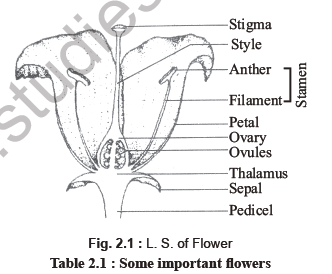
•  Flowers are highly modifi ed shoots, bearing nodes and modifi ed fl oral leaves, which are meant essentially for sexual reproduction in plant. The fl ower is commonly borne on short or long stalk called the pedicel, it has upper swollen region known as receptacle or thalamus or torus.
•  Flowers, usually have four different kinds of fl oral members arranged in four whorls (i.e., calyx, corolla, androecium and gynoecium). attached on the receptacle. Of these, the two lower whorls (i.e., calyx and corolla) are sterile and considered as non-essential, accessory or helping whorls. The two upper whorls (i.e., androecium and gynoecium) are fertile and considered as essential or reproductive whorls.
 
(i) Callyx – It consists of number of green leafy sepals. It is the outermost whorl.
Calyx protects all the inner fl oral whorls in the bud condition and it synthesizes the food of the plant body when green in colour.
 
(ii) Corrolllla – It consists of a number of usually bright coloured petals and is the second whorl in the flower.
 
(iii) Androecium – This is the male whorl and consists of stamens and each stamen can be regarded as modifi ed leaf (microsporophyll) that consists of fi lament and anther.The anther may contains two-four microsporangia that produce a large number of pollen grains.
 
(iv) Gynoecium or Pistil – It is present in the centre of the fl ower and is the female reproductive whorl. Its unit is called carpel. Each carpel is made up of ‘3’ parts — ovary, style and stigma. Ovary is the swollen basal part of the carpel that encloses ovules and each ovule encloses embryo sac containing egg. Stigma is the receptive part of carpel whereas style is the tubular structure that joins stigma & ovary.
Thus, androecium & gynoecium are the two innermost whorl of fl ower in which sexual reproduction take place. Anther bears spores in sporangia and ovary contains ovules which bear embryo-sac with egg.
 
 
NEET Biology Sexual Reproduction in flowering plants Notes


Useful Resources and Notes for NEET Biology Sexual Reproduction in Flowering Plants

Essential Notes for NEET Biology

Review targeted study resources for Sexual Reproduction in Flowering Plants tailored for NEET learners. Utilizing these structured notes and quick-revision tools ensures complete alignment with current NEET evaluation standards.

Verified Solutions for NEET Biology

Each resource draws directly from authorized textbooks to maintain academic accuracy. Evaluating solved examples allows NEET students to master the formal presentation and answer-writing standards expected in upcoming school exams.

Enhance Accuracy with Online Tests

For peak performance in upcoming evaluations, integrate official Biology sample papers directly into your study schedule. Follow up your revision by attempting online MCQ tests for Sexual Reproduction in Flowering Plants to refine calculation speed and precision.

FAQs

What is included in the advanced study material for NEET Biology Sexual Reproduction in Flowering Plants?

Our advanced study package for Sexual Reproduction in Flowering Plants includes detailed concepts, diagrams, Mind Maps, and explanation of complex topics to ensure NEET students learn as per syllabus for 2026 exams.

How do Mind Maps for Biology Sexual Reproduction in Flowering Plants help in revision?

The Mind Maps provided for Sexual Reproduction in Flowering Plants act as visual anchors which will help faster recall during high-pressure exams.

Are these Biology resources suitable for both classroom teaching and self-study?

Yes, teachers use our NEET Biology resources for lesson planning as they are in simple language and have lot of solved examples.

Is this advanced study material for Sexual Reproduction in Flowering Plants free to download in PDF?

Yes, You can download the complete, mobile-friendly PDF of the Biology Sexual Reproduction in Flowering Plants advanced resources for free.

Does this material cover rationalized content for the 2026-27 NEET session?

Yes, our subject matter experts have updated the Sexual Reproduction in Flowering Plants material to align with the rationalized NCERT textbooks and have removed deleted topics and added new competency-based questions.