
NEET Biology Breathing and Exchange of Gases Notes

NEET Biology Study Guide: NEET Biology Breathing and Exchange of Gases Notes

Explore structured advanced study materials through the NEET Biology Breathing and Exchange of Gases Notes. Tailored for NEET learners, utilizing these Biology resources ensures thorough preparation and strengthens foundational knowledge before final NEET evaluations.

Download Breathing and Exchange of Gases Study Material PDF

Navigate directly to the advanced Biology study materials using the digital viewer below. Each resource pack includes detailed conceptual summaries and solved practice questions, allowing students to instantly reinforce their learning.
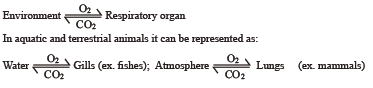
Respiration is a physiochemical process involving exchange of gases and oxidation of food material to release energy.
It is a catabolic process and includes two parts:
 
1. External Respiration:
 
It includes intake of oxygen and removal of carbon-di-oxide from the body. It is also known as ventilation or breathing.
 
NEET Biology Breathing and Exchange of Gases Notes
 
2. Internal Respiration:
 
It includes gaseous exchange between the cells and fl uid medium and utilization of oxygen, and production of carbon-di-oxide, by the cells.
 
Survey of respiratory structures in animals
 
• In Protozoans, Porifers, Coelenterates and Helminthes there are no specialized respiratory structures, and exchange of gases occurs through general body surface.
• In Annelids respiration is either cutaneous (ex. Earthworm and Nereis) or branchial.
• In Arthropods there are various type of respiratory structures like Gills (in crustaceans), book lungs (in arachnids) and tracheal tubes (in insects). In Prawn, the gills (8 pairs) are of 3 types : (i) Podobranchs-1 pair; (ii) Arthrobranch-2 pairs (iii) Pleurobranch-5 pairs. All the gills are  hyllobranch type. In Cockroach there are three pairs of longitudinal tracheal tubes. Each lateral tube contains 10 spiracles (Total spiracles = 10 pairs).
• In Molluscs the respiratory structure are mainly Gills.
• In Echinoderms the gills, body wall, respiratory tree and Tubee ffeeeett (primarily the locomotory structures) are the respiratory structures.
• In Protochordates and Cyclostomes the respiratory structures are Gills.
• In Fishes the Gills are the main respiratory structures but in lung fi shes (Dipnoi) the Gills and Lungs both are well developed.
• In Amphibians the respiratory structures are either Gills (Branchial respiration) or Lungs (Pulmonary respiration). In Frog the respiration is Cutaneous, Bucco-pharyngeal as well as Pulmonary.
• In Reptiles birds and mammals the respiration is Pulmonary.
 
RESPIRATORY SYSTEM IN HUMAN
 
In human the respiratory structures are Lungs which are endodermal in origin. The respiratory system contains following important components:
 
Nasal passage
 
• It contains hair for fi ltering out dust particles.
• Bowman’s glands secrete mucus.
• Turbinals (bones) warm up the air.
• The sensory lining of nasal passage is called Schneiderian membrane.
 
Pharynx
 
• It is a common passage for gut and respiratory tract.
• The openings of internal nostrils in pharynx are called Choane.
• The opening between Pharynx and Larynx is called Glottis. It is closed by epiglottis during swallowing of food. However, the opening between Pharynx and Gut (Oesophagus) is different, and is called Gullet.
• The lateral sides of Pharynx contain openings of Eustachian canals also.
 

NEET NEET Biology Study Material: Breathing and Exchange of Gases

Quick Revision Material for Breathing and Exchange of Gases

Review targeted study resources for Breathing and Exchange of Gases tailored for NEET learners. Utilizing these structured notes and quick-revision tools ensures complete alignment with current NEET evaluation standards.

Expert Notes and Solved Exam Questions

Designed around the official curriculum, these study guides guarantee standard compliance. Reviewing step-by-step solutions clarifies complex sub-topics within Breathing and Exchange of Gases and demystifies standard marking schemes for Biology evaluations.

Additional Study Resources for NEET

For peak performance in upcoming evaluations, integrate official Biology sample papers directly into your study schedule. Follow up your revision by attempting online MCQ tests for Breathing and Exchange of Gases to refine calculation speed and precision.

FAQs

What is included in the advanced study material for NEET Biology Breathing and Exchange of Gases?

Our advanced study package for Breathing and Exchange of Gases includes detailed concepts, diagrams, Mind Maps, and explanation of complex topics to ensure NEET students learn as per syllabus for 2026 exams.

How do Mind Maps for Biology Breathing and Exchange of Gases help in revision?

The Mind Maps provided for Breathing and Exchange of Gases act as visual anchors which will help faster recall during high-pressure exams.

Are these Biology resources suitable for both classroom teaching and self-study?

Yes, teachers use our NEET Biology resources for lesson planning as they are in simple language and have lot of solved examples.

Is this advanced study material for Breathing and Exchange of Gases free to download in PDF?

Yes, You can download the complete, mobile-friendly PDF of the Biology Breathing and Exchange of Gases advanced resources for free.

Does this material cover rationalized content for the 2026-27 NEET session?

Yes, our subject matter experts have updated the Breathing and Exchange of Gases material to align with the rationalized NCERT textbooks and have removed deleted topics and added new competency-based questions.