

Official NEET Study Materials for NEET Biology
Review targeted academic resources with the NEET Biology Cellular Respiration Concept Map. Built according to official NEET standards for the 2026-27 term, these downloadable NEET Biology study materials support effective daily practice and deeper conceptual understanding for Cellular Respiration.
Advanced Resources for Biology
Navigate directly to the advanced Biology study materials using the digital viewer below. Each resource pack includes detailed conceptual summaries and solved practice questions, allowing students to instantly reinforce their learning.
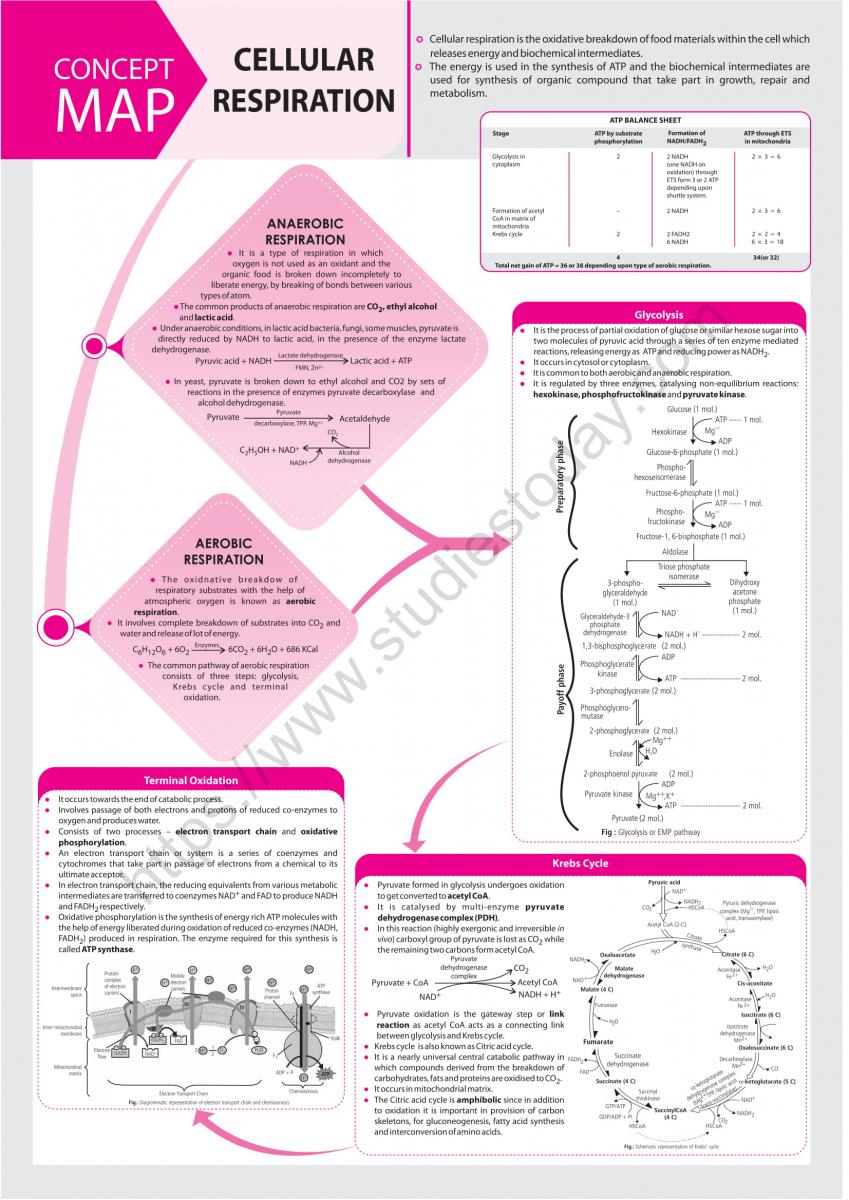
Cellular Respiration Concept Map (text version)
Cellular respiration is the oxidative breakdown of food materials within the cell which releases energy and biochemical intermediates. The energy is used in the synthesis of ATP and the biochemical intermediates are used for synthesis of organic compound that take part in growth, repair and metabolism.
Anaerobic Respiration
It is a type of respiration in which oxygen is not used as an oxidant and the organic food is broken down incompletely to liberate energy, by breaking of bonds between various types of atom. The common products of anaerobic respiration are CO2, ethyl alcohol and lactic acid.
Under anaerobic conditions, in lactic acid bacteria, fungi, some muscles, pyruvate is directly reduced by NADH to lactic acid, in the presence of the enzyme lactate dehydrogenase.
Pyruvic acid + NADH → Lactic acid + ATP (enzyme: lactate dehydrogenase; cofactors: FMN, Zn2+)
In yeast, pyruvate is broken down to ethyl alcohol and CO2 by sets of reactions in the presence of enzymes pyruvate decarboxylase and alcohol dehydrogenase.
Pyruvate → Acetaldehyde + CO2 (enzyme: pyruvate decarboxylase; cofactors: TPP, Mg2+)
Acetaldehyde + NADH → C2H5OH + NAD+ (enzyme: alcohol dehydrogenase)
Aerobic Respiration
The oxidative breakdown of respiratory substrates with the help of atmospheric oxygen is known as aerobic respiration. It involves complete breakdown of substrates into CO2 and water and release of lot of energy.
C6H12O6 + 6O2 → 6CO2 + 6H2O + 686 KCal (enzymes)
The common pathway of aerobic respiration consists of three steps: glycolysis, Krebs cycle and terminal oxidation.
ATP Balance Sheet
| Stage | ATP by substrate phosphorylation | Formation of NADH/FADH2 | ATP through ETS in mitochondria |
|---|---|---|---|
| Glycolysis in cytoplasm | 2 | 2 NADH (one NADH on oxidation) through ETS form 3 or 2 ATP depending upon shuttle system. | 2 × 3 = 6 |
| Formation of acetyl CoA in matrix of mitochondria | – | 2 NADH | 2 × 3 = 6 |
| Krebs cycle | 2 | 2 FADH2 6 NADH | 2 × 2 = 4 6 × 3 = 18 |
| Total | 4 | 34 (or 32) |
Total net gain of ATP = 36 or 38 depending upon type of aerobic respiration.
Glycolysis
It is the process of partial oxidation of glucose or similar hexose sugar into two molecules of pyruvic acid through a series of ten enzyme mediated reactions, releasing energy as ATP and reducing power as NADH2. It occurs in cytosol or cytoplasm. It is common to both aerobic and anaerobic respiration. It is regulated by three enzymes, catalysing non-equilibrium reactions: hexokinase, phosphofructokinase and pyruvate kinase.
Preparatory phase
- Glucose (1 mol.) → Glucose-6-phosphate (1 mol.): enzyme hexokinase, Mg++; ATP (1 mol.) is used and ADP is formed.
- Glucose-6-phosphate → Fructose-6-phosphate (1 mol.): enzyme phosphohexoseisomerase.
- Fructose-6-phosphate → Fructose-1, 6-bisphosphate (1 mol.): enzyme phosphofructokinase, Mg++; ATP (1 mol.) is used and ADP is formed.
- Fructose-1, 6-bisphosphate → (enzyme aldolase) 3-phosphoglyceraldehyde (1 mol.) + Dihydroxy acetone phosphate (1 mol.); the two are interconverted by triose phosphate isomerase.
Payoff phase
- 3-phosphoglyceraldehyde (1 mol.) → 1,3-bisphosphoglycerate (2 mol.): enzyme glyceraldehyde-3-phosphate dehydrogenase; NAD+ is reduced to NADH + H+ (2 mol.).
- 1,3-bisphosphoglycerate → 3-phosphoglycerate (2 mol.): enzyme phosphoglycerate kinase; ADP → ATP (2 mol.).
- 3-phosphoglycerate → 2-phosphoglycerate (2 mol.): enzyme phosphoglyceromutase.
- 2-phosphoglycerate → 2-phosphoenol pyruvate (2 mol.): enzyme enolase, Mg++; H2O is removed.
- 2-phosphoenol pyruvate → Pyruvate (2 mol.): enzyme pyruvate kinase, Mg++, K+; ADP → ATP (2 mol.).
Fig: Glycolysis or EMP pathway
Terminal Oxidation
It occurs towards the end of catabolic process. Involves passage of both electrons and protons of reduced co-enzymes to oxygen and produces water. Consists of two processes - electron transport chain and oxidative phosphorylation.
An electron transport chain or system is a series of coenzymes and cytochromes that take part in passage of electrons from a chemical to its ultimate acceptor. In electron transport chain, the reducing equivalents from various metabolic intermediates are transferred to coenzymes NAD+ and FAD to produce NADH and FADH2 respectively.
Oxidative phosphorylation is the synthesis of energy rich ATP molecules with the help of energy liberated during oxidation of reduced co-enzymes (NADH, FADH2) produced in respiration. The enzyme required for this synthesis is called ATP synthase.
Fig: Diagrammatic representation of electron transport chain and chemiosmosis (protein complexes of electron carriers, mobile electron carriers, proton channel, ATP synthase, intermembrane space, inner mitochondrial membrane, mitochondrial matrix).
Krebs Cycle
Pyruvate formed in glycolysis undergoes oxidation to get converted to acetyl CoA. It is catalysed by multi-enzyme pyruvate dehydrogenase complex (PDH). In this reaction (highly exergonic and irreversible in vivo) carboxyl group of pyruvate is lost as CO2 while the remaining two carbons form acetyl CoA.
Pyruvate + CoA + NAD+ → Acetyl CoA + NADH + H+ (pyruvate dehydrogenase complex)
Pyruvate oxidation is the gateway step or link reaction as acetyl CoA acts as a connecting link between glycolysis and Krebs cycle. Krebs cycle is also known as Citric acid cycle. It is a nearly universal central catabolic pathway in which compounds derived from the breakdown of carbohydrates, fats and proteins are oxidised to CO2. It occurs in mitochondrial matrix. The Citric acid cycle is amphibolic since in addition to oxidation it is important in provision of carbon skeletons, for gluconeogenesis, fatty acid synthesis and interconversion of amino acids.
Steps of the cycle: Acetyl CoA (2-C) + Oxaloacetate (4 C) → Citrate (6 C) (citrate synthase) → Cis-aconitate (aconitase) → Isocitrate (6 C) → Oxalosuccinate (6 C) (isocitrate dehydrogenase, Mn2+; NAD+ → NADH) → α-ketoglutarate (5 C) (decarboxylase; CO2 released) → Succinyl CoA (4 C) (α-ketoglutarate dehydrogenase complex; NAD+ → NADH, CO2 released) → Succinate (4 C) (succinyl thiokinase; GDP + Pi → GTP/ATP) → Fumarate (succinate dehydrogenase; FAD → FADH2) → Malate (4 C) (fumarase; H2O added) → Oxaloacetate (malate dehydrogenase; NAD+ → NADH).
Fig: Schematic representation of Krebs' cycle
Biology NEET Exam Resources: Cellular Respiration
Core Study Kit: NEET Biology Cellular Respiration
Explore essential learning tools for NEET Biology Cellular Respiration. This curated collection features in-depth notes and targeted practice questions built around the active 2026 curriculum to streamline your daily revision.
NCERT-Aligned Solutions for Cellular Respiration
Built using official NCERT guidelines for NEET Biology, these materials provide reliable academic support. Integrating past examination questions and step-by-step solutions helps students understand official NEET grading criteria.
Next Steps in Your Exam Preparation
For peak performance in upcoming evaluations, integrate official Biology sample papers directly into your study schedule. Follow up your revision by attempting online MCQ tests for Cellular Respiration to refine calculation speed and precision.
FAQs
Our advanced study package for Cellular Respiration includes detailed concepts, diagrams, Mind Maps, and explanation of complex topics to ensure NEET students learn as per syllabus for 2026 exams.
The Mind Maps provided for Cellular Respiration act as visual anchors which will help faster recall during high-pressure exams.
Yes, teachers use our NEET Biology resources for lesson planning as they are in simple language and have lot of solved examples.
Yes, You can download the complete, mobile-friendly PDF of the Biology Cellular Respiration advanced resources for free.
Yes, our subject matter experts have updated the Cellular Respiration material to align with the rationalized NCERT textbooks and have removed deleted topics and added new competency-based questions.