

Official NEET Study Materials for NEET Biology
Review targeted academic resources with the NEET Biology Reproduction in Organism Notes. Built according to official NEET standards for the 2026-27 term, these downloadable NEET Biology study materials support effective daily practice and deeper conceptual understanding for Reproduction in Organism.
Advanced Resources for Biology
Access the complete useful resource PDF for NEET Biology below. Regular practice with these targeted academic notes builds familiarity with complex topics and helps secure higher marks in final school evaluations.
Reproduction in Organisms is Chapter 1 of Class 12 Biology, and these NEET and board exam notes cover asexual reproduction in plants and animals, sexual reproduction, pre-fertilization, fertilization and post-fertilization events, with life span and chromosome number tables and a Check Point section.
Terms and Definitions
1. Agamospermy - formation of embryos and seeds by asexual methods without meiosis and sexual fusion of gametes
2. Diplospory - embryo formed from a diploid megaspore mother cell
3. Apospory - embryo sac formed from a diploid unicellular mother cell
4. Apogamy - development of a sporophyte from a haploid gametophyte without gametic fusion
5. Mitospores - accessory spores taking part in asexual reproduction
6. Propagules - detached plant parts that develop into new individuals
Important Points to Remember
1. Approximate life span of some organisms
2. Difference between asexual and sexual reproduction
3. Chromosome numbers in meiocytes and gametes
Basics of Reproduction
Reproduction is the process by which all living organisms give rise to new organisms similar to themselves. It is essential for the survival of the species since all living beings have a similar life span.
All organisms are alike because they:
• are made up of cells.
• respond to external stimuli.
• have various mechanisms for maintaining homeostasis.
• have heritable genetic material.
• take birth, grow, reproduce and die after completing their life span.
The period from birth to death is known as life span. The life span of organisms varies from one organism to another.
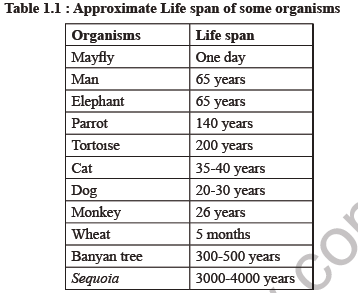
Table 1.1: Approximate Life span of some organisms
| Organisms | Life span |
|---|---|
| Mayfly | One day |
| Man | 65 years |
| Elephant | 65 years |
| Parrot | 140 years |
| Tortoise | 200 years |
| Cat | 35-40 years |
| Dog | 20-30 years |
| Monkey | 26 years |
| Wheat | 5 months |
| Banyan tree | 300-500 years |
| Sequoia | 3000-4000 years |
Connecting Concepts
• Maximum life span - the maximum number of years survived or the greatest age reached by any member of a species.
• Average life span - the average number of years survived or age reached by members of a population.
• Life expectancy - the age at which half the population still survives. Maximum life span is a characteristic of the species, and life expectancy is a characteristic of the population.
Reproduction ensures the continuity of the species, generation after generation. Genetic variation is created and inherited during reproduction.
Four basic processes of reproduction are DNA replication, cell division, formation of reproductive units and development of new individuals.
Living organisms reproduce by two different modes of reproduction:
(i) Asexual reproduction
(ii) Sexual reproduction
The rate of reproduction is faster in asexual reproduction. In lower organisms, reproduction occurs commonly by fission and budding, whereas in higher organisms reproduction occurs with the help of well developed sex organs.
Table 1.2: Difference between asexual and sexual reproduction
| Asexual reproduction | Sexual reproduction |
|---|---|
| 1. It occurs only in invertebrates and lower chordates. | It occurs almost in all types of animals. |
| 2. It is always uniparental. | It is usually biparental. |
| 3. Gametes are not formed. | Two types of gametes are formed. |
| 4. It involves only mitosis. | It involves both meiosis and mitosis. |
| 5. Daughter organisms are genetically identical to the parent. | Daughter organisms genetically differ from their parents. |
| 6. Since there is no variation, it does not contribute to evolution of the species. | Because of variations, it contributes to the evolution of species. |
| 7. Occurs by fission, budding or fragmentation. | Occurs by the formation of haploid gametes which fuse to form a diploid zygote. |
| 8. It is a quick method of multiplication. | It is a slower method of multiplication. |
ASEXUAL REPRODUCTION
Asexual reproduction is a type of process in which new organisms are produced without the formation and fusion of gametes. In this case, all the genes and genetic contents are received by the offspring from one parent through mitotic cell division. Offsprings are genetically and morphologically identical to the parents and are termed clones.
Random mutation is the source of genetic variation in this type of reproduction.
Asexual reproduction occurs most commonly in unicellular organisms, in plants and in certain animals that have relatively simple organisations.
In plants, asexual reproduction is of three types: agamospermy, spore formation and vegetative reproduction. In animals, it is of the following types: fission, budding, fragmentation and cysts and spores.
Asexual Reproduction in Plants
Agamospermy
Agamospermy is a kind of plant apomixis in which the embryos and seeds are formed by asexual reproductive methods without involving meiotic gametogenesis and sexual fusion of gametes. It occurs widely in ferns and the flowering plants.
Agamospermy is of three types: recurrent apomixis, adventitive embryony and non-recurrent agamospermy.
Flow Chart 1.1: Types of Agamospermy
Agamospermy (3 types)
1. Recurrent apomixis (two types: Diplospory and Apospory)
Diplospory: diploid megaspore mother cell gives a diploid (2n) embryo sac with a diploid egg cell, which grows into a diploid embryo. Eg. Apple, Allium
Apospory: diploid unicellular mother cell gives rise to the embryo.
2. Adventitive embryony: embryo formed directly from the diploid sporophytic cells (nucellus or integument) of the ovule, but never from the egg. Eg. Citrus, Opuntia. In Citrus, a seed may possess up to 40 embryos (one normal and the rest adventive).
3. Non-recurrent apomixis: embryo developed parthenogenetically from haploid egg, synergid or antipodal cells. Two types:
Apospory: aposporous gametophyte is generally diploid. It leads to polyploidy, hence new species in pteridophytes and bryophytes. Gametophyte gives rise to sporophyte.
Apogamy: no gametic fusion involved. Such sporophytes are not viable if produced from haploid gametophytes. Sporophyte gives rise to gametophyte.
Spore Formation
Fungi and simple plants such as algae reproduce through spores. Spores after a certain time give rise to young ones. In different organisms, the spores are of different kinds: zoospores, sporangiospores, chlamydospores, conidia, etc., e.g., Phytophthora, Rhizopus.
Spores taking part in asexual reproduction are called accessory spores or mitospores.
[Figure: Fig. 1.1 Asexual reproductive structures. (a) Zoospores of Chlamydomonas, shown as small motile cells with flagella. (b) Conidia of Penicillium, shown as a branched conidiophore with the conidia labelled.]
Vegetative Propagation or Reproduction
Regeneration or formation of a new individual from any vegetative part of the body is called vegetative reproduction or vegetative propagation. The lower plants reproduce vegetatively through budding, fission, fragmentation, gemmae, resting buds, spores, etc.
Since the formation of these structures does not involve two parents, the process is asexual.
Importance of vegetative propagation:
• Growing of some seedless fruit plants, e.g., banana, rose, grapes, orange, etc.
• It is the only means to produce genetically identical offsprings and preserve a stock of desired variety.
• It is an easier, less expensive and rapid method of propagation.
• Superior quality flowers and fruits can be produced by the method of grafting.
• It also helps in removing common infections from the plant (parent).
It is a very common mode of reproduction and it may be natural vegetative propagation or artificial vegetative propagation.
I. Natural Methods of Vegetative Propagation
In natural methods of propagation, a portion of the plant gets detached from the body of the mother plant. The detached portion may be a part of stem, leaf, root etc., which develops into a new independent plant under suitable environmental conditions. These structures are called vegetative propagules.
(i) Vegetative propagation by stems
The modified stems like bulbs, runners, rhizomes, corms, tubers, offsets, etc., help the plant to multiply under favourable conditions.
Underground stem:
• Suckers - Chrysanthemum
• Rhizomes - Ginger, Banana
• Bulbs - Onion
• Tubers - Potato
Creeping stems:
• Runners - Cynodon, Oxalis
• Stolons - Fragaria
• Offset - Pistia
• Aerial stem - Opuntia
(ii) Vegetative propagation by roots
The roots of some woody plants produce shoots which grow into new plants, e.g., Murraya, Lebbeck tree (Albizzia), Sissoo (Dalbergia sissoo) etc. Modified tuberous roots of sweet potato, asparagus, dahlia, tapioca, Tinospora etc. develop buds and each of them forms a new plant.
(iii) Vegetative propagation by leaves
The leaves generally do not help in vegetative propagation. However, in Bryophyllum pinnatum and B. daigremontianum, buds develop along the leaf margins which, on detachment, produce independent plants. In elephant ear plant (Begonia), leaf buds are produced from the petiole and veins throughout the surface of the leaf. Walking fern propagates through leaf tips.
(iv) Vegetative propagation by reproductive parts
Flowers are primarily associated with sexual reproduction. But in Globba, American aloe (Agave), onion (Allium cepa), etc., special multicellular structures called bulbils occur on the stem. These are modifications of axillary buds. Bulbils grow into new plants when shed from the mother plant.
[Figure: Fig. 1.2 Vegetative propagules in angiosperms. (a) Runner of Oxalis, with nodes, internodes, leaves and adventitious roots. (b) Rhizome of Ginger, with buds and adventitious roots. (c) Tuber of Potato, with eyes (buds) and adventitious buds. (d) Offset of Pistia, with leaves, adventitious roots and root pocket. (e) Buds of Bryophyllum leaf, with plantlets along the margin. (f) Bulb of Onion, with fleshy leaf bases and reduced stem. (g) Bulbil of Agave.]
II. Artificial Methods of Vegetative Propagation
Several methods of vegetative propagation are man made and developed by plant growers and horticulturists for commercial production of crops. They are called artificial methods. In this method a portion is separated from the body of the plant and then grown independently.
The various modes of artificial vegetative reproduction are cutting, layering, grafting and micropropagation.
(i) Cutting
• The small piece of any plant (stem, root or leaf) used for propagation is called a cutting.
• Leaf cuttings are used to propagate Sansevieria, Begonia, Bryophyllum, Gloxinia and Kalanchoe.
• Root cuttings are used to propagate citron and tamarind.
• Stem cuttings are most commonly used for artificial propagation. Cuttings (about 20-30 cm long pieces of stem) put into moist soil develop adventitious roots and buds at the base, which develop into new plants.
• Grapes, sugarcane, rose, bougainvillea, carnation, coleus, duranta, etc. are propagated by stem cuttings.
• The favourable time for planting cuttings is the spring.
(ii) Layering
• It differs from cutting in that the development of adventitious roots is induced before the plant part is detached from the parent plant.
• Layering can be of different types: mound layering and air layering.
• In mound layering, the lower branch of the stem is bent and covered in such a way that the tip of the branch remains above the ground. After a few days, the covered part of the stem produces adventitious roots. At this stage the branch is cut off from the parent plant and grows into a new plant. This method is commonly employed for propagating strawberry, jasmine, grapevine, raspberry, etc.
• Air layering (gootee) is employed in plants with thick branches which cannot be easily bent. In this method, part of the stem is girdled (a ring of bark is removed) or slit at an upward angle. This part is covered with moist moss or cotton and enclosed in a polythene bag to prevent drying. The wrapped portion is called gootee. The roots appear after some time and at that stage the branch is cut and planted. It grows into a new individual.
• This method is used in vegetative propagation of litchi, pomegranate, orange, lemon, guava, bougainvillea, etc.
(iii) Grafting
• A new variety produced by joining parts of two different plants is called grafting. The rooted shoot of one plant, called the stock, is joined with a piece of shoot of another plant known as the scion. The root stock is generally derived from a plant resistant to diseases and efficient in water and mineral absorption. The scion is a stem cutting from a superior quality plant.
• The grafting ends of both stock and scion are cut obliquely and placed over one another so that the cambia of the two come in close contact. The two pieces are firmly held together by tape, rubber tubing, etc. This results in fusion of cambia and formation of new vascular tissue.
• Grafting is generally done between related varieties or species. This method has been practised for many economically useful plants, such as rose, mango, apple, pear, guava, citrus, rubber, etc.
• There are various methods of grafting, like tongue or whip grafting, wedge grafting and crown grafting. Besides these, a technique called bud grafting uses only a single bud along with a small portion of bark having intact cambium instead of a scion.
• Bud grafting is widely practised in roses, plums, apple, etc.
(iv) Micropropagation
• It is the raising of new plants with the help of tissue culture technique.
• Small pieces of plant organs or tissues are grown aseptically in a suitable nutrient medium. Initially it results in the formation of an undifferentiated mass of cells called callus, which later differentiates to produce a large number of plantlets. These plantlets are then transferred to separate pots or nursery beds to obtain a large number of plants.
• Tissue culture is useful in obtaining virus free plants, homozygous diploids and in commercial micropropagation of orchids, carnation, gladiolus, chrysanthemum and other ornamental plants. This method is also employed for quick multiplication of plants.
Asexual Reproduction in Animals
Fission
Fission is the commonest and simplest method of reproduction. In fission, the body of an individual divides to produce two or more equal sized daughters.
Fission is of two types: binary fission and multiple fission.
Binary fission is one of the most common modes of asexual reproduction in which the parent cell divides into two small and approximately equal sized individuals, e.g., bacteria, Amoeba.
Modes of binary fission are:
• Simple binary fission (e.g., Amoeba)
• Longitudinal binary fission (e.g., Euglena)
• Transverse binary fission (e.g., Paramecium)
• Oblique binary fission (e.g., Ceratium)
[Figure: Fig. 1.3 Binary fission in Amoeba, showing a constriction in the parent cell, the daughter cells and the parent cell.]
Multiple fission: In this division, the parent cell divides into many small daughter individuals simultaneously, e.g., Plasmodium, Amoeba etc. It occurs during unfavourable conditions.
[Figure: Fig. 1.4 Multiple fission in Plasmodium, showing the parent cell enclosed in a cyst, the protoplast dividing and the daughter cells.]
Budding
Budding is an unequal division of the parent where the identity of the parent body is still maintained. It is in contrast to binary fission, where the parent body divides equally into two and no identity of the parent is left.
Budding is the formation of a multicellular or unicellular outgrowth (called a bud) on or inside the parental body. A bud formed inside the body is called a gemmule or statoblast, and a bud formed on the external surface is called an exogenous bud (e.g., Hydra).
Budding is found in sponges, annelids, coelenterates (Hydra), (Syllis) and tunicates (Salpa) among animals, and among fungi it is seen in yeast.
[Figure: Fig. 1.5 Budding in yeast, showing the parent cell, the dividing nucleus, the enlarging bud and the nucleus of the bud.]
[Figure: Fig. 1.6 Gemmules in sponge.]
Fragmentation
In fragmentation the body may break into two or more fragments and each fragment develops into a complete individual, e.g., Spirogyra.
It is found in some flatworms (Microstomum), and in sea anemones among coelenterates and echinoderms.
Cyst and Spores
Cysts and spores are minute propagules which function as sporulation as well as penetrating structures.
In sporulation, which occurs in many protozoa and bacteria, asexual reproduction occurs by the division of the nucleus into several daughter nuclei, and then each daughter nucleus gets enclosed by a small amount of cytoplasm to form a spore.
SEXUAL REPRODUCTION
Sexual reproduction involves the fusion of male and female gametes by the process of fertilization. It results in offspring that are not identical to the parents or to each other.
When male and female gametes are produced from male and female parents respectively, it is called unisexual reproduction, e.g., man, cow, etc.
When both male and female gametes are produced from the same individual, it is called bisexual reproduction, e.g., earthworm, tapeworm.
Phases in an Organism's Life
There are three phases in an organism's life: juvenile phase, reproductive phase and old phase.
• Juvenile phase or vegetative phase: All organisms have to reach a certain phase of growth and maturity before they can reproduce sexually. This growth period is known as the juvenile phase or vegetative phase (in plants). Its duration varies in different organisms.
• Reproductive phase: When the organism starts reproducing in its life cycle, this is known as the reproductive phase.
• Some plants flower seasonally whereas others flower throughout the year.
• Plants like biennials and annuals show clear cut vegetative, reproductive and senescent phases, but in perennial species it is very difficult to define these phases.
• Bamboo species flower only once in their lifetime, generally after 50-100 years, produce a large number of fruits and die. Another plant, Strobilanthus kunthiana (neela kurinji), flowers once in 12 years. This plant flowered during Sept.-Oct.
• In animals, the juvenile phase is followed by morphological and physiological changes prior to active reproductive behaviour.
• Among animals, birds living in nature lay eggs seasonally, whereas birds in captivity lay eggs throughout the year.
• Placental females show changes in ovaries, accessory reproductive ducts and hormones during the reproductive phase.
• Oestrus cycle is the term for cyclical changes during the reproductive phase in non-primate mammals like cows, sheep, deer, dogs, tigers, etc. Such changes in primates are called the menstrual cycle, as in humans, apes and monkeys.
• Senescence or old phase: In this phase, there is progressive deterioration in the body and rate of metabolism that ultimately leads to death.
In flowering plants, sperms are produced inside the germinating pollen grains of anthers, whereas the egg is produced inside an embryo sac in the ovule.
Events in sexual reproduction can be grouped into three distinct stages:
(i) Pre-fertilization events
(ii) Fertilization
(iii) Post-fertilization events
PRE-FERTILIZATION EVENTS
The events before the fusion of gametes are known as pre-fertilization events. The main pre-fertilization events are gametogenesis and gamete transfer.
Gametogenesis
The process of formation of two types of gametes is known as gametogenesis. Gametes (male or female) are haploid cells.
In some algae, the two gametes are similar in appearance and are called homogametes or isogametes.
In the majority of sexually reproducing organisms, gametes are different from each other and are called heterogametes. In a heterogametic organism, the male gamete is called an antherozoid or sperm and the female gamete is called an egg or ovum.
Sperm and egg cells are gametes or sex cells containing only one set of chromosomes (haploid). Gametes are produced through meiotic division.
Homothallic and monoecious terms are used to denote the bisexual or hermaphrodite condition, and heterothallic and dioecious terms are used to describe the unisexual condition.
In flowering plants, the unisexual male flower is staminate (bearing stamens) while the female is pistillate (bearing pistils). In some flowering plants, both male and female flowers may be present on the same individual (monoecious) or on separate individuals (dioecious). Cucurbits and coconuts are bisexual plants, whereas papaya and date palm are unisexual plants.
Earthworm, sponge, tapeworm and leech bear both male and female reproductive organs and are called hermaphrodite or bisexual animals, while cockroach is a unisexual animal.
In diploid organisms, specialized cells called meiocytes (gamete mother cells) undergo meiosis. After meiosis, only one set of chromosomes goes into each gamete.
[Figure: Fig. 1.7 Diversity of sexuality in organisms. (a) Bisexual animal, Earthworm, with clitellum. (b) Unisexual animal, Cockroach. (c) Monoecious plant, Chara, with antheridium (male sex organ) and oogonium (female sex organ). (d) Dioecious plant, Marchantia, with antheridiophore (male thallus) and archegoniophore (female thallus). (e) Bisexual flower, sweet potato, with stamen and carpel.]
Table 1.3: Chromosome numbers in meiocytes (diploid, 2n) and gametes (haploid, n) of some organisms
| Name of organism | Chromosome numbers in meiocytes (2n) | Chromosome numbers in gametes (n) |
|---|---|---|
| Ophioglossum (a fern) | 1260 | 630 |
| Apple | 34 | 17 |
| Rice | 24 | 12 |
| Maize | 20 | 10 |
| Potato | 48 | 24 |
| Onion | 32 | 16 |
| Human beings | 46 | 23 |
| House fly | 12 | 6 |
| Rat | 42 | 21 |
| Dog | 78 | 39 |
| Cat | 38 | 19 |
| Fruit fly | 8 | 4 |
Gamete Transfer
Once the male and female gametes are formed inside the gametangia, they are brought into contact with each other to facilitate their fusion (syngamy or fertilization).
In most cases, the male gamete is motile (algae, bryophytes and pteridophytes) and the female gamete is stationary, except in a few fungi and algae in which both types of gametes are motile.
The transfer of gametes takes place through different media like water, air, etc. During their transfer, a large number of male gametes fail to reach the female gametes. To compensate for this loss, male gametes are produced in much larger numbers than female gametes.
In seed plants, pollen grains are the carriers of male gametes and the ovule has the egg or female gamete. Pollen grains produced in the anthers are transferred to the stigma by a process known as pollination.
Pollination is of two types: self pollination and cross pollination.
• Self pollination is the transfer of pollen grains from anther to stigma within the same flower, e.g., pea.
• Cross pollination is the transfer of pollen grains from the anthers of one flower to the stigma of a flower of a different plant, through the agency of air, water or animals, particularly insects.
In dioecious animals, since male and female gametes are formed in different individuals, the organisms must evolve a special mechanism for gamete transfer.
FERTILIZATION
Fertilization is the complete and permanent fusion of two gametes from different or the same parent to form a diploid zygote. This process is also called syngamy and is the most vital event of sexual reproduction.
The terms syngamy and fertilization are frequently used interchangeably.
In animals, male gametes are transferred to female gametes by three distinct patterns, depending on whether fertilization and embryonic development occur within or outside the maternal body:
(i) External fertilization and external development
(ii) Internal fertilization and external development
(iii) Internal fertilization and internal development
External fertilization and external development
• Parents release sperms and eggs into the surrounding water, where fertilization takes place and zygotes develop into offspring, e.g., Obelia, Nereis, Labeo and frog.
• Here the physical contact between the parents may or may not occur.
Internal fertilization and external development
• Sperms are passed from the male into the female with an intromittent organ. Animals with this type of fertilization usually produce fewer zygotes because of the protection provided by egg shells, e.g., shark, lizard, birds, etc.
Internal fertilization and internal development
• Fertilization and the development of the embryo take place internally, e.g., mammals.
• In some organisms the female gamete develops into a new organism without fertilization. This process is known as parthenogenesis, e.g., rotifers, honeybees and some lizards.
• Parthenogenesis is of two types: natural and artificial. Natural parthenogenesis is a regular phenomenon in the life history of some animals. Artificial parthenogenesis is the production of a complete individual without fertilization.
Syngamy is the fusion of two entire gametes to form a zygote, including the fusion of nuclei, while fertilization includes all the associated events that ultimately lead to syngamy.
On the basis of the source of fusion of gametes, syngamy is of two types: endogamy and exogamy.
(i) Endogamy: fusion of two gametes of the same parent, which is self-fertilization, e.g., Taenia.
(ii) Exogamy: fusion of gametes produced from different parents, which is cross-fertilization, e.g., frog, humans.
On the basis of the structure of the fusing gametes, syngamy is of two types: isogamy and anisogamy.
(i) Isogamy: the fusing gametes are similar morphologically but behaviourally different, e.g., Monocystis.
(ii) Anisogamy (heterogamy): the gametes differ in form, size, structure and behaviour, e.g., frogs and humans.
POST-FERTILIZATION EVENTS
The events after the formation of the zygote are known as post-fertilization events.
Two haploid gametes fuse to form a diploid zygote (2n). The zygote is the vital link that ensures continuity of species between organisms of one generation and the next.
After the formation of the zygote, it develops into an embryo, and this process is known as embryogenesis. During embryogenesis, a new individual forms by the process of cell division and differentiation.
On the basis of the development of the zygote, animals are of two types: oviparous and viviparous.
• Oviparous animals lay fertilized or unfertilized eggs in a safe place in the environment. These eggs are covered by a hard calcareous shell. After the incubation period, the young ones hatch out from the eggs, e.g., reptiles and birds.
• Viviparous animals give birth to young ones, e.g., the majority of mammals, including humans.
In flowering plants, the zygote is formed inside the ovule of the ovary. The ovary develops into a fruit, which develops a thick wall called pericarp. Under favourable conditions, seeds germinate to produce new plants.
[Figure: Fig. 1.8 A few kinds of fruit showing seeds (S) and the protective pericarp (P).]
CHECK POINT (Chapter 1: Reproduction in Organisms)
Check Point (Page 6)
1. Match the following:
Column I: A. Suckers, B. Zoospore, C. Bulbils, D. Chlamydospores
Column II: 1. Rhizopus, 2. Ulothrix, 3. Agave, 4. Mint
Answer: A - 4 (Mint), B - 2 (Ulothrix), C - 3 (Agave), D - 1 (Rhizopus)
2. Give two examples of vegetative propagation by roots and stems.
Answer:
Roots: Sweet potato and dahlia
Stems: Ginger (rhizome) and potato (tuber)
3. Air layering is used in the vegetative propagation of litchi, lemon etc. (True or False).
Answer: True
4. Buds present in individual notches along the margin of a potato leaf are capable of forming new plants. (True or False, if false correct the statement).
Answer: False. The buds along the leaf margin that form new plants are found in Bryophyllum leaves, not in potato leaves.
5. ................. is a highly reduced stem represented by a small disc like structure upon which numerous fleshy scale leaves are borne (which store food material).
Answer: Bulb
Check Point (Page 6, True or False)
1. State True or False:
(i) Gemmule is a reproductive structure in sponges.
(ii) In adverse environmental conditions, an Hydra withdraws its pseudopodia and secretes a three layered hard covering or cyst around itself.
(iii) To begin with a small outgrowth of the parent's body develops into a miniature individual is called fragmentation.
(iv) Multiple fission is the commonest and simplest method of reproduction.
(v) In longitudinal binary fission, the plane of cytoplasmic division coincides with the longitudinal axis of the individual as in Euglena and Vorticella.
Answer:
(i) True
(ii) False. Amoeba, not Hydra, withdraws its pseudopodia and secretes a three layered cyst in adverse conditions.
(iii) False. This is budding, not fragmentation.
(iv) False. Binary fission is the commonest and simplest method of reproduction.
(v) True
Check Point (Page 11)
1. Which of the following parts in flowering parts are diploid? Anther, Pollen, Male gamete, Ovary, Egg.
Answer: Anther and Ovary. Pollen, male gamete and egg are haploid.
2. Give an example of a plant which flowers once in a 12 years.
Answer: Strobilanthus kunthiana (neela kurinji)
3. Fill in the blanks:
(i) Flowering plants in which male and female structures are found on the same plant are called .................... .
(ii) ..................... is a form of animal sexual reproduction in which a sperm cell is united with an egg cell outside the body of the female species.
Answer:
(i) Monoecious
(ii) External fertilization
4. Fusion of two gametes dissimilar in size as in some species of Chlamydomonas is called anisogamous. (True or False)
Answer: True
Biology NEET Exam Resources: Reproduction in Organism
Essential Notes for NEET Biology
Review targeted study resources for Reproduction in Organism tailored for NEET learners. Utilizing these structured notes and quick-revision tools ensures complete alignment with current NEET evaluation standards.
Verified Solutions for NEET Biology
Designed around the official curriculum, these study guides guarantee standard compliance. Reviewing step-by-step solutions clarifies complex sub-topics within Reproduction in Organism and demystifies standard marking schemes for Biology evaluations.
Enhance Accuracy with Online Tests
Maximize your grade potential by utilizing NEET Biology practice papers in tandem with these structured notes. All printable assignments and interactive mock tests on our platform are updated for the 2026 session and available free of charge.
FAQs
Our advanced study package for Reproduction in Organism includes detailed concepts, diagrams, Mind Maps, and explanation of complex topics to ensure NEET students learn as per syllabus for 2026 exams.
The Mind Maps provided for Reproduction in Organism act as visual anchors which will help faster recall during high-pressure exams.
Yes, teachers use our NEET Biology resources for lesson planning as they are in simple language and have lot of solved examples.
Yes, You can download the complete, mobile-friendly PDF of the Biology Reproduction in Organism advanced resources for free.
Yes, our subject matter experts have updated the Reproduction in Organism material to align with the rationalized NCERT textbooks and have removed deleted topics and added new competency-based questions.