

Official NEET Study Materials for NEET Biology
Explore structured advanced study materials through the NEET Biology Human Digestive System Concept Map. Tailored for NEET learners, utilizing these Biology resources ensures thorough preparation and strengthens foundational knowledge before final NEET evaluations.
Advanced Resources for Biology
Navigate directly to the advanced Biology study materials using the digital viewer below. Each resource pack includes detailed conceptual summaries and solved practice questions, allowing students to instantly reinforce their learning.
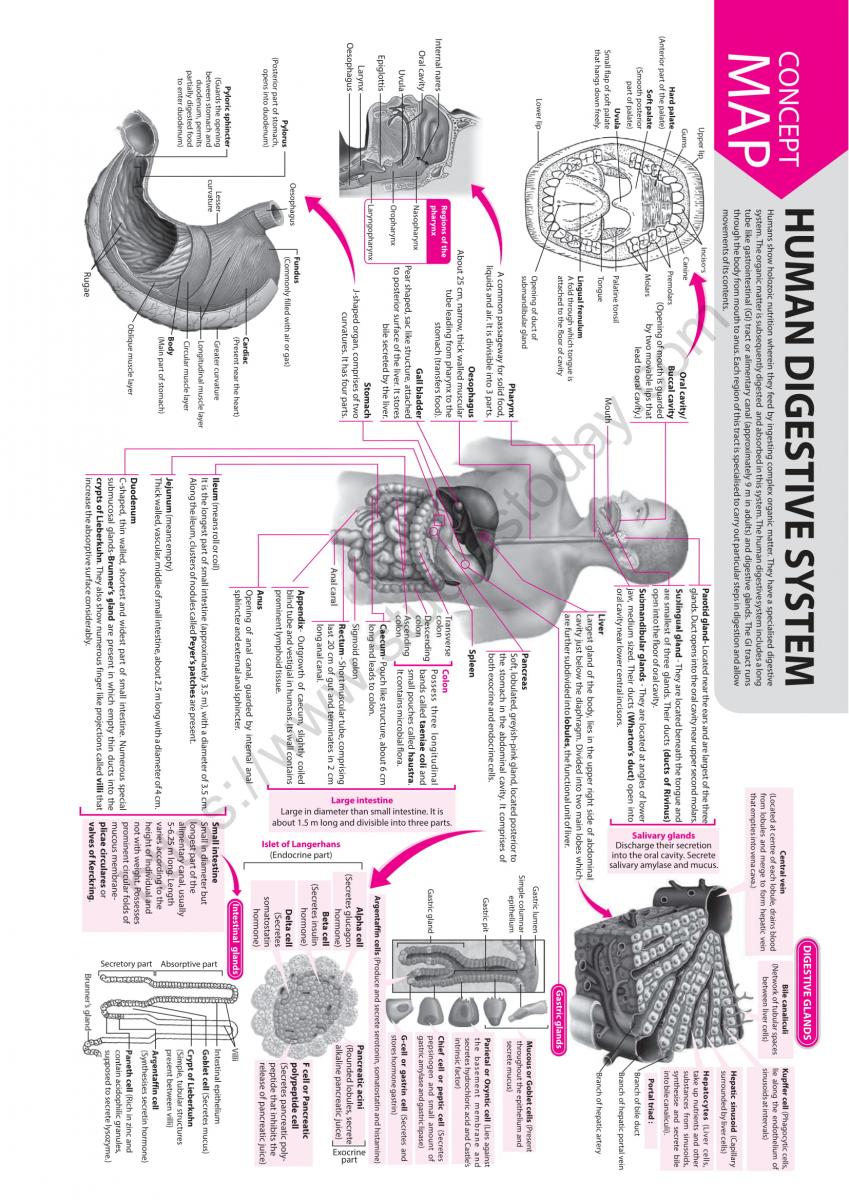
Human Digestive System Concept Map (text version)
Humans show holozoic nutrition wherein they feed by ingesting complex organic matter. They have a specialised digestive system. The organic matter is subsequently digested and absorbed in this system. The human digestive system includes a long tube like gastrointestinal (GI) tract or alimentary canal (approximately 9 m in adults) and digestive glands. The GI tract runs through the body from mouth to anus. Each region of this tract is specialised to carry out particular steps in digestion and allow movements of its contents.
Oral Cavity / Buccal Cavity
Opening of mouth is guarded by two movable lips that lead to oral cavity. Parts labelled in the figure: upper lip, lower lip, gums, incisors, canine, premolars, molars, palatine tonsil, tongue.
Hard palate (Anterior part of the palate)
Soft palate (Smooth posterior part of palate)
Uvula Small flap of soft palate that hangs down freely.
Lingual frenulum A fold through which tongue is attached to the floor of cavity.
Opening of duct of submandibular gland.
Pharynx
A common passageway for solid food, liquids and air. It is divisible into 3 parts: nasopharynx, oropharynx and laryngopharynx (regions of the pharynx). (Figure: internal nares, oral cavity, uvula, epiglottis, larynx, oesophagus.)
Oesophagus
About 25 cm, narrow, thick walled muscular tube leading from pharynx to the stomach (transfers food).
Stomach
J-shaped organ, comprises of two curvatures. It has four parts: Cardiac (present near the heart), Fundus (commonly filled with air or gas), Body (main part of stomach) and Pylorus (posterior part of stomach, opens into duodenum). Pyloric sphincter guards the opening between stomach and duodenum, permits partially digested food to enter duodenum. (Figure labels: oesophagus, lesser curvature, greater curvature, longitudinal muscle layer, circular muscle layer, oblique muscle layer, rugae.)
Gall Bladder
Pear shaped, sac like structure, attached to posterior surface of the liver. It stores bile secreted by the liver.
Small Intestine
Small in diameter but longest part of the alimentary canal, usually 5-6.25 m long. Length varies according to the height of individual and not with weight. Possesses prominent circular folds of mucous membrane- plicae circulares or valves of Kerckring.
Duodenum: C-shaped, thin walled, shortest and widest part of small intestine. Numerous special submucosal glands- Brunner's gland are present in which empty thin ducts into the crypts of Lieberkuhn. They also show numerous finger like projections called villi that increase the absorptive surface considerably.
Jejunum (means empty): Thick walled, vascular, middle of small intestine, about 2.5 m long with a diameter of 4 cm.
Ileum (means roll or coil): It is the longest part of small intestine (approximately 3.5 m), with a diameter of 3.5 cm. Along the ileum, clusters of nodules called Peyer's patches are present.
Large Intestine
Large in diameter than small intestine. It is about 1.5 m long and divisible into three parts.
Caecum: Pouch like structure, about 6 cm long and leads to colon.
Appendix: Outgrowth of caecum, slightly coiled blind tube and vestigial in humans. Its wall contains prominent lymphoid tissue.
Colon: Possess three longitudinal bands called taeniae coli and small pouches called haustra. It contains microbial flora. Parts: ascending colon, transverse colon, descending colon, sigmoid colon.
Rectum: Short muscular tube, comprising last 20 cm of gut and terminates in 2 cm long anal canal.
Anus: Opening of anal canal, guarded by internal anal sphincter and external anal sphincter.
Digestive Glands
Salivary glands: Discharge their secretion into the oral cavity. Secrete salivary amylase and mucus.
Parotid gland: Located near the ears and are largest of the three glands. Duct opens into the oral cavity near upper second molars.
Sublingual gland: They are located beneath the tongue and are smallest of three glands. Their ducts (ducts of Rivinus) open into the floor of oral cavity.
Submandibular glands: They are located at angles of lower jaw, medium sized. Their ducts (Wharton's duct) open into oral cavity near lower central incisors.
Liver: Largest gland of the body, lies in the upper right side of abdominal cavity just below the diaphragm. Divided into two main lobes which are further subdivided into lobules, the functional unit of liver.
Central vein: (Located at centre of each lobule, drains blood from lobules and merge to form hepatic vein that empties into vena cava.)
Bile canaliculi: (Network of tubular spaces between liver cells)
Kupffer cell: (Phagocytic cells, lie along the endothelium of sinusoids at intervals)
Hepatic sinusoid: (Capillary surrounded by liver cells)
Hepatocytes: (Liver cells, take up nutrients and other substances from sinusoids, synthesise and secrete bile into bile canaliculi).
Portal triad: branch of bile duct, branch of hepatic portal vein, branch of hepatic artery.
Pancreas: Soft, lobulated, greyish-pink gland, located posterior to the stomach in the abdominal cavity. It comprises of both exocrine and endocrine cells.
Spleen (shown in the figure).
Pancreatic acini (exocrine part): Rounded lobules, secrete alkaline pancreatic juice.
Islet of Langerhans (endocrine part): Alpha cell (secretes glucagon hormone), Beta cell (secretes insulin hormone), Delta cell (secretes somatostatin hormone), F cell or Pancreatic polypeptide cell (secretes pancreatic polypeptide that inhibits the release of pancreatic juice).
Gastric Glands
(Figure labels: gastric lumen, simple columnar epithelium, gastric pit, gastric gland.)
Mucous or Goblet cells: (Present throughout the epithelium and secrete mucus)
Parietal or Oxyntic cell: (Lies against the basement membrane and secretes hydrochloric acid and Castle's intrinsic factor)
Chief cell or peptic cell: (Secretes pepsinogen and small amount of gastric amylase and gastric lipase)
G-cell or gastrin cell: (Secretes and stores hormone gastrin)
Argentaffin cells: (Produce and secrete serotonin, somatostatin and histamine)
Intestinal Glands
(Figure labels: villi, intestinal epithelium, secretory part, absorptive part, Brunner's gland.)
Goblet cell (Secretes mucus)
Crypt of Lieberkuhn (Simple, tubular structures present between villi)
Argentaffin cell (Synthesises secretin hormone)
Paneth cell (Rich in zinc and contain acidophilic granules, supposed to secrete lysozyme.)
Biology NEET Exam Resources: Human Digestive System
Quick Revision Material for Human Digestive System
Review targeted study resources for Human Digestive System tailored for NEET learners. Utilizing these structured notes and quick-revision tools ensures complete alignment with current NEET evaluation standards.
Expert Notes and Solved Exam Questions
Each resource draws directly from authorized textbooks to maintain academic accuracy. Evaluating solved examples allows NEET students to master the formal presentation and answer-writing standards expected in upcoming school exams.
Additional Study Resources for NEET
Maximize your grade potential by utilizing NEET Biology practice papers in tandem with these structured notes. All printable assignments and interactive mock tests on our platform are updated for the 2026 session and available free of charge.
FAQs
Our advanced study package for Human Digestive System includes detailed concepts, diagrams, Mind Maps, and explanation of complex topics to ensure NEET students learn as per syllabus for 2026 exams.
The Mind Maps provided for Human Digestive System act as visual anchors which will help faster recall during high-pressure exams.
Yes, teachers use our NEET Biology resources for lesson planning as they are in simple language and have lot of solved examples.
Yes, You can download the complete, mobile-friendly PDF of the Biology Human Digestive System advanced resources for free.
Yes, our subject matter experts have updated the Human Digestive System material to align with the rationalized NCERT textbooks and have removed deleted topics and added new competency-based questions.