

NEET Biology Study Guide: NEET Biology Animal Kingdom Notes
Access comprehensive study materials and useful resources for Animal Kingdom using the NEET Biology Animal Kingdom Notes. Designed to align with the 2026-27 NEET academic guidelines, these advanced resources help NEET Biology students reinforce core concepts beyond standard textbooks.
Download Animal Kingdom Study Material PDF
View or download the dedicated NEET Biology Animal Kingdom Notes resource below. Engaging with these advanced study guides under focused conditions ensures continuous academic progress and mastery of the 2026-27 curriculum for Animal Kingdom.
These NEET Biology notes on the Animal Kingdom cover the grades of organisation, body wall, symmetry, body plan and coelom, followed by the salient features and classification of every non-chordate phylum from Protozoa to Echinodermata, the phylum Hemichordata, and the chordates, including fishes, amphibians, reptiles, birds and mammals, with examples, parasites and key terms for quick revision.
PART-I: ANIMAL KINGDOM
The animal kingdom covers about 35 phyla, of which 11 are considered major phyla. Ten of the major phyla are non-chordates and one, Phylum Chordata, is chordate.
While going through the chapter pay special attention to the following:
Terms and definitions: 1. Parazoa 2. Paurometabola 3. Filter feeders 4. Pseudocoelomate 5. Metagenesis 6. Malacology 7. Hexapoda 8. Botryoidal tissue 9. Entomology 10. Living fossil 11. Flame cell 12. Paedogenesis
Common names: 1. Hook worm 2. Jelly fish 3. Venus flower basket 4. Sea mouse 5. Sea hare 6. Portuguese man of war 7. Ship worm 8. Cuttle fish 9. Aristotle's lantern 10. Sea anemone
Infective stages: 1. Tetranucleated cyst 2. Embryonated egg 3. Sporozoite 4. Bladderworm larva 5. Metacercaria 6. Trophozoite
Differences: 1. Bilateral and biradial symmetry 2. Schizocoel and enterocoel 3. Blind sac and cell aggregate body plan 4. Strobilization and metamerism
Larvae: 1. Trochophore 2. Tornaria 3. Planula 4. Amphiblastula 5. Rhabditiform 6. Miracidium 7. Glochidium 8. Nauplius
At a Glance
- Grade of organization
- Body wall
- Body plan
- Coelom
- Protostomes and deuterostomes
- Anamniota and amniota
- Protozoa
- Porifera
- Cnidaria (coelenterata)
- Ctenophora
- Platyhelminthes
- Aschelminthes
- Annelida
- Arthropoda
- Mollusca
- Echinodermata
- Hemichordata
- Chordata
- Cephalochordata
- Urochordata
- Vertebrata
- Pisces
- Amphibia
- Reptilia
- Aves
- Mammalia
The 11 major phyla
1. Phylum Protozoa: single celled (solitary or colonial) eukaryotes
2. Phylum Porifera: sponges
3. Phylum Cnidaria: jelly fishes and sea anemones
4. Phylum Ctenophora*: comb jellies
5. Phylum Platyhelminthes: flat worms
6. Phylum Aschelminthes: round worms or thread worms
7. Phylum Annelida: segmented worms (earthworm, leech etc.)
8. Phylum Arthropoda: jointed-legged invertebrates
9. Phylum Mollusca: snails, bivalves, octopus etc.
10. Phylum Echinodermata: sea star, brittle star, sea lily etc.
11. Phylum Chordata: protochordates and vertebrates
* As Ctenophora includes fewer than 100 species, it is generally considered a minor phylum along with Rotifera, Phoronida, Brachiopoda and Gastrotricha.
Connecting concepts
Protozoans are single celled eukaryotes classified in Kingdom Protista. The multicellular animals are called metazoans and are placed in Kingdom Animalia. Metazoans are further divided into Parazoa and Eumetazoa. Parazoa includes the porifers, which have a cellular grade of organisation. Eumetazoa includes the cnidarians and ctenophores to the chordates. In parazoans the egg (zygote) develops into an ectoderm at the vegetal pole and an endoderm at the animal pole. In eumetazoans it is just reverse.
Grades of organisation
There are five grades of organisation in animals.
1. Sub-cellular or protoplasmic grade: found in protozoans, where the functions of the body are carried out by different organelles of the cell. In Amoeba and Paramecium, osmoregulation is done by the contractile vacuole, and locomotion is by pseudopodia and cilia respectively.
2. Cellular grade: found in porifers, where individual functions are performed by particular cells. Choanocytes create water currents by flagellar beating, thesocytes store food, scleroblasts form spicules and myocytes carry out contraction.
3. Tissue grade: developed in cnidarians and ctenophores, where specific tissues such as nervous and gonadal tissue are present.
4. Organ grade: found in flat worms (Platyhelminthes), where tissues are organised into organs such as the brain and excretory organs.
5. Organ-system grade: from Aschelminthes to Chordata. These animals have organ systems such as the digestive, reproductive, respiratory and circulatory systems, with various degrees of complexity.
Body wall
In metazoans the body develops from two or three germ layers.
1. Diploblastic body wall: the body develops from two germ layers, ectoderm and endoderm, with mesoglea (a non-cellular layer) between them. Examples: porifers and cnidarians.
2. Triploblastic body wall: the body develops from three germ layers, ectoderm, mesoderm and endoderm. Examples: flat worms to chordates.
Symmetry
Protozoans such as Amoeba and Entamoeba, and most porifers, are asymmetrical. Higher forms have a specific symmetry. There are four major types.
1. Radial symmetry: the body can be cut into two identical halves through any radius. Right and left, or dorsal and ventral, sides are not differentiated. It suits sessile animals, which can feed from all directions. Examples: cnidarians (except anthozoans) and echinoderms (adults).
2. Bilateral symmetry: the body can be divided into right and left halves through one plane only, the sagittal section. Examples: flat worms to molluscs, and all chordates.
3. Biradial symmetry: each of the four sides is identical to the opposite side but different from the adjacent side. The internal organisation is always bilateral. Examples: anthozoans (cnidarians) and ctenophores.
4. Spherical symmetry: the body is ball-shaped and both longitudinal and equatorial cuts give similar halves. Example: Volvox.
Body plan
There are three body plans, based on the presence, absence or complexity of the gut.
1. Cell-aggregate body plan: the gut is not differentiated and digestion is wholly intracellular. The body is a group of differentiated cells. Example: porifers.
2. Blind sac body plan: the gut has a single opening, the mouth, and no anal opening, so undigested waste leaves through the same mouth. Examples: cnidarians, ctenophores and flat worms.
3. Tube-within-tube body plan: the gut is complete, tubular and has separate mouth and anal openings. Examples: aschelminthes to chordates.
Coelom
The coelom is a body cavity between the body wall and the gut. On this basis animals are of three types.
1. Acoelomates: no body cavity. Examples: porifers, cnidarians and flat worms. In flat worms the space between ectoderm and endoderm is filled with mesodermal tissue.
2. Pseudocoelomates: the body cavity is lined by mesoderm only on the side towards the body wall. It represents a persistent blastocoel. The gut is not muscular and the organs lie loose, without mesenteries. Examples: aschelminthes (nematodes) and rotifers.
3. Eucoelomates: a true coelom lined with mesoderm on both sides. The organs are held in place by mesenteries. Examples: annelids to chordates. On the basis of origin, the true coelom is of two types:
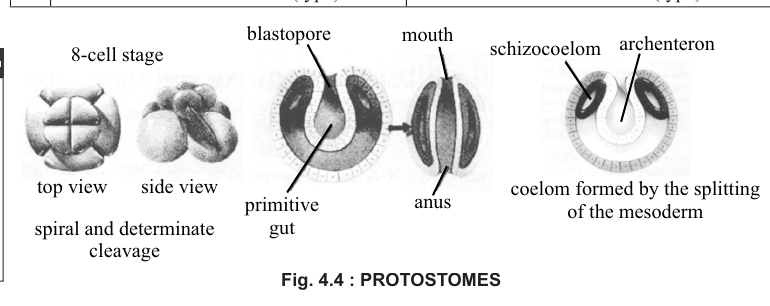
(a) Schizocoel: formed by the splitting of mesodermal segments. Examples: annelids, arthropods and molluscs.
(b) Enterocoel: formed by pouching or outpocketing of the archenteron (the cavity of the gastrula). Examples: echinoderms and chordates.
Note: The haemocoel of arthropods, some annelids and some molluscs is a blood-filled cavity of an open circulatory system. It is not a true coelom. The true coelom is greatly reduced in these animals.
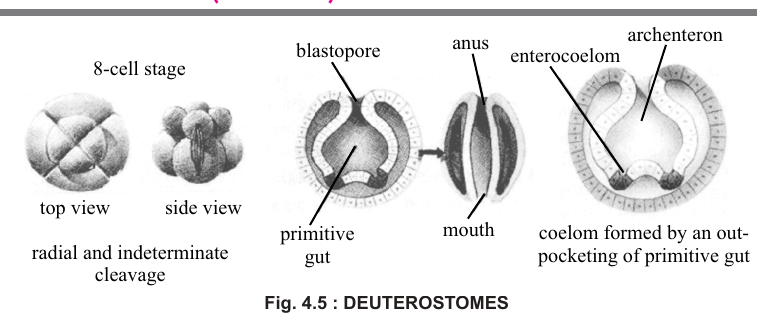
Protostomes and deuterostomes
All eucoelomates are either protostomes or deuterostomes.
In protostomes (annelids, arthropods and molluscs) the mouth forms at the site of the blastopore (Gk. protos: first, stoma: mouth), and the anus forms later at the opposite end.
In deuterostomes (echinoderms and chordates) the anus forms at the site of the blastopore and the mouth forms later as a second opening (Gk. deuteros: second, stoma: mouth).
| Feature | Protostomes | Deuterostomes |
| Blastopore | Forms the mouth | Forms the anus |
| Cleavage | Spiral: daughter cells of a new tier lie obliquely at the junction of previous cells | Radial: daughter cells lie vertically above or below previous cells |
| Fate of cleavage cells | Determinate (fixed); separated cells at the 4-cell stage cannot form complete embryos | Indeterminate; separated cells at the 4-cell stage can form complete, though smaller, embryos |
| Coelom | Schizocoel | Enterocoel |
Note: In arthropods, cleavage is highly modified due to the large amount of yolk. It is superficial meroblastic.
Check Point
1. Differentiate between: (i) Schizocoel and Enterocoel (ii) Protostomes and Deuterostomes (iii) Diploblastic and Triploblastic condition (iv) Parazoa and Eumetazoa (v) Metagenesis and Metamorphosis
Anamniota and amniota
Among higher vertebrates (reptiles, birds and mammals) the eggs are either laid outside the body (oviparous) and are cleidoic (shelled or box-like), or develop inside the body (ovoviviparous or viviparous) and are non-cleidoic. All these animals have extra-embryonic membranes: amnion, chorion and allantois, and the yolk sac, either to face the terrestrial environment or for the formation of the placenta. Such animals are called amniotes. Lower vertebrates without these membranes, namely cyclostomes, fishes and amphibians, are called anamniotes.
PHYLUM PROTOZOA
Protos means first and zoan means animal. Protozoa is the first animal phylum. The study of protozoans is called protozoology, and Antony von Leeuwenhoek is called its father. The term Protozoa was given by Goldfuss, and the group belongs to Kingdom Protista of Haeckel.
Important characters
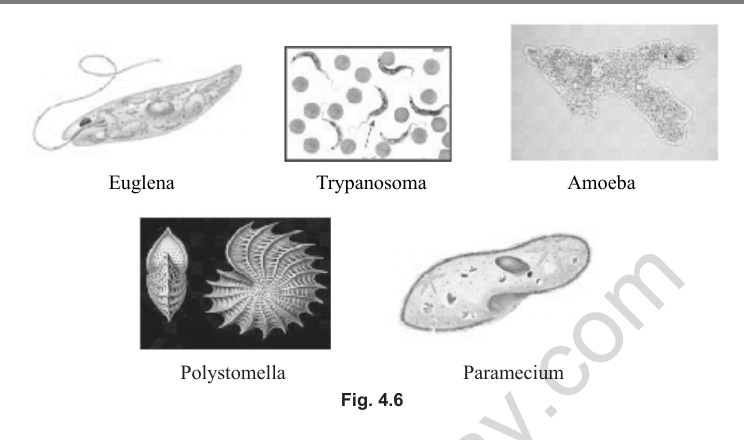
Single celled, solitary or colonial eukaryotes. Size ranges from 1 µm to 5000 µm. Mostly aquatic: freshwater or marine, or endoparasitic. Grade of organisation is protoplasmic (sub-cellular). Locomotion is by cilia, flagella or pseudopodia, or absent. A skeleton may or may not be present, and if present it is calcareous or siliceous. Foraminifers have an external shell of calcium carbonate (for example Polystomella), whereas radiolarians have internal plates of silica.
Osmoregulation is by the contractile vacuole in freshwater protozoans, which live in a hypotonic medium. The contractile vacuole is absent in parasitic and most marine forms. Symmetry is radial, bilateral or absent. Nutrition is holozoic or holophytic, and digestion is intracellular within food vacuoles. Reserve food is glycogen or starch-like bodies. Respiration is through the plasma membrane. Excretion is ammonotelic (NH3), through the general body surface. Blood and nervous tissue are absent. Euglena has a stigma (eye spot) as its sensory structure. Reproduction is asexual (budding, spore formation, binary fission or multiple fission) or sexual (conjugation in Paramecium, gamete formation in Plasmodium).
Check Point
1. What are locomotory structures in the following protozoans: Trypanosoma, Babesia, Paramecium, Opalina, Euglena, Leishmania?
2. Name the diseases caused by: Entamoeba histolytica, Leishmania donovani, Plasmodium, Trypanosoma gambiense.
Classification of protozoa (based on locomotory structures)
1. Subphylum Sarcomastigophora
(i) Superclass Mastigophora (Flagellata): locomotion by flagella. It is the most primitive class. Binary fission is longitudinal. It has two subdivisions:
Phytomastigophora: green, with chloroplasts, mostly free living, reserve food is starch (paramylon bodies), and has 1 to 2 flagella. Examples: Euglena, Volvox, Noctiluca and Ceratium. Noctiluca shows bioluminescence and is called the "burning of the sea".
Zoomastigophora: non-green, without chloroplasts, mostly parasitic, reserve food is glycogen, and has 1 to many flagella. Examples: Trypanosoma, Leishmania, Giardia, Trichomonas, Trichonympha, Proterospongia and Mastigamoeba.
Important parasites of this group:
Trypanosoma brucei: digenetic; primary host cattle, secondary host a fly. Disease: Nagana.
Trypanosoma cruzi: digenetic; primary host man, secondary host a dipteran fly. Disease: Chagas disease.
Trypanosoma evansi: digenetic; primary host horse, secondary host horse fly (Tabanus). Disease: Surra (skin disease).
Trypanosoma gambiense: causes sleeping sickness in man.
Trichomonas: T. tenax aggravates pyorrhoea; T. vaginalis causes leucorrhoea.
Leishmania donovani: digenetic; primary host man, secondary host sand fly (Phlebotomus). Disease: Kala-azar (Dum-dum fever).
Leishmania tropica: causes Oriental sore or Delhi boil (skin leishmaniasis).
Giardia: a bilaterally symmetrical flagellate, commonly called the "grand old man of the intestine". It causes diarrhoea.
Trichonympha: a symbiotic protozoan in the gut of termites, which helps in cellulose digestion.
(ii) Superclass Sarcodina (Rhizopoda): locomotion by pseudopodia (false legs). Forms are free living or parasitic. It includes heliozoans, foraminifers, radiolarians and amoebids. Examples: Amoeba, Entamoeba, Polystomella, Arcella, Pelomyxa and Babesia.
Babesia is an RBC parasite, transmitted through ticks, and causes Texas fever in cattle.
Entamoeba histolytica: monogenetic parasite of the colon (large intestine) of man. It causes amoebiasis or amoebic dysentery. The infective stage is the tetranucleated cyst, and infection is through contaminated food and water.
Entamoeba gingivalis (or buccalis): monogenetic parasite in the pockets between teeth and gums. It aggravates pyorrhoea. Infective stage: trophozoite. Mode of infection: mouth to mouth kissing.
Entamoeba coli: a commensal of the colon.
2. Subphylum Ciliophora (Class Ciliata): the biggest and most advanced class of protozoans. Locomotion is by cilia, and binary fission is transverse. Nuclei are dimorphic: the micronucleus is reproductive and the macronucleus is vegetative. Examples: Paramecium and Vorticella. Rectal ciliates live in the rectum of frogs and toads, and include Balantidium, Nyctotherus and Opalina. Opalina is multinucleated, with micro- and macronuclei not differentiated. Though its locomotory structures are cilia, it is sometimes placed in superclass Opalinata.
3. Subphylum Sporozoa: locomotory structures are absent. Members are the most specialised for parasitic life and are exclusively endoparasites. The contractile vacuole is absent. Examples: Plasmodium, Monocystis and Eimeria. Monocystis is an endoparasite in the seminal vesicle of earthworms, feeding on sperms. Eimeria causes coccidiosis in poultry birds.
4. Subphylum Cnidospora: spore formation occurs throughout life. Spores contain a polar capsule and a coiled filament for attachment. The trophozoite is multinucleated. Examples: Nosema and Myxidium. Nosema bombycis causes pebrine disease in the silkworm, Bombyx mori.
PHYLUM PORIFERA
Porifera means pore-bearing animals. There are two types of pores: ostia (incurrent pores) and osculum (excurrent pore). Each ostium acts as a mouth and the osculum acts as an anus, so a sponge has many mouths but one anal opening. The term Porifera was given by Grant, but the animal nature of sponges was established by Ellis. Porifers are multicellular and are the most primitive metazoans. The study of sponges is called parazoology.
Important characters
Commonly called sponges. All are aquatic, mostly marine, and free living, not parasitic. All are sessile in the adult stage, so locomotory structures are absent. Grade is cellular. Regeneration power is very high. Body plan is cell-aggregate. Symmetry is radial or asymmetrical. The skeleton is made of spicules or spongin fibres. Body wall is diploblastic and mesoderm is absent. Mesoglea is non-cellular and jelly-like. The body cavity is the spongocoel or paragastric cavity. The coelom is absent, so the animals are acoelomate. A canal system is present, which is a characteristic feature of porifers.
Respiration is aerobic through the general body surface. Excretion is ammonotelic through the general body surface. All porifers are filter feeders. A filter feeder is an animal that creates a water current by ciliary or flagellar beating and picks up food particles from it. Digestion is intracellular. Blood and nervous tissue are absent.
Reproduction is asexual and sexual, and most are bisexual. Asexual reproduction is by budding, or by gemmules in freshwater forms. In sexual reproduction, development is indirect and the larva is a parenchymula or an amphiblastula.
Body wall
The ectoderm consists of thin, polygonal pinacocytes. The endoderm consists of funnel-shaped choanocytes, or collar cells. The collar is formed by a number of microvilli. Choanocytes are the characteristic cells of porifers, and they create the water current for filter feeding. The mesoglea contains wandering cells called amoebocytes. There are six or seven types of amoebocytes:
1. Archaeocytes: undifferentiated and totipotent cells that can transform into any type of amoebocyte.
2. Myocytes: contractile cells around the openings, formed from pinacocytes.
3. Collenocytes: connective tissue type cells.
4. Thesocytes: food storing cells.
5. Scleroblasts (spongioblasts): form the spicules or spongin fibres.
6. Germ cells: for reproduction.
Canal system
The canal system circulates water for feeding, respiration, excretion and reproduction. There are three types.
1. Ascon type: the simplest. Water enters through the ostia, passes into the spongocoel and leaves through the osculum.
2. Sycon type: water enters through the ostia into incurrent canals, passes through prosopyles into radial canals (flagellated chambers lined with choanocytes), then through apopyles into the spongocoel and out through the osculum.
3. Leucon type (rhagon type): the most complicated. Water enters through the ostia into incurrent canals, passes through prosopyles into radial canals (flagellated chambers), then through inner apopyles into excurrent canals, then through outer apopyles into the spongocoel, and leaves through the osculum. The rhagon type is present in the larvae of animals that have the leucon type in the adult.
Endoskeleton
The endoskeleton consists of spicules or spongin fibres. Spicules are calcareous (calcium carbonate) or siliceous (silica). Calcareous spicules are monoaxon or triaxon. Siliceous spicules are six-rayed, four-rayed or amphidiscs.
Examples: Spongilla (freshwater sponge), Euspongia (marine bath sponge), Sycon (Scypha) and Leucosolenia.
Connecting concepts: In young Euplectella, before the sieve plate of the osculum has formed, young crustaceans Spongicola (male and female) enter its body. Later, when the sieve plate develops, they cannot escape and remain there till death. Hence Euplectella is a symbol of union till death.
Classification of porifers (based on the skeleton, not the canal system)
1. Class Calcarea: calcareous spicules, monoaxon or triaxon. All marine. Canal system is Ascon or Sycon type. Examples: Leucosolenia (simplest sponge), Clathrina, Grantia and Sycon (Scypha). In Leucosolenia and Sycon the larva is an amphiblastula, while in Clathrina it is a parenchymula.
2. Class Hexactinellida (Hyalospongia): commonly called glass sponges, semitransparent. All marine. Canal system is leucon type. Spicules are siliceous and six-rayed. Examples: Euplectella (Venus flower basket), a wedding gift and symbol of "till death do us apart", and Hyalonema (glass rope sponge).
3. Class Demospongia: marine or freshwater. Canal system is leucon type. Spicules, if present, are siliceous but not six-rayed. Spongin fibres are present or absent. Examples: Cliona (boring sponge, which bores into molluscan shells and harms the pearl industry), Chalina (dead man's finger), Euspongia (common bath sponge, with spongin fibres and no spicules), Spongilla (common freshwater sponge), Ephydatia (freshwater sponge) and Hippospongia (horse sponge). Freshwater sponges also produce gemmules for asexual reproduction.
PHYLUM CNIDARIA (COELENTERATA)
The term Coelenterata, also called Cnidaria, was given by Leuckart. The characteristic feature is the presence of nematoblasts or cnidoblasts (stinging cells).
Important characters
Symmetry is radial or biradial. Animals are aquatic, mostly marine, and either sessile or free swimming. Grade is cell-tissue. Body plan is blind sac. Locomotory structures are tentacles. Body wall is diploblastic, with ectoderm and endoderm and mesoglea between them. The body cavity is the coelenteron or gastrovascular cavity. The coelom is absent, so the animals are acoelomate. Individuals may be solitary or colonial, and colonies may be monomorphic, dimorphic or polymorphic.
Respiration is aerobic through the general body surface. Excretion is ammonotelic through the general body surface. Digestion is partly extracellular (in the coelenteron, hence the name gastrovascular cavity) and partly intracellular (in nutritive cells). Undigested food leaves through the mouth. Nervous tissue appears for the first time as a network of non-polarised neurons. Brain and nerves are absent.
Reproduction is asexual, sexual or both. Asexual reproduction is by budding. In sexual reproduction, development is direct or indirect, and the larva is a planula, or a planula and an ephyra.
Polyp and medusa: the two body forms
| Medusa | Polyp |
| Umbrella or cup-shaped | Tubular |
| Tentacles solid | Tentacles hollow or solid |
| Tentaculocysts (balancing structures) present | Tentaculocysts absent |
| Reproductive form | Mainly feeding form |
| Always free swimming | Sessile or free swimming |
| Only sexual reproduction | Asexual or sexual reproduction |
| Dioecious | Monoecious or dioecious |
Examples of coelenterates: Adamsia (sea anemone), Pennatula (sea pen), Gorgonia (sea fan) and Physalia (Portuguese man of war).
Check Point
1. Fill in the blanks with suitable words: (i) Alternation of generation in hydrozoans is called ........... (ii) The characteristic cells of Cnidarians are ........... (iii) ........... is called Venus flower basket. (iv) The members of class ........... of Cnidaria show biradial symmetry. (v) Larvae in Aurelia are ........... and ...........
Classification of cnidarians (four classes)
1. Class Hydrozoa: freshwater or marine. Polyp forms, or polyp and medusa forms. When both are present there is an alternation of generations called metagenesis. This is not a true alternation of generations, as both forms are diploid. The polyp stage has no pharynx. Mesoglea is thin. Germ cells and nematoblasts are derived from the ectoderm only. Examples: Hydra, a freshwater form with direct development. Obelia, commonly called sea fur, shows metagenesis with a planula larva. Physalia, the Portuguese man of war, has a polymorphic colony with different types of zooids under one pneumatophore.
2. Class Scyphozoa: all marine. Only the medusa form is present, so metagenesis is absent. Mesoglea is very thick and jelly-like, so they are called jelly fishes. Germ cells develop from the endoderm. Nematoblasts are present in both ectoderm and endoderm. Tentaculocysts are present. Asexual reproduction is absent. All forms are dioecious. Example: Aurelia, the common jelly fish. Aurelia has a planula and an ephyra larva.
3. Class Cubozoa: all marine. Medusae last longer than polyps. The medusae are squarish rather than circular, which gives the name cubozoans. Eyes are the most complicated for detecting light. Example: Chironex (sea wasp), which has deadly nematocysts that can kill humans.
4. Class Anthozoa (Actinozoa): the largest class of cnidarians, all marine. Only the polyp form is present, so the medusoid stage and metagenesis are absent. The polyp has a pharynx and mesenteries. Germ cells develop from the endoderm. Nematoblasts are present in both ectoderm and endoderm. Symmetry is biradial. Most forms secrete an exoskeleton of corals. A solitary coral is called Corallium, while colonial forms make a coral reef. Examples: sea anemone (Adamsia or Metridium), sea pen (Pennatula), sea fan (Gorgonia), pipe coral (Tubipora), mushroom coral (Fungia), red coral and moonga (Corallium rubrum).
Coral reefs: three types
1. Fringing reef: coral reefs close to the seashore.
2. Barrier reef: coral reefs away from the seashore. The coral reef of Australia is the largest coral reef, covering about 2000 km. area.
3. Atoll reef: a ring-shaped reef surrounding a water body called a lagoon.
PHYLUM CTENOPHORA
Ctenophora is a minor phylum with fewer than 100 species. Ctenophores are colourful, transparent, jelly-fish-like animals with well-marked bioluminescence. They are commonly called comb jellies because of their eight comb plates, also called paddle plates or ciliary plates, which are used for locomotion. This is their characteristic feature. They are also known as sea gooseberries or sea walnuts because of their shape.
Important characters
They are free swimming (pelagic), exclusively marine and solitary. Symmetry is biradial and tetramerous. In NCERT books it is mentioned as radial. They are acoelomate and have tissue grade organisation. The body plan is blind sac. The mouth is at one end, opening into an endodermal gastrovascular cavity through the pharynx. The sensory organ is at the opposite end.
Nematocysts are absent, but the tentacles, generally one pair, carry adhesive cells called colloblasts or lasso cells for capturing prey. Euchlora rubra, however, lacks colloblasts but has nematocysts. The body is unsegmented. The body wall is diploblastic, but the epidermis is ciliated and the mesenchyme contains muscle fibres, connective tissue and amoeboid cells. Polymorphism is absent. A statocyst, a balancing organ, is present. They are carnivores, feeding on the eggs and larvae of crustaceans and molluscs. Skeletal, respiratory, excretory and circulatory systems are absent. The brain is absent, but a diffuse network of neurons is present.
Reproduction is only sexual. Asexual reproduction is absent, but regeneration power is great. All are bisexual (hermaphrodite), with endodermal gonads. Fertilisation is external or internal. Cleavage is complete, determinate and dissymmetrical. Development is indirect with a cydippid larva. There is no planula larva and no metagenesis. Some ctenophores show dissogeny, in which both larva and adult become sexually mature. Paedogenesis is common.
Taxonomic position
Some zoologists still include Cnidaria and Ctenophora (Acnidaria) in the phylum Coelenterata. Ctenophores are considered missing links between Cnidaria and Platyhelminthes, and intermediate between radiata and bilateria. They may represent a blind offshoot that did not give rise to higher forms, though some features indicate common origin with Cnidaria. Examples: Ctenoplana, Beroe and Pleurobrachia.
Classification of ctenophores
1. Class Tentaculata: adults have two aboral tentacles or oral lobes. Examples: Cestus (Venus's girdle), Ctenoplana and Pleurobrachia.
2. Class Nuda: tentacles or oral lobes are absent in both adults and larvae. Example: Beroe.
PHYLUM PLATYHELMINTHES
The term Platyhelminthes was given by Gegenbaur. These are dorsoventrally flattened animals, commonly called flat worms.
Important characters
Tissue-organ level of organisation. Cephalisation appears for the first time. Bilaterally symmetrical. Acoelomate. Body wall is triploblastic. Excretory structures are flame cells (protonephridia or solenocytes), which develop for the first time. They are aquatic or terrestrial, and free living or parasitic. The body plan is blind sac: the mouth is present but the anal opening is absent. The alimentary canal is incomplete and branched, and digestion is extracellular. Respiration is aerobic in free living forms and anaerobic in parasitic forms. Locomotion is by suckers or ciliated skin. Nervous tissue is well developed and a brain is present. Blood or a blood vascular system is absent. Reproduction is asexual by transverse fission, or sexual. Fertilisation may be self or cross. Development is direct or indirect.
Examples: Planaria, Taenia (tapeworm), Fasciola (liver fluke) and Schistosoma (blood fluke).
Classification of flat worms
1. Class Turbellaria: commonly called flat worms. The body is unsegmented. Locomotion is by gliding or crawling with the ciliated epidermis, which also contains small rod-shaped bodies called rhabdites of uncertain function. They are aquatic or terrestrial and free living. Suckers are absent. The intestine is branched. They are bisexual (monoecious). Regeneration is present and is of the morphallaxis type. Asexual reproduction is by transverse fission. In sexual reproduction development is direct or indirect (Muller's larva). Examples: Planaria (Dugesia), a freshwater form with its mouth in the middle of the body and eye spots in the head, with direct development; and Bipalium, a terrestrial and burrowing form.
2. Class Trematoda: commonly called flukes. The body is unsegmented. Suckers are present. They are endoparasites with a branched intestine. They are unisexual (blood fluke) or bisexual. Asexual reproduction and regeneration are absent. Development is indirect in sexual reproduction.
Blood fluke (Schistosoma): the female lies in the gynaecophoric canal of the male. It is digenetic, with man or another mammal as primary host and a snail as secondary host. It causes schistosomiasis or bilharzia.
Liver fluke (Fasciola hepatica): endoparasite in the liver of sheep or goat. It shows heterogenesis or polyembryony. It has five larval stages: miracidium, sporocyst, redia, cercaria and metacercaria. It is digenetic. The primary host is sheep or goat and the secondary host is a mollusc, Planorbis or Limnaea. The miracidium is the infective stage for Planorbis, and the metacercaria is the infective stage for sheep.
3. Class Cestoda: commonly called tapeworms. The body is segmented, but the segmentation is false and is called strobilisation. The segments are called proglottids. Suckers are present for attachment. They are endoparasites. Mouth and gut are absent, so digested food is absorbed through the skin (osmotrophs), and the scolex is therefore not called a head. They are bisexual (monoecious). Regeneration and asexual reproduction are absent. Development is indirect.
Taenia solium (pork tapeworm): digenetic, with man as primary host and pig as secondary host. The larva is a bladderworm or cysticercus. The infective stage for man is the cysticercus larva, and for the pig it is the onchosphere stage. Infection is through improperly cooked pork.
Taenia saginata (beef tapeworm): primary host man, secondary host cattle.
Echinococcus (dog tapeworm).
Check Point
1. Write the names of primary and secondary hosts of the following parasites: (i) Wuchereria bancrofti (ii) Fasciola hepatica (iii) Taenia solium (iv) Dracunculus medinensis (v) Plasmodium (vi) Trypanosoma gambiense
PHYLUM ASCHELMINTHES
Aschelminthes is a heterogeneous group. It includes Nematoda, Rotifera, Acanthocephala, Gastrotricha and Nematomorpha, all of them pseudocoelomate groups. Nematoda is considered a class of Aschelminthes, or a minor phylum if Aschelminthes is taken as a superphylum.
Important characters of Nematoda
Nematoda is the largest group of Aschelminthes. Animals are commonly called round worms or thread worms, and all are true worms. They are cylindrical, triploblastic and bilaterally symmetrical. The body is unsegmented. They are free living (for example Rhabditis) or parasitic in animals and plants. Anguina and Heterodera are plant nematodes of wheat and potato respectively. The body cavity is a pseudocoel, which is a persistent blastocoel. The body plan is tube-within-tube, with a complete alimentary canal. Excretory structures are renette cells. Respiratory and circulatory systems are absent.
The number of cells in different parts of the body is fixed throughout life. This numerical constancy of cells or nuclei is called eutely. Growth occurs by increase in the size of cells, which is called auxetic growth. Asexual reproduction and regeneration are absent. Sexes are separate (dioecious), with prominent sexual dimorphism. Sperms are amoeboid and have no tail. Cleavage is determinate and spiral. Development is indirect, and the larva is rhabditiform (rhabditoid), which resembles the free-living Rhabditis.
Important nematodes
Ascaris (round worm): an endoparasite in the small intestine of humans, particularly children. It is a monogenetic parasite. The infective stage for humans is the embryonated egg, which contains a second-instar larva.
Ancylostoma duodenale (hookworm): a monogenetic parasite of the small intestine. The infective stage is the larva or juvenile, which pierces the soft skin.
Oxyuris or Enterobius vermicularis (pinworm or seatworm): a monogenetic parasite of the human intestine. The infective stage is the egg, and infection is through contaminated food and water.
Wuchereria bancrofti (filaria worm): a digenetic parasite of the lymph, not the intestine. Primary host is man and secondary host is the female Culex mosquito. The infective stage is the microfilaria. It causes filariasis or elephantiasis.
Dracunculus medinensis (guinea worm or serpent worm): male forms are rarely found. It is viviparous and a subcutaneous parasite. It is digenetic, with man as primary host and Cyclops (a crustacean, which is an arthropod) as secondary host.
Other important nematodes are Loa loa (eye worm), Trichinella spiralis (muscle worm) and Trichuris trichiura (whipworm).
PHYLUM ANNELIDA
The term Annelida was given by Lamarck. Body is segmented, with ring-shaped segments. It has true segmentation, or metamerism. The number of segments is fixed. New segments are not added and old ones are not removed. True segments are called metameres. Animals are aquatic or terrestrial, free living or parasitic. They are triploblastic and bilaterally symmetrical. Locomotory structures are setae and parapodia.
Important characters
The body plan is tube-within-tube. Animals are eucoelomate, with a true schizocoel. The alimentary canal is well differentiated with mouth and anal openings. Respiration is through gills (branchiae), cirri and skin. Excretory structures are nephridia. The blood vascular system is present and developed for the first time. The blood pigment is dissolved in the plasma, and RBCs are absent. The blood vascular system is of the open or closed type. Of the four major respiratory pigments (haemoglobin, haemerythrin, chlorocruorin and haemocyanin), the first three are present in annelids. Haemocyanin is absent in annelids but present in molluscs and arthropods. The nervous system includes the CNS, PNS and ANS. The ventral nerve cord is ganglionated. Sexes are separate or combined. Reproduction is sexual only. Fertilisation is external or internal. Development is direct or indirect. If indirect, the larva is a trochophore.
Examples: Pheretima (earthworm), Hirudinaria (leech) and Nereis (sand worm).
Classification of annelids
1. Class Polychaeta (poly: many, chaetae: setae): all marine. Locomotory structures are parapodia. The head is differentiated and has eyes. Clitellum is absent. They are carnivorous. The blood vascular system is closed. Sexes are separate, with external fertilisation in water and indirect development through a trochophore larva. Examples: Nereis (rug worm, clam worm or sand worm), which in the breeding season is called Heteronereis; Chaetopterus (paddle worm), which shows bioluminescence; Aphrodite (sea mouse); Arenicola (lug worm); Sabella; and Polygordius. Aphrodite is also the name of the Greek goddess of beauty, love and fertility. Polygordius, which lacks parapodia, is placed in a separate class, Archiannelida.
2. Class Oligochaeta (oligo: few, chaetae: setae): terrestrial and soil-eating. Parapodia are absent. The head is not differentiated and eyes are absent. Clitellum is present throughout life. They are bisexual, with external fertilisation inside a cocoon, and development is direct with no larva. Examples: Pheretima (earthworm), Lumbricus (European earthworm), Megascolex (South Indian earthworm) and Tubifex. Tubifex lives in muddy or highly polluted water. It tolerates very low oxygen levels and is therefore used as an indicator of water pollution. It is bright red in colour and is called the blood worm.
3. Class Hirudinea: hirudin, an anticoagulant present in the saliva, is produced by these animals. Setae and parapodia are absent. They are aquatic, mostly marine. The head is not differentiated. There are five pairs of eyes. They are sanguivorous (blood sucking) and ectoparasites on vertebrates. The blood vascular system is open and is called the haemocoelomic system. Clitellum develops only in the breeding season. They are bisexual, with internal fertilisation and direct development. Examples: Hirudinaria (leech), which has 33 segments and botryoidal tissue thought to be excretory in nature; Hirudo (European leech); and Pontobdella, an ectoparasite on fishes.
Note: Besides annelids, metameric segmentation is also seen in arthropods and chordates.
PHYLUM ARTHROPODA
Arthros means jointed and podos means legs, so arthropods are animals with jointed legs or appendages. The term was given by von Siebold. Arthropoda is the largest phylum of the animal kingdom and covers about 80 percent of all animals. Animals are aquatic, terrestrial or aerial. Arthropods are the only non-chordates that can fly. The exoskeleton is made of chitin, a polysaccharide of N-acetylglucosamine. Its periodic removal, called ecdysis or moulting, is essential for growth. The body is metamerically segmented.
The blood vascular system is open (capillaries absent, haemocoel present). Blood pigment is present or absent (absent in insects). If present, it is haemocyanin, which contains copper instead of iron. Respiratory structures are gills, book lungs and tracheal tubes. Excretory structures are green glands (antennal glands), coxal glands and Malpighian tubules. The nervous system is well developed. Eyes are simple or compound. Sexes are separate, with well-marked sexual dimorphism. Fertilisation is internal. Development is mostly indirect.
Examples: scorpion, prawn, mosquito, honeybee, silkworm, butterfly, lac insect, Limulus (king crab), grasshopper, silverfish and spider.
Classification of arthropods (four subphyla)
1. Subphylum Onychophora (onychos: claws, phoros: bearing): Example: Peripatus (walking worm), a living connecting link between annelids and arthropods. Its excretory ducts and unjointed legs, like parapodia, are annelidan characters, while its antennae and tracheal respiration are arthropodan characters. Onychophora is now raised to phylum level.
2. Subphylum Trilobita (tri: three): body three-lobed. Giant arthropods, all extinct.
3. Subphylum Chelicerata: two classes.
(A) Class Merostomata, order Xiphosurida. Example: Limulus (king crab or horseshoe crab), a living fossil with compound eyes.
(B) Class Arachnida (arachne: spider, oid: like). Chelicerae are one pair, comparable to mandibles. Pedipalps are one pair, comparable to maxillae. Walking legs are four pairs. The body is differentiated into prosoma (cephalothorax) and opisthosoma. Antennae are absent. Eyes are simple. Excretory structures are coxal glands. Respiration is by book lungs. Forms are free living or parasitic.
Scorpion: carnivorous, feeds on insects, and has an abdominal sting with neurotoxic poison. Sexual dimorphism is indistinct. Mating follows a courtship dance, and after mating the female devours the male. It is viviparous and produces dozens of young.
Spider: web is secreted by abdominal glands.
Ticks and mites: ectoparasites on mammals. Scabies (washerman's itch) is caused by mites (Sarcoptes). Ticks transmit fevers such as Colorado tick fever, typhus fever and Rocky Mountain spotted fever.
4. Subphylum Mandibulata: mandibles are present. It includes four classes.
(A) Class Crustacea (crusta: hard covering of the exoskeleton on the cephalothorax, called the carapace). Animals are aquatic and respire through gills. The number of legs is variable, generally five pairs. Antennae are two pairs. Excretory organs are green glands at the base of the antennae, which are also called antennal glands. Compound eyes are present. Development is mostly indirect. Larvae include nauplius (the first and most common larva), zoea, megalopa, phyllosoma and alima. Examples: Palaemon (prawn), with nauplius and metanauplius larvae; Astacus (crayfish), with no larva; Cancer (crab), with zoea and megalopa larvae; Eupagurus (hermit crab); Squilla, with alima larva; Sacculina, a parasite on crabs, with nauplius, kentrogen and cypris larvae; Cyclops, the secondary host of the guinea worm, with nauplius larva; and Daphnia (water flea), shrimp and woodlice.
(B) Class Chilopoda: centipedes. One pair of legs per segment. The body is differentiated into head and abdomen (thorax absent). Metameric segmentation is prominent. Eyes are simple. They are carnivorous and poisonous. Development is direct. Example: Scolopendra.
(C) Class Diplopoda: millipedes. Two pairs of legs per segment. The body is differentiated into head, thorax and abdomen. Eyes are absent. They are herbivorous and non-poisonous. Development is direct. Example: Julus.
(D) Class Insecta (Hexapoda): the study of insects is called entomology. The body is divided into head, thorax and abdomen. There is one pair of antennae and compound eyes. Wings are absent or present, one or two pairs. There are three pairs of legs, so they are called hexapods. Blood pigment is absent. Respiration is through tracheal tubes. Excretion is through Malpighian tubules. Development is direct or indirect. Indirect larvae are caterpillars, maggots or grubs. Examples: butterfly, housefly, honeybee, wasp, louse, termite, moth, mosquito, dragonfly, bed bug, flea, cicada, silverfish (Lepisma) and Chironomus.
The male cicada produces a loud, shrill sound audible from kilometres away. Its embryonic development can take up to 17 years, so it is called the seventeen-year locust. Silent Valley in Kerala is named for the absence of this insect.
According to the present classification, Insecta, Chilopoda and Diplopoda are placed in subphylum Uniramia, and Crustacea has been raised to subphylum level.
Mouth parts in insects
1. Sponging type: housefly. Mandibles are absent.
2. Siphoning type: butterflies and moths. Mandibles are absent.
3. Cutting and chewing type: cockroach, grasshopper, termites and ants. Mandibles are present.
4. Chewing and lapping type: honeybee.
5. Piercing and sucking type: female mosquito, louse, flea and bed bug. In male mosquitoes the mouthparts are sucking only, and they feed on flower nectar.
Metamorphosis in insects
1. Ametabola: no metamorphosis. The young resemble the adult. Eggs, then young, then adult. Example: Lepisma (silverfish).
2. Paurometabola: gradual metamorphosis. Eggs, then nymph, then adult. Examples: cockroach, grasshopper and locust.
3. Hemimetabola: incomplete metamorphosis. The habitat of the young differs from the adult. Eggs, then naiads, then adult. Example: dragonfly (naiads are aquatic, adults are aerial).
4. Holometabola: complete metamorphosis. Eggs, then larva, then pupa, then adult. Examples: housefly, butterfly and mosquito. Their larvae are the maggot, caterpillar and wriggler respectively.
5. Hypermetabola: various larval forms. Eggs, then larva (1), larva (2), and so on, then pupa, then adult. Example: blister beetle.
Check Point
1. What are respiratory and excretory structures in the following: (i) Crab (ii) Mosquito (iii) Nereis (iv) Spider (v) Starfish (vi) Liver fluke (vii) Pila (viii) Ascaris
PHYLUM MOLLUSCA
Molluscus means soft bodied. The term Mollusca was given by Johnston. The study of molluscs is malacology and the study of molluscan shells is conchology. It is the second largest phylum of the animal kingdom. It includes the squid, which is the largest and most intelligent invertebrate.
Important characters
Animals are aquatic or terrestrial. They are triploblastic, bilaterally symmetrical and eucoelomate, with a schizocoelic coelom. The body is unsegmented and differentiated into head, visceral mass and foot. The visceral mass is covered by a fleshy flap called the mantle or pallium. The skeleton is a shell or plates of calcium carbonate. Excretion is by metanephridia, also called the organ of Bojanus. Respiration is by gills (ctenidia) in aquatic forms and by a pulmonary sac in terrestrial forms. The blood vascular system is open or closed. The blood pigment is haemocyanin. The heart is myogenic. Locomotion is by the foot, or by arms modified from the foot. The nervous system is of the annelidan type. Most are dioecious. Development is indirect or direct.
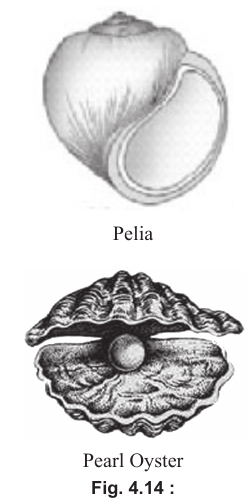
Examples: Pila (apple snail), Unio, Pinctada (pearl oyster), Octopus (devil fish), Loligo (squid), Sepia (cuttle fish), Aplysia (sea hare), Dentalium (tusk shell) and Chaetopleura (chiton).
Classification of molluscs (six classes)
1. Class Monoplacophora: a single exoskeleton plate. All marine. The body is segmented, which is an exceptional case. Eyes and tentacles are absent. Example: Neopilina galatheae, a connecting link between annelids and molluscs and an important living fossil.
2. Class Amphineura (Polyplacophora): two pairs of ventral nerve cords give the nervous system a ladder-shaped appearance. All marine, with many exoskeleton plates. The head is well differentiated. Development is indirect with a trochophore larva. Example: Chiton, which has eight exoskeleton plates.
3. Class Gastropoda: the foot is on the stomach. The head is well differentiated, and eyes and tentacles are well developed. The shell is coiled and the adult body is asymmetrical. The visceral mass is coiled, showing torsion. They may be marine, freshwater or terrestrial. Development is indirect with a trochophore or veliger larva. Examples: Pila (apple snail), a freshwater snail; Helix (garden snail); Aplysia (sea hare), which has no shell; Limax (slug), which has no shell; Patella; Doris (sea lemon); and Planorbis, the secondary host of Fasciola hepatica.
4. Class Pelecypoda (Bivalvia): two shell plates. Freshwater or marine. The head, eyes and tentacles are not differentiated. Development is indirect with a glochidium larva. Examples: Unio, Mytilus, clam, Teredo (ship worm), oysters such as the Indian pearl oyster Pinctada vulgaris, and Solen (razor shell). The pearl is secreted by the shell glands in the mantle. The pearl industry is said to be the oldest industry of Japan.
5. Class Scaphopoda: the foot is boat-shaped. All marine. Larva is a trochophore. Example: Dentalium (elephant tusk shell).
6. Class Cephalopoda: the foot is modified into arms and a siphon, and sits on the head. The shell is internal or absent. Eyes are well developed and resemble vertebrate eyes. The blood vascular system is closed. Development is direct, with no larval stage.
Examples: Octopus (devil fish), with eight arms and no shell. Sepia (cuttle fish), with ten arms (two long and eight short) and an internal shell called cuttle bone. Loligo (squid), with ten arms, the largest invertebrate. Nautilus, which has an external ornamented shell.
Octopus, Sepia and Loligo secrete a blue-black ink to defend against predators. Sepia and Loligo also show jet propulsion for locomotion.
PHYLUM ECHINODERMATA
Echinodermata means spiny-skinned animals (echino: spines, derma: skin). All are exclusively marine. The endoskeleton is mesodermal and made of ossicles and spicules. Symmetry is radial in adults, generally pentamerous, and bilateral in larvae. The body is unsegmented. The coelom is eucoelomate, of the enterocoel type, which is a chordate character. Locomotion is by tube feet. Respiration is by gills (branchiae), tube feet and the respiratory tree. The excretory system is absent, and excretion is by wandering amoebocytes. The blood vascular system is called the haemal system. It is reduced and open. The water vascular or ambulacral system helps in locomotion. Its opening is called the madreporite. Cephalisation is absent and the brain is not differentiated. Sexes are separate, but sexual dimorphism is absent. Fertilisation is external in water. Development is indirect and the larvae are bilaterally symmetrical.
Examples: Asterias (star fish), Echinus (sea urchin), Antedon (sea lily), Ophiura (brittle star) and sea cucumber.
Classification of echinoderms (five classes; extinct classes are not included)
1. Class Asteroidea, e.g. Asterias (star fish or sea star): pentamerous symmetry. The mouth is on the oral or ventral side and the anal opening is on the aboral or dorsal side. The madreporite is dorsal. Pedicellariae are present and remove dirt particles from the body surface. Digestion is outside the body and the stomach is everted. There are two larval types: bipinnaria and brachiolaria.
2. Class Ophiuroidea, e.g. Ophiothrix (brittle star): the mouth and madreporite are both ventral. The anal opening is absent. Arms are distinct from the central disc. They show autotomy of arms, which gives them the name brittle stars. Larva is pluteus.
3. Class Echinoidea, e.g. Echinus (sea urchin) and Clypeaster (sand dollar): locomotion is by movable spines, and arms are absent. The jaw apparatus is called Aristotle's lantern. Larva is echinopluteus.
4. Class Holothuroidea, e.g. Holothuria or Cucumaria (sea cucumber): arms are absent but five tentacles show pentamerous symmetry. Respiration is by a respiratory tree. Autotomy is by evisceration, which is the removal of the visceral organs including the alimentary canal. Larva is auricularia.
5. Class Crinoidea, e.g. Antedon (sea lily or feather star): mostly sessile, so the mouth is aboral or dorsal. The water vascular system and madreporite are absent. There are five arms, each divided into two branches, like a lily flower. Larva is pentacrinoid or doliolaria.
Check Point
1. To which phyla are these terms/names associated? (i) Comb-jellies (ii) True worms (iii) Tornaria (iv) Eutely (v) Parapodia (vi) Aristotle's lantern (vii) Holometabola (viii) Corals
PHYLUM HEMICHORDATA
Hemichordata was previously placed in phylum Chordata but is now placed among non-chordates. The structure once thought to be a notochord is now known to be a buccal diverticulum, which is an ectodermal structure.
While going through the chapter pay special attention to the following:
Terms and definitions: 1. Neoteny 2. Homeotherm 3. Ophidology 4. Ratitae 5. Cleidoic (eggs) 6. Amniota 7. Ornithology 8. Ungulates 9. Catadromous (fishes)
Taxonomic groups: 1. Chiroptera 2. Impennae 3. Prototheria 4. Lacertilia 5. Primates 6. Cotylosauria 7. Gymnophiona 8. Perissodactyla 9. Chondrichthyes
Animals / Larvae: 1. Sphenodon 2. Platypus 3. Phrynosoma 4. Axolotl larva 5. Latimeria 6. Chameleon 7. Herdmania
Structures: 1. Preen gland 2. Lateral line organ 3. Wish bone 4. Pineal eye 5. Blubber 6. Remiges
It has two classes: Enteropneusta, e.g. Balanoglossus, and Pterobranchia, e.g. Rhabdopleura, which is sessile and colonial.
Balanoglossus (acorn worm or tongue worm) is a connecting link between non-chordates and chordates. Its body has three regions: proboscis, collar and trunk. Its coelom is enterocoel. Its nervous system is dorsal and tubular, which is a chordate character. Pharyngeal gill slits are present, which is also a chordate character. Development is indirect with a tornaria larva.
PART-II: ANIMAL KINGDOM (CHORDATA)
PHYLUM CHORDATA
Chordates share these features at some stage of their life cycle: a notochord, a dorsal tubular nerve cord, pharyngeal gill slits, and an endostyle or thyroid gland. Their eyes develop from the nervous epithelium and not from the skin epithelium.
The phylum is divided into three subphyla: 1. Cephalochordata, 2. Urochordata and 3. Vertebrata. Cephalochordates and urochordates are called protochordates or acraniates, while vertebrates are called craniates.
Subphylum Cephalochordata
The notochord extends into the head region. All are marine. Excretion is by protonephridia with solenocytes. Pharyngeal gill slits are present in adults. The coelom is enterocoel. Development is mostly direct. Amphioxus (Branchiostoma, or lancelet) shows all three chordate characters in the adult. Its notochord extends from head to tail.
Subphylum Urochordata (Tunicata)
The outer covering is made of tunicin, a type of cellulose, which is secreted in the presence of vanadium. All are marine. The blood vascular system is open. Many forms are sessile. Urochordates are the only chordates that can be sessile. The coelom is secondarily absent. The excretory system is lacking. Forms are unisexual or bisexual. Asexual reproduction by budding occurs in many forms. Development is direct or indirect. Some forms show neoteny (retention of larval characters in adults) and alternation of generations.
It has three classes:
Ascidiacea: sessile tunicates, solitary or colonial. Example: Herdmania (sea squirt). Its tadpole larva shows retrogressive metamorphosis.
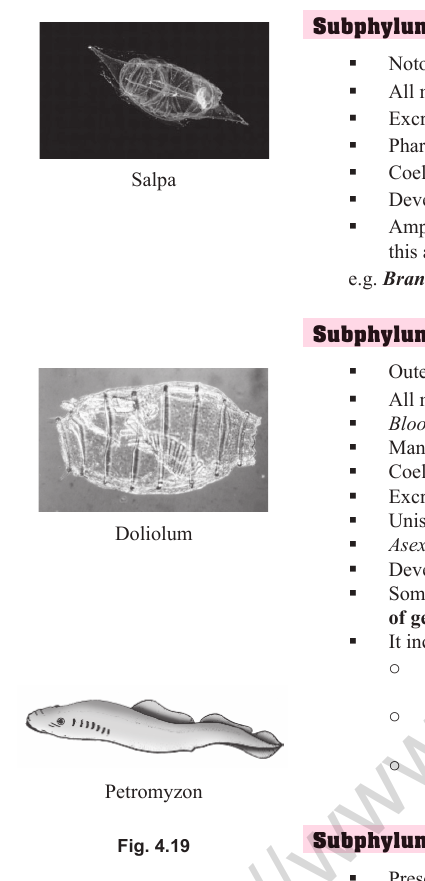
Thaliacea: pelagic tunicates that reproduce asexually by budding. Examples: Salpa and Doliolum.
Larvacea: transparent and free floating. Adults show neoteny and have only two gill slits. Example: Oikopleura.
Subphylum Vertebrata (Craniata)
Vertebrates have a brain box or cranium, a hepatic portal system, paired fins or limbs, a ventral heart and a post-anal tail. They are divided into two groups: I. Agnatha (jawless vertebrates) and II. Gnathostomata (jawed vertebrates).
I. Agnatha
1. Class Ostracodermi: the first vertebrate group, which appeared in the Ordovician. They were armoured fishes and all are extinct.
2. Class Cyclostomata: all are ectoparasites on fishes. The mouth is circular. Gills are 6 to 14 pairs. Scales are absent. Fins are unpaired and paired appendages are absent. The inner ear has two semicircular canals. Cyclostomes are marine but migrate to freshwater for spawning.
Petromyzon (lamprey): 7 pairs of gills with 7 pairs of external gill slits. Unisexual. Development is indirect and the larva is an ammocoete.
Myxine (hagfish): 6 pairs of gills with only one pair of external gill slits. Bisexual. Development is direct.
II. Gnathostomata (jawed vertebrates), two superclasses
1. Superclass Pisces: members do not have the pentadactyl (five-fingered) plan. All are aquatic fishes.
2. Superclass Tetrapoda: members have paired pentadactyl limbs. It includes the classes Amphibia, Reptilia, Aves and Mammalia.
SUPERCLASS PISCES
The study of fishes is called ichthyology. Fishes are aquatic and mostly marine. They are poikilothermic, or cold-blooded. Locomotion is by fins. There are two types: paired (lateral) fins, which are pectoral and pelvic fins, and unpaired (median) fins, which are dorsal, caudal, ventral and anal fins. The exoskeleton is made of ecto-mesodermal scales. Respiration is by 5 to 7 pairs of gills. Excretion is by a mesonephros or opisthonephros kidney. The blood vascular system is closed with a single circulation. The heart has two chambers and carries only deoxygenated blood, so it is a venous heart. There are 10 pairs of cranial nerves. Only the inner ear is present, and it is used for balancing only. Eyelids are absent. Internal nostrils are absent except in lungfishes. The lateral line organ has neuromast cells for detecting water vibrations; it acts as a rheoreceptor. The skull is monocondylic, with one occipital condyle. Vertebral centra are amphicoelous. Ribs are present. The jaw suspensorium is hyostylic, where the lower jaw articulates with the hyomandibular bone of the upper jaw. Sexes are separate. Fertilisation is mostly external in water. Development is direct, with fry and fingerling stages.
Classification of fishes (three classes)
1. Class Placodermi: armoured jawed fishes with fused bony scales. All are extinct.
2. Class Chondrichthyes: subclasses Elasmobranchii and Holocephali.
3. Class Osteichthyes (Teleostomi).
| Class Chondrichthyes | Class Osteichthyes (Teleostomi) |
| Cartilaginous endoskeleton | Bony endoskeleton |
| Mostly marine | Freshwater or marine |
| About 5 percent of all fishes | About 95 percent of all fishes |
| Placoid scales in the skin | Cycloid, ganoid or ctenoid scales |
| Mouth ventral | Mouth terminal |
| 5 pairs of gill slits | 4 pairs of gill slits |
| Operculum (gill cover) absent | Operculum present |
| Heterocercal tail (unequal lobes) | Homocercal tail (equal lobes) |
| Pelvic fins of males form claspers for sperm transfer | Claspers absent |
| Among the largest fishes | Average to small-sized fishes |
| Scroll valve present in the intestine | Scroll valve absent |
| Air bladder absent | Air bladder or swim bladder present (for buoyancy, respiration or sound production) |
| Kidney opisthonephros | Kidney mesonephros |
| Ampullae of Lorenzini (thermoreceptors) present in the snout | Absent |
| Oviparous, ovoviviparous or viviparous | Oviparous |
| Mermaid's purse (egg case) in oviparous forms | Egg cases absent |
Examples of chondrichthyes: Sharks, such as Scoliodon (dog fish), a viviparous fish with a high sense of smell. Pristis (saw fish). Chimaera (king of herrings or rat fish), which has an operculum and is unusual for that reason. Rays: Trygon (sting ray) and Torpedo (electric ray). Skates: Raja.
Examples of osteichthyes: Latimeria (coelacanth), a fleshy-lobed finned fish of the group Crossopterygii. It is a living fossil and a connecting link between fishes and amphibians. Hippocampus (sea horse), which shows parental care. Exocoetus (flying fish). Anabas (climbing perch), which has an accessory respiratory structure and can survive out of water for several days. Echeneis or Remora (sucker fish). Gambusia (minnow), which feeds on mosquito larvae. Labeo rohita (rohu), Mystus cinghala (singhara), Clarias batrachus (magur), eel, salmon and Acipenser.
Teleostomi also includes lungfishes (group Dipnoi). They link fishes and amphibians. They have both gills and lungs. The lungs are a modification of the air bladder, and they arise dorsally from the oesophagus. The skull is cartilaginous and the notochord persists throughout life. They have internal nostrils. All are freshwater forms. There are only three genera: Protopterus (African), Lepidosiren (South American) and Neoceratodus (Australian).
Migration in fishes
1. Anadromous fishes migrate from sea to freshwater for breeding. Examples: sturgeon (Acipenser) and salmon (trout).
2. Catadromous fishes migrate from freshwater to sea for breeding. Example: eel (Anguilla).
Check Point
1. Explain why: (i) Scoliodon is called a dog-fish. (ii) Amphibians are called poikilothermic. (iii) Trouts are called 'anadromous fishes'. (iv) The metamorphosis in tadpole larva of Herdmania is called retrogressive. (v) The fishes have not been included in 'Tetrapoda'.
CLASS AMPHIBIA
Amphibia is the smallest class of vertebrates. None are marine. They are terrestrial, amphibious or freshwater forms. The body is differentiated into head, trunk and tail. The neck is absent in all amphibians. The tail is absent in most terrestrial or amphibious forms. They are cold-blooded (poikilothermic). They undergo aestivation (summer sleep) or hibernation (winter sleep). The alimentary canal opens into a cloaca. The kidney is of the mesonephros type, and excretion is mostly ureotelic. Respiration is cutaneous, branchial or pulmonary. The heart has three chambers, with a sinus venosus. The blood vascular system is closed, and the systemic arch is paired. Both renal and hepatic portal systems are well developed. The exoskeleton is lacking in most forms. Sexes are separate, and fertilisation is mostly external. They are oviparous and extra-embryonic membranes are absent.
Examples: frog (Rana tigrina), toads (Bufo), tree frog (Hyla), salamander and Ichthyophis (limbless amphibian).
Classification of amphibians (two subclasses)
Subclass 1, Stegocephalia: all extinct, commonly called stem amphibians or labyrinthodonts. They had dermal bony plates and large teeth.
Subclass 2, Lissamphibia: dermal bony plates are absent and teeth are simpler and smaller. The living forms are in three orders.
1. Order Apoda (Gymnophiona), from Gr. gymnos, naked: legs are absent, so they are called limbless amphibians. The tail is vestigial or reduced. They are fossorial (burrowing) with vestigial eyes. The exoskeleton consists of scales embedded in the skin. A copulatory organ is present, so fertilisation is internal. Both forms show parental care. Examples: Uraeotyphlus (blind worm) and Ichthyophis.
2. Order Urodela (Caudata), from L. cauda, tail: the tail is well developed. Legs are present and equal in size. Gills persist in adults for respiration. The exoskeleton is lacking. The copulatory organ is absent and fertilisation is external. Examples: Ambystoma (salamander), whose larva is called the axolotl. It shows neoteny and paedogenesis when iodine is deficient. Others: Necturus (mud puppy), Siren (mud eel), Triturus (newt), Amphiuma (Congo eel) and Proteus (blind salamander).
3. Order Anura (Salientia), from L. saliens, leaping: hind limbs are longer than fore limbs, for leaping. The hind toes are webbed. The tail is absent in adults but present in the larva. Gills are absent in adults. Fertilisation is external. Examples: Rana tigrina (Indian bull frog), R. pipiens (leopard frog), Bufo (toad), Alytes (mid-wife toad), which shows parental care; Hyla (tree frog); Rhacophorus (flying frog); Pipa (Surinam toad); Bombinator (fire-bellied toad); and Xenopus.
CLASS REPTILIA
The study of reptiles is called herpetology. The study of lizards is called saurology. The study of snakes is called ophidology or serpentology.
General characters
Reptiles are cold-blooded (poikilothermic) and are true land or terrestrial vertebrates. The exoskeleton is made of scales. Respiration is pulmonary. The kidney is metanephros. The heart is incompletely four-chambered, but completely four-chambered in crocodiles and alligators. The systemic arches are paired. The left and right systemic arches communicate through the foramen of Panizza. The alimentary canal opens into a cloaca. There are 12 pairs of cranial nerves. The olfactory structure is Jacobson's organ. A columella auris is present in the ear. Lizards have external, middle and internal ears, but snakes have only an internal ear. Fertilisation is internal and the animals are oviparous, with cleidoic (shelled) eggs. Extra-embryonic membranes, amnion, chorion and allantois, are present, so they belong to the group Amniota. Larvae are absent and development is direct.
Examples: tortoise (Testudo), turtle (Chelone), garden lizard (Calotes), wall lizard (Hemidactylus), chameleon (Girgit), crocodile and alligator.
Classification of reptiles (based on the temporal fossa in the skull)
1. Anapsida: no temporal opening or fossa. Order Cotylosauria (stem reptiles), e.g. Seymouria (extinct). Order Chelonia: teeth absent but a jaw plate is present, and no sternum. Examples: Testudo (tortoise, a freshwater form) and Trionyx (turtle, a marine form).
2. Parapsida: a lateral temporal opening, one on either side. All extinct.
3. Synapsida: one fused temporal opening on either side. Mammal-like reptiles, all extinct. Example: Pelycosaurus.
4. Diapsida: two pairs of temporal openings, one pair on either side.
Diapsida has three orders:
A. Rhynchocephalia: Sphenodon punctatum (tuatara), a living fossil of New Zealand with a third eye (pineal eye) that is functional in young ones.
B. Crocodilia: the heart is four-chambered. Teeth are thecodont. A muscular diaphragm is present. These three are mammalian characters. Examples: crocodile (narrower snout and a fourth mandibular tooth visible), alligator (broader, rounded snout, found in North America and China, not in India), and gavial (narrow and very long snout).
C. Squamata: two suborders, Lacertilia and Ophidia.
Lacertilia (lizards): examples are Hemidactylus (wall lizard), Draco (flying lizard), Calotes (garden lizard) and Chameleon (girgit). The chameleon has a protrusible tongue, a prehensile tail, asynchronous vision and colour-changing ability. Heloderma (Gila monster) is the only poisonous lizard, found in Mexico. Varanus (monitor lizard, called gho in India). Uromastix (spiny-tailed lizard). Mabuya is a viviparous lizard. Anguis (European) and Ophisaurus (Indian) are glass snakes, both limbless lizards. Phrynosoma (horned toad) is a lizard with hygroscopic skin.
Ophidia (snakes): eyelids are fixed and the nictitating membrane is absent. The right lung is very long and functional, and the left lung is rudimentary. The tympanum, urinary bladder, limbs, girdles and sternum are absent. Python and sand boa retain vestigial hind limbs.
Poisonous snakes: Naja (cobra), with neurotoxic poison. Enhydrina and Hydrophis are sea snakes and are deadly poisonous. Bungarus (krait). Crotalus (rattlesnake) and vipers, with haemotoxic poison. The loreal pit of pit vipers is a thermoreceptor. The viper is viviparous.
Non-poisonous snakes: Python (ajgar), Eryx johnii (sand boa or double-headed snake), Natrix (pond snake), Zamenis or Ptyas (rat snake or dhaman), Dendrophis (tree snake) and Typhlops (blind snake).
CLASS AVES
The study of birds is called ornithology. The study of bird nests is called nidology. The study of bird migration is called phenology. Dr. Salim Ali is known as the bird man of India.
Important characters
Birds are homeothermic, endothermic or warm-blooded. Body temperature is the highest among vertebrates, about 40 to 45 degrees Celsius. The exoskeleton is ectodermal and consists of beak, feathers and claws. Feathers are the characteristic feature of birds. Forelimbs are modified into wings, and the body is streamlined so that it has the least air resistance during flight. The stomach is absent, but a crop and gizzard are present. Respiration is pulmonary. The lungs are inelastic and are supplemented with air sacs. Residual air is absent. The sound box, called the syrinx, is at the base of the trachea. The kidney is metanephros. The urinary bladder is absent, and the animals are uricotelic. The heart has four chambers and birds have the richest blood among vertebrates, with the most RBCs per cubic mm. Only the right systemic arch is present. There are 12 pairs of cranial nerves, and the olfactory lobes are reduced. The eyes are telescopic, with a pecten attached to the choroid. The middle ear has a single ear ossicle. A nictitating membrane is present. Uropygeal (preen) glands are present in the skin of the tail region for dressing the feathers. The gut opens into a cloaca. In adult females the right ovary and oviduct degenerate. Birds are oviparous with cleidoic eggs. Extra-embryonic membranes, amnion, chorion and allantois, are present, so they belong to Amniota. The allantois acts as the urinary bladder of the embryo. Development is direct.
Skeletal features
Bones are spongy and pneumatic, and the marrow cavity is absent. The skull is monocondylic and the vertebrae are heterocoelous. A few thoracic vertebrae, all lumbar and sacral vertebrae, and a few caudal vertebrae fuse to form the synsacrum. The posterior caudal vertebrae fuse to form the pygostyle. The two clavicles fuse with the interclavicle to form a fork-shaped bone called the furcula or wishbone. The carpals and metacarpals fuse to form the carpometacarpus, or wing bone. The tarsals and metatarsals fuse to form the tarsometatarsus. The ribs are double-headed with an uncinate process. The sternum is keeled for attachment of flight muscles.
Examples: pigeon (Columba), crow (Corvus), parrot (Psittacula), peacock (Pavo cristatus), penguin (Aptenodytes), vulture (Neophron) and ostrich (Struthio).
Classification of birds (two subclasses)
1. Archaeornithes: primitive birds, all extinct. Example: Archaeopteryx lithographica, found in the lime stone rocks of the Jurassic period in Bavaria, Germany, discovered by Andreas Wagner. Features: toothed beaks, flat sternum, no furcula, wing bone absent, feathers present.
2. Neornithes: modern birds, in four superorders.
A. Palaeognathae (Ratitae): birds with primitive jaws. All flightless birds: ostrich (African), rhea (American ostrich), cassowary and emu (Australian), and kiwi (New Zealand).
B. Impennae: penguins, found in Antarctica (south pole birds). Forelimbs are modified into flippers.
C. Odontognathae: fish-eating toothed birds, all extinct.
D. Neognathae: modern birds.
Notable birds: Arctic tern is a migratory bird that travels from the north to the south pole. Humming bird is the smallest bird. Swift is the fastest flying bird, and some swifts hibernate. The peacock (Pavo cristatus) belongs to the order Galliformes. The male is called peacock and is India's national bird. Koel or cuckoo (Eudynamis) is a brood parasite that lays its eggs in a crow's nest, and it is the male that has the melodious call. The Great Indian bustard is a highly endangered bird of Rajasthan. Albatross is the largest bird. Vulture is a carnivorous bird. Eagle and hawk are predatory birds.
Check Point
1. Fill in the blanks, each with a suitable word. (i) ........... is a covering of cellulose-like material in Urochordates. (ii) Retention of larval characters in adults is called ........... (iii) Living jaw-less vertebrates belong to class ........... (iv) Study of fishes is called ........... (v) Limb-less amphibians belong to order ........... (vi) ........... is the study of birds. (vii) Human belongs to order ........... (viii) The order ........... contains egg laying mammals. (ix) Flight-less birds belong to group ........... (x) The scientific name of our national bird is ........... (xi) In birds the sound box is called ........... (xii) The tortoises and turtles belong to order ........... (xiii) Study of birds is called ...........
Check Point
1. Name the following: (i) The rheoreceptor organ in fishes (ii) The larva of Petromyzon (iii) The chordates that reproduce by budding (iv) Cutaneous glands in birds for feather dressing (v) The structure modified to lungs in the members of Dipnoi (vi) A homologue structure of thyroid in protochordates (vii) Excretory structures in Cephalochordates (viii) The poisonous lizard of the world (ix) The paired fins in fishes (x) African and American lung fishes (xi) The group that includes reptiles, birds and mammals (xii) The mammal that has volant adaptations (xiii) A living fossil of New Zealand (xiv) Subcutaneous fat layer in whales (xv) The bone formed by the fusion of clavicles and interclavicles in birds
Types of feet in birds
1. Perching type: adapted for fastening the foot to a branch. Examples: sparrow and crow.
2. Raptorial type: adapted for snatching or robbing food. Examples: owl, vulture, kite and eagle.
3. Wading type: adapted for walking on water surface. Examples: jacana and heron.
4. Cursorial type: adapted for running. Examples: ostrich, Great Indian bustard, rhea and emu.
5. Scansorial type: adapted for climbing. Examples: woodpecker and parrot.
Types of feathers
1. Flight feathers (quill feathers): have a rachis (shaft), and barbs and barbules that interlock. They are of three types: A. Remiges, the feathers of the wings. B. Rectrices, the feathers of the tail, for steering flight or braking. C. Coverts, which fill the gap between remiges and rectrices.
2. Down feathers: for insulation in young birds. The rachis is absent and barbs and barbules do not interlock.
3. Filoplumes: minute hair-like feathers with unknown function.
Fig. 4.25 : Flight feather, down feather and filoplume
The assemblage of feathers is called plumage. Feathers are made of beta-keratin.
Beaks in birds
1. Seed-eating beak: short and stout. Example: sparrow.
2. Insect-eating beak: small and delicate. Examples: swift and swallow.
3. Fruit-eating beak: sharp, strong and hooked. Example: parrot.
4. Fish-catching beak: long, powerful and sharply pointed. Examples: heron and kingfisher.
5. Mud-straining beak: broad and flat with a serrated border, acting as a sieve. Example: duck.
6. Flower-probing beak: very long, narrow and pointed. Example: humming bird.
CLASS MAMMALIA
Mammals are homeothermic, endothermic or warm-blooded. The exoskeleton includes hair, horns, hoofs, claws, nails, antlers and scales. A muscular diaphragm separates the thorax from the abdomen. There are generally seven cervical vertebrae. The vertebrae are amphiplatyan, or acoelous, with no centrum. Ribs are double-headed without an uncinate process. There are three ear ossicles: malleus, incus and stapes. The cheek bone, or zygomatic arch, is present. Sweat, mammary and sebaceous glands are present. The kidney is metanephros and the main excretory product is urea. Respiration is pulmonary only. Teeth are thecodont, diphyodont and heterodont. The heart has four chambers and only the left systemic arch is present. There are 12 pairs of cranial nerves. The corpus callosum and pons varolii are present in the brain. They are amniotes, with amnion, chorion and allantois. Most are viviparous, development is direct, and a placenta is generally present. These characteristics describe the eutherians.
Examples: duck-billed platypus (Ornithorhynchus), kangaroo (Macropus), flying fox (Pteropus), monkey (Macaca), dog (Canis), cat (Felis), horse (Equus caballus), dolphin (Delphinus), blue whale (Balaenoptera) and tiger (Panthera tigris).
Classification of mammals (three subclasses)
1. Prototheria: order Monotremata, egg-laying mammals. The uterus and vagina are absent. The placenta is absent. The pinna (external ear) is absent. Mammary glands have no teats and are functional in both sexes. Teeth are absent in adults, and only horny jaws are present. The corpus callosum is absent but pons varolii is present. A cloaca is present.
Ornithorhynchus (duck-billed platypus) is truly oviparous and is the only poisonous mammal, with a poison gland in the thigh.
Tachyglossus (echidna or spiny anteater) is ovoviviparous, with yolky eggs. Development is internal but the placenta is absent.
2. Metatheria (marsupials): pouched mammals. The uterus and vagina are paired. The pinna is present. Mammary glands have teats and are functional in females only. Teeth are monophyodont. The corpus callosum is absent. The placenta is mainly a yolk sac placenta (vitellochorion). They are viviparous and give birth to premature young. Examples: Macropus (kangaroo), Didelphis (opossum) and Koala (teddy bear). A newborn kangaroo is about the size of a bean and weighs about 1 g, whereas a newborn calf weighs about 45 kg, although the adults of kangaroo and cow are of similar size.
3. Eutheria: true placental mammals. The uterus and vagina are single. They are viviparous. The pinna is present. Mammary glands have teats and are functional in females. Teeth are diphyodont. The corpus callosum is present. The placenta is true or allantochorion. There are 16 orders. The important ones are:
A. Primates: lemurs, loris, tarsiers, monkeys, apes and humans.
B. Insectivora: includes the smallest mammals. Examples: hedgehog, mole (Talpa) and shrew.
C. Lagomorpha: rabbit (Oryctolagus) and hare (Lepus).
D. Proboscidea: elephant.
E. Cetacea: whales, dolphins and porpoises. The blue whale is the largest mammal. It has no teeth and feeds on plankton. Its subcutaneous fat is called blubber, and its jaw plate is called baleen. The sperm whale, a toothed whale, feeds on fishes. Ambergris, used in perfumes, is obtained from its intestine. Dolphins are very intelligent and have an echolocation system. Porpoises are also cetaceans.
F. Carnivora: terrestrial (Fissipedia), such as dog, tiger, lion and cat; and aquatic (Pinnipedia), such as seal, walrus and sea lion.
G. Sirenia: sea cows, including the manatee. They have 6 to 9 neck vertebrae.
H. Artiodactyla: even-toed ungulates (hoofed animals) with two or four toes and a four-chambered stomach. Horns are generally present. Examples: cow, buffalo, sheep, deer, antelope, goat, camel, pig, giraffe and hippopotamus. All except the pig are cud-chewing ruminants.
I. Perissodactyla: odd-toed ungulates with one or three toes, a simple stomach, and no horns. Examples: rhino, horse, zebra and ass.
J. Chiroptera: bats, which also have an echolocation system. They include fruit-eating flying foxes and insectivorous bats.
K. Rodentia: the largest order of mammals. Examples: rats, squirrels, guinea pig and porcupine.
Key terms to revise
Parazoa, pseudocoelomate, metagenesis, malacology, hexapoda, botryoidal tissue, entomology, living fossil, flame cell, paedogenesis, protostome, deuterostome, cleidoic egg, amniota, anamniota, ichthyology, herpetology, ornithology, neoteny, ratitae, catadromous and anadromous fishes, and eutely.
Useful Resources and Notes for NEET Biology Animal Kingdom
Core Study Kit: NEET Biology Animal Kingdom
Explore essential learning tools for NEET Biology Animal Kingdom. This curated collection features in-depth notes and targeted practice questions built around the active 2026 curriculum to streamline your daily revision.
NCERT-Aligned Solutions for Animal Kingdom
Built using official NCERT guidelines for NEET Biology, these materials provide reliable academic support. Integrating past examination questions and step-by-step solutions helps students understand official NEET grading criteria.
Next Steps in Your Exam Preparation
For peak performance in upcoming evaluations, integrate official Biology sample papers directly into your study schedule. Follow up your revision by attempting online MCQ tests for Animal Kingdom to refine calculation speed and precision.
FAQs
Our advanced study package for Animal Kingdom includes detailed concepts, diagrams, Mind Maps, and explanation of complex topics to ensure NEET students learn as per syllabus for 2026 exams.
The Mind Maps provided for Animal Kingdom act as visual anchors which will help faster recall during high-pressure exams.
Yes, teachers use our NEET Biology resources for lesson planning as they are in simple language and have lot of solved examples.
Yes, You can download the complete, mobile-friendly PDF of the Biology Animal Kingdom advanced resources for free.
Yes, our subject matter experts have updated the Animal Kingdom material to align with the rationalized NCERT textbooks and have removed deleted topics and added new competency-based questions.