

NEET Biology Study Guide: NEET Biology Asexual Reproduction Concept Map Set 02
Access comprehensive study materials and useful resources for Asexual Reproduction using the NEET Biology Asexual Reproduction Concept Map Set 02. Designed to align with the 2026-27 NEET academic guidelines, these advanced resources help NEET Biology students reinforce core concepts beyond standard textbooks.
Download Asexual Reproduction Study Material PDF
Access the complete useful resource PDF for NEET Biology below. Regular practice with these targeted academic notes builds familiarity with complex topics and helps secure higher marks in final school evaluations.
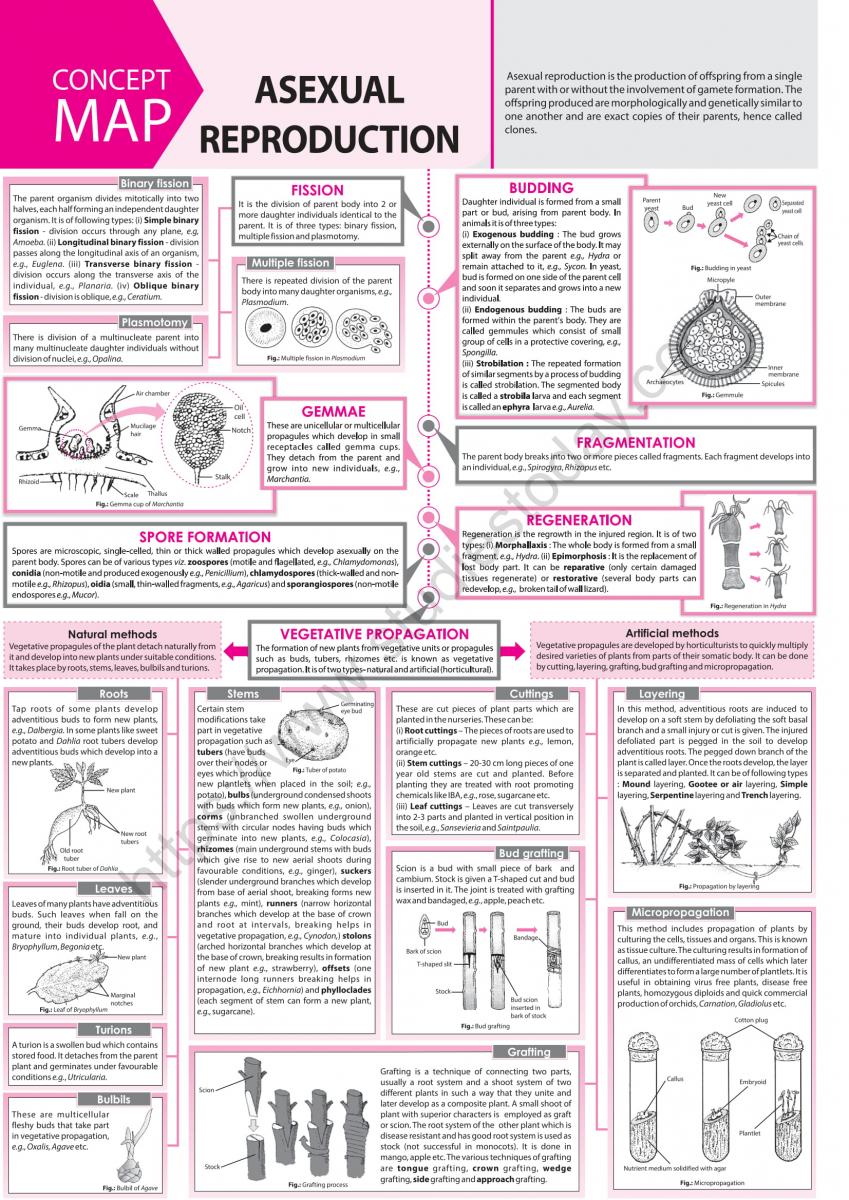
Asexual Reproduction Concept Map (text version)
Asexual reproduction is the production of offspring from a single parent with or without the involvement of gamete formation. The offspring produced are morphologically and genetically similar to one another and are exact copies of their parents, hence called clones.
Fission
It is the division of a parent body into 2 or more daughter individuals identical to the parent. It is of three types: binary fission, multiple fission and plasmotomy.
Binary fission: The parent organism divides mitotically into two halves, each half forming an independent daughter organism. It is of following types: (i) Simple binary fission - division occurs through any plane, e.g., Amoeba. (ii) Longitudinal binary fission - division passes along the longitudinal axis of an organism, e.g., Euglena. (iii) Transverse binary fission - division occurs along the transverse axis of the individual, e.g., Planaria. (iv) Oblique binary fission - division is oblique, e.g., Ceratium.
Multiple fission: There is repeated division of the parent body into many daughter organisms, e.g., Plasmodium.
Plasmotomy: There is division of a multinucleate parent into many multinucleate daughter individuals without division of nuclei, e.g., Opalina.
Budding
Daughter individual is formed from a small part or bud, arising from parent body. In animals it is of three types:
(i) Exogenous budding: The bud grows externally on the surface of the body. It may split away from parent body, e.g., Hydra, or remain attached to it, e.g., Sycon. In yeast, bud is formed on one side of the parent cell and soon it separates and grows into a new individual.
(ii) Endogenous budding: The buds are formed within the parent's body. They are called gemmules which consist of small group of cells in a protective covering, e.g., Spongilla.
(iii) Strobilation: The repeated formation of similar segments by a process of budding is called strobilation. The segmented body is called a strobila larva and each segment is called an ephyra larva, e.g., Aurelia.
Gemmae
These are unicellular or multicellular propagules which develop in small receptacles called gemma cups. They detach from the parent and grow into new individuals, e.g., Marchantia.
Fragmentation
The parent body breaks into two or more pieces called fragments. Each fragment develops into an individual, e.g., Spirogyra, Rhizopus etc.
Regeneration
Regeneration is the regrowth in the injured region. It is of two types: (i) Morphallaxis: The whole body is formed from a small fragment, e.g., Hydra. (ii) Epimorphosis: It is the replacement of lost body part. It can be reparative (only certain damaged tissues regenerate) or restorative (several body parts can redevelop, e.g., broken tail of wall lizard).
Spore Formation
Spores are microscopic, single-celled, thin or thick walled propagules which develop asexually on the parent body. Spores can be of various types viz. zoospores (motile and flagellated, e.g., Chlamydomonas), conidia (non-motile and produced exogenously e.g., Penicillium), chlamydospores (thick-walled and non-motile e.g., Rhizopus), oidia (small, thin-walled fragments, e.g., Agaricus) and sporangiospores (non-motile endospores e.g., Mucor).
Vegetative Propagation
The formation of new plants from vegetative units or propagules such as buds, tubers, rhizomes etc. is known as vegetative propagation. It is of two types - natural and artificial (horticultural).
Natural methods: Vegetative propagules of the plant detach naturally from it and develop into new plants under suitable conditions. It takes place by roots, stems, leaves, bulbils and turions.
Roots: Tap roots of some plants develop adventitious buds to form new plants, e.g., Dalbergia. In some plants like sweet potato and Dahlia root tubers develop adventitious buds which develop into a new plants.
Leaves: Leaves of many plants have adventitious buds. Such leaves when fall on the ground, their buds develop root, and mature into individual plants, e.g., Bryophyllum, Begonia etc.
Turions: A turion is a swollen bud which contains stored food. It detaches from the parent plant and germinates under favourable conditions e.g., Utricularia.
Bulbils: These are multicellular fleshy buds that take part in vegetative propagation, e.g., Oxalis, Agave etc.
Stems: Certain stem modifications take part in vegetative propagation such as tubers (have buds over their nodes or eyes which produce new plantlets when placed in the soil; e.g., potato), bulbs (underground condensed shoots with buds which form new plants, e.g., onion), corms (unbranched swollen underground stems with circular nodes having buds which germinate into new plants, e.g., Colocasia), rhizomes (main underground stems with buds which give rise to new aerial shoots during favourable conditions, e.g., ginger), suckers (slender underground branches which develop from base of aerial shoot, breaking forms new plants, e.g., mint), runners (narrow horizontal branches which develop at the base of crown and root at intervals, breaking helps in vegetative propagation, e.g., Cynodon), stolons (arched horizontal branches which develop at the base of crown, breaking results in formation of new plant e.g., strawberry), offsets (one internode long runners breaking helps in propagation, e.g., Eichhornia) and phylloclades (each segment of stem can form a new plant, e.g., sugarcane).
Artificial methods: Vegetative propagules are developed by horticulturists to quickly multiply desired varieties of plants from parts of their somatic body. It can be done by cutting, layering, grafting, bud grafting and micropropagation.
Cuttings: These are cut pieces of plants which are planted in the nurseries. These can be:
(i) Root cuttings - The pieces of roots are used to artificially propagate new plants e.g., lemon, orange etc.
(ii) Stem cuttings - 20-30 cm long pieces of one year old stems are cut and planted. Before planting they are treated with root promoting chemicals like IBA, e.g., rose, sugarcane etc.
(iii) Leaf cuttings - Leaves are cut transversely into 2-3 parts and planted in vertical position in the soil, e.g., Sansevieria and Saintpaulia.
Bud grafting: Scion is a bud with small piece of bark and cambium. Stock is given a T-shaped cut and bud is inserted in it. The joint is treated with grafting wax and bandaged, e.g., apple, peach etc.
Layering: In this method, adventitious roots are induced to develop on a soft stem by defoliating the soft basal branch and a small injury or cut is given. The injured defoliated part is pegged in the soil to develop adventitious roots. The pegged down branch of the plant is called layer. Once the roots develop, the layer is separated and planted. It can be of following types: Mound layering, Gootee or air layering, Simple layering, Serpentine layering and Trench layering.
Micropropagation: This method includes propagation of plants by culturing the cells, tissues and organs. This is known as tissue culture. The culturing results in formation of callus, an undifferentiated mass of cells which later differentiates to form a large number of plantlets. It is useful in obtaining virus free plants, disease free plants, homozygous diploids and quick commercial production of orchids, Carnation, Gladiolus etc.
Grafting: Grafting is a technique of connecting two parts, usually a root system and a shoot system of two different plants in such a way that they unite and later develop as a composite plant. A small shoot of plant with superior characters is employed as graft or scion. The root system of the other plant which is disease resistant and has good root system is used as stock (not successful in monocots). It is done in mango, apple etc. The various techniques of grafting are tongue grafting, crown grafting, wedge grafting, side grafting and approach grafting.
Free NEET Study Guides: NEET Biology Asexual Reproduction
Core Study Kit: NEET Biology Asexual Reproduction
Review targeted study resources for Asexual Reproduction tailored for NEET learners. Utilizing these structured notes and quick-revision tools ensures complete alignment with current NEET evaluation standards.
NCERT-Aligned Solutions for Asexual Reproduction
Designed around the official curriculum, these study guides guarantee standard compliance. Reviewing step-by-step solutions clarifies complex sub-topics within Asexual Reproduction and demystifies standard marking schemes for Biology evaluations.
Next Steps in Your Exam Preparation
Wrap up your chapter revision by testing your knowledge against standard objective question formats. Explore our full library of free, up-to-date sample papers and online assessments to secure top grades in your NEET examinations.
FAQs
Our advanced study package for Asexual Reproduction includes detailed concepts, diagrams, Mind Maps, and explanation of complex topics to ensure NEET students learn as per syllabus for 2026 exams.
The Mind Maps provided for Asexual Reproduction act as visual anchors which will help faster recall during high-pressure exams.
Yes, teachers use our NEET Biology resources for lesson planning as they are in simple language and have lot of solved examples.
Yes, You can download the complete, mobile-friendly PDF of the Biology Asexual Reproduction advanced resources for free.
Yes, our subject matter experts have updated the Asexual Reproduction material to align with the rationalized NCERT textbooks and have removed deleted topics and added new competency-based questions.