

Download NEET NEET Biology Useful Resources
Explore structured advanced study materials through the NEET Biology Asexual Reproduction Concept Map Set 01. Tailored for NEET learners, utilizing these Biology resources ensures thorough preparation and strengthens foundational knowledge before final NEET evaluations.
Access NEET Study Guides and Summaries
Access the complete useful resource PDF for NEET Biology below. Regular practice with these targeted academic notes builds familiarity with complex topics and helps secure higher marks in final school evaluations.
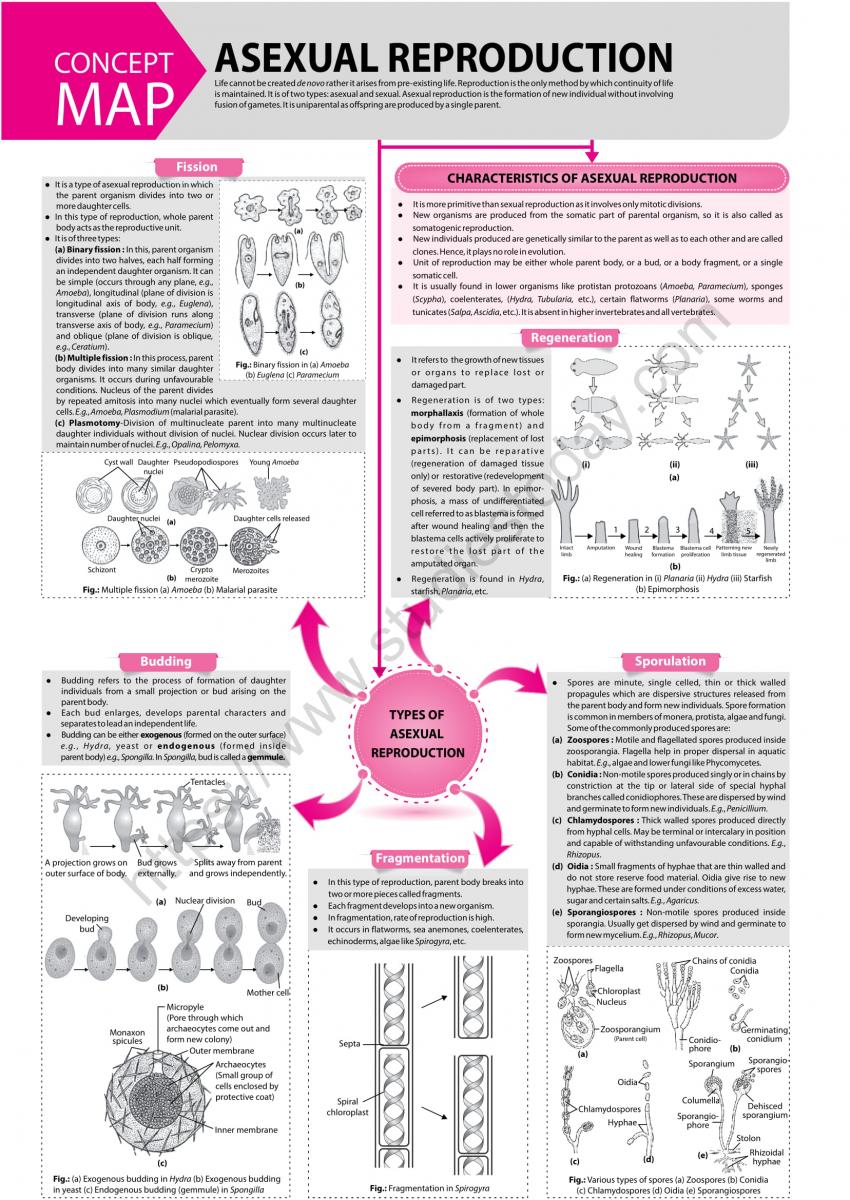
Asexual Reproduction: Concept Map
Life cannot be created de novo rather it arises from pre-existing life. Reproduction is the only method by which continuity of life is maintained. It is of two types: asexual and sexual. Asexual reproduction is the formation of new individual without involving fusion of gametes. It is uniparental as offsprings are produced by a single parent.
Characteristics of Asexual Reproduction
- It is more primitive than sexual reproduction as it involves only mitotic divisions.
- New organisms are produced from the somatic part of parental organism, so it is also called as somatogenic reproduction.
- New individuals produced are genetically similar to the parent as well as to each other and are called clones. Hence, it plays no role in evolution.
- Unit of reproduction may be either whole parent body, or a bud, or a body fragment, or a single somatic cell.
- It is usually found in lower organisms like protistan protozoans (Amoeba, Paramecium), sponges (Scypha), coelenterates (Hydra, Tubularia, etc.), certain flatworms (Planaria), some worms and tunicates (Salpa, Ascidia, etc.). It is absent in higher invertebrates and all vertebrates.
Types of Asexual Reproduction
Fission
- It is a type of asexual reproduction in which the parent organism divides into two or more daughter cells.
- In this type of reproduction, whole parent body acts as the reproductive unit.
- It is of three types:
- (a) Binary fission : In this, parent organism divides into two halves, each half forming an independent daughter organism. It can be simple (occurs through any plane, e.g., Amoeba), longitudinal (plane of division is longitudinal axis of body, e.g., Euglena), transverse (plane of division runs along transverse axis of body, e.g., Paramecium) and oblique (plane of division is oblique, e.g., Ceratium).
- (b) Multiple fission : In this process, parent body divides into many similar daughter organisms. It occurs during unfavourable conditions. Nucleus of the parent divides by repeated amitosis into many nuclei which eventually form several daughter cells. E.g., Amoeba, Plasmodium (malarial parasite).
- (c) Plasmotomy-Division of multinucleate parent into many multinucleate daughter individuals without division of nuclei. Nuclear division occurs later to maintain number of nuclei. E.g., Opalina, Pelomyxa.
Figures: binary fission in (a) Amoeba (b) Euglena (c) Paramecium; multiple fission (a) Amoeba (cyst wall, daughter nuclei, pseudopodiospores, young Amoeba, daughter cells released) (b) malarial parasite (schizont, crypto merozoite, merozoites).
Regeneration
- It refers to the growth of new tissues or organs to replace lost or damaged part.
- Regeneration is of two types: morphallaxis (formation of whole body from a fragment) and epimorphosis (replacement of lost parts). It can be reparative (regeneration of damaged tissue only) or restorative (redevelopment of severed body part). In epimorphosis, a mass of undifferentiated cell referred to as blastema is formed after wound healing and then the blastema cells actively proliferate to restore the lost part of the amputated organ.
- Regeneration is found in Hydra, starfish, Planaria, etc.
Figure: (a) Regeneration in (i) Planaria (ii) Hydra (iii) Starfish; (b) Epimorphosis (intact limb, amputation, wound healing, blastema formation, blastema cell proliferation, patterning new limb tissue, newly regenerated limb).
Budding
- Budding refers to the process of formation of daughter individuals from a small projection or bud arising on the parent body.
- Each bud enlarges, develops parental characters and separates to lead an independent life.
- Budding can be either exogenous (formed on the outer surface) e.g., Hydra, yeast or endogenous (formed inside parent body) e.g., Spongilla. In Spongilla, bud is called a gemmule.
Figures: (a) Exogenous budding in Hydra (a projection grows on outer surface of body, bud grows externally, splits away from parent and grows independently); (b) Exogenous budding in yeast (developing bud, nuclear division, bud, mother cell); (c) Endogenous budding (gemmule) in Spongilla (micropyle, outer membrane, archaeocytes, inner membrane, monaxon spicules).
Fragmentation
- In this type of reproduction, parent body breaks into two or more pieces called fragments.
- Each fragment develops into a new organism.
- In fragmentation, rate of reproduction is high.
- It occurs in flatworms, sea anemones, coelenterates, echinoderms, algae like Spirogyra, etc.
Figure: fragmentation in Spirogyra (septa, spiral chloroplast).
Sporulation
Spores are minute, single celled, thin or thick walled propagules which are dispersive structures released from the parent body and form new individuals. Spore formation is common in members of monera, protista, algae and fungi. Some of the commonly produced spores are:
- (a) Zoospores : Motile and flagellated spores produced inside zoosporangia. Flagella help in proper dispersal in aquatic habitat. E.g., algae and lower fungi like Phycomycetes.
- (b) Conidia : Non-motile spores produced singly or in chains by constriction at the tip or lateral side of special hyphal branches called conidiophores. These are dispersed by wind and germinate to form new individuals. E.g., Penicillium.
- (c) Chlamydospores : Thick walled spores produced directly from hyphal cells. May be terminal or intercalary in position and capable of withstanding unfavourable conditions. E.g., Rhizopus.
- (d) Oidia : Small fragments of hyphae that are thin walled and do not store reserve food material. Oidia give rise to new hyphae. These are formed under conditions of excess water, sugar and certain salts. E.g., Agaricus.
- (e) Sporangiospores : Non-motile spores produced inside sporangia. Usually get dispersed by wind and germinate to form new mycelium. E.g., Rhizopus, Mucor.
Figure: various types of spores (a) Zoospores (b) Conidia (c) Chlamydospores (d) Oidia (e) Sporangiospores.
Useful Resources and Notes for NEET Biology Asexual Reproduction
Core Study Kit: NEET Biology Asexual Reproduction
Access comprehensive study material for Asexual Reproduction, including revision notes, concept maps, and high-probability questions. These resources are designed in alignment with the latest 2026 NEET syllabus for NEET Biology to support effective exam preparation.
NCERT-Aligned Solutions for Asexual Reproduction
Each resource draws directly from authorized textbooks to maintain academic accuracy. Evaluating solved examples allows NEET students to master the formal presentation and answer-writing standards expected in upcoming school exams.
Next Steps in Your Exam Preparation
Wrap up your chapter revision by testing your knowledge against standard objective question formats. Explore our full library of free, up-to-date sample papers and online assessments to secure top grades in your NEET examinations.
FAQs
Our advanced study package for Asexual Reproduction includes detailed concepts, diagrams, Mind Maps, and explanation of complex topics to ensure NEET students learn as per syllabus for 2026 exams.
The Mind Maps provided for Asexual Reproduction act as visual anchors which will help faster recall during high-pressure exams.
Yes, teachers use our NEET Biology resources for lesson planning as they are in simple language and have lot of solved examples.
Yes, You can download the complete, mobile-friendly PDF of the Biology Asexual Reproduction advanced resources for free.
Yes, our subject matter experts have updated the Asexual Reproduction material to align with the rationalized NCERT textbooks and have removed deleted topics and added new competency-based questions.