

Official NEET Study Materials for NEET Biology
Review targeted academic resources with the NEET Biology DNA Replication Concept Map. Built according to official NEET standards for the 2026-27 term, these downloadable NEET Biology study materials support effective daily practice and deeper conceptual understanding for DNA Replication.
Advanced Resources for Biology
View or download the dedicated NEET Biology DNA Replication Concept Map resource below. Engaging with these advanced study guides under focused conditions ensures continuous academic progress and mastery of the 2026-27 curriculum for DNA Replication.
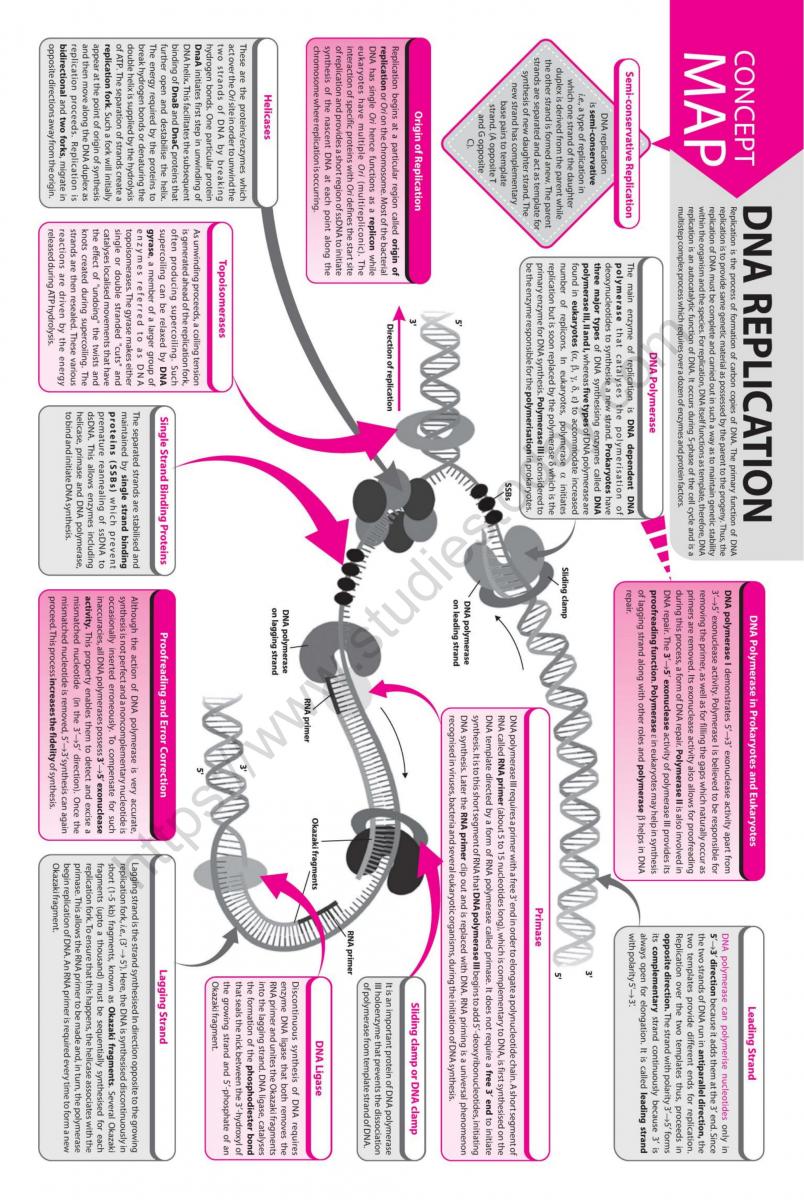
DNA Replication Concept Map (text version)
Replication is the process of formation of carbon copies of DNA. The primary function of DNA replication is to provide same genetic material as possessed by the parent to the progeny. Thus, the replication of DNA must be complete and carried out in such a way as to maintain genetic stability within the organism and the species. For replication, DNA itself functions as template, therefore, DNA replication is an autocatalytic function of DNA. It occurs during S-phase of the cell cycle and is a multistep complex process which requires over a dozen of enzymes and protein factors.
Semi-conservative Replication
DNA replication is semi-conservative i.e., a type of replication in which one strand of the daughter duplex is derived from the parent while the other strand is formed anew. The parent strands are separated and act as template for synthesis of new daughter strand. The new strand has complementary base pairs to template strand (A opposite T and G opposite C).
Origin of Replication
Replication begins at a particular region called origin of replication or Ori on the chromosome. Most of the bacterial DNA has single Ori hence functions as a replicon while eukaryotes have multiple Ori (multirepliconic). The interaction of specific proteins with Ori defines the start site of replication and provides a short region of ssDNA to initiate synthesis of the nascent DNA at each point along the chromosome where replication is occurring.
Helicases
These are the proteins/enzymes which act over the Ori site in order to unwind the two strands of DNA by breaking hydrogen bonds. One particular protein DnaA initiates first step in unwinding of DNA helix. This facilitates the subsequent binding of DnaB and DnaC proteins that further open and destabilise the helix. The energy required by the proteins to break hydrogen bonds or denaturing the double helix is supplied by the hydrolysis of ATP. The separation of strands create a replication fork. Such a fork will initially appear at the point of origin of synthesis and then move along the DNA duplex as replication proceeds. Replication is bidirectional and two forks, migrate in opposite directions away from the origin.
Topoisomerases
As unwinding proceeds, a coiling tension is generated ahead of the replication fork, often producing supercoiling. Such supercoiling can be relaxed by DNA gyrase, a member of a larger group of enzymes referred to as DNA topoisomerases. The gyrase makes either single or double stranded "cuts" and catalyses localised movements that have the effect of "undoing" the twists and knots created during supercoiling. The strands are then resealed. These various reactions are driven by the energy released during ATP hydrolysis.
Single Strand Binding Proteins
The separated strands are stabilised and maintained by single strand binding proteins (SSBs) which prevent premature reannealing of ssDNA to dsDNA. This allows enzymes including helicase, primase and DNA polymerase, to bind and initiate DNA synthesis.
DNA Polymerase
The main enzyme of replication is DNA dependent DNA polymerase that catalyses the polymerisation of deoxynucleotides to synthesise a new strand. Prokaryotes have three major types of DNA synthesising enzymes called DNA polymerase III, II and I, whereas five types of DNA polymerase are found in eukaryotes (α, β, γ, δ, ε) to accommodate increased number of replicons. In eukaryotes, polymerase α initiates replication but is soon replaced by the polymerase δ which is the primary enzyme for DNA synthesis. Polymerase III is considered to be the enzyme responsible for the polymerisation in prokaryotes.
DNA Polymerase in Prokaryotes and Eukaryotes
DNA polymerase I demonstrates 5'→3' exonuclease activity apart from 3'→5' exonuclease activity. Polymerase I is believed to be responsible for removing the primer, as well as for filling the gaps which naturally occur as primers are removed. Its exonuclease activity also allows for proofreading during this process, a form of DNA repair. Polymerase II is also involved in DNA repair. The 3'→5' exonuclease activity of polymerase III provides its proofreading function. Polymerase ε in eukaryotes may help in synthesis of lagging strand along with other roles and polymerase β helps in DNA repair.
Leading Strand
DNA polymerase can polymerise nucleotides only in 5'→3' direction because it adds them at the 3' end. Since the two strands of DNA run in antiparallel direction, the two templates provide different ends for replication. Replication over the two templates thus, proceeds in opposite direction. The strand with polarity 3'→5' forms its complementary strand continuously because 3' is always open for elongation. It is called leading strand with polarity 5'→3'.
Primase
DNA polymerase III requires a primer with a free 3' end in order to elongate a polynucleotide chain. A short segment of RNA called RNA primer (about 5 to 15 nucleotides long), which is complementary to DNA, is first synthesised on the DNA template directed by a form of RNA polymerase called primase. It does not require a free 3' end to initiate synthesis. It is to this short segment of RNA that DNA polymerase III begins to add 5'-deoxyribonucleotides, initiating DNA synthesis. Later the RNA primer clip out and is replaced with DNA. RNA priming is a universal phenomenon recognised in viruses, bacteria and several eukaryotic organisms, during the initiation of DNA synthesis.
Sliding Clamp or DNA Clamp
It is an important protein of DNA polymerase III holoenzyme that prevents the dissociation of polymerase from template strand of DNA.
Proofreading and Error Correction
Although the action of DNA polymerase is very accurate, synthesis is not perfect and a noncomplementary nucleotide is occasionally inserted erroneously. To compensate for such inaccuracies, all DNA polymerases possess 3'→5' exonuclease activity. This property enables them to detect and excise a mismatched nucleotide (in the 3'→5' direction). Once the mismatched nucleotide is removed, 5'→3' synthesis can again proceed. This process increases the fidelity of synthesis.
Lagging Strand
Lagging strand is the strand synthesised in direction opposite to the growing replication fork, i.e., (3' → 5'). Here, the DNA is synthesised discontinuously in short (1-5 kb) fragments, known as Okazaki fragments. Several Okazaki fragments (upto a thousand) must be sequentially synthesised for each replication fork. To ensure that this happens, the helicase associates with the primase. This allows the RNA primer to be made and, in turn, the polymerase begin replication of DNA. An RNA primer is required every time to form a new Okazaki fragment.
DNA Ligase
Discontinuous synthesis of DNA requires enzyme DNA ligase that both removes the RNA primer and unites the Okazaki fragments into the lagging strand. DNA ligase, catalyses the formation of the phosphodiester bond that seals the nick between the 3'-hydroxyl of the growing strand and 5'-phosphate of an Okazaki fragment.
Fig: Replication fork (direction of replication, SSBs, sliding clamp, DNA polymerase on leading strand, DNA polymerase on lagging strand, RNA primer, Okazaki fragments).
Biology NEET Exam Resources: DNA Replication
Quick Revision Material for DNA Replication
Review targeted study resources for DNA Replication tailored for NEET learners. Utilizing these structured notes and quick-revision tools ensures complete alignment with current NEET evaluation standards.
Expert Notes and Solved Exam Questions
Designed around the official curriculum, these study guides guarantee standard compliance. Reviewing step-by-step solutions clarifies complex sub-topics within DNA Replication and demystifies standard marking schemes for Biology evaluations.
Additional Study Resources for NEET
Maximize your grade potential by utilizing NEET Biology practice papers in tandem with these structured notes. All printable assignments and interactive mock tests on our platform are updated for the 2026 session and available free of charge.
FAQs
Our advanced study package for DNA Replication includes detailed concepts, diagrams, Mind Maps, and explanation of complex topics to ensure NEET students learn as per syllabus for 2026 exams.
The Mind Maps provided for DNA Replication act as visual anchors which will help faster recall during high-pressure exams.
Yes, teachers use our NEET Biology resources for lesson planning as they are in simple language and have lot of solved examples.
Yes, You can download the complete, mobile-friendly PDF of the Biology DNA Replication advanced resources for free.
Yes, our subject matter experts have updated the DNA Replication material to align with the rationalized NCERT textbooks and have removed deleted topics and added new competency-based questions.