

Download NEET NEET Biology Useful Resources
Access comprehensive study materials and useful resources for Earthworm using the NEET Biology Earthworm Concept Map. Designed to align with the 2026-27 NEET academic guidelines, these advanced resources help NEET Biology students reinforce core concepts beyond standard textbooks.
Access NEET Study Guides and Summaries
Access the complete useful resource PDF for NEET Biology below. Regular practice with these targeted academic notes builds familiarity with complex topics and helps secure higher marks in final school evaluations.
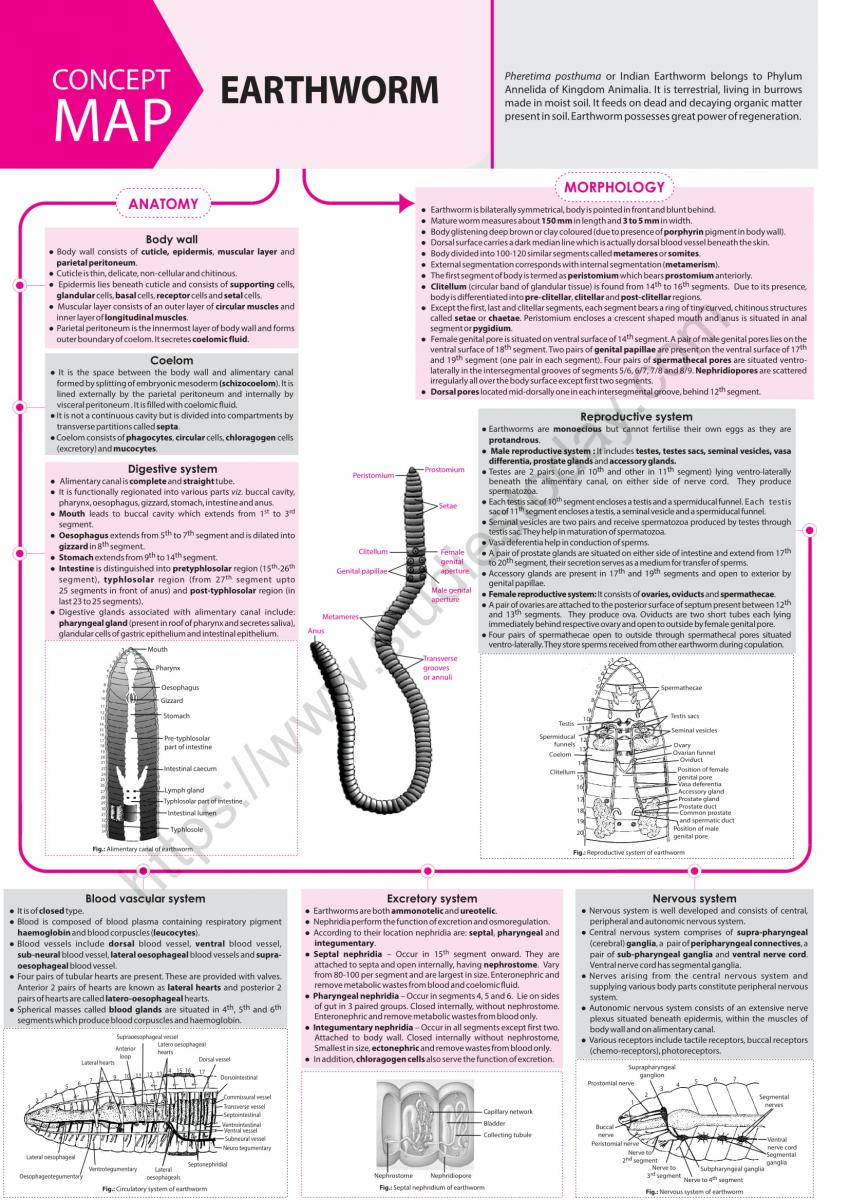
Earthworm: Concept Map
Pheretima posthuma or Indian Earthworm belongs to Phylum Annelida of Kingdom Animalia. It is terrestrial, living in burrows made in moist soil. It feeds on dead and decaying organic matter present in soil. Earthworm possesses great power of regeneration.
Morphology
- Earthworm is bilaterally symmetrical, body is pointed in front and blunt behind.
- Mature worm measures about 150 mm in length and 3 to 5 mm in width.
- Body glistening deep brown or clay coloured (due to presence of porphyrin pigment in body wall).
- Dorsal surface carries a dark median line which is actually dorsal blood vessel beneath the skin.
- Body divided into 100-120 similar segments called metameres or somites.
- External segmentation corresponds with internal segmentation (metamerism).
- The first segment of body is termed as peristomium which bears prostomium anteriorly.
- Clitellum (circular band of glandular tissue) is found from 14th to 16th segments. Due to its presence, body is differentiated into pre-clitellar, clitellar and post-clitellar regions.
- Except the first, last and clitellar segments, each segment bears a ring of tiny curved, chitinous structures called setae or chaetae. Peristomium encloses a crescent shaped mouth and anus is situated in anal segment or pygidium.
- Female genital pore is situated on ventral surface of 14th segment. A pair of male genital pores lies on the ventral surface of 18th segment. Two pairs of genital papillae are present on the ventral surface of 17th and 19th segment (one pair in each segment). Four pairs of spermathecal pores are situated ventro-laterally in the intersegmental grooves of segments 5/6, 6/7, 7/8 and 8/9. Nephridiopores are scattered irregularly all over the body surface except first two segments.
- Dorsal pores located mid-dorsally one in each intersegmental groove, beginning between 12th and 13th segment.
Labelled external features in the figure: peristomium, prostomium, setae, clitellum, female genital aperture, male genital aperture, genital papillae, metameres, transverse grooves or annuli, anus.
Anatomy
Body wall
- Body wall consists of cuticle, epidermis, muscular layer and parietal peritoneum.
- Cuticle is thin, delicate, non-cellular and chitinous.
- Epidermis lies beneath cuticle and consists of supporting cells, glandular cells, basal cells, receptor cells and setal cells.
- Muscular layer consists of an outer layer of circular muscles and inner layer of longitudinal muscles.
- Parietal peritoneum is the innermost layer of body wall and forms outer boundary of coelom. It secretes coelomic fluid.
Coelom
- It is the space between the body wall and alimentary canal formed by splitting of embryonic mesoderm (schizocoelom). It is lined externally by the parietal peritoneum and internally by visceral peritoneum. It is filled with coelomic fluid.
- It is not a continuous cavity but is divided into compartments by transverse partitions called septa.
- Coelom consists of phagocytes, circular cells, chloragogen cells (excretory) and mucocytes.
Digestive system
- Alimentary canal is complete and straight tube.
- It is functionally regionated into various parts viz. buccal cavity, pharynx, oesophagus, gizzard, stomach, intestine and anus.
- Mouth leads to buccal cavity which extends from 1st to 3rd segment.
- Oesophagus extends from 5th to 7th segment and is dilated into gizzard in 8th segment.
- Stomach extends from 9th to 14th segment.
- Intestine is distinguished into pretyphlosolar region (15th-26th segment), typhlosolar region (from 27th segment upto 25 segments in front of anus) and post-typhlosolar region (in last 23 to 25 segments).
- Digestive glands associated with alimentary canal include: pharyngeal gland (present in roof of pharynx and secretes saliva), glandular cells of gastric epithelium and intestinal epithelium.
Figure: alimentary canal of earthworm (mouth, pharynx, oesophagus, gizzard, stomach, pre-typhlosolar part of intestine, intestinal caecum, lymph gland, typhlosolar part of intestine, intestinal lumen, ventral vessel, typhlosole).
Reproductive system
- Earthworms are monoecious but cannot fertilise their own eggs as they are protandrous.
- Male reproductive system : It includes testes, testes sacs, seminal vesicles, vasa differentia, prostate glands and accessory glands.
- Testes are 2 pairs (one in 10th and other in 11th segment) lying ventro-laterally beneath the alimentary canal, on either side of nerve cord. They produce spermatozoa.
- Each testis sac of 10th segment encloses a testis and a spermiducal funnel. Each testis sac of 11th segment encloses a testis, a seminal vesicle and a spermiducal funnel.
- Seminal vesicles are two pairs and receive spermatozoa produced by testes through testis sac. They help in maturation of spermatozoa.
- Vasa deferentia help in conduction of sperms.
- A pair of prostate glands are situated on either side of intestine and extend from 17th to 20th segment, their secretion serves as a medium for transfer of sperms.
- Accessory glands are present in 17th and 19th segments and open to exterior by genital papillae.
- Female reproductive system: It consists of ovaries, oviducts and spermathecae.
- A pair of ovaries are attached to the posterior surface of septum present between 12th and 13th segments. They produce ova. Oviducts are two short tubes each lying immediately behind respective ovary and open to outside by female genital pore.
- Four pairs of spermathecae open to outside through spermathecal pores situated ventro-laterally. They store sperms received from other earthworm during copulation.
Figure: reproductive system of earthworm (spermathecae, testis, testis sacs, spermiducal funnels, seminal vesicles, coelom, ovary, ovarian funnel, oviduct, clitellum, position of female genital pore, vasa deferentia, accessory gland, prostate gland, prostate duct, common prostatic and spermatic duct, position of male genital pore).
Blood vascular system
- It is of closed type.
- Blood is composed of blood plasma containing respiratory pigment haemoglobin and blood corpuscles (leucocytes).
- Blood vessels include dorsal blood vessel, ventral blood vessel, sub-neural blood vessel, lateral oesophageal blood vessels and supra-oesophageal blood vessel.
- Four pairs of tubular hearts are present. These are provided with valves. Anterior 2 pairs of hearts are known as lateral hearts and posterior 2 pairs of hearts are called latero-oesophageal hearts.
- Spherical masses called blood glands are situated in 4th, 5th and 6th segments which produce blood corpuscles and haemoglobin.
Figure: circulatory system of earthworm (supra-oesophageal vessel, latero-oesophageal hearts, lateral hearts, dorsal vessel, dorso-intestinal, commissural vessel, transverse vessel, septointestinal, ventro-intestinal, ventral vessel, subneural vessel, neuro-tegumentary, ventro-tegumentary, septonephridial, lateral oesophageal, oesophageo-tegumentary).
Excretory system
- Earthworms are both ammonotelic and ureotelic.
- Nephridia perform the function of excretion and osmoregulation.
- According to their location nephridia are: septal, pharyngeal and integumentary.
- Septal nephridia – Occur in 15th segment onward. They are attached to septa and open internally, having nephrostome. Vary from 80-100 per segment and are largest in size. Enteronephric and remove metabolic wastes from blood and coelomic fluid.
- Pharyngeal nephridia – Occur in segments 4, 5 and 6. Lie on sides of gut in 3 paired groups. Closed internally, without nephrostome. Smallest in size, ectonephric and remove wastes from blood only.
- Integumentary nephridia – Occur in all segments except first two. Attached to body wall. Closed internally without nephrostome, Smallest in size, ectonephric and remove wastes from blood only.
- In addition, chloragogen cells also serve the function of excretion.
Figure: septal nephridium of earthworm (nephrostome, nephridiopore, capillary network, bladder, collecting tubule).
Nervous system
- Nervous system is well developed and consists of central, peripheral and autonomic nervous system.
- Central nervous system comprises of supra-pharyngeal (cerebral) ganglia, a pair of peripharyngeal connectives, a pair of sub-pharyngeal ganglia and ventral nerve cord. Ventral nerve cord has segmental ganglia.
- Nerves arising from the central nervous system and supplying various body parts constitute peripheral nervous system.
- Autonomic nervous system consists of an extensive nerve plexus situated beneath epidermis, within the muscles of body wall and on alimentary canal.
- Various receptors include tactile receptors, buccal receptors (chemo-receptors), photoreceptors.
Figure: nervous system of earthworm (supra-pharyngeal ganglion, prostomial nerve, buccal nerve, peristomial nerve, nerve to 2nd, 3rd and 4th segment, subpharyngeal ganglion, ventral nerve cord, segmental ganglia, segmental nerves).
Free NEET Study Guides: NEET Biology Earthworm
Essential Notes for NEET Biology
Explore essential learning tools for NEET Biology Earthworm. This curated collection features in-depth notes and targeted practice questions built around the active 2026 curriculum to streamline your daily revision.
Verified Solutions for NEET Biology
Built using official NCERT guidelines for NEET Biology, these materials provide reliable academic support. Integrating past examination questions and step-by-step solutions helps students understand official NEET grading criteria.
Enhance Accuracy with Online Tests
For peak performance in upcoming evaluations, integrate official Biology sample papers directly into your study schedule. Follow up your revision by attempting online MCQ tests for Earthworm to refine calculation speed and precision.
FAQs
Our advanced study package for Earthworm includes detailed concepts, diagrams, Mind Maps, and explanation of complex topics to ensure NEET students learn as per syllabus for 2026 exams.
The Mind Maps provided for Earthworm act as visual anchors which will help faster recall during high-pressure exams.
Yes, teachers use our NEET Biology resources for lesson planning as they are in simple language and have lot of solved examples.
Yes, You can download the complete, mobile-friendly PDF of the Biology Earthworm advanced resources for free.
Yes, our subject matter experts have updated the Earthworm material to align with the rationalized NCERT textbooks and have removed deleted topics and added new competency-based questions.