

Download NEET NEET Biology Useful Resources
Access comprehensive study materials and useful resources for Frog using the NEET Biology Frog Concept Map. Designed to align with the 2026-27 NEET academic guidelines, these advanced resources help NEET Biology students reinforce core concepts beyond standard textbooks.
Access NEET Study Guides and Summaries
Access the complete useful resource PDF for NEET Biology below. Regular practice with these targeted academic notes builds familiarity with complex topics and helps secure higher marks in final school evaluations.
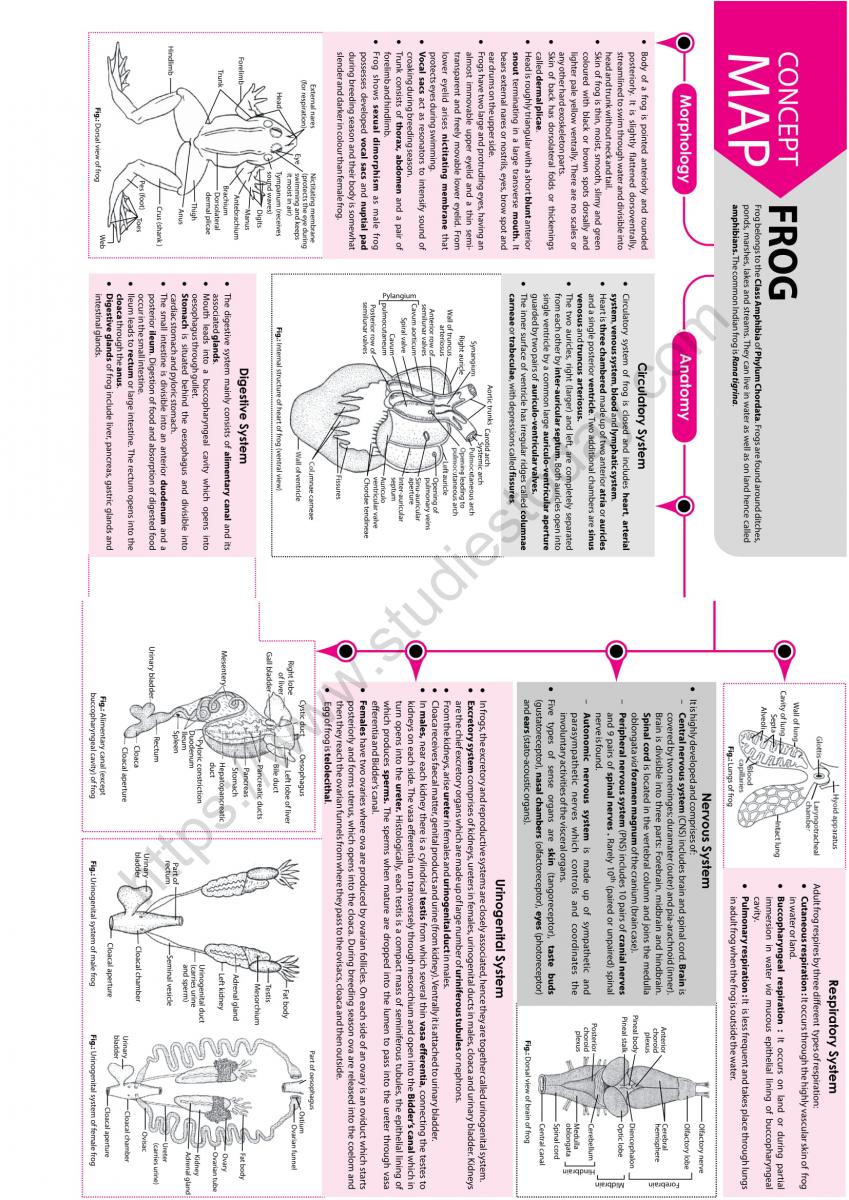
Frog Concept Map (text version)
Frog belongs to the Class Amphibia of Phylum Chordata. Frogs are found around ditches, ponds, marshes, lakes and streams. They can live in water as well as on land hence called amphibians. The common Indian frog is Rana tigrina.
Morphology
Body of a frog is pointed anteriorly and rounded posteriorly. It is slightly flattened dorsoventrally, streamlined to swim through water and divisible into head and trunk without neck and tail.
Skin of frog is thin, moist, smooth, slimy and green coloured with black or brown spots dorsally and lighter pale yellow ventrally. There are no scales or any other hard exoskeleton parts.
Skin of back has dorsolateral folds or thickenings called dermal plicae.
Head is roughly triangular with a short blunt anterior snout terminating in a large transverse mouth. It bears external nares or nostrils, eyes, brow spot and ear drums on the upper side.
Frogs have two large and protruding eyes, having an almost immovable upper eyelid and a thin semi-transparent and freely movable lower eyelid. From lower eyelid arises nictitating membrane that protects eyes during swimming.
Vocal sacs act as resonators to intensify sound of croaking during breeding season.
Trunk consists of thorax, abdomen and a pair of forelimb and hindlimb.
Frog shows sexual dimorphism as male frog possesses developed vocal sacs and nuptial pad during breeding season and their body is somewhat slender and darker in colour than female frog.
Fig: Dorsal view of frog (labelled: external nares (for respiration), head, eye, nictitating membrane (protects the eye during swimming and keeps it moist in air), tympanum (receives sound waves), digits, manus, antebrachium, brachium, dorsolateral dermal plicae, forelimb, trunk, thigh, anus, hindlimb, crus (shank), pes (foot), toes, web).
Anatomy
Circulatory System
Circulatory system of frog is closed and includes heart, arterial system, venous system, blood and lymphatic system.
Heart is three chambered made up of two anterior atria or auricles and a single posterior ventricle. Two additional chambers are sinus venosus and truncus arteriosus.
The two auricles, right (larger) and left, are completely separated from each other by inter-auricular septum. Both auricles open into single ventricle by a common large auriculo-ventricular aperture guarded by two pairs of auriculo-ventricular valves.
The inner surface of ventricle has irregular ridges called columnae carneae or trabeculae, with depressions called fissures.
Fig: Internal structure of heart of frog (ventral view) (labelled: aortic trunks, carotid arch, systemic arch, pulmocutaneous arch, synangium, right auricle, left auricle, wall of truncus arteriosus, anterior and posterior row of semilunar valves, cavum aorticum, spiral valve, cavum pulmocutaneum (pylangium), opening of pulmonary veins, sinu-auricular aperture, inter-auricular septum, auriculo-ventricular valve, chordae tendineae, fissures, columnae carneae, wall of ventricle).
Digestive System
The digestive system mainly consists of alimentary canal and its associated glands.
Mouth leads into a buccopharyngeal cavity which opens into oesophagus through gullet.
Stomach is situated behind the oesophagus and divisible into cardiac stomach and pyloric stomach.
The small intestine is divisible into an anterior duodenum and a posterior ileum. Digestion of food and absorption of digested food occur in the small intestine.
Ileum leads to rectum or large intestine. The rectum opens into the cloaca through the anus.
Digestive glands of frog include liver, pancreas, gastric glands and intestinal glands.
Fig: Alimentary canal (except buccopharyngeal cavity) of frog (labelled: oesophagus, right lobe and left lobe of liver, gall bladder, cystic duct, bile duct, pancreatic ducts, stomach, pancreas, pyloric constriction, duodenum, ileum, hepatopancreatic duct, spleen, mesentery, urinary bladder, rectum, cloaca, cloacal aperture).
Respiratory System
Adult frog respires by three different types of respiration:
Cutaneous respiration: It occurs through the highly vascular skin of frog in water or land.
Buccopharyngeal respiration: It occurs on land or during partial immersion in water via mucous epithelial lining of buccopharyngeal cavity.
Pulmonary respiration: It is less frequent and takes place through lungs in adult frog when the frog is outside the water.
Fig: Lungs of frog (hyoid apparatus, glottis, laryngotracheal chamber, wall of lung, cavity of lung, septa, alveoli, blood capillaries, intact lung).
Nervous System
It is highly developed and comprises of:
Central nervous system (CNS) includes brain and spinal cord. Brain is covered by two meninges; duramater (outer) and pia-arachnoid (inner). Brain is divisible into three parts: Forebrain, midbrain and hindbrain. Spinal cord is located in the vertebral column and joins the medulla oblongata via foramen magnum of the cranium (brain case).
Peripheral nervous system (PNS) includes 10 pairs of cranial nerves and 9 pairs of spinal nerves. Rarely 10th (paired or unpaired) spinal nerve is found.
Autonomic nervous system is made up of sympathetic and parasympathetic nerves which controls and coordinates the involuntary activities of the visceral organs.
Five types of sense organs are skin (tangoreceptor), taste buds (gustatoreceptor), nasal chambers (olfactoreceptor), eyes (photoreceptor) and ears (stato-acoustic organs).
Fig: Dorsal view of brain of frog (olfactory nerve, olfactory lobe, cerebral hemisphere, diencephalon (forebrain), optic lobe (midbrain), cerebellum, medulla oblongata (hindbrain), pineal body, pineal stalk, anterior and posterior choroid plexus, spinal cord, central canal).
Urinogenital System
In frogs, the excretory and reproductive systems are closely associated, hence they are together called urinogenital system.
Excretory system comprises of kidneys, ureters in females, urinogenital ducts in males, cloaca and urinary bladder. Kidneys are the chief excretory organs which are made up of large number of uriniferous tubules or nephrons.
From the kidneys, arise ureter in females and urinogenital duct in males.
Cloaca receives faecal matter, genital products and urine (from kidney). Ventrally it is attached to urinary bladder.
In males, near each kidney there is a cylindrical testis from which several thin vasa efferentia, connecting the testes to kidneys on each side. The vasa efferentia run transversely through mesorchium and open into the Bidder's canal which in turn opens into the ureter. Histologically, each testis is a compact mass of seminiferous tubules, the epithelial lining of which produces sperms. The sperms when mature are dropped into the lumen to pass into the ureter through vasa efferentia and Bidder's canal.
Females have two ovaries where ova are produced by ovarian follicles. On each side of an ovary is an oviduct which starts anteriorly and forms uterus, which opens into the cloaca. During breeding season ova are released into the coelom and then they reach the ovarian funnels from where they pass to the ovisacs, cloaca and then outside.
Egg of frog is telolecithal.
Figs: Urinogenital system of male frog (kidney, testis, mesorchium, fat body, adrenal gland, urinogenital duct (carries urine and sperm), seminal vesicle, urinary bladder, cloaca, cloacal aperture) and of female frog (ovary, ovarian tubule, fat body, kidney, adrenal gland, ureter (carries urine), ovisac, oviduct, ovarian funnel, ostium, cloaca, cloacal aperture).
NEET NEET Biology Study Material: Frog
Core Study Kit: NEET Biology Frog
Access comprehensive study material for Frog, including revision notes, concept maps, and high-probability questions. These resources are designed in alignment with the latest 2026 NEET syllabus for NEET Biology to support effective exam preparation.
NCERT-Aligned Solutions for Frog
Built using official NCERT guidelines for NEET Biology, these materials provide reliable academic support. Integrating past examination questions and step-by-step solutions helps students understand official NEET grading criteria.
Next Steps in Your Exam Preparation
Wrap up your chapter revision by testing your knowledge against standard objective question formats. Explore our full library of free, up-to-date sample papers and online assessments to secure top grades in your NEET examinations.
FAQs
Our advanced study package for Frog includes detailed concepts, diagrams, Mind Maps, and explanation of complex topics to ensure NEET students learn as per syllabus for 2026 exams.
The Mind Maps provided for Frog act as visual anchors which will help faster recall during high-pressure exams.
Yes, teachers use our NEET Biology resources for lesson planning as they are in simple language and have lot of solved examples.
Yes, You can download the complete, mobile-friendly PDF of the Biology Frog advanced resources for free.
Yes, our subject matter experts have updated the Frog material to align with the rationalized NCERT textbooks and have removed deleted topics and added new competency-based questions.