

NEET Biology Study Guide: NEET Biology Floral Morphology Concept Map
Access comprehensive study materials and useful resources for Floral Morphology using the NEET Biology Floral Morphology Concept Map. Designed to align with the 2026-27 NEET academic guidelines, these advanced resources help NEET Biology students reinforce core concepts beyond standard textbooks.
Download Floral Morphology Study Material PDF
Access the complete useful resource PDF for NEET Biology below. Regular practice with these targeted academic notes builds familiarity with complex topics and helps secure higher marks in final school evaluations.
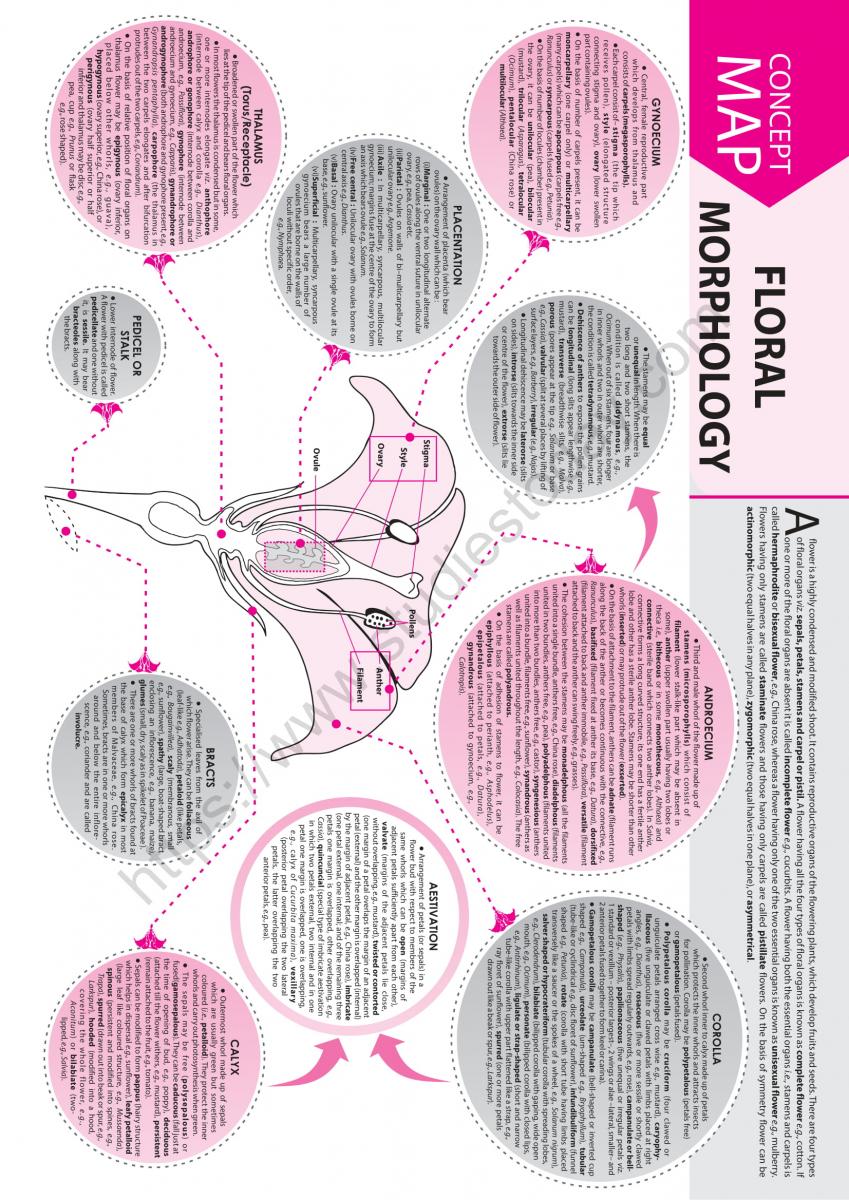
Floral Morphology Concept Map (text version)
A flower is a highly condensed and modified shoot. It contains reproductive organs of the flowering plants, which develop fruits and seeds. There are four types of floral organs viz. sepals, petals, stamens and carpel or pistil. A flower having all the four types of floral organs is known as complete flower e.g., cotton. If one or more of the floral organs are absent it is called incomplete flower e.g., cucurbits. A flower having both the essential organs i.e., stamens and carpels is called hermaphrodite or bisexual flower, e.g., China rose, whereas a flower having only one of the two essential organs is known as unisexual flower e.g., mulberry. Flowers having only stamens are called staminate flowers and those having only carpels are called pistillate flowers. On the basis of symmetry flower can be actinomorphic (two equal halves in any plane), zygomorphic (two equal halves in one plane), or asymmetrical.
Pedicel or Stalk
Lower internode of flower. A flower with pedicel is called pedicellate and one without it, is sessile. It may bear bracteoles along with the bracts.
Bracts
Specialised leaves from the axil of which flower arise. They can be foliaceous (leaf-like e.g., Adhatoda), petaloid (like petals, e.g., Bougainvillea), scaly (membranous, small e.g., sunflower), spathy (large, boat-shaped bract enclosing an inflorescence, e.g., banana, maize), glumes (small, dry, scaly as in spikelet of Poaceae).
There are one or more whorls of bracts found at the base of calyx which form epicalyx in most members of Malvaceae, e.g., China rose. Sometimes, bracts are in one or more whorls around and below the entire inflorescence, e.g., coriander and are called involucre.
Thalamus (Torus/Receptacle)
Broadened or swollen part of the flower which lies at the tip of the pedicel and bears floral organs.
In most flowers the thalamus is condensed but in some, one or more internodes elongate viz. anthophore (internode between calyx and corolla e.g., Dianthus), androphore or gonophore (internode between corolla and androecium, e.g., Passiflora), gynophore (internode between androecium and gynoecium, e.g., Capparis), gynandrophore or androgynophore (both androphore and gynophore present, e.g., Gynandropsis pentaphylla), carpophore (the thalamus in between the two carpels elongates and after bifurcation protrudes out of the two carpels, e.g., Coriandrum).
On the basis of relative position of floral organs on thalamus flower may be epigynous (ovary inferior, placed below other whorls, e.g., guava), hypogynous (ovary superior, e.g., China rose), or perigynous (ovary half superior or half inferior and thalamus may be disc e.g., pea, cup e.g., Prunus or flask e.g., rose shaped).
Calyx
Outermost whorl made up of sepals which are usually green but sometimes coloured (i.e., petalloid). They protect the inner whorls and carry out photosynthesis when green.
The sepals may be free (polysepalous) or fused (gamosepalous). They can be caducous (fall just at the time of opening of bud, e.g., poppy), deciduous (attached till the flower withers, e.g., mustard), persistent (remain attached to the fruit, e.g., tomato).
Sepals can be modified to form pappus (hairy structure which helps in dispersal e.g., sunflower), leafy petalloid (large leaf like coloured structure, e.g., Mussaenda), spinous (persistent and modified into spines, e.g., Trapa), spurred (drawn out into beak or spur, e.g., Larkspur), hooded (modified into a hood, covering the whole flower, e.g., Aconitum) or bilabiate (two-lipped, e.g., Salvia).
Corolla
Second whorl inner to calyx made up of petals which protects the inner whorls and attracts insects for pollination. Corolla may be polypetalous (petals free) or gamopetalous (petals fused).
Polypetalous corolla may be cruciform (four clawed or unguiculate petals arranged cross wise e.g., mustard), caryophyllaceous (five unguiculate or clawed petals with limbs placed at right angles, e.g., Dianthus), rosaceous (five or more sessile or shortly clawed petals with limbs spread regularly outwards, e.g., rose), campanulate or bell-shaped (e.g., Physalis), papilionaceous (five unequal or irregular petals viz. 1 standard or vexillum – posterior largest –, 2 wings or alae – lateral, smaller – and 2 anterior petals fused together to form keel or carina).
Gamopetalous corolla may be campanulate (bell-shaped or inverted cup shaped e.g., Campanula), urceolate (urn-shaped e.g., Bryophyllum), tubular (tube-like or cylindrical e.g., disc floret of sunflower), infundibuliform (funnel shaped e.g., Petunia), rotate (corolla with short tube having limbs placed transversely like a saucer or the spokes of a wheel, e.g., Solanum nigrum), salver shaped or hypocrateriform (tubular corolla with spreading lobes, e.g., Clerodendrum), bilabiate (bilipped corolla with gaping, wide open mouth, e.g., Ocimum), personate (bilipped corolla with closed lips, e.g., Antirrhinum), ligulate or strap-shaped (short and narrow tube-like corolla with upper part flattened like a strap, e.g., ray floret of sunflower), spurred (one or more petals drawn out like a beak or spur, e.g., Larkspur).
Aestivation
Arrangement of petals (or sepals) in a flower bud with respect to members of the same whorls which can be open (margins of adjacent petals sufficiently apart from each other), valvate (margins of the adjacent petals lie close, without overlapping, e.g., mustard), twisted or contorted (one margin of a petal overlaps the margin of an adjacent petal (external) and the other margin is overlapped (internal) by the margin of adjacent petal, e.g., China rose), imbricate (one petal external, one internal; and of the remaining three petals one margin is overlapped, other overlapping, e.g., Cassia), quincuncial (special type of imbricate aestivation in which two petals external, two internal and in one petal one margin is overlapped, one is overlapping, e.g., calyx of Cucurbita maxima), vexillary (posterior petal overlapping the two lateral petals, the latter overlapping the two anterior petals, e.g., pea).
Androecium
Third and male whorl of the flower made up of stamens (microsporophylls) which consist of filament (lower stalk-like part which may be absent in some), anther (upper swollen part usually having two lobes or theca i.e., bithecous or in some monothecous, e.g., Althaea) and connective (sterile band which connects two anther lobes). In Salvia, connective forms a long curved structure, its one end has a fertile anther lobe and other has a sterile anther lobe. Stamens may be shorter than other whorls (inserted) or may protrude out of the flower (exserted).
On the basis of attachment to the filament, anthers can be adnate (filament runs along the back of the anther or becomes continuous with the connective, e.g., Ranunculus), basifixed (filament fixed at anther its base, e.g., Datura), dorsifixed (filament attached to back and anther immobile, e.g., Passiflora), versatile (filament attached to back and the anther can swing freely, e.g., grasses).
The cohesion between the stamens may be monadelphous (all the filaments united into a single bundle, anthers free, e.g., China rose), diadelphous (filaments united in two bundles, anthers free, e.g., pea), polyadelphous (filaments united into more than two bundles, anthers free, e.g., castor), syngenesious (anthers united into a bundle, filaments free, e.g., sunflower), synandrous (anthers as well as filaments united throughout the length, e.g., Colocasia). The free stamens are called polyandrous.
On the basis of adhesion of stamens to flower, it can be epiphyllous (attached to perianth, e.g., Asphodelus), epipetalous (attached to petals, e.g., Datura), gynandrous (attached to gynoecium, e.g., Calotropis).
The stamens may be equal or unequal in length. When there is two long and two short stamens, the condition is called didynamous, e.g., Ocimum. When out of six stamens, four are longer in inner whorls and two in outer whorl are shorter, the condition is called tetradynamous, e.g., mustard.
Dehiscence of anthers to expose the pollen grains can be longitudinal (long slits appear lengthwise e.g., mustard), transverse (breadthwise slits, e.g., Malva), porous (pores appear at the tip e.g., Solanum or base e.g., Cassia), valvular (split at several places by lifting of surface layers, e.g., Barberry), irregular (e.g., Najas). Longitudinal dehiscence may be laterorse (slits on sides), introrse (slits towards the inner side or centre of the flower), extrorse (slits lie towards the outer side of flower).
Gynoecium
Central, female reproductive part which develops from thalamus and consists of carpels (megasporophylls). Each carpel consist of – stigma (the tip which receives pollen), style (elongated structure connecting stigma and ovary), ovary (lower swollen part containing ovules).
On the basis of number of carpels present, it can be monocarpellary (one carpel only) or multicarpellary (many carpels) which can be apocarpous (carpels free e.g., Ranunculus) or syncarpous (carpels fused e.g., Petunia).
On the basis of number of locules (chamber) present in the ovary, it can be unilocular (pea), bilocular (mustard), trilocular (Asparagus), tetralocular (Ocimum), pentalocular (China rose) or multilocular (Althaea).
Placentation
Arrangement of placenta (which bear ovules) on the ovary wall which can be:
(i) Marginal: One or two longitudinal alternate rows of ovules along the ventral suture in unilocular ovary, e.g., pea, Cassia etc.
(ii) Parietal: Ovules on walls of bi-multicarpellary but unilocular ovary e.g., Argemone.
(iii) Axile: In multicarpellary, syncarpous, multilocular gynoecium; margins fuse at the centre of the ovary to form an axis which bears ovule e.g., Solanum.
(iv) Free central: Unilocular ovary with ovules borne on central axis e.g., Dianthus.
(v) Basal: Ovary unilocular with a single ovule at its base, e.g., sunflower.
(vi) Superficial: Multicarpellary, syncarpous gynoecium bears a large number of ovules that are borne on the walls of loculi without specific order, e.g., Nymphaea.
Fig: Longitudinal section of a flower (stigma, style, ovary, ovule, pollens, anther, filament).
Biology NEET Exam Resources: Floral Morphology
Core Study Kit: NEET Biology Floral Morphology
Explore essential learning tools for NEET Biology Floral Morphology. This curated collection features in-depth notes and targeted practice questions built around the active 2026 curriculum to streamline your daily revision.
NCERT-Aligned Solutions for Floral Morphology
Built using official NCERT guidelines for NEET Biology, these materials provide reliable academic support. Integrating past examination questions and step-by-step solutions helps students understand official NEET grading criteria.
Next Steps in Your Exam Preparation
Maximize your grade potential by utilizing NEET Biology practice papers in tandem with these structured notes. All printable assignments and interactive mock tests on our platform are updated for the 2026 session and available free of charge.
FAQs
Our advanced study package for Floral Morphology includes detailed concepts, diagrams, Mind Maps, and explanation of complex topics to ensure NEET students learn as per syllabus for 2026 exams.
The Mind Maps provided for Floral Morphology act as visual anchors which will help faster recall during high-pressure exams.
Yes, teachers use our NEET Biology resources for lesson planning as they are in simple language and have lot of solved examples.
Yes, You can download the complete, mobile-friendly PDF of the Biology Floral Morphology advanced resources for free.
Yes, our subject matter experts have updated the Floral Morphology material to align with the rationalized NCERT textbooks and have removed deleted topics and added new competency-based questions.