

NEET Biology Study Guide: NEET Biology Kingdom Fungi Concept Map
Access comprehensive study materials and useful resources for Kingdom Fungi using the NEET Biology Kingdom Fungi Concept Map. Designed to align with the 2026-27 NEET academic guidelines, these advanced resources help NEET Biology students reinforce core concepts beyond standard textbooks.
Download Kingdom Fungi Study Material PDF
View or download the dedicated NEET Biology Kingdom Fungi Concept Map resource below. Engaging with these advanced study guides under focused conditions ensures continuous academic progress and mastery of the 2026-27 curriculum for Kingdom Fungi.
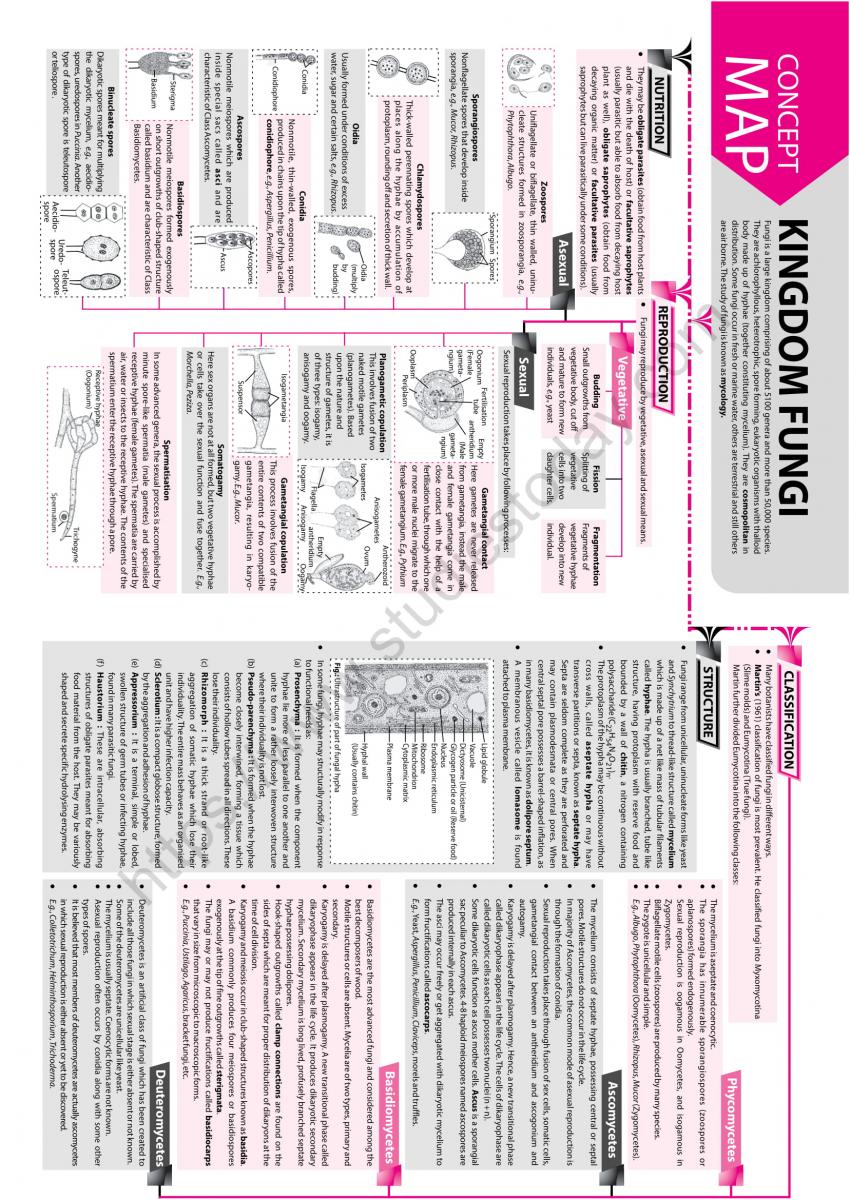
Kingdom Fungi Concept Map (text version)
Fungi is a large kingdom comprising of about 5100 genera and more than 50,000 species. They are achlorophyllous, heterotrophic, spore forming, eukaryotic organisms with thalloid body made up of hyphae (together constituting mycelium). They are cosmopolitan in distribution. Some fungi occur in fresh or marine water, others are terrestrial and still others are air borne. The study of fungi is known as mycology.
Nutrition
They may be obligate parasites (obtain food from host plants and die with the death of host) or facultative saprophytes (usually parasitic but able to absorb food from decaying host plant as well), obligate saprophytes (obtain food from decaying organic matter) or facultative parasites (usually saprophytes but can live parasitically under some conditions).
Structure
Fungi range from unicellular, uninucleate forms like yeast and Synchytrium to thread-like structure called mycelium which is made up of a net like mass of tubular filaments called hyphae. The hypha is usually branched, tube like structure, having protoplasm with reserve food and bounded by a wall of chitin, a nitrogen containing polysaccharide (C22H54N4O21)n.
The protoplasm of the hypha may be continuous without cross walls, called aseptate hypha or may have transverse partitions or septa, known as septate hypha. Septa are seldom complete as they are perforated and may contain plasmodesmata or central pores. When central septal pore possesses a barrel-shaped inflation, as in many basidiomycetes, it is known as dolipore septum.
A membranous vesicle called lomasome is found attached to plasma membrane.
Fig: Ultrastructure of part of fungal hypha (labelled: lipid globule, vacuole, dictyosome (unicisternal), glycogen particle or oil (reserve food), nucleus, endoplasmic reticulum, ribosome, mitochondrion, cytoplasmic matrix, plasma membrane, hyphal wall (usually contains chitin)).
In some fungi, hyphae may structurally modify in response to functional needs as:
(a) Prosenchyma: It is formed when the component hyphae lie more or less parallel to one another and unite to form a rather loosely interwoven structure where their individuality is not lost.
(b) Pseudo-parenchyma: It is formed when the hyphae become closely interwined, forming a tissue which consists of hollow tubes spread in all directions. These lose their individuality.
(c) Rhizomorph: It is a thick strand or root-like aggregation of somatic hyphae which lose their individuality. The entire mass behaves as an organised unit and have higher infection capacity.
(d) Sclerotium: It is a compact globose structure, formed by the aggregation and adhesion of hyphae.
(e) Appressorium: It is a terminal, simple or lobed, swollen structure of germ tubes or infecting hyphae, found in many parasitic fungi.
(f) Haustorium: These are intracellular, absorbing structures of obligate parasites meant for absorbing food material from the host. They may be variously shaped and secrete specific hydrolysing enzymes.
Reproduction
Fungi may reproduce by vegetative, asexual and sexual means.
Vegetative reproduction
Budding: Small outgrowths from vegetative body, cut off and mature to form new individuals, e.g., yeast.
Fission: Splitting of vegetative cells into two daughter cells.
Fragmentation: Fragments of vegetative hyphae develop into new individual.
Asexual reproduction
Zoospores: Uniflagellate or biflagellate, thin walled, uninucleate structures formed in zoosporangia, e.g., Phytophthora, Albugo.
Sporangiospores: Nonflagellate spores that develop inside sporangia, e.g., Mucor, Rhizopus.
Chlamydospores: Thick-walled perennating spores which develop at places along the hyphae by accumulation of protoplasm, rounding off and secretion of thick wall.
Oidia: Usually formed under conditions of excess water, sugar and certain salts, e.g., Rhizopus. (Oidia multiply by budding.)
Conidia: Nonmotile, thin-walled, exogenous spores, produced singly or in chains upon the tip of hypha called conidiophore, e.g., Aspergillus, Penicillium.
Ascospores: Nonmotile meiospores which are produced inside special sacs called asci and are characteristic of Class Ascomycetes.
Basidiospores: Nonmotile meiospores formed exogenously on short outgrowths of club-shaped structure called basidium and are characteristic of Class Basidiomycetes.
Binucleate spores: Dikaryotic spores meant for multiplying the dikaryotic mycelium, e.g., aecidiospores, uredospores in Puccinia. Another type of dikaryotic spore is teleutospore or teliospore.
Figs: zoospores in zoosporangium, sporangium with spores, chlamydospores, oidia, conidia on conidiophore, ascus with ascospores, basidium with sterigma and basidiospores, aecidiospore, uredospore and teleutospore.
Sexual reproduction takes place by following processes:
Gametangial contact: Here gametes are never released from gametangia, instead the male and female gametangia come in close contact with the help of a fertilisation tube, through which one or more male nuclei migrate to the female gametangium. E.g., Pythium. (Fig: oogonium (female gametangium), fertilisation tube, empty antheridium (male gametangium), ooplasm, periplasm.)
Planogametic copulation: This involves fusion of two naked motile gametes (planogametes). Based upon the nature and structure of gametes, it is of three types: isogamy, anisogamy and oogamy. (Fig: isogametes with flagella, anisogametes, oogamy with antherozoid, ovum and empty antheridium.)
Gametangial copulation: This process involves fusion of the entire contents of two compatible gametangia, resulting in karyogamy. E.g., Mucor. (Fig: isogametangia and suspensor.)
Somatogamy: Here sex organs are not at all formed, but two vegetative hyphae or cells take over the sexual function and fuse together. E.g., Morchella, Peziza.
Spermatisation: In some advanced genera, the sexual process is accomplished by minute spore-like spermatia (male gametes) and specialised receptive hyphae (female gametes). The spermatia are carried by air, water or insects to the receptive hyphae. The contents of the spermatium enter the receptive hyphae through a pore. (Fig: receptive hyphae (oogonium), trichogyne, spermatium.)
Classification
Many botanists have classified fungi in different ways. Martin's (1961) classification of fungi is most prevalent. He classified fungi into Myxomycotina (Slime molds) and Eumycotina (True fungi). Martin further divided Eumycotina into the following classes:
Phycomycetes
The mycelium is aseptate and coenocytic. The sporangia has innumerable sporangiospores (zoospores or aplanospores) formed endogenously. Sexual reproduction is oogamous in Oomycetes, and isogamous in Zygomycetes. Biflagellate motile cells (zoospores) are produced by many species. The zygote is unicellular and simple. E.g., Albugo, Phytophthora (Oomycetes), Rhizopus, Mucor (Zygomycetes).
Ascomycetes
The mycelium consists of septate hyphae, possessing central or septal pores. Motile structures do not occur in the life cycle. In majority of Ascomycetes, the common mode of asexual reproduction is through the formation of conidia. Sexual reproduction takes place through fusion of sex cells, somatic cells, gametangial contact between an antheridium and ascogonium and autogamy. Karyogamy is delayed after plasmogamy. Hence, a new transitional phase called dikaryophase appears in the life cycle. The cells of dikaryophase are called dikaryotic cells as each cell possesses two nuclei (n + n). Some dikaryotic cells function as ascus mother cells. Ascus is a sporangial sac peculiar to Ascomycetes. 4-8 haploid meiospores named ascospores are produced internally in each ascus. The asci may occur freely or get aggregated with dikaryotic mycelium to form fructifications called ascocarps. E.g., Yeast, Aspergillus, Penicillium, Claviceps, morels and truffles.
Basidiomycetes
Basidiomycetes are the most advanced fungi and considered among the best decomposers of wood. Motile structures or cells are absent. Mycelia are of two types, primary and secondary. Karyogamy is delayed after plasmogamy. A new transitional phase called dikaryophase appears in the life cycle. It produces dikaryotic secondary mycelium. Secondary mycelium is long lived, profusely branched septate hyphae possessing dolipores. Hook-shaped outgrowths called clamp connections are found on the sides of septa which are meant for proper distribution of dikaryons at the time of cell division. Karyogamy and meiosis occur in club-shaped structures known as basidia. A basidium commonly produces four meiospores or basidiospores exogenously at the tip of fine outgrowths called sterigmata. The fungi may or may not produce fructifications called basidiocarps that vary in size from microscopic to macroscopic forms. E.g., Puccinia, Ustilago, Agaricus, bracket fungi, etc.
Deuteromycetes
Deuteromycetes is an artificial class of fungi which has been created to include all those fungi in which sexual stage is either absent or not known. Some of the deuteromycetes are unicellular like yeast. The mycelium is usually septate. Coenocytic forms are not known. Asexual reproduction often occurs by conidia along with some other types of spores. It is believed that most members of deuteromycetes are actually ascomycetes in which sexual reproduction is either absent or yet to be discovered. E.g., Colletotrichum, Helminthosporium, Trichoderma.
Useful Resources and Notes for NEET Biology Kingdom Fungi
Quick Revision Material for Kingdom Fungi
Explore essential learning tools for NEET Biology Kingdom Fungi. This curated collection features in-depth notes and targeted practice questions built around the active 2026 curriculum to streamline your daily revision.
Expert Notes and Solved Exam Questions
Built using official NCERT guidelines for NEET Biology, these materials provide reliable academic support. Integrating past examination questions and step-by-step solutions helps students understand official NEET grading criteria.
Additional Study Resources for NEET
Maximize your grade potential by utilizing NEET Biology practice papers in tandem with these structured notes. All printable assignments and interactive mock tests on our platform are updated for the 2026 session and available free of charge.
FAQs
Our advanced study package for Kingdom Fungi includes detailed concepts, diagrams, Mind Maps, and explanation of complex topics to ensure NEET students learn as per syllabus for 2026 exams.
The Mind Maps provided for Kingdom Fungi act as visual anchors which will help faster recall during high-pressure exams.
Yes, teachers use our NEET Biology resources for lesson planning as they are in simple language and have lot of solved examples.
Yes, You can download the complete, mobile-friendly PDF of the Biology Kingdom Fungi advanced resources for free.
Yes, our subject matter experts have updated the Kingdom Fungi material to align with the rationalized NCERT textbooks and have removed deleted topics and added new competency-based questions.