

Official NEET Study Materials for NEET Biology
Explore structured advanced study materials through the NEET Biology Inflorescence Concept Map. Tailored for NEET learners, utilizing these Biology resources ensures thorough preparation and strengthens foundational knowledge before final NEET evaluations.
Advanced Resources for Biology
Access the complete useful resource PDF for NEET Biology below. Regular practice with these targeted academic notes builds familiarity with complex topics and helps secure higher marks in final school evaluations.
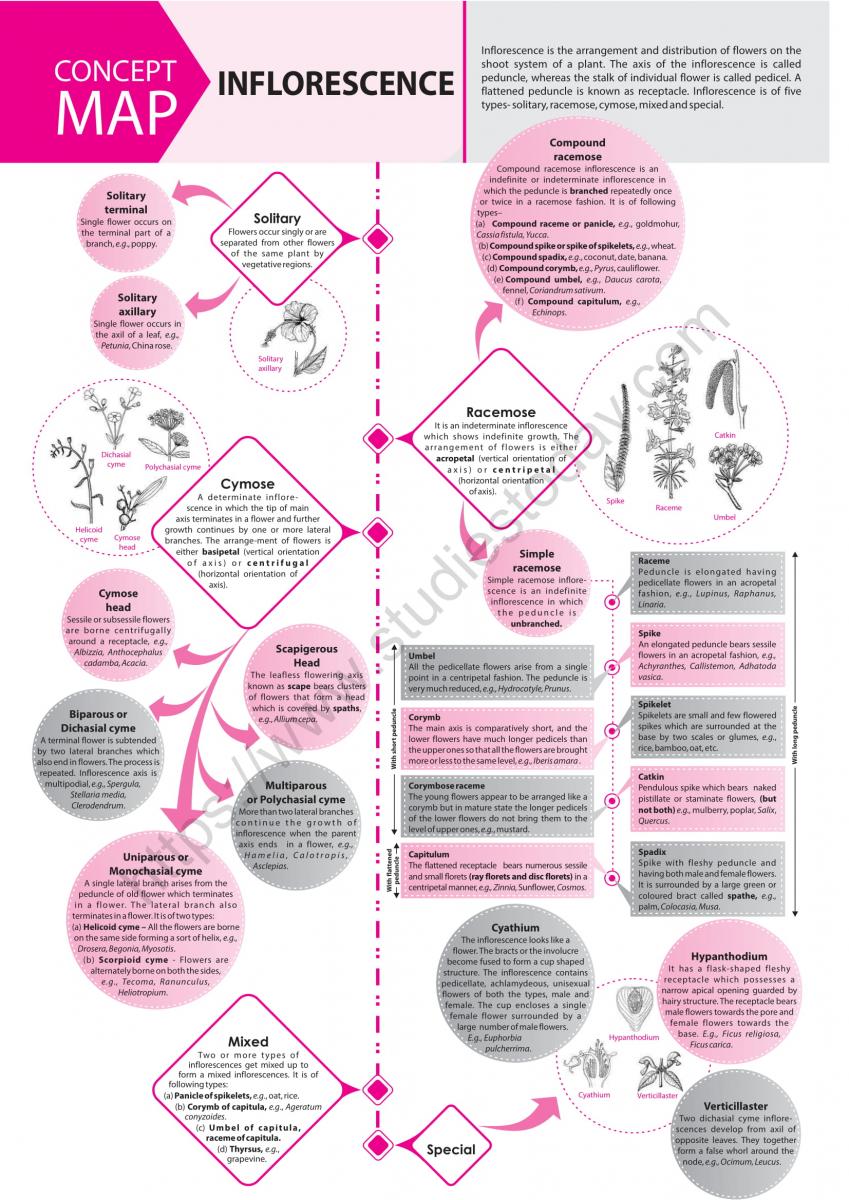
Inflorescence: Concept Map
Inflorescence is the arrangement and distribution of flowers on the shoot system of a plant. The axis of the inflorescence is called peduncle, whereas the stalk of individual flower is called pedicel. A flattened peduncle is known as receptacle. Inflorescence is of five types- solitary, racemose, cymose, mixed and special.
Solitary
Flowers occur singly or are separated from other flowers of the same plant by vegetative regions.
- Solitary terminal: Single flower occurs on the terminal part of a branch, e.g., poppy.
- Solitary axillary: Single flower occurs in the axil of a leaf, e.g., Petunia, China rose.
Racemose
It is an indeterminate inflorescence which shows indefinite growth. The arrangement of flowers is either acropetal (vertical orientation of axis) or centripetal (horizontal orientation of axis). Types shown in figure: spike, raceme, catkin, umbel.
Simple racemose
Simple racemose inflorescence is an indefinite inflorescence in which the peduncle is unbranched.
With long peduncle:
- Raceme: Peduncle is elongated having pedicellate flowers in an acropetal fashion, e.g., Lupinus, Raphanus, Linaria.
- Spike: An elongated peduncle bears sessile flowers in an acropetal fashion, e.g., Achyranthes, Callistemon, Adhatoda vasica.
- Spikelet: Spikelets are small and few flowered spikes which are surrounded at the base by two scales or glumes, e.g., rice, bamboo, oat, etc.
- Catkin: Pendulous spike which bears naked pistillate or staminate flowers, (but not both) e.g., mulberry, poplar, Salix, Quercus.
- Spadix: Spike with fleshy peduncle and having both male and female flowers. It is surrounded by a large green or coloured bract called spathe, e.g., palm, Colocasia, Musa.
With short peduncle:
- Umbel: All the pedicellate flowers arise from a single point in a centripetal fashion. The peduncle is very much reduced, e.g., Hydrocotyle, Prunus.
- Corymb: The main axis is comparatively short, and the lower flowers have much longer pedicels than the upper ones so that all the flowers are brought more or less to the same level, e.g., Iberis amara.
- Corymbose raceme: The young flowers appear to be arranged like a corymb but in mature state the longer pedicels of the lower flowers do not bring them to the level of upper ones, e.g., mustard.
With flattened peduncle:
- Capitulum: The flattened receptacle bears numerous sessile and small florets (ray florets and disc florets) in a centripetal manner, e.g., Zinnia, Sunflower, Cosmos.
Compound racemose
Compound racemose inflorescence is an indefinite or indeterminate inflorescence in which the peduncle is branched repeatedly once or twice in a racemose fashion. It is of following types–
- (a) Compound raceme or panicle, e.g., goldmohur, Cassia fistula, Yucca.
- (b) Compound spike or spike of spikelets, e.g., wheat.
- (c) Compound spadix, e.g., coconut, date, banana.
- (d) Compound corymb, e.g., Pyrus, cauliflower.
- (e) Compound umbel, e.g., Daucus carota, fennel, Coriandrum sativum.
- (f) Compound capitulum, e.g., Echinops.
Cymose
A determinate inflorescence in which the tip of main axis terminates in a flower and further growth continues by one or more lateral branches. The arrangement of flowers is either basipetal (vertical orientation of axis) or centrifugal (horizontal orientation of axis). Types shown in figure: dichasial cyme, polychasial cyme, helicoid cyme, cymose head.
- Cymose head: Sessile or subsessile flowers are borne centrifugally around a receptacle, e.g., Albizzia, Anthocephalus cadamba, Acacia.
- Scapigerous Head: The leafless flowering axis known as scape bears clusters of flowers that form a head which is covered by spaths, e.g., Allium cepa.
- Biparous or Dichasial cyme: A terminal flower is subtended by two lateral branches which also end in flowers. The process is repeated. Inflorescence axis is multipodial, e.g., Spergula, Stellaria media, Clerodendrum.
- Multiparous or Polychasial cyme: More than two lateral branches continue the growth of inflorescence when the parent axis ends in a flower, e.g., Hamelia, Calotropis, Asclepias.
- Uniparous or Monochasial cyme: A single lateral branch arises from the peduncle of old flower which terminates in a flower. The lateral branch also terminates in a flower. It is of two types:
(a) Helicoid cyme – All the flowers are borne on the same side forming a sort of helix, e.g., Drosera, Begonia, Myosotis.
(b) Scorpioid cyme - Flowers are alternately borne on both the sides, e.g., Tecoma, Ranunculus, Heliotropium.
Mixed
Two or more types of inflorescences get mixed up to form a mixed inflorescences. It is of following types:
- (a) Panicle of spikelets, e.g., oat, rice.
- (b) Corymb of capitula, e.g., Ageratum conyzoides.
- (c) Umbel of capitula, raceme of capitula.
- (d) Thyrsus, e.g., grapevine.
Special
- Cyathium: The inflorescence looks like a flower. The bracts or the involucre become fused to form a cup shaped structure. The inflorescence contains pedicellate, achlamydeous, unisexual flowers of both the types, male and female. The cup encloses a single female flower surrounded by a large number of male flowers. E.g., Euphorbia pulcherrima.
- Hypanthodium: It has a flask-shaped fleshy receptacle which possesses a narrow apical opening guarded by hairy structure. The receptacle bears male flowers towards the pore and female flowers towards the base. E.g., Ficus religiosa, Ficus carica.
- Verticillaster: Two dichasial cyme inflorescences develop from axil of opposite leaves. They together form a false whorl around the node, e.g., Ocimum, Leucus.
Biology NEET Exam Resources: Inflorescence
Essential Notes for NEET Biology
Explore essential learning tools for NEET Biology Inflorescence. This curated collection features in-depth notes and targeted practice questions built around the active 2026 curriculum to streamline your daily revision.
Verified Solutions for NEET Biology
Designed around the official curriculum, these study guides guarantee standard compliance. Reviewing step-by-step solutions clarifies complex sub-topics within Inflorescence and demystifies standard marking schemes for Biology evaluations.
Enhance Accuracy with Online Tests
Maximize your grade potential by utilizing NEET Biology practice papers in tandem with these structured notes. All printable assignments and interactive mock tests on our platform are updated for the 2026 session and available free of charge.
FAQs
Our advanced study package for Inflorescence includes detailed concepts, diagrams, Mind Maps, and explanation of complex topics to ensure NEET students learn as per syllabus for 2026 exams.
The Mind Maps provided for Inflorescence act as visual anchors which will help faster recall during high-pressure exams.
Yes, teachers use our NEET Biology resources for lesson planning as they are in simple language and have lot of solved examples.
Yes, You can download the complete, mobile-friendly PDF of the Biology Inflorescence advanced resources for free.
Yes, our subject matter experts have updated the Inflorescence material to align with the rationalized NCERT textbooks and have removed deleted topics and added new competency-based questions.