

Advanced Study Material for NEET Biology: Cockroach
Explore structured advanced study materials through the NEET Biology Cockroach Concept Map. Tailored for NEET learners, utilizing these Biology resources ensures thorough preparation and strengthens foundational knowledge before final NEET evaluations.
Practice NEET Biology Resources: Cockroach
Navigate directly to the advanced Biology study materials using the digital viewer below. Each resource pack includes detailed conceptual summaries and solved practice questions, allowing students to instantly reinforce their learning.
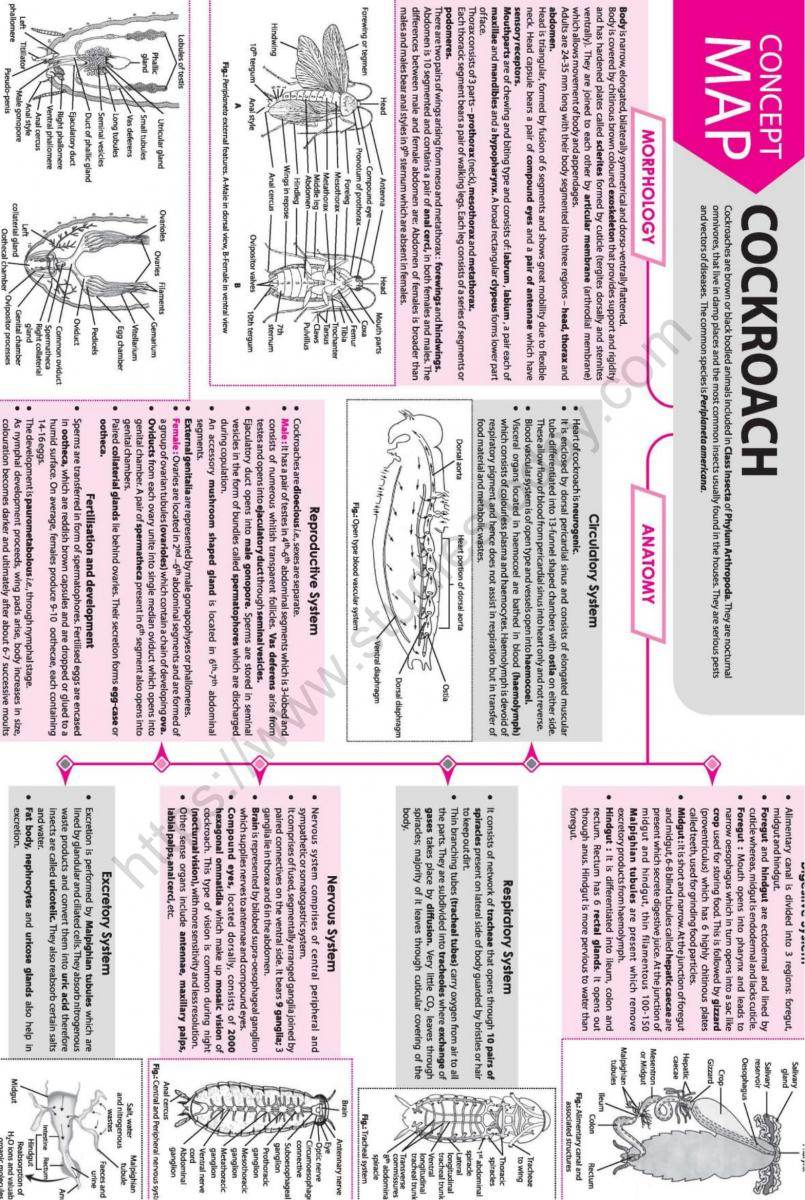
Cockroach Concept Map (text version)
Cockroaches are brown or black bodied animals included in Class Insecta of Phylum Arthropoda. They are nocturnal omnivores, that live in damp places and the most common insects usually found in the houses. They are serious pests and vectors of diseases. The common species is Periplaneta americana.
Morphology
Body is narrow, elongated, bilaterally symmetrical and dorso-ventrally flattened. Body is covered by chitinous brown coloured exoskeleton that provides support and rigidity and has hardened plates called sclerites formed by cuticle (tergites dorsally and sternites ventrally). They are joined to each other by articular membrane (arthrodial membrane) which allows movement of body and appendages.
Adults are 24-35 mm long with their body segmented into three regions – head, thorax and abdomen.
Head is triangular, formed by fusion of 6 segments and shows great mobility due to flexible neck. Head capsule bears a pair of compound eyes and a pair of antennae which have sensory receptors.
Mouthparts are of chewing and biting type and consists of: labrum, labium, a pair each of maxillae and mandibles and a hypopharynx. A broad rectangular clypeus forms lower part of face.
Thorax consists of 3 parts – prothorax (neck), mesothorax and metathorax. Each thoracic segment bears a pair of walking legs. Each leg consists of a series of segments or podomeres. There are two pairs of wings arising from meso and metathorax: forewings and hindwings.
Abdomen is 10 segmented and contains a pair of anal cerci, in both females and males. The differences between male and female abdomen are: Abdomen of females is broader than males and males bear anal styles in 9th sternum which are absent in females.
Fig: Periplaneta external features. A-Male in dorsal view, B-Female in ventral view (labelled: head, antenna, compound eye, pronotum of prothorax, foreleg, mesothorax, metathorax, middle leg, abdomen, hindleg, wings in repose, anal cercus, forewing or tegmen, hindwing, 10th tergum, anal style, mouth parts, coxa, femur, tibia, trochanter, tarsus, claws, pulvillus, 7th sternum, ovipositor valves).
Anatomy
Circulatory System
Heart of cockroach is neurogenic. It is enclosed by dorsal pericardial sinus and consists of elongated muscular tube differentiated into 13-funnel shaped chambers with ostia on either side. These allow flow of blood from pericardial sinus into heart only and not reverse.
Blood vascular system is of open type and vessels open into haemocoel. Visceral organs located in haemocoel are bathed in blood (haemolymph) which consists of colourless plasma and haemocytes. Haemolymph is devoid of respiratory pigment and hence does not assist in respiration but in transfer of food material and metabolic wastes.
Fig: Open type blood vascular system (dorsal aorta, heart portion of dorsal aorta, ostia, dorsal diaphragm, ventral diaphragm).
Digestive System
Alimentary canal is divided into 3 regions: foregut, midgut and hindgut. Foregut and hindgut are ectodermal and lined by cuticle whereas, midgut is endodermal and lacks cuticle.
Foregut: Mouth opens into pharynx and leads to narrow oesophagus which in turn opens into a sac like crop used for storing food. This is followed by gizzard (proventriculus) which has 6 highly chitinous plates called teeth, used for grinding food particles.
Midgut: It is short and narrow. At the junction of foregut and midgut, 6-8 blind tubules called hepatic caecae are present which secrete digestive juice. At the junction of midgut and hindgut, thin filamentous 100-150 Malpighian tubules are present which remove excretory products from haemolymph.
Hindgut: It is differentiated into ileum, colon and rectum. Rectum has 6 rectal glands. It opens out through anus. Hindgut is more pervious to water than foregut.
Fig: Alimentary canal and associated structures (salivary gland, salivary reservoir, oesophagus, crop, gizzard, hepatic caecae, mesentron or midgut, Malpighian tubules, ileum, colon, rectum).
Respiratory System
It consists of network of tracheae that opens through 10 pairs of spiracles present on lateral side of body guarded by bristles or hair to keep out dirt.
Thin branching tubes (tracheal tubes) carry oxygen from air to all the parts. They are subdivided into tracheoles where exchange of gases takes place by diffusion. Very little CO2 leaves through spiracles; majority of it leaves through cuticular covering of the body.
Fig: Tracheal system (tracheae to wing, thoracic spiracles, 1st abdominal spiracle, lateral longitudinal tracheal trunk, ventral longitudinal tracheal trunk, transverse commissures, 8th abdominal spiracle).
Nervous System
Nervous system comprises of central peripheral and sympathetic or somatogastric system. It comprises of fused, segmentally arranged ganglia joined by paired connectives on the ventral side. It bears 9 ganglia; 3 ganglia lie in thorax and 6 in the abdomen.
Brain is represented by bilobed supra-oesophageal ganglion which supplies nerves to antennae and compound eyes.
Compound eyes, located dorsally, consists of 2000 hexagonal ommatidia which make up mosaic vision of cockroach. This type of vision is common during night (nocturnal vision), with more sensitivity and less resolution.
Other sense organs include antennae, maxillary palps, labial palps, anal cerci, etc.
Fig: Central and Peripheral nervous system (brain, antennary nerve, eye, optic nerve, circumoesophageal connective, suboesophageal ganglion, prothoracic, mesothoracic and metathoracic ganglia, ventral nerve cord, abdominal ganglion, anal cercus).
Excretory System
Excretion is performed by Malpighian tubules which are lined by glandular and ciliated cells. They absorb nitrogenous waste products and convert them into uric acid therefore insects are called uricotelic. They also reabsorb certain salts and water.
Fat body, nephrocytes and uricose glands also help in excretion.
Fig: Excretory system (Malpighian tubule, salt, water and nitrogenous wastes, midgut, intestine, rectum, hindgut, faeces and urine, reabsorption of H2O, ions and valuable organic molecules).
Reproductive System
Cockroaches are dioecious i.e., sexes are separate.
Male: It has a pair of testes in 4th-6th abdominal segments which is 3-lobed and consists of numerous whitish transparent follicles. Vas deferens arise from testes and opens into ejaculatory duct through seminal vesicles. Ejaculatory duct opens into male gonopore. Sperms are stored in seminal vesicles in the form of bundles called spermatophores which are discharged during copulation.
An accessory mushroom shaped gland is located in 6th-7th abdominal segments.
External genitalia are represented by male gonapophyses or phallomeres.
Female: Ovaries are located in 2nd-6th abdominal segments and are formed of a group of ovarian tubules (ovarioles) which contain a chain of developing ova.
Oviducts from each ovary unite into single median oviduct which opens into genital chamber. A pair of spermatheca present in 6th segment also opens into genital chambers.
Paired collaterial glands lie behind ovaries. Their secretion forms egg-case or ootheca.
Figs: Male and female reproductive organs (lobules of testis, phallic gland, utricular gland, vas deferens, seminal vesicles, ejaculatory duct, phallomeres, male gonopore; ovaries, ovarioles, oviduct, spermatheca, collaterial glands, genital chamber, oothecal chamber).
Fertilisation and development
Sperms are transferred in form of spermatophores. Fertilised eggs are encased in ootheca, which are reddish brown capsules and are dropped or glued to a humid surface. On average, females produce 9-10 oothecae, each containing 14-16 eggs.
The development is paurometabolous i.e., through nymphal stage. As nymphal development proceeds, wing pads arise, body increases in size, colouration becomes darker and ultimately after about 6-7 successive moults the adult is formed.
NEET NEET Biology Study Material: Cockroach
Quick Revision Material for Cockroach
Access comprehensive study material for Cockroach, including revision notes, concept maps, and high-probability questions. These resources are designed in alignment with the latest 2026 NEET syllabus for NEET Biology to support effective exam preparation.
Expert Notes and Solved Exam Questions
Each resource draws directly from authorized textbooks to maintain academic accuracy. Evaluating solved examples allows NEET students to master the formal presentation and answer-writing standards expected in upcoming school exams.
Additional Study Resources for NEET
For peak performance in upcoming evaluations, integrate official Biology sample papers directly into your study schedule. Follow up your revision by attempting online MCQ tests for Cockroach to refine calculation speed and precision.
FAQs
Our advanced study package for Cockroach includes detailed concepts, diagrams, Mind Maps, and explanation of complex topics to ensure NEET students learn as per syllabus for 2026 exams.
The Mind Maps provided for Cockroach act as visual anchors which will help faster recall during high-pressure exams.
Yes, teachers use our NEET Biology resources for lesson planning as they are in simple language and have lot of solved examples.
Yes, You can download the complete, mobile-friendly PDF of the Biology Cockroach advanced resources for free.
Yes, our subject matter experts have updated the Cockroach material to align with the rationalized NCERT textbooks and have removed deleted topics and added new competency-based questions.