

NEET Biology Study Guide: NEET Biology Organisms and Environment Notes
Explore structured advanced study materials through the NEET Biology Organisms and Environment Notes. Tailored for NEET learners, utilizing these Biology resources ensures thorough preparation and strengthens foundational knowledge before final NEET evaluations.
Download Organisms and Environment Study Material PDF
View or download the dedicated NEET Biology Organisms and Environment Notes resource below. Engaging with these advanced study guides under focused conditions ensures continuous academic progress and mastery of the 2026-27 curriculum for Organisms and Environment.
NEET Biology Chapter 13 Organisms and Environment notes covering ecology and its levels of organisation, abiotic factors such as temperature, light, water and soil, how organisms respond to them through conformers, regulators and partial regulators, adaptations of desert and polar animals and plants, population attributes such as natality, mortality, sex ratio and age pyramids, exponential and logistic growth models, and the interspecific interactions of parasitism, commensalism, mutualism, predation, competition and amensalism.
Important Terms, Differences and Laws
Terms and Definitions:
1. Ecology - the study of interaction among organisms and between the organisms and their abiotic or physical environment.
2. Precipitation - the water that falls on the earth as rain, snow and sleet.
3. Homeostasis - the maintenance of a constant internal environment, such as constant body temperature or osmotic concentration.
4. Altitude sickness - the set of symptoms shown at high altitude due to the fall in partial pressure of oxygen.
5. Demography - the study of the attributes of a population, such as its size, age and sex structure.
6. Bio-index number - the ratio of birth rate to death rate.
7. Population explosion - a sudden, very rapid increase in population size.
8. Carrying capacity - the maximum number of individuals which the environment can support or sustain.
Differences:
1. Regulators and conformers - regulators maintain a constant internal environment, while conformers change with the surroundings.
2. Euryhaline and stenohaline - euryhaline organisms tolerate a wide range of salinity, while stenohaline organisms tolerate only a narrow range.
3. Photosynthesis and chemosynthesis - photosynthesis uses light energy, while chemosynthesis uses energy from chemical reactions.
4. S-shaped and J-shaped growth curves - the S-shaped (logistic) curve levels off at carrying capacity, while the J-shaped (exponential) curve rises without limit.
5. Emigration and immigration - emigration is the movement out of a population, while immigration is the movement into a population.
6. Bell-shaped and urn-shaped age-sex pyramids - the bell-shaped pyramid shows a stable population, while the urn-shaped pyramid shows a declining population.
7. Lag phase and log phase of population growth - the lag phase is the initial phase of acclimatisation, while the log phase is the phase of rapid increase.
8. Natality rate and mortality rate - natality is the number of births, while mortality is the number of deaths in a population.
Laws, Rules and Acts:
1. Allen's rule - the polar animals have shorter extremities such as ears, nose and appendages to reduce heat loss.
2. Gause rule (competitive exclusion principle) - two closely related species competing for the same limited resource cannot co-exist indefinitely, and the competitively inferior species is eliminated.
ECOLOGY AND ITS LEVELS
Ecology is the study of interaction among organisms and between the organisms and their abiotic or physical environment.
The ecology is concerned with the following four levels of biological organisation:
1. Organism level
2. Population level
3. Community level
4. Biome level
This chapter deals with the first two levels, that is, organisms and populations. At the organism level, we study the adaptations of organisms to their environment. The adaptation may be for their survival or for the process of reproduction. This aspect of ecology is called physiological ecology.
The seasonal variation of temperature and precipitation (including rain, snow and sleet) is responsible for the formation of major biomes, such as rain forest, deciduous forest, desert, tundra and sea coast. The local variations (physical or chemical) in each biome further differentiate various habitats, such as polar regions, high mountain tops, rain soaked forests (Meghalaya), Rajasthan deserts, ocean trenches and hot springs.
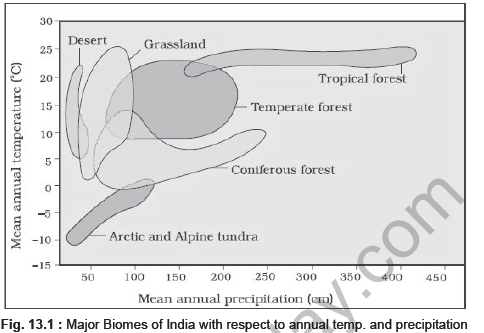
[Figure: Fig. 13.1 Major biomes of India with respect to mean annual temperature (y-axis, -15 to 30 °C) and mean annual precipitation (x-axis, 50 to 450 cm). Desert lies at low precipitation and high temperature, grassland and temperate forest lie in the middle, coniferous forest lies at lower temperature, tropical forest lies at highest temperature and precipitation, and Arctic and alpine tundra lies at the lowest temperature.]
Each habitat comprises both abiotic and biotic components. The most important abiotic components (physical or chemical) that characterise various habitats are temperature, light, water and soil. The biotic components that interact with organisms are mainly pathogens, parasites, predators and competitors. Over a period of time, organisms evolve through natural selection to optimise their survival and reproduction in a given habitat.
ABIOTIC FACTORS
1. Temperature
Temperature is the most important factor and plays a significant role in determining the habitat.
1. Organisms that tolerate a wide range of temperature are called eurythermal. Organisms that tolerate a narrow range of temperature are called stenothermal.
2. The temperature ranges from 0 °C in polar regions to more than 50 °C in tropical regions. In the same habitat, the temperature may vary from one season to another.
3. Some unique habitats, such as hot springs and hydrothermal vents, have an average temperature exceeding 100 °C.
4. The mango tree of the tropical and subtropical region cannot grow in temperate countries like Germany and Canada. The polar bear and snow leopard cannot be found in the forests of Tamil Nadu and Kerala. Tuna fish is not found in the oceans of temperate regions.
5. Global warming in recent years is affecting the distribution range of various species.
Connecting Concepts:
1. Eurythermal and stenothermal are different from poikilotherms and homeotherms. Most aquatic forms of poikilotherms (cold blooded animals) have a narrow range of temperature tolerance for their development, so they are stenothermic. Amphibious and terrestrial forms of cold blooded animals have a wide range of temperature tolerance, so they are eurythermic.
2. Fishes with a temperature tolerance range of less than 19 °C are taken as stenothermic, while animals like frogs and toads, with a tolerance range of more than 19 °C, are considered eurythermic.
3. Homeotherms (warm blooded animals), also known as endotherms, maintain a constant body temperature irrespective of the surrounding temperature.
2. Light
1. Most plants (autotrophs) require sunlight for the synthesis of food by photosynthesis. Some plants, such as shrubs and herbs, photosynthesise in low light conditions.
2. Marine plants (algae) inhabiting different depths of the ocean need different colour components of the visible spectrum. Red algae, with the red pigment phycoerythrin, are found at greater depths of the sea than brown or green algae, and they absorb blue light for photosynthesis.
3. Sunlight cannot penetrate deep into the ocean. At depths greater than 500 m, the inhabitants live in darkness and cannot photosynthesise. The source of energy for such deep sea organisms (such as bacteria) is chemosynthesis. The animals of deep sea areas are either blind or show bioluminescence.
4. Animals also require light for their diurnal and seasonal activities. Foraging, migration and reproduction depend on specific photoperiods (duration of exposure) and intensity of light. Sunlight is also the source of heat, and it varies from one biome to another.
Connecting Concepts:
1. Below 5000-6000 m in the ocean is the abyssal zone. It is the largest area and covers about 60% of the earth's surface. Here, the pressure exceeds 200 atm. Its water is cold and still. There is no sunlight, so there is no vitamin D formation, and there is deficiency of calcium in the water, so the spines and appendages of organisms do not develop. Due to the lack of calcium and other skeletal support, the fishes and crustaceans of the deep sea are delicately structured. Most benthic organisms (those that live on or near the bottom of the sea) are scavengers.
2. The energy source of most of the benthos is organic matter drifting from the top. The geothermal or hydrothermal energy of the earth supports the benthic food chain.
3. Water
1. Water is another important abiotic factor that influences the life of organisms. Life on earth originated in water, and without water, life cannot be sustained.
2. The availability of water, in the form of precipitation, is different in different biomes. In deserts, plants and animals have special adaptations for the scarcity of water.
3. In aquatic organisms, the pH and chemical composition of water are important for their survival.
4. Salinity is the salt concentration, expressed in ppt (parts per thousand). It is less than 5 ppt in inland water, 32-35 ppt in the sea and more than 100 ppt in some hypersaline lagoons.
5. Most freshwater animals cannot live in sea water for long due to osmotic problems. The same happens when a marine animal is transferred to a freshwater body.
6. Organisms that tolerate a wide range of salinity are called euryhaline. Organisms that tolerate only a narrow range of salinity are called stenohaline. These terms should not be confused with eurythermic and stenothermic.
4. Soil
1. The study of soil, an edaphic factor, is called pedology.
2. Soil is the weathered superficial layer of the earth's crust, intermixed with living organisms. The nature and properties of soil vary from place to place, depending upon climate, weathering and the process of soil development.
3. Plants depend upon soil for nutrients, water supply and anchorage. The holding capacity, pH, percolation properties, topography and mineral composition of soil determine the types of vegetation in the area.
4. A good fertile soil consists of mineral matter (about 40%), water and soil solution (about 25%), soil air (about 25%) and organic matter (about 10%).
5. Loam is the best soil for plant growth.
6. The soil also affects seed germination, size of plants, depth of the root system, susceptibility to frost and parasites, and the flowering of plants. The type of vegetation determines the type of animals it supports.
7. In an aquatic environment, the type of sediment determines the category of the thriving organisms.
HOW DO ORGANISMS RESPOND TO ABIOTIC FACTORS?
The fitness of a species in a particular environment depends upon the efficiency of its physiological and biochemical processes within the body.
Some animals maintain their body temperature or osmotic concentration of body fluid at the optimum level, and maintain a constant internal environment. This process is called homeostasis. Their performance is at its maximum regardless of the weather conditions outside the body. Humans use artificial means, such as air conditioners in summer and heaters or blowers in winter, to maximise working efficiency. Animals, however, have natural means, mainly physiological, to manage such stressful conditions.
There are three categories of animals that have specific ways to respond to external environment (or abiotic factors):
1. Conformers
2. Regulators
3. Partial regulators
[Figure: Fig. 13.2 Response of organisms to abiotic factors. Internal level is plotted against external level. The conformers line rises diagonally, showing that internal level changes with external level. The regulators line is horizontal, showing a constant internal level. The partial regulators line lies between the two, rising at first and then levelling off.]
1. Conformers
Most animals (up to 99%) and nearly all plants cannot maintain a constant internal environment. Their body temperature and osmotic concentration change according to the surrounding conditions. Such animals and plants are called conformers.
1. Thermal regulation and osmoregulation are energetically expensive, so a vast number of animals have not adopted these ways to maintain a constant internal environment.
2. Smaller animals have a larger body surface area in comparison to their volume. They lose body heat very fast when it is cold outside, or they spend much energy cooling the body when it is hot outside.
3. This is the main reason why very small animals are rarely found in polar regions.
2. Regulators
Some animals maintain their homeostasis by physiological or behavioural means. All birds and mammals (homeothermic or warm blooded), and a few lower vertebrates and invertebrates, can maintain a constant body temperature and constant osmotic concentration regardless of the surrounding conditions. Such organisms are called regulators.
1. Humans maintain their body temperature at 37 °C.
2. When it is hot outside (in summer), humans sweat, mainly to cool the body.
3. When the surrounding temperature is lower than the body temperature (in winter), humans shiver. The muscle contraction produces heat to raise the body temperature.
4. Plants do not have any such mechanisms to maintain internal temperature.
3. Partial Regulators
If the stressful conditions are localised, animals can 'escape in place' by migrating to a nearby region with better environmental conditions. If the unfavourable conditions last for a shorter duration, animals can 'escape in time' by avoiding those conditions and suspending their activities. Based on the situation, partial regulators may proceed to migration or to suspension of body activities.
(i) Migration: The animal moves temporarily away from a stressful environment to a more hospitable area and returns when conditions are favourable. Every winter, thousands of birds migrate from Siberia (extremely cold) to Keoladeo National Park in Bharatpur (Rajasthan).
(ii) Suspension of body activities:
1. During unfavourable conditions, lower plants, fungi and bacteria produce thick-walled spores, which germinate when conditions are favourable.
2. The seeds and other vegetative reproductive structures of higher plants undergo dormancy and reduce their metabolic activities when conditions are unfavourable. They form new plants when moisture and temperature conditions are suitable.
3. Animals that cannot migrate avoid the stressful condition for a period of time (escape in time). They undergo hibernation in winter, for example, in bears, or aestivation in summer, for example, in snails and some fishes. Frogs undergo hibernation in winter and aestivation in summer.
4. When conditions are unfavourable, many species of zooplankton in lakes and ponds enter diapause, a stage of suspended development. Diapause also occurs in the eggs, larvae or pupae of insects in adverse conditions, and it ends when favourable conditions return. Diapause in insects may depend upon the photoperiod, temperature and hormonal conditions.
ADAPTATIONS
Adaptations are the morphological, physiological or behavioural attributes that enable organisms to survive and reproduce in their habitat. Temporary migration to avoid unfavourable conditions, suspension of growth and development, and reduction of metabolic activity are also adaptations.
Adaptations of Desert Plants (Xerophytes)
Many desert plants have the following adaptations to reduce water loss through transpiration:
1. They have either no leaves, or small, scaly leaves, or leaves reduced to spines (for example, Opuntia). If leaves are present, they are covered with a thick cuticle. In some desert plants, the leaves roll or fold.
2. Stomata are arranged in deep pits (sunken stomata) to minimise water loss through transpiration.
3. They have a special photosynthetic pathway (CAM), so that stomata remain closed during the day. The carbon dioxide is fixed by forming a C4 molecule at night, when stomata can open without much loss of water.
4. In some desert plants, the leaves or stem are succulent to absorb or store water during the brief rainy season.
5. Some plants have a high osmotic pressure to endure desiccation.
6. In still other plants, the root system is very extensively developed.
Connecting Concepts: CAM (Crassulacean Acid Metabolism) plants belong to the family Crassulaceae. In these plants, carbon dioxide is fixed as a C4 molecule at night, when stomata can open without much loss of water. During the day, stomata are closed to conserve water and carbon dioxide cannot enter the plant. The cactus (Opuntia) is a CAM plant and can survive under stressful conditions.
Adaptations of Desert Animals (Xerocoles)
Desert animals, besides aestivation (summer sleep) or diapause, also have morphological and physiological adaptations.
1. Kangaroo rats of North American deserts meet their water requirement through internal fat oxidation, where water is a by-product.
2. They have no sweat glands.
3. They concentrate their urine, and their faeces are dry, to minimise water loss.
4. They are burrowing animals and seal the burrow during the day to keep the inside moist.
5. To avoid heat, they are active for feeding at night (nocturnal).
6. The camel, called the ship of the desert, has a low surface area to body size ratio.
7. The camel excretes highly concentrated urine and can withstand dehydration up to 25% of its body weight.
8. The camel has thick foot pads, thick skin and hard lips.
9. The hump stores fat, which on oxidation produces water as a by-product.
Behavioural Adaptations of Desert Lizards
Desert lizards maintain their body temperature fairly constant by the following behaviour:
1. When their body temperature drops below their comfort zone, they bask in the sun and absorb heat.
2. When the surrounding temperature starts increasing, they move into the shade.
3. They burrow into the soil to escape above-ground heat, and they may feed at night (nocturnal) when the ambient temperature drops.
Adaptations of Animals of Colder Regions
1. Polar animals have shorter extremities, such as ears, nose and appendages, to minimise heat loss. This is Allen's rule.
2. Aquatic mammals, such as whales and seals, have a thick layer of fat called blubber beneath the skin. Blubber acts as an insulator and reduces the loss of body heat.
3. Many fishes thrive below the ice at sub-zero temperatures in the Antarctic Ocean. The ice acts as an insulator and prevents the underlying water from freezing.
Physiological Adaptations to Altitude
When we go to a higher altitude (above 3500 m), such as Rohtang Pass near Manali or Mansarover in Tibet, we develop altitude sickness, with the following symptoms:
1. Nausea and vomiting
2. Heart palpitation
3. High breathing rate
4. Fatigue
Altitude sickness happens because the partial pressure of oxygen drops at higher altitude, and sufficient oxygen is not available. Gradually, we become acclimatised or physiologically adapted, and the symptoms disappear. This happens by:
1. Increase in the number of red blood cells (RBC) produced.
2. Decrease in the binding capacity of haemoglobin.
3. Increase in the breathing rate.
Adaptations to Deep Sea
Certain marine invertebrates and fishes are adapted to survive at great depths of the ocean, where the pressure can be more than 100 times the normal atmospheric pressure. Such organisms have the following adaptations:
1. The bodies of some animals, like Salpa and jellyfishes, are completely filled with water, so an increase in pressure has little effect.
2. Many fishes have a swim bladder containing compressed gases.
3. Their cell membranes, proteins and other biomolecules differ in composition. High pressure of the water column would otherwise distort such complex biomolecules.
Note: Hydrostatic pressure increases by 1 atmosphere for every 10 m of depth. So, the pressure is 2 atm at 10 m and 11 atm at 100 m.
Check Point
Fill in the blank with a suitable term or word:
(i) The animals whose body temperature and osmotic concentration are according to surroundings are called ............... .
(ii) The seeds undergo ............... to reduce their metabolic activities.
(iii) ............... is the stage of suspended development.
(iv) The desert plants are called ............... .
(v) According to ............... rule, the polar animals have shorter extremities.
(vi) At higher altitude, the binding capacity of haemoglobin ............... .
(vii) By increase in ............... m of depth, the hydrostatic pressure increases by 1 atmosphere.
Answer:
(i) conformers
(ii) dormancy
(iii) Diapause
(iv) xerophytes
(v) Allen's
(vi) decreases
(vii) 10
Check Point
Answer the following:
(i) What is the study of organisms and their relationship with physical environment called? Answer: Ecology.
(ii) What are stenothermic animals? Answer: Animals that tolerate a narrow range of temperature.
(iii) Which colour algae is found at greater depth of sea? Answer: Red algae.
(iv) What is the term used for organisms that tolerate a wide range of salinity? Answer: Euryhaline.
(v) What is the name of the zone that covers the maximum area of the earth's surface? Answer: Abyssal zone.
(vi) Which soil is the best for plant growth? Answer: Loam.
(vii) What is the study of soil called? Answer: Pedology.
(viii) What is the maintenance of constant internal body environment called? Answer: Homeostasis.
POPULATIONS
A population is a group of individuals of a particular species, which can potentially interbreed, live in a well-defined geographical area, and share or compete for similar resources. For an ecological point of view, a group of asexual individuals is also known as a population.
Examples of populations are:
1. Tigers in a national park
2. Rats in an abandoned building
3. Lotus plants in a pond
4. Teak-wood trees in a forest
5. Bacteria in a Petri dish
Natural selection also operates at the population level. A population has certain attributes that are not represented by the individuals. The important attributes are life expectancy, sex ratio, birth rate, death rate and age distribution.
Birth or Natality Rate: The number of births per thousand of a population per year. It can also be expressed as a percentage or per capita (per individual).
Example: If there were 50 lotus plants in a pond last year, and this year the population has increased to 58 due to reproduction, then:
1. Increase in population = 58 - 50 = 8
2. Per capita birth rate per year = 8 / 50 = 0.16 offspring per lotus per year
Death or Mortality Rate: The number of deaths occurring in a population of one thousand per year. It can also be expressed as a percentage or per capita.
Example: If in a population of 50 house flies, 5 died in a week, then the per capita death rate per week = 5 / 50 = 0.1.
Life Expectancy: The length of time for which an individual of a given species can expect to live. It is a characteristic of a population, not of a species. It is defined as the age at which half the population still survives (M50). Life expectancy differs with sex and time period. For example, the life expectancy (M50) of US females was 58, 76 and 81 years in the years 1900, 1960 and 1980 respectively.
Life Span: The maximum number of years a member of a species has been known to survive. The life span of humans is estimated to be 121 years. Life span is a characteristic of a species. Drosophila, domestic dog and tortoise have life spans of 3 months, 20 years and more than 150 years respectively.
Population Growth: The gross value of population growth is calculated as the difference between birth rate and death rate.
Dispersal: The movement of individuals in or out of a population affects its size. Movement of individuals into a population is called immigration. Movement out of a population is called emigration. A set of local populations connected by dispersing individuals is called a metapopulation.
An accurate population growth includes migrant individuals also:
Population growth = (Birth rate + Immigrants) - (Death rate + Emigrants)
Zero Population Growth: When birth rate equals death rate, the growth of the population is zero, and the size of the population remains constant. This is called zero population growth or demographic transition. When migration is considered, zero population growth means:
Birth rate + immigrants = Death rate + emigrants
Bio-Index Number: The ratio of birth rate to death rate. For zero population growth, the bio-index number is one.
Bio-index number = Birth rate / Death rate
Population Size and Density: The population size may range from a few individuals to millions, depending upon the species, the geographical area, the impact of predators, the outcome of competition and the effect of pesticides.
1. Population density is the number of individuals per unit area (for terrestrial organisms) or per unit volume (for aquatic or aerial organisms).
2. Sometimes the population density is not required, and relative density serves the purpose. For example, the number of fish caught per trap in a lake can be used as population density.
3. When comparing about 200 Parthenium plants with one huge banyan tree, population density becomes less useful. In such cases, biomass or percent cover is used as the measure of population size.
4. When organisms cannot be seen or counted directly, population size is measured indirectly, from faecal pellets or pug marks.
Sex Ratio: The number of females per thousand males. According to the 2001 census, it was 933 in India.
Age and Sex Structure: The proportion of individuals of different ages and sexes. It is depicted as a pyramid, plotting the percentage of population of each sex in each age class.
1. In developing countries like India, the pyramid is less steep, as there are a larger number of younger people.
2. In developed countries, the pyramid is steeper, which represents a nearly stable population.
[Figure: Fig. 13.3 Age-sex ratio in (A) developing countries, with a broad base of younger age classes, and (B) developed countries, with a steeper pyramid. Males are shown on the left and females on the right, with the younger age classes at the bottom and the older age classes at the top.]
Check Point
Write appropriate TERM against each of the following statements:
(i) The ratio of birth rate to death rate ............... .
(ii) A set of local populations connected by dispersing individuals ............... .
(iii) The maximum number of individuals which the environment can support ............... .
(iv) Population growth when birth rate equals death rate ............... .
(v) The maximum time an individual of a species can expect to live ............... .
(vi) The movement of individuals out of a population ............... .
(vii) The number of females per thousand of males ............... .
(viii) Pyramid of declining population ............... .
Answer:
(i) Bio-index number
(ii) Metapopulation
(iii) Carrying capacity
(iv) Zero population growth
(v) Life span
(vi) Emigration
(vii) Sex ratio
(viii) Urn-shaped pyramid
Age Distribution Pyramids: For constructing age pyramids, three age groups are considered:
1. Pre-reproductive age (0-14 years)
2. Reproductive age (15-60 years)
3. Post-reproductive age (more than 60 years)
There are three types of pyramids:
1. Triangular pyramid - indicates an expanding population with a high growth rate.
2. Bell-shaped pyramid - indicates a stable population with zero growth rate.
3. Urn-shaped pyramid - indicates a declining population with negative growth rate.
[Figure: Fig. 13.4 Three age pyramids, labelled P1 (pre-reproductive age), P2 (reproductive age) and P3 (post-reproductive age). (A) Triangular pyramid, wide at the base and narrowing at the top. (B) Bell-shaped pyramid, with the widest part in the middle. (C) Urn-shaped pyramid, narrow at the base and wider at the top.]
Population Growth: Population density is not static, and it keeps changing with time. Population size depends on the availability of food, weather conditions, predation pressure, and so on. Population size or density in a given area during a given period depends upon four basic processes:
1. Natality (B)
2. Mortality (D)
3. Immigration (I)
4. Emigration (E)
[Figure: Fig. 13.5 Population size at the centre, with natality and immigration shown as positive inputs (+) and mortality and emigration shown as negative outputs (-).]
If N is the population density at time t, the density at time (t + 1) will be:
N(t + 1) = N(t) + [(B + I) - (D + E)]
Until a new habitat is colonised, birth and death are the most important factors influencing population density.
GROWTH MODELS
The growth of a population with time shows specific and predictable patterns. The two common patterns are:
1. Exponential or geometric growth pattern
2. Logistic growth pattern
1. Exponential Growth
When resources such as food and space in a habitat are unlimited, each species realises its full reproductive or biotic potential and grows in an exponential or geometric fashion. For example, if a reindeer population is allowed to grow in a predator-free environment, the population grows beyond the carrying capacity and forms a J-shaped growth pattern or curve. Such growth also occurs in algal blooms, in insects during the rainy season and in Paramecium, which doubles every day.
Under unlimited resources and the absence of checks, any species can grow exponentially. Even the slowest breeder, the elephant (gestation period of 22 months), can grow to an enormous number.
[Figure: Fig. 13.6 Population growth curve (J-shaped). Number of individuals rises steeply against time, crosses the carrying capacity K (dashed line), and then the population crash phase follows (arrow pointing downward). K = carrying capacity.]
If the population size is N, and the birth rate and death rate per capita are b and d, the change in population size during a unit time period t is:
dN/dt = (b - d) × N
If (b - d) = r, then dN/dt = rN.
Here, r is called the intrinsic rate of natural increase, or biotic potential (maximum capacity of reproduction). It indicates the impact of biotic and abiotic factors on population growth. The value of r for the human population in India in 1981 was 0.02.
Problem 1: If the population of rats in an abandoned dwelling in 2001 was 200, and in 2005 it was 240, find the value of r.
1. dN = 240 - 200 = 40
2. dt = 2005 - 2001 = 4
3. dN/dt = rN, so 40 / 4 = r × 200
4. r = 10 / 200 = 0.05 individuals per rat per year
Problem 2: If the population doubles in 3 years, what is the intrinsic rate of increase of the population?
1. dN/dt = rN, where dN = 2N - N = N and dt = 3
2. N / 3 = rN, so r = 1 / 3 = 0.33
The integral form of the exponential growth equation is:
Nt = N0 ert
where Nt is the population density after time t, N0 is the population density at time zero, r is the intrinsic rate of natural increase, and e is the base of natural logarithms (2.718...).
2. Logistic Growth
In nature, no species has unlimited resources to permit exponential growth. Competition between individuals for limited resources begins. A population growing in a habitat first shows a lag phase, followed by a phase of acceleration or deceleration (log phase), and finally the stage of asymptote, when population density reaches the carrying capacity (plateau or stationary phase).
[Figure: Fig. 13.7 Population growth curve (sigmoid, S-shaped). The curve has a lag phase at the start, then a log phase of rapid rise, then a plateau phase at the carrying capacity K.]
This type of growth pattern is also called Verhulst-Pearl logistic growth, and it can be represented by the equation:
dN/dt = rN × (K - N) / K
where K is the carrying capacity of nature in that habitat.
The term (K - N) / K, or 1 - N/K, is the environmental resistance.
Carrying Capacity (K): The maximum number of individuals which the environment can support or sustain. It is the capacity of the environment and not of the individuals. The carrying capacity of the environment depends upon three components:
1. Productive system - includes cropland, orchards, etc., which provide food and fibres.
2. Protective system - includes forests and oceans, which regulate temperature and humidity.
3. Waste assimilative system - includes the generation of waste material in water, air and soil.
Environmental Resistance: Factors such as predators, diseases, calamities and shortage of food impose a check on population, and together they form environmental resistance. Since resources for growth become limited for most animal populations, the logistic growth model is considered the more realistic one.
Check Point
Fill in the blanks (1-10), each with a suitable word:
In yeast population the growth curve is ........(1)........ shaped. In the beginning there is ........(2)........ phase in which the population acclimatises with the surroundings. In ........(3)........ phase the population increases tremendously. At stationary phase, also called as ........(4)........, the birth rate ........(5)........ death rate. The 'K' indicates ........(6)........ at which population reaches maximum value. In ........(7)........ shaped growth curve, the population grows further till ........(8)........ occurs due to sudden shortage of food. Such growth curve does not show ........(9)........ phase and occurs in ........(10)........ population.
Answer:
(1) S (sigmoid)
(2) lag
(3) log
(4) plateau phase
(5) equals
(6) carrying capacity
(7) J
(8) population crash
(9) plateau
(10) laboratory (or any population with unlimited resources)
Check Point
Write True or False against the following statements:
(i) In algal bloom the population growth curve is J shaped.
(ii) The change in population size is represented as dN/dt = r + N.
(iii) The logistic growth curve is sigmoid.
(iv) K - N/K is called carrying capacity.
(v) Bamboo breeds only once in its lifetime.
Answer:
(i) True
(ii) False, the change is represented as dN/dt = rN.
(iii) True
(iv) False, (K - N)/K is the environmental resistance, not the carrying capacity.
(v) True
Variations in Life History of Organisms
Populations evolve to maximise their reproductive fitness with a high value of r in the given habitat. Organisms do this by developing the most efficient reproductive strategy under the given selection pressure.
1. Bamboo and Pacific salmon fish breed only once in their lifetime, while birds and mammals breed many times in their lifetime.
2. Oysters produce a large number of small offspring, while birds and mammals produce a small number of large offspring.
3. Life history traits have evolved in relation to the constraints imposed by the biotic and abiotic components of their habitat.
POPULATION INTERACTIONS
In nature, no species can survive in isolation. Even plant species, which synthesise their own food, cannot survive alone. They need soil microbes to break down organic matter and return inorganic nutrients for absorption. Plants also need animals (insects) for pollination. Plants, animals and microbes interact in various ways to form a biological community. Interspecific associations arise from the interaction of populations of different species. Such associations can be beneficial, harmful (detrimental) or neutral.
The following table shows the interspecific associations. '+' indicates a beneficial interaction, '-' a detrimental interaction and '0' a neutral interaction.
| S. No. | Name of Interaction | Species A | Species B |
|---|---|---|---|
| 1 | Parasitism | + | - |
| 2 | Commensalism | + | 0 |
| 3 | Mutualism | + | + |
| 4 | Predation | + | - |
| 5 | Competition | - | - |
| 6 | Amensalism | - | 0 |
Parasitism (+, -)
One species (the parasite) benefits, and the other (the host) is harmed. Parasitism ensures free lodging and free meals. Many parasites are host specific, while others can parasitise various species of hosts.
Hosts evolve special mechanisms to reject or resist the parasite, and parasites evolve mechanisms to counteract and neutralise these effects. Parasites have the following adaptations for survival:
1. Loss of unnecessary sense organs
2. Presence of suckers or adhesive organs to attach to the host body
3. Loss of digestive system
4. High reproductive capacity
5. Complex life cycle with one or two hosts
Most parasites harm the host by reducing its growth, reproduction, survival and population density. They may also make the host physically weak and vulnerable to predation.
Parasites are of three types:
1. Ectoparasite
2. Endoparasite
3. Brood parasite
Ectoparasites live or feed on the external surface of the host. Familiar examples are lice and bed bugs on humans, ticks on dogs and leeches on cattle. Mosquitoes are not considered true ectoparasites, since they take only a meal from the host body and do not make a lodging. Among plants, the common example is Cuscuta, which has lost both chlorophyll and leaves during evolution and parasitises hedge plants. Other ectoparasites include copepods, Petromyzon and hagfishes, whose hosts are marine fishes.
[Figure: Fig. 13.8 Examples of ectoparasites: a bed bug, Petromyzon (lamprey) attached to a fish, and a tick on a dog.]
Endoparasites live inside the body of the host. Their morphological and anatomical features are greatly simplified, but their life cycles are more complex because of their extreme specialisation. Their reproductive potential is very high. They can be monogenetic (involving a single host) or digenetic (involving two hosts).
1. Monogenetic endoparasites: Ascaris (round worm) in the small intestine and Entamoeba in the large intestine.
2. Digenetic endoparasites: Taenia (tapeworm) in the intestine, Fasciola (liver fluke) in the liver, and Plasmodium, which lives in humans and the female Anopheles mosquito.
3. The filarial worm is a lymph parasite.
[Figure: Fig. 13.9 Examples of endoparasites: Ascaris (male) and liver fluke.]
Brood parasites lay their eggs in the nest of a host, which incubates them. The koel or cuckoo is a brood parasite, and the host is the crow. The eggs of the parasitic bird have evolved resemblances with the host's eggs in colour, shape and size.
Commensalism (+, 0)
One species benefits, and the other is neither benefited nor harmed. The association of egret and cattle is the classical example. As cattle move during grazing, they stir up and flush out insects from the vegetation, which would otherwise be difficult for the egret to find and catch. The cattle gain no benefit from the egret.
Other examples of commensalism are the clownfish hiding in the colony of sea anemone, the orchid growing as an epiphyte on a mango tree, and the barnacle growing on the back of a whale. The sea anemone, the mango tree and the whale derive no benefit from the association.
[Figure: Fig. 13.10 Commensalism examples: an egret feeding near a buffalo, and a clownfish with a sea anemone.]
Mutualism (+, +)
Both species benefit. Lichens are such a relationship between a fungus and photosynthetic algae or cyanobacteria. Mycorrhizae are a similar association between a fungus and the roots of higher plants. The fungus helps the plant absorb essential nutrients from the soil, while the plant provides food to the fungus.
In plant-animal associations, co-evolution of mutualism occurs. In many species of fig trees, there is a close one-to-one relationship with a species of wasp, which pollinates the figs. The female wasp pollinates the fig inflorescence while searching for a suitable site for egg laying (oviposition). She lays her eggs inside the fruit, and the seeds of the fruit are consumed by the developing larvae of the wasp. Both are mutually benefited.
Some plants have evolved special structures for pollination by insects such as bees, butterflies and bumble bees. To ensure pollination, the Mediterranean orchid (Ophrys) employs sexual deceit. One petal of the flower resembles the female bee very closely in shape, colour and markings. The male bee perceives that petal as a female bee and attempts pseudocopulation with the flower. During the process, pollen grains are dusted over the body of the male bee. When the same bee pseudocopulates with other flowers, the pollen grains are transferred to them, and pollination occurs. This is an example of co-evolution in the orchid and the bee.
[Figure: Fig. 13.11 Mutualism examples: a fig and its wasp, and the Ophrys orchid flower resembling a female bee.]
Predation (+, -)
Like parasitism, in predation one species benefits and the other is harmed. Common examples of predator and prey are tiger and deer, cat and mouse, and lion and zebra. In a broader ecological sense, a sparrow feeding on seeds, or herbivorous animals eating plants, are also predators. Predators have the following important roles in the community:
1. Herbivores act as a conduit for transferring the energy fixed by plants to higher trophic levels.
2. Predators keep the prey population under check. Otherwise, the prey may reach a very high population density and make the ecosystem unstable.
When an exotic species is introduced into a new geographical area, it can grow exponentially in the absence of natural predators. Examples are the prickly pear (cactus) introduced into Australia, Nile perch introduced into Lake Victoria (East Africa), and Eichhornia introduced into water bodies in India. Other exotic species that spread rapidly due to the absence of predators are Parthenium, Lantana and Clarias.
Predation also reduces competition among prey species and maintains species diversity. When Pisaster (star fish), a predator, was removed from the American Pacific coast, about 10 species of invertebrates became extinct due to interspecific competition.
If a predator overexploits the prey, the prey might become extinct, and the predator may then also become extinct due to lack of food. In nature, this is a rare event.
[Figure: Fig. 13.12 Examples of exotic species: prickly pear and lantana.]
Prey species have evolved defence mechanisms to reduce the impact of predation. They either run away, or they have poison secretion or stings, warning colouration and a distasteful nature (in various insects), or they show camouflage (in insects and frogs).
Herbivores are plant predators. Among insects, about 25% are phytophagous. Unlike animals, plants cannot run away from predators, so they have evolved morphological and chemical defences against herbivores:
1. Morphological defences: thorns in Acacia and cactus.
2. Chemical defences: secretion of nicotine, caffeine and quinine in tobacco, coffee and Cinchona respectively, and cardiac glycosides in Calotropis.
Check Point
Fill in the blanks with suitable word or statements:
(i) ............... is an example of brood parasite.
(ii) The + : 0 association is called ............... .
(iii) Association between Petromyzon and fish is ............... .
(iv) The Cuscuta on hedge plant is ............... relationship.
(v) The association between orchid and a mango tree is called ............... .
(vi) The example of ............... is egret and cattle.
(vii) Mosquito is not a true parasite since it does not ............... host-body.
(viii) The life cycle of Ascaris involves ............... host/s.
Answer:
(i) Koel (cuckoo)
(ii) Commensalism
(iii) Ectoparasitism
(iv) Parasitic
(v) Commensalism
(vi) Commensalism
(vii) make a lodging on
(viii) one
Check Point
Name the following associations:
(i) Algae and fungi (lichens) ............... .
(ii) Fig and wasp ............... .
(iii) Herbivorous insects and plants ............... .
(iv) Clownfish and the colony of sea anemone ............... .
(v) Tiger and deer ............... .
(vi) Association in which both species are harmed ............... .
(vii) Penicillium and Staphylococcus ............... .
(viii) Mediterranean orchid and bees ............... .
Answer:
(i) Mutualism
(ii) Mutualism
(iii) Predation
(iv) Commensalism
(v) Predation
(vi) Competition
(vii) Amensalism
(viii) Mutualism
Competition (-, -)
Competition is an interspecific process in which the fitness of one species (measured in terms of r) is significantly lower in the presence of another species. Charles Darwin also considered interspecific competition a potent force in organic evolution. Competition generally occurs when closely related species compete for the same limited or depleting resource. However, competition may also occur between totally unrelated species for the same resource. For example, flamingos visiting South American lakes compete with resident fishes for the common food, zooplankton.
Competition may even occur when resources such as food and space are abundant, since the feeding efficiency of one species may be reduced by the interfering presence of other species. This is called interference competition.
Gause's competitive exclusion principle states that two closely related species competing for the same resource cannot co-exist indefinitely, and the competitively inferior species will eventually be eliminated. This is true only when resources are limited.
Species facing competition may evolve mechanisms that promote co-existence rather than exclusion. One such mechanism is resource partitioning, that is, avoiding competition by choosing different timings of feeding or by behavioural differences in feeding patterns.
In nature, the tortoise of the Galapagos Islands became extinct within a decade after goats, which were competitively superior, were introduced on the island, due to the greater browsing efficiency of the goat.
When a competitively superior species is experimentally removed, a species whose distribution is restricted to a small geographical area expands its range dramatically into a larger area. This is called competitive release.
Amensalism (-, 0)
One species is harmed, but the other remains neutral. For example, the fungus Penicillium notatum, growing close to bacteria such as Staphylococcus, kills the bacteria by secreting penicillin, while the fungus remains unaffected. Similarly, leaves falling from a tree may kill or adversely affect the seedlings growing underneath the tree.
Free NEET Study Guides: NEET Biology Organisms and Environment
Comprehensive Study Resources for Organisms and Environment
Review targeted study resources for Organisms and Environment tailored for NEET learners. Utilizing these structured notes and quick-revision tools ensures complete alignment with current NEET evaluation standards.
Understanding Marking Schemes
Built using official NCERT guidelines for NEET Biology, these materials provide reliable academic support. Integrating past examination questions and step-by-step solutions helps students understand official NEET grading criteria.
Complete Revision for Biology
For peak performance in upcoming evaluations, integrate official Biology sample papers directly into your study schedule. Follow up your revision by attempting online MCQ tests for Organisms and Environment to refine calculation speed and precision.
FAQs
Our advanced study package for Organisms and Environment includes detailed concepts, diagrams, Mind Maps, and explanation of complex topics to ensure NEET students learn as per syllabus for 2026 exams.
The Mind Maps provided for Organisms and Environment act as visual anchors which will help faster recall during high-pressure exams.
Yes, teachers use our NEET Biology resources for lesson planning as they are in simple language and have lot of solved examples.
Yes, You can download the complete, mobile-friendly PDF of the Biology Organisms and Environment advanced resources for free.
Yes, our subject matter experts have updated the Organisms and Environment material to align with the rationalized NCERT textbooks and have removed deleted topics and added new competency-based questions.