NEET Biology Respiration in Plants Notes

Read and download the NEET Biology Respiration in Plants Notes. Designed for 2025-26, this advanced study material provides NEET Biology students with detailed revision notes, sure-shot questions, and detailed answers. Prepared by expert teachers and they follow the latest NEET, NCERT, and KVS guidelines to ensure you get best scores.

Advanced Study Material for NEET Biology Respiration in Plants

To achieve a high score in Biology, students must go beyond standard textbooks. This NEET Respiration in Plants study material includes conceptual summaries and solved practice questions to improve you understanding.

NEET Biology Respiration in Plants Notes and Questions


 Respiration is defi ned as a conversion of chemical bond energy of various organic molecules into energy of usable form within living cells (i.e., ATP).
 The phenomenon of breaking of the C–C bond of complex organic molecules occurs through oxidation. The compounds that are oxidized, are known as respiratory substrates.
The breakdown of respiratory substrates provide carbon skeleton for the synthesis of a large number of other essential plant products, such as polysaccharides, proteins, fats, nucleic acids, pigments, cytochromes etc.
 The specific organelle in a cell where most of the respiration occurs is the mitochondria.
 During the process of respiration, oxygen is utilized and carbon dioxide, water and energy are released as products. This energy is utilized in various energy requiring processes of the organisms.
 The reaction that occurs in common respiration of glucose can be summed up as –
C6H12O6 + 6O2 → 6CO2 + 6H2O + energy
 The mechanism of breakdown of food materials within the cell to release and trapping this energy for ATP synthesis is known as cellular respiration. Hence, cellular respiration is an enzyme controlled process of biological oxidation of food materials in a living cell, using molecular oxygen (O2), producing CO2 & H2O and releasing energy in a small steps and storing it in biologically useful forms generally ATP.
 Hence, Respiration is a catabolic, exothermic and oxidative process.
 Only green plants and cyanobacteria can prepare their own food by the process of photosynthesis. They trap light energy and convert it into chemical energy that is stored in the bonds of carbohydrates like glucose, sucrose and starch. They are called autotrophs.
Animals are heterotrophic, i.e., they obtain food from plants directly (herbivores) or indirectly (carnivores). Saprophytes, like fungi, are dependent on dead and decaying matter.
 
DO PLANTS BREATHE?
 
 Plants require O2 for respiration to occur and they also give out CO2. Hence, plants have systems in place that ensure the availability of O2. Plants, unlike animals, have no specialized organs for gaseous exchange but they have stomata and lenticels for this purpose.
 Plant get along without respiratory organ because each plant part take care of its own gas exchange. There is little transport of gases from one part to another.
 Roots, stems and leaves respire at rates far lower than animals do. Only during photosynthesis, large volumes of gases exchanged and, each leaf is well adapted to take care of its own needs during these periods.
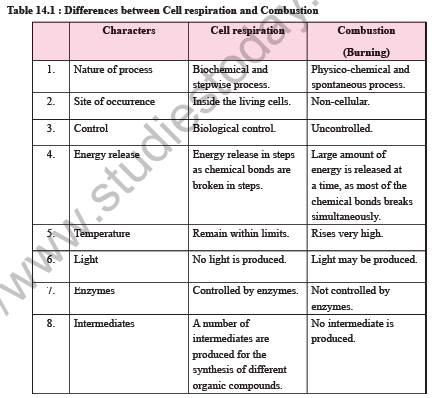
 According to Lavosier, cell respiration resembles the combustion (e.g. burning of coal, wood, oil etc.) in the breakdown of complex organic compounds in the presence of oxygen & production of carbon dioxide and energy, but there are certain fundamental differences between cell respiration & combustion (Refer table 14.1
 
NEET Biology Respiration in Plants Notes
 
 
Biotechnology Principles and Processes
NEET Biology Biotechnology Principles and Processes Notes
Chemical Coordination and Integration
NEET Biology Chemical Coordination and Integration Notes
Excretory Products and their Elimination
NEET Biology Excretory Products and their Elimination Notes
Principals of Inheritance and Variation
NEET Biology Principals of Inheritance and Variation Notes
Sexual Reproduction in Flowering Plants
NEET Biology Sexual Reproduction in Flowering Plants Notes
Strategies for Enhancement in Food Production
NEET Biology Strategies for Enhancement in Food Production Notes

NEET NEET Biology Respiration in Plants Study Material

Students can find all the important study material for Respiration in Plants on this page. This collection includes detailed notes, Mind Maps for quick revision, and Sure Shot Questions that will come in your NEET exams. This material has been strictly prepared on the latest 2026 syllabus for NEET Biology. Our expert teachers always suggest you to use these tools daily to make your learning easier and faster.

Respiration in Plants Expert Notes & Solved Exam Questions

Our teachers have used the latest official NCERT book for NEET Biology to prepare these study material. We have included previous year examination questions and also step-by-step solutions to help you understand the marking scheme too. After reading the above chapter notes and solved questions also solve the practice problems and then compare your work with our NCERT solutions for NEET Biology.

Complete Revision for Biology

To get the best marks in your NEET exams you should use Biology Sample Papers along with these chapter notes. Daily practicing with our online MCQ Tests for Respiration in Plants will also help you improve your speed and accuracy. All the study material provided on studiestoday.com is free and updated regularly to help NEET students stay ahead in their studies and feel confident during their school tests.

What is included in the advanced study material for NEET Biology Chapter Respiration in Plants?

Our advanced study package for Chapter Respiration in Plants includes detailed concepts, diagrams, Mind Maps, and explanation of complex topics to ensure NEET students learn as per syllabus for 2026 exams.

How do Mind Maps for Biology Chapter Respiration in Plants help in revision?

The Mind Maps provided for Chapter Respiration in Plants act as visual anchors which will help faster recall during high-pressure exams.

Are these Biology resources suitable for both classroom teaching and self-study?

Yes, teachers use our NEET Biology resources for lesson planning as they are in simple language and have lot of solved examples.

Is this advanced study material for Chapter Respiration in Plants free to download in PDF?

Yes, You can download the complete, mobile-friendly PDF of the Biology Chapter Respiration in Plants advanced resources for free.

Does this material cover rationalized content for the 2025-26 NEET session?

Yes, our subject matter experts have updated the Chapter Respiration in Plants material to align with the rationalized NCERT textbooks and have removed deleted topics and added new competency-based questions.