

Official NEET Study Materials for NEET Biology
Explore structured advanced study materials through the NEET Biology Metabolism Concept Map. Tailored for NEET learners, utilizing these Biology resources ensures thorough preparation and strengthens foundational knowledge before final NEET evaluations.
Advanced Resources for Biology
Navigate directly to the advanced Biology study materials using the digital viewer below. Each resource pack includes detailed conceptual summaries and solved practice questions, allowing students to instantly reinforce their learning.
Metabolism Concept Map (text version)
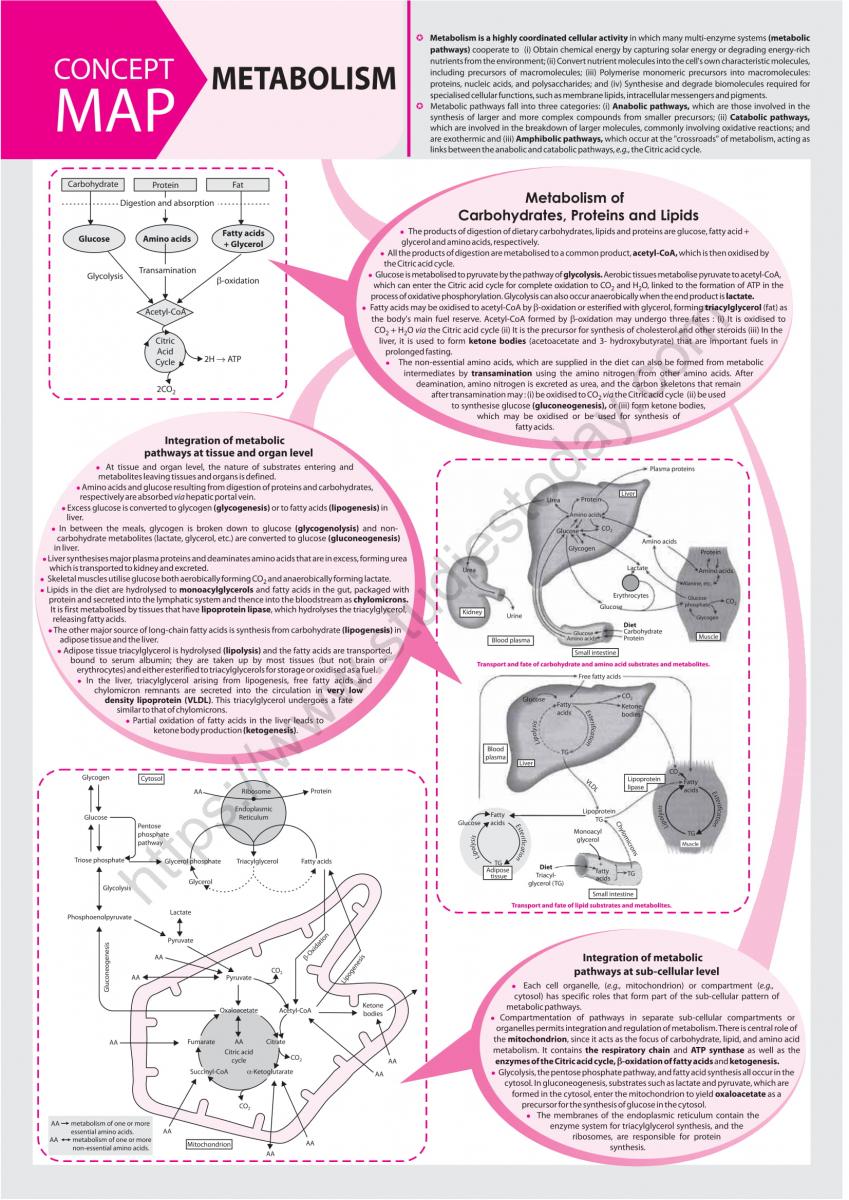
Metabolism is a highly coordinated cellular activity in which many multi-enzyme systems (metabolic pathways) cooperate to (i) Obtain chemical energy by capturing solar energy or degrading energy-rich nutrients from the environment; (ii) Convert nutrient molecules into the cell's own characteristic molecules, including precursors of macromolecules; (iii) Polymerise monomeric precursors into macromolecules: proteins, nucleic acids and polysaccharides; and (iv) Synthesise and degrade biomolecules required for specialised cellular functions, such as membrane lipids, intracellular messengers and pigments.
Metabolic pathways fall into three categories: (i) Anabolic pathways, which are those involved in the synthesis of larger and more complex compounds from smaller precursors; (ii) Catabolic pathways, which are involved in the breakdown of larger molecules, commonly involving oxidative reactions; and are exothermic and (iii) Amphibolic pathways, which occur at the "crossroads" of metabolism, acting as links between the anabolic and catabolic pathways, e.g., the Citric acid cycle.
Flow diagram: Carbohydrate, Protein and Fat undergo digestion and absorption to give Glucose, Amino acids and Fatty acids + Glycerol; these are converted (glycolysis, transamination, β-oxidation) to Acetyl-CoA, which enters the Citric Acid Cycle giving 2H → ATP and 2CO2.
Metabolism of Carbohydrates, Proteins and Lipids
The products of digestion of dietary carbohydrates, lipids and proteins are glucose, fatty acid + glycerol and amino acids, respectively. All the products of digestion are metabolised to a common product, acetyl-CoA, which is then oxidised by the Citric acid cycle.
Glucose is metabolised to pyruvate by the pathway of glycolysis. Aerobic tissues metabolise pyruvate to acetyl-CoA, which can enter the Citric acid cycle for complete oxidation to CO2 and H2O, linked to the formation of ATP in the process of oxidative phosphorylation. Glycolysis can also occur anaerobically when the end product is lactate.
Fatty acids may be oxidised to acetyl-CoA by β-oxidation or esterified with glycerol, forming triacylglycerol (fat) as the body's main fuel reserve. Acetyl-CoA formed by β-oxidation may undergo three fates: (i) It is oxidised to CO2 + H2O via the Citric acid cycle (ii) It is the precursor for synthesis of cholesterol and other steroids (iii) In the liver, it is used to form ketone bodies (acetoacetate and 3- hydroxybutyrate) that are important fuels in prolonged fasting.
The non-essential amino acids, which are supplied in the diet can also be formed from metabolic intermediates by transamination using the amino nitrogen from other amino acids. After deamination, amino nitrogen is excreted as urea, and the carbon skeletons that remain after transamination may: (i) be oxidised to CO2 via the Citric acid cycle (ii) be used to synthesise glucose (gluconeogenesis), or (iii) form ketone bodies, which may be oxidised or be used for synthesis of fatty acids.
Integration of Metabolic Pathways at Tissue and Organ Level
At tissue and organ level, the nature of substrates entering and metabolites leaving tissues and organs is defined. Amino acids and glucose resulting from digestion of proteins and carbohydrates, respectively are absorbed via hepatic portal vein.
Excess glucose is converted to glycogen (glycogenesis) or to fatty acids (lipogenesis) in liver. In between the meals, glycogen is broken down to glucose (glycogenolysis) and non-carbohydrate metabolites (lactate, glycerol, etc.) are converted to glucose (gluconeogenesis) in liver.
Liver synthesises major plasma proteins and deaminates amino acids that are in excess, forming urea which is transported to kidney and excreted.
Skeletal muscles utilise glucose both aerobically forming CO2 and anaerobically forming lactate.
Lipids in the diet are hydrolysed to monoacylglycerols and fatty acids in the gut, packaged with protein and secreted into the lymphatic system and thence into the bloodstream as chylomicrons. It is first metabolised by tissues that have lipoprotein lipase, which hydrolyses the triacylglycerol, releasing fatty acids.
The other major source of long-chain fatty acids is synthesis from carbohydrate (lipogenesis) in adipose tissue and the liver.
Adipose tissue triacylglycerol is hydrolysed (lipolysis) and the fatty acids are transported, bound to serum albumin; they are taken up by most tissues (but not brain or erythrocytes) and either esterified to triacylglycerols for storage or oxidised as a fuel.
In the liver, triacylglycerol arising from lipogenesis, free fatty acids and chylomicron remnants are secreted into the circulation in very low density lipoprotein (VLDL). This triacylglycerol undergoes a fate similar to that of chylomicrons. Partial oxidation of fatty acids in the liver leads to ketone body production (ketogenesis).
Fig: Transport and fate of carbohydrate and amino acid substrates and metabolites (small intestine, liver, blood plasma, kidney, muscle, erythrocytes).
Fig: Transport and fate of lipid substrates and metabolites (small intestine, liver, adipose tissue, muscle; chylomicron, VLDL, lipoprotein lipase).
Integration of Metabolic Pathways at Sub-cellular Level
Each cell organelle (e.g., mitochondrion) or compartment (e.g., cytosol) has specific roles that form part of the sub-cellular pattern of metabolic pathways.
Compartmentation of pathways in separate sub-cellular compartments or organelles permits integration and regulation of metabolism. There is central role of the mitochondrion, since it acts as the focus of carbohydrate, lipid, and amino acid metabolism. It contains the respiratory chain and ATP synthase as well as the enzymes of the Citric acid cycle, β-oxidation of fatty acids and ketogenesis.
Glycolysis, the pentose phosphate pathway, and fatty acid synthesis all occur in the cytosol. In gluconeogenesis, substrates such as lactate and pyruvate, which are formed in the cytosol, enter the mitochondrion to yield oxaloacetate as a precursor for the synthesis of glucose in the cytosol.
The membranes of the endoplasmic reticulum contain the enzyme system for triacylglycerol synthesis, and the ribosomes, are responsible for protein synthesis.
Fig: Sub-cellular metabolic map (cytosol, endoplasmic reticulum, mitochondrion; AA = metabolism of essential and non-essential amino acids).
Useful Resources and Notes for NEET Biology Metabolism
Quick Revision Material for Metabolism
Explore essential learning tools for NEET Biology Metabolism. This curated collection features in-depth notes and targeted practice questions built around the active 2026 curriculum to streamline your daily revision.
Expert Notes and Solved Exam Questions
Built using official NCERT guidelines for NEET Biology, these materials provide reliable academic support. Integrating past examination questions and step-by-step solutions helps students understand official NEET grading criteria.
Additional Study Resources for NEET
Maximize your grade potential by utilizing NEET Biology practice papers in tandem with these structured notes. All printable assignments and interactive mock tests on our platform are updated for the 2026 session and available free of charge.
FAQs
Our advanced study package for Metabolism includes detailed concepts, diagrams, Mind Maps, and explanation of complex topics to ensure NEET students learn as per syllabus for 2026 exams.
The Mind Maps provided for Metabolism act as visual anchors which will help faster recall during high-pressure exams.
Yes, teachers use our NEET Biology resources for lesson planning as they are in simple language and have lot of solved examples.
Yes, You can download the complete, mobile-friendly PDF of the Biology Metabolism advanced resources for free.
Yes, our subject matter experts have updated the Metabolism material to align with the rationalized NCERT textbooks and have removed deleted topics and added new competency-based questions.