
NEET Biology The Living World and Taxonomy Notes

Advanced Study Material for NEET Biology: The Living World and Taxonomy

Access comprehensive study materials and useful resources for The Living World and Taxonomy using the NEET Biology The Living World and Taxonomy Notes. Designed to align with the 2026-27 NEET academic guidelines, these advanced resources help NEET Biology students reinforce core concepts beyond standard textbooks.

Practice NEET Biology Resources: The Living World and Taxonomy

Navigate directly to the advanced Biology study materials using the digital viewer below. Each resource pack includes detailed conceptual summaries and solved practice questions, allowing students to instantly reinforce their learning.
There is no clear cut distinction between living and non-living things. The organisms like viruses are non-living by themselves but become active and multiply when they are inside the living cells. They are neither plants nor animals but have hereditary material of their own. The prions do not even have the hereditary material and propagate diseases like Kuru and Madcow.
The living organisms occur almost in every habitat on earth. We can fi nd them from cold mountains to hot springs. A wide range of the living organisms can be found in fresh or marine water bodies and forests. The living froms as compared to non-livings have some fundamental characteristics. They are defi ned as ‘the self-replicating, self evolving with self-regulating interactive systems capable of responding to external stimuli’. All living organisms- the past, the present and the future, are linked to one another by sharing the common genetic material.
Following are the important distinctive characteristics exhibited by living forms.
 
1. Growth :
 
The increase in mass and increase in the number of individuals are twin characteristics of growth. The multi-cellular organisms grow by cell division. The animals grow up to a certain age, whereas the plants grow throughout their life. The cell devision also occurs to replace lost cells. The unicellular organisms also grow by cell division but there it is a type of reproduction. In multicellular organisms, whether animals or plants, the growth and reproduction are mutually exclusive events. Though the non-livings, like mountains, sand mounds and snow also grow, if we consider the increase in body mass as criterion, but this growth is by accumulation of material on the surface, and not from inside as we see in animals. So, growth alone cannot be considered as a defi ning property of living organisms until and unless it is well specified.
 
2. Reproduction :
 
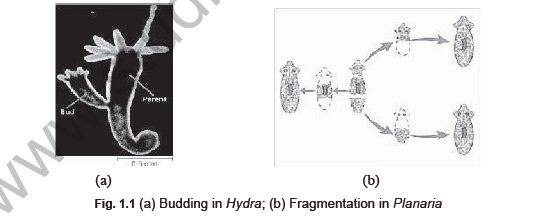
The living organisms reproduce asexually as well as sexually to multiply their number. Fungi reproduce asexually by spore formation. The lower organisms, like Hydra and Yeast, reproduce by budding. In Planaria (fl at worm), there is fragmentation and regeneration of lost parts. In unicellular forms, as described above, the reproduction is synonymous with growth. Moreover, there are living organisms who do not reproduce, e.g., mule, worker honey bee or infertile human. Thus, the reproduction, like growth, can also not be taken as defi ning characteristic of the living forms. On the other hand, this is however true, that non-living objects are not capable of reproducing or replicating themselves.
 
 
NEET Biology The Living World and Taxonomy Notes


Biology NEET Exam Resources: The Living World and Taxonomy

Essential Notes for NEET Biology

Explore essential learning tools for NEET Biology The Living World and Taxonomy. This curated collection features in-depth notes and targeted practice questions built around the active 2026 curriculum to streamline your daily revision.

Verified Solutions for NEET Biology

Built using official NCERT guidelines for NEET Biology, these materials provide reliable academic support. Integrating past examination questions and step-by-step solutions helps students understand official NEET grading criteria.

Enhance Accuracy with Online Tests

Maximize your grade potential by utilizing NEET Biology practice papers in tandem with these structured notes. All printable assignments and interactive mock tests on our platform are updated for the 2026 session and available free of charge.

FAQs

What is included in the advanced study material for NEET Biology The Living World and Taxonomy?

Our advanced study package for The Living World and Taxonomy includes detailed concepts, diagrams, Mind Maps, and explanation of complex topics to ensure NEET students learn as per syllabus for 2026 exams.

How do Mind Maps for Biology The Living World and Taxonomy help in revision?

The Mind Maps provided for The Living World and Taxonomy act as visual anchors which will help faster recall during high-pressure exams.

Are these Biology resources suitable for both classroom teaching and self-study?

Yes, teachers use our NEET Biology resources for lesson planning as they are in simple language and have lot of solved examples.

Is this advanced study material for The Living World and Taxonomy free to download in PDF?

Yes, You can download the complete, mobile-friendly PDF of the Biology The Living World and Taxonomy advanced resources for free.

Does this material cover rationalized content for the 2026-27 NEET session?

Yes, our subject matter experts have updated the The Living World and Taxonomy material to align with the rationalized NCERT textbooks and have removed deleted topics and added new competency-based questions.