NEET Biology Morphology of Flowering Plants Notes

Read and download the NEET Biology Morphology of Flowering Plants Notes. Designed for 2025-26, this advanced study material provides NEET Biology students with detailed revision notes, sure-shot questions, and detailed answers. Prepared by expert teachers and they follow the latest NEET, NCERT, and KVS guidelines to ensure you get best scores.

Advanced Study Material for NEET Biology Morphology of Flowering Plants

To achieve a high score in Biology, students must go beyond standard textbooks. This NEET Morphology of Flowering Plants study material includes conceptual summaries and solved practice questions to improve you understanding.

NEET Biology Morphology of Flowering Plants Notes and Questions


• Angiosperms are flowering, fruit bearing, spermatophytic plants that are well adapted for land. These plants are the most advanced and evolved group that exists today.
•  Angiosperms appeared in lower cretaceous period of mesozoic era but flourished in tertiary period of coenozoic era. They all have enclosed seeds and bear flowers. The flowering plants vary in size and ranging from small grasses to tall Eucalyptus or giant banyan trees.
•  Angiosperms lack archegonium which is replaced by pistil. They have double fertilization and endosperm is triploid.
•  The male gametes are nonmotile and carried by pollen tube to avoid dependence on water for fertilization.
•  These plants have been broadly classifi ed into monocots and dicots. Monocots are more advanced than dicots and have probably evolved from primitive dicots.
•  Plant morphology refers to the study of external form and structure of plants.
•  There are two major systems in flowering plants i.e., root system and shoot system.
 
THE ROOT
 
The main characteristics of root are as following :
• It is the underground system, usually below the soil and originates from the radicle.
•  Generally it is positively geotropic, negatively phototropic and positively hydrotropic.
•  The roots grow in downward direction for the purpose of anchorage and absorption of water and nutrients from the soil.
•  It lacks nodes, internodes, leaves and buds.
•  Unicellular hair and a terminal root cap or calyptra is present.
• The roots may be absent in some hydrophytes, but when present they are poorly developed and lack hair.
 
Functions of root
 
• The primary functions of root are fixation of plant fi rmly in soil, absorption of water and conduction of mineral nutrients.
• Roots also prevent soil erosion. The secondary or special functions of root include food storage, providing additional mechanical support, photosynthesis, respiration and vegetative multiplication, etc.
 
Types of Roots
 
• Roots are divided into two types:
 
(i) Tap roots
(ii) Adventitious roots
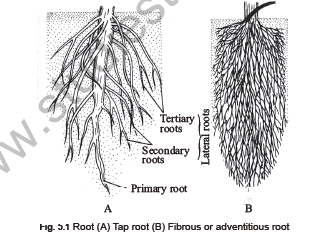
(i) Tap root : Tap root or primary root develops from the radicle. It form lateral branches or secondary roots which are further branched to form tertiary roots. Thus tap root along with its branches, i.e., secondary and tertiary roots from tap root system. It is generally found in dicotyledons.
(ii) Adventitious roots : These roots develop from any part of the plant instead of radicle.
 
 
NEET Biology Morphology of Flowering Plants Notes
 
Biotechnology Principles and Processes
NEET Biology Biotechnology Principles and Processes Notes
Chemical Coordination and Integration
NEET Biology Chemical Coordination and Integration Notes
Excretory Products and their Elimination
NEET Biology Excretory Products and their Elimination Notes
Principals of Inheritance and Variation
NEET Biology Principals of Inheritance and Variation Notes
Sexual Reproduction in Flowering Plants
NEET Biology Sexual Reproduction in Flowering Plants Notes
Strategies for Enhancement in Food Production
NEET Biology Strategies for Enhancement in Food Production Notes

NEET NEET Biology Morphology of Flowering Plants Study Material

Students can find all the important study material for Morphology of Flowering Plants on this page. This collection includes detailed notes, Mind Maps for quick revision, and Sure Shot Questions that will come in your NEET exams. This material has been strictly prepared on the latest 2026 syllabus for NEET Biology. Our expert teachers always suggest you to use these tools daily to make your learning easier and faster.

Morphology of Flowering Plants Expert Notes & Solved Exam Questions

Our teachers have used the latest official NCERT book for NEET Biology to prepare these study material. We have included previous year examination questions and also step-by-step solutions to help you understand the marking scheme too. After reading the above chapter notes and solved questions also solve the practice problems and then compare your work with our NCERT solutions for NEET Biology.

Complete Revision for Biology

To get the best marks in your NEET exams you should use Biology Sample Papers along with these chapter notes. Daily practicing with our online MCQ Tests for Morphology of Flowering Plants will also help you improve your speed and accuracy. All the study material provided on studiestoday.com is free and updated regularly to help NEET students stay ahead in their studies and feel confident during their school tests.

What is included in the advanced study material for NEET Biology Chapter Morphology of Flowering Plants?

Our advanced study package for Chapter Morphology of Flowering Plants includes detailed concepts, diagrams, Mind Maps, and explanation of complex topics to ensure NEET students learn as per syllabus for 2026 exams.

How do Mind Maps for Biology Chapter Morphology of Flowering Plants help in revision?

The Mind Maps provided for Chapter Morphology of Flowering Plants act as visual anchors which will help faster recall during high-pressure exams.

Are these Biology resources suitable for both classroom teaching and self-study?

Yes, teachers use our NEET Biology resources for lesson planning as they are in simple language and have lot of solved examples.

Is this advanced study material for Chapter Morphology of Flowering Plants free to download in PDF?

Yes, You can download the complete, mobile-friendly PDF of the Biology Chapter Morphology of Flowering Plants advanced resources for free.

Does this material cover rationalized content for the 2025-26 NEET session?

Yes, our subject matter experts have updated the Chapter Morphology of Flowering Plants material to align with the rationalized NCERT textbooks and have removed deleted topics and added new competency-based questions.