

Advanced Study Material for Class 10 Science: Chapter 01 Chemical Reactions and Equations
Review targeted academic resources with the Class 10 Science Chemical Reactions Exam Notes. Built according to official CBSE standards for the 2026-27 term, these downloadable Class 10 Science study materials support effective daily practice and deeper conceptual understanding for Chapter 01 Chemical Reactions and Equations.
Practice Class 10 Science Resources: Chapter 01 Chemical Reactions and Equations
View or download the dedicated Class 10 Science Chemical Reactions Exam Notes resource below. Engaging with these advanced study guides under focused conditions ensures continuous academic progress and mastery of the 2026-27 curriculum for Chapter 01 Chemical Reactions and Equations.
Class 10 Science Chemical Reactions Exam Notes. Please refer to the examination notes which you can use for preparing and revising for exams. These notes will help you to revise the concepts quickly and get good marks.
Introduction
In the previous class, you have read about physical an chemical changes. Chemical changes result from chemical reaction taking placed between substances. In this chapter we shall deal with the chemical reactions and their representation in the form of chemical equations.
The processes in which a substance or substances undergo change to produce new substances with new properties are known as chemical reactions. for example, when calcium carbonate is heated, calcium oxide (lime) and carbon dioxide are formed. The breaking up of calcium carbonate into calcium oxide and carbon dioxide is, thus, a chemical reaction because calcium carbonate changes into new substances, calcium oxide and carbon dioxide.
Reactant :
The substance which takes part in a chemical reaction is called reactant. For example, in the breaking up of calcium carbonate into calcium oxide and carbon dioxide, calcium carbonate is the reactant. Similarly, sodium and water are the reactants when they react.
Product :
A product is a new substance formed in a chemical reaction. For example, hydrogen and sodium hydroxide are the products of the reaction between sodium and water.
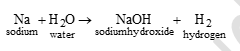
Similarly, in the breaking up of calcium carbonate, calcium oxide and carbon dioxide are the products.
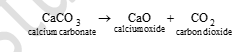
You know, atoms in a molecule are held together by a force of attraction called bond. The molecules do not participate directly in a chemical reaction. First they break down into atoms and these atoms then take part in the reaction. New bonds are formed between the atoms to form the products. That is, there take place rearrangement or regroupings of atoms in various ways to give products. For example, when ammonium cyanate is heated, different bonds in ammonium cyanate molecules are broken and new bonds are formed to produce urea.
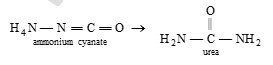
Here, we see that the molecular formulae of both ammonium cyanate and urea are the same, but their properties are quite different and they are two different compounds. Such compounds are known as isomers of each other and the reactions that produce such isomers are called isomerization reactions.
Valency :
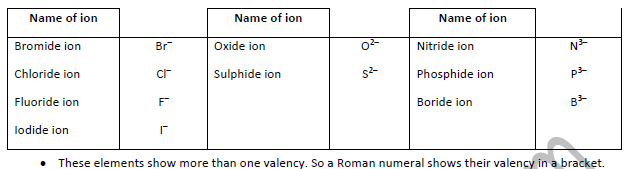
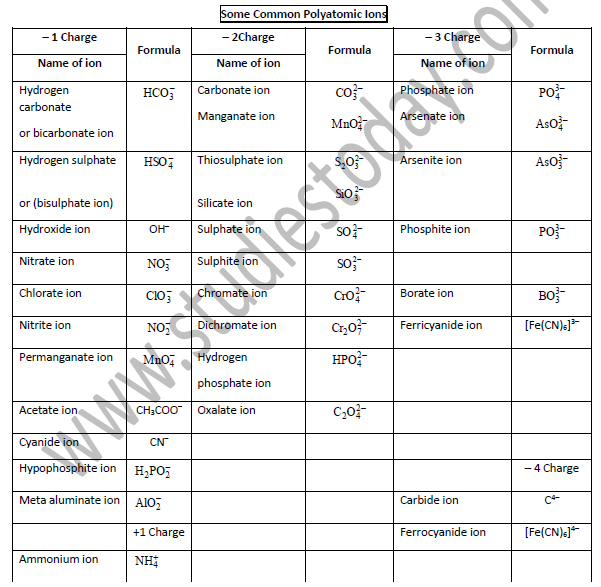
The number of electrons shared by an atom is called its valency. It is also called the combining capacity of an atom, e.g., Cl atom can share one valence electron, its valency is 1, Oxygen can share two valence electrons, its valency is 2. Nitrogen can share 3 valence electrons, its valency is 3, Carbon can share 4 valency electrons, therefore its valency is 4 and so on.
It means if carbon combines with Chlorine, Carbon will share four valence electrons with four chlorine atoms, therefore the molecular formula of the covalent compound will be

Please click on below link to download pdf file for Class 10 Science Chemical Reactions Exam Notes
Free study material for Science
CBSE Class 10 Science Study Material: Chapter 01 Chemical Reactions and Equations
Core Study Kit: Class 10 Science Chapter 01 Chemical Reactions and Equations
Access comprehensive study material for Chapter 01 Chemical Reactions and Equations, including revision notes, concept maps, and high-probability questions. These resources are designed in alignment with the latest 2026 CBSE syllabus for Class 10 Science to support effective exam preparation.
NCERT-Aligned Solutions for Chapter 01 Chemical Reactions and Equations
Built using official NCERT guidelines for Class 10 Science, these materials provide reliable academic support. Integrating past examination questions and step-by-step solutions helps students understand official CBSE grading criteria.
Next Steps in Your Exam Preparation
For peak performance in upcoming evaluations, integrate official Science sample papers directly into your study schedule. Follow up your revision by attempting online MCQ tests for Chapter 01 Chemical Reactions and Equations to refine calculation speed and precision.
FAQs
Our advanced study package for Chapter 01 Chemical Reactions and Equations includes detailed concepts, diagrams, Mind Maps, and explanation of complex topics to ensure Class 10 students learn as per syllabus for 2026 exams.
The Mind Maps provided for Chapter 01 Chemical Reactions and Equations act as visual anchors which will help faster recall during high-pressure exams.
Yes, teachers use our Class 10 Science resources for lesson planning as they are in simple language and have lot of solved examples.
Yes, You can download the complete, mobile-friendly PDF of the Science Chapter 01 Chemical Reactions and Equations advanced resources for free.
Yes, our subject matter experts have updated the Chapter 01 Chemical Reactions and Equations material to align with the rationalized NCERT textbooks and have removed deleted topics and added new competency-based questions.