

Download CBSE Class 10 Science Useful Resources
Access comprehensive study materials and useful resources for Practical Questions using the CBSE Class 10 Science Categories of practical skills. Designed to align with the 2026-27 CBSE academic guidelines, these advanced resources help Class 10 Science students reinforce core concepts beyond standard textbooks.
Access CBSE Study Guides and Summaries
View or download the dedicated CBSE Class 10 Science Categories of practical skills resource below. Engaging with these advanced study guides under focused conditions ensures continuous academic progress and mastery of the 2026-27 curriculum for Practical Questions.
CBSE Class 10 Science Categories of practical skills. Please refer to the examination notes which you can use for preparing and revising for exams. These notes will help you to revise the concepts quickly and get good marks.
CATEGORIES OF PRACTICAL SKILLS
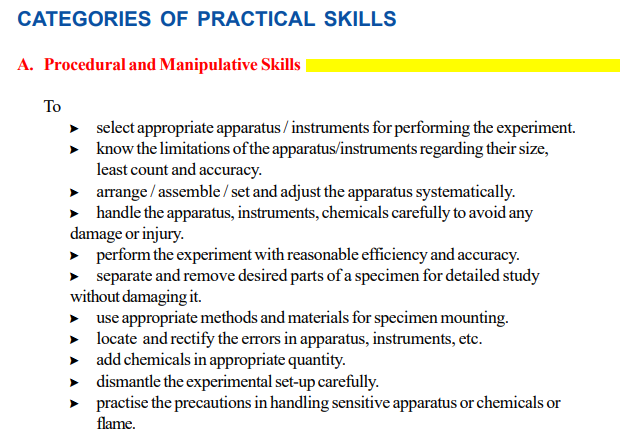
A. Procedural and Manipulative Skills [2 Marks]
To
- select appropriate apparatus / instruments for performing the experiment.
- know the limitations of the apparatus/instruments regarding their size, least count and accuracy.
- arrange / assemble / set and adjust the apparatus systematically.
- handle the apparatus, instruments, chemicals carefully to avoid any damage or injury.
- perform the experiment with reasonable efficiency and accuracy.
- separate and remove desired parts of a specimen for detailed study without damaging it.
- use appropriate methods and materials for specimen mounting.
- locate and rectify the errors in apparatus, instruments, etc.
- add chemicals in appropriate quantity.
- dismantle the experimental set-up carefully.
- practise the precautions in handling sensitive apparatus or chemicals or flame.
Answer:
1. Procedural and manipulative skills form the foundation of hands-on laboratory work in science.
2. These skills test a student's ability to handle equipment safely and assemble apparatus accurately during practical examinations.
Teacher's Note:
a) Emphasises safe handling of chemicals and sensitive apparatus.
b) Ensures students understand equipment limitations before starting experiments.
c) Essential framework for evaluating internal practical assessments in Class 10 science.
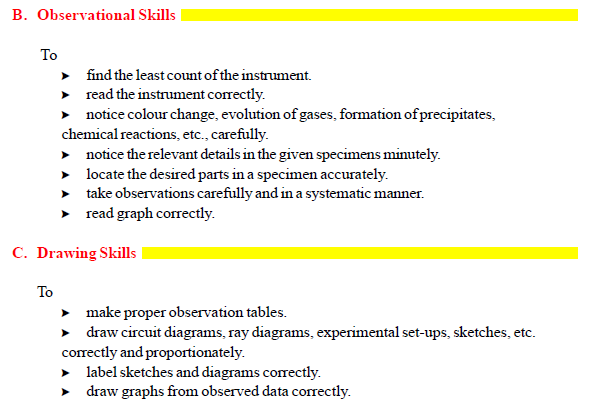
B. Observational Skills [2 Marks]
To
- find the least count of the instrument.
- read the instrument correctly.
- notice colour change, evolution of gases, formation of precipitates, chemical reactions, etc., carefully.
- notice the relevant details in the given specimens minutely.
- locate the desired parts in a specimen accurately.
- take observations carefully and in a systematic manner.
- read graph correctly.
Answer:
1. Observational skills measure precision in recording qualitative and quantitative data during experiments.
2. Students must accurately note phenomena such as colour changes, gas evolution, and instrument readings.
Teacher's Note:
a) Focuses on accurate data collection and least count determination.
b) Crucial for minimizing experimental errors in physics, chemistry, and biology practicals.
C. Drawing Skills [2 Marks]
To
- make proper observation tables.
- draw circuit diagrams, ray diagrams, experimental set-ups, sketches, etc. correctly and proportionately.
- label sketches and diagrams correctly.
- draw graphs from observed data correctly.
Answer:
1. Drawing skills evaluate the graphical and diagrammatic representation of scientific data and experimental setups.
2. Proper labeling, proportional ray diagrams, and neatly structured observation tables are key components.
Teacher's Note:
a) Requires neatness and accurate labeling in diagrams and graphs.
b) Helps students visually interpret experimental relationships.
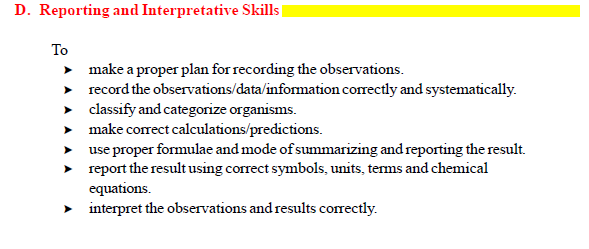
D. Reporting and Interpretative Skills [2 Marks]
To
- make a proper plan for recording the observations.
- record the observations/data/information correctly and systematically.
- classify and categorize organisms.
- make correct calculations/predictions.
- use proper formulae and mode of summarizing and reporting the result.
- report the result using correct symbols, units, terms and chemical equations.
- interpret the observations and results correctly.
Answer:
1. Reporting and interpretative skills form an essential component of practical laboratory work in science.
2. These skills ensure that experimental findings are communicated accurately using proper scientific terminology, units, and chemical equations.
Teacher's Note:
a) Focuses on systematic data recording and accurate calculations during experiments.
b) Emphasizes the use of standard symbols, units, and proper chemical equations in science reports.
Free study material for Science
Science Class 10 Exam Resources: Practical Questions
Essential Notes for Class 10 Science
Explore essential learning tools for Class 10 Science Practical Questions. This curated collection features in-depth notes and targeted practice questions built around the active 2026 curriculum to streamline your daily revision.
Verified Solutions for Class 10 Science
Built using official NCERT guidelines for Class 10 Science, these materials provide reliable academic support. Integrating past examination questions and step-by-step solutions helps students understand official CBSE grading criteria.
Enhance Accuracy with Online Tests
For peak performance in upcoming evaluations, integrate official Science sample papers directly into your study schedule. Follow up your revision by attempting online MCQ tests for Practical Questions to refine calculation speed and precision.
FAQs
Our advanced study package for Practical Questions includes detailed concepts, diagrams, Mind Maps, and explanation of complex topics to ensure Class 10 students learn as per syllabus for 2026 exams.
The Mind Maps provided for Practical Questions act as visual anchors which will help faster recall during high-pressure exams.
Yes, teachers use our Class 10 Science resources for lesson planning as they are in simple language and have lot of solved examples.
Yes, You can download the complete, mobile-friendly PDF of the Science Practical Questions advanced resources for free.
Yes, our subject matter experts have updated the Practical Questions material to align with the rationalized NCERT textbooks and have removed deleted topics and added new competency-based questions.