

Official CBSE Study Materials for Class 10 Science
Access comprehensive study materials and useful resources for Chapter 09 Light Reflection and Refraction using the CBSE Class 10 Science Light reflection and refraction Sure Shot Questions Set 02. Designed to align with the 2026-27 CBSE academic guidelines, these advanced resources help Class 10 Science students reinforce core concepts beyond standard textbooks.
Advanced Resources for Science
Access the complete useful resource PDF for Class 10 Science below. Regular practice with these targeted academic notes builds familiarity with complex topics and helps secure higher marks in final school evaluations.
CBSE Class 10 Science Light reflection and refraction Sure Shot Questions B. There are many more useful educational material which the students can download in pdf format and use them for studies. Study material like concept maps, important and sure shot question banks, quick to learn flash cards, flow charts, mind maps, teacher notes, important formulas, past examinations question bank, important concepts taught by teachers. Students can download these useful educational material free and use them to get better marks in examinations. Also refer to other worksheets for the same chapter and other subjects too. Use them for better understanding of the subjects.
CHAPTER - 10
LIGHT - REFLECTION AND REFRACTION
ASSIGNMENT QUESTIONS SET - 2
MULTIPLE CHOICE QUESTIONS
1. Which of the following can make a parallel beam of light when light from a point source is incident on it? [1 Mark]
(a) Concave mirror as well as convex lens
(b) Convex mirror as well as concave lens
(c) Two plane mirrors placed at 90° to each other
(d) Concave mirror as well as concave lens
Answer: (a) Concave mirror as well as convex lens
1. A concave mirror converges light rays coming from its focus to form a parallel beam when placed at the focus, but a point source at the focus of a concave mirror or convex lens produces a parallel beam.
2. Both a concave mirror and a convex lens are converging optical devices that can render a parallel beam from a point source placed at their respective principal foci.
3. Hence, the correct option is (a).
Teacher's Note:
a) Converging mirrors and lenses make diverging rays parallel.
b) Diverging devices like convex mirrors and concave lenses diverge parallel rays.
2. A 10 mm long awl pin is placed vertically in front of a concave mirror. A 5 mm long image of the awl pin is formed at 30 cm in front of the mirror. The focal length of this mirror is [1 Mark]
(a) - 30 cm
(b) - 20 cm
(c) - 40 cm
(d) - 60 cm
Answer: (b) - 20 cm
1. Given height of object \(h_o\) = 10 mm = 1 cm, height of image \(h_i\) = -5 mm = -0.5 cm (real image in front of mirror), and image distance v = -30 cm.
2. Magnification m = \(\frac{h_i}{h_o}\) = \(\frac{-0.5}{1}\) = -0.5 and m = \(-\frac{v}{u}\), so -0.5 = \(-\frac{-30}{u}\), which gives u = -60 cm.
3. Using mirror formula \(\frac{1}{f}\) = \(\frac{1}{v}\) + \(\frac{1}{u}\) = \(\frac{1}{-30}\) + \(\frac{1}{-60}\) = \(\frac{-2 - 1}{60}\) = \(\frac{-3}{60}\) = \(\frac{-1}{20}\).
4. Focal length f = -20 cm, hence the correct option is (b).
Teacher's Note:
a) Real images formed by concave mirrors are always inverted, so image height is taken negative.
b) Mirror formula signs must be applied strictly according to the Cartesian sign convention.
3. Under which of the following conditions a concave mirror can form an image larger than the actual object? [1 Mark]
(a) When the object is kept at a distance equal to its radius of curvature
(b) When object is kept at a distance less than its focal length
(c) When object is placed between the focus and centre of curvature
(d) When object is kept at a distance greater than its radius of curvature
Answer: (c) When object is placed between the focus and centre of curvature
1. When an object is placed between the focus and the centre of curvature of a concave mirror, a real, inverted, and magnified image is formed beyond the centre of curvature.
2. When the object is at less than focal length, the image is virtual and magnified, but option (c) specifically lists the standard real magnified case.
3. Hence, the correct option is (c).
Teacher's Note:
a) Concave mirrors produce magnified real images when objects are between F and C.
b) Memorize ray diagram position table for quick recall in board exams.
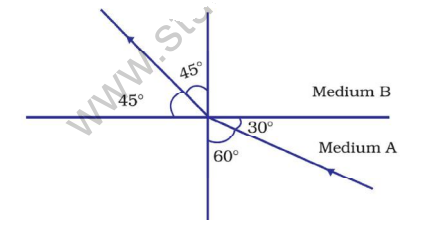
4. The below Figure shows a ray of light as it travels from medium A to medium B. Refractive index of the medium B relative to medium A is [1 Mark]
(a) \(\frac{\sqrt{3}}{\sqrt{2}}\)
(b) \(\frac{\sqrt{2}}{\sqrt{3}}\)
(c) \(\frac{1}{\sqrt{2}}\)
(d) \(\sqrt{2}\)
Answer: (a) \(\frac{\sqrt{3}}{\sqrt{2}}\)
1. Angle of incidence in medium A with the normal is i = 60° (since the angle with interface is 30°, angle with normal is 90° - 30° = 60°).
2. Angle of refraction in medium B with the normal is r = 45° (since angle with interface is 45°).
3. Refractive index of medium B relative to medium A is \(_{A}n_{B} = \frac{\sin i}{\sin r} = \frac{\sin 60^\circ}{\sin 45^\circ} = \frac{\frac{\sqrt{3}}{2}}{\frac{1}{\sqrt{2}}} = \frac{\sqrt{3}}{\sqrt{2}}\).
4. Hence, the correct option is (a).
Teacher's Note:
a) Always measure angles of incidence and refraction with respect to the normal line, not the surface boundary.
b) Snell's law states that the ratio of the sine of the angle of incidence to the sine of the angle of refraction is constant.
5. Which of the following statements is true? [1 Mark]
(a) A convex lens has 4 dioptre power having a focal length 0.25 m
(b) A convex lens has -4 dioptre power having a focal length 0.25 m
(c) A concave lens has 4 dioptre power having a focal length 0.25 m
(d) A concave lens has -4 dioptre power having a focal length 0.25 m
Answer: (a) A convex lens has 4 dioptre power having a focal length 0.25 m
1. Power of a lens P = \(\frac{1}{f \text{ (in metres)}}\).
2. A convex lens has a positive focal length, so P = \(\frac{1}{0.25}\) = +4 D.
3. Therefore, a convex lens of focal length 0.25 m has a power of 4 dioptre.
4. Hence, the correct option is (a).
Teacher's Note:
a) Convex lenses have positive focal lengths and positive powers.
b) Concave lenses have negative focal lengths and negative powers.
6. Magnification produced by a rear view mirror fitted in vehicles [1 Mark]
(a) is less than one
(b) is more than one
(c) is equal to one
(d) can be more than or less than one depending upon the position of the object in front of it
Answer: (a) is less than one
1. A rear view mirror fitted in vehicles is a convex mirror.
2. A convex mirror always produces a virtual, erect, and diminished image for all positions of the object in front of it.
3. Since the image size is always smaller than the object size, the magnification (\(m = \frac{h_i}{h_o}\)) is always less than one.
4. Hence, the correct option is (a).
Teacher's Note:
a) Convex mirrors provide a wider field of view and always form diminished images.
b) Magnification for diminished images is always between 0 and 1.
7. A light ray enters from medium A to medium B as shown in below Figure. The refractive index of medium B relative to A will be [1 Mark]
(a) greater than unity
(b) less than unity
(c) equal to unity
(d) zero
Answer: (a) greater than unity
1. Observe the bending of the light ray towards the normal as it enters medium B from medium A.
2. When a ray bends towards the normal, the speed of light in medium B is less than the speed of light in medium A.
3. The relative refractive index is given by \(n_{BA} = \frac{v_A}{v_B}\).
4. Since \(v_A \gt v_B\), the refractive index of medium B relative to A is greater than unity, so the correct option is (a).
Teacher's Note:
a) Snell law states that refractive index relates the ratio of sines of angles.
b) Remember that bending towards the normal always indicates an optically denser medium.
c) A common trap is confusing relative refractive index with absolute refractive index.
d) Verify using the angle of incidence being greater than the angle of refraction.
8. Beams of light are incident through the holes A and B and emerge out of box through the holes C and D respectively as shown in the below Figure. Which of the following could be inside the box? [1 Mark]
(a) A rectangular glass slab
(b) A convex lens
(c) A concave lens
(d) A prism
Answer: (c) A concave lens
1. Parallel beams of light enter through holes A and B.
2. After passing through the box, the beams diverge outward at holes C and D.
3. A concave lens diverges incoming parallel light rays.
4. Therefore, the device inside the box is a concave lens, making option (c) correct.
Teacher's Note:
a) Diverging lenses cause parallel rays to appear to come from a focal point.
b) Do not confuse with a convex lens which converges rays.
c) Check ray directions carefully at the exit points.
9. A beam of light is incident through the holes on side A and emerges out of the holes on the other face of the box as shown in the below Figure. Which of the following could be inside the box? [1 Mark]
(a) Concave lens
(b) Rectangular glass slab
(c) Prism
(d) Convex lens
Answer: (d) Convex lens
1. Parallel rays of light enter side A of the box.
2. The emerging rays on side B converge towards a single common focal point.
3. A convex lens is a converging lens that bends parallel incoming rays to meet at a focus.
4. Hence, the correct option is (d).
Teacher's Note:
a) Converging optical components decrease the spread of parallel beams.
b) Notice the intersection of emergent rays forming a focal point.
c) Always distinguish between convex (converging) and concave (diverging) behavior.
10. Rays from Sun converge at a point 15 cm in front of a concave mirror. Where should an object be placed so that size of its image is equal to the size of the object? [1 Mark]
(a) 15 cm in front of the mirror
(b) 30 cm in front of the mirror
(c) between 15 cm and 30 cm in front of the mirror
(d) more than 30 cm in front of the mirror
Answer: (b) 30 cm in front of the mirror
1. Since the sun rays converge at a point in front of a concave mirror, that point is the focus (F) of the mirror.
2. Therefore, focal length \(f\) = -15 cm, and the radius of curvature \(R\) = 2f = -30 cm.
3. For the size of the image to be equal to the size of the object, the object must be placed at the centre of curvature.
4. Hence, the correct option is (b).
Teacher's Note:
a) Parallel rays from infinity converge at the principal focus of a concave mirror.
b) Students often confuse the focal length with the radius of curvature; remember R = 2f.
c) An object placed at the centre of curvature of a concave mirror forms a real, inverted image of the same size.
11. A full length image of a distant tall building can definitely be seen by using [1 Mark]
(a) a concave mirror
(b) a convex mirror
(c) a plane mirror
(d) both concave as well as plane mirror
Answer: (b) a convex mirror
1. A convex mirror always forms a virtual, erect, and diminished image of an object placed anywhere in front of it.
2. It has a wider field of view because it curves outward, enabling it to view a large area including distant tall buildings.
3. Hence, the correct option is (b).
Teacher's Note:
a) Convex mirrors are commonly used as rear-view mirrors in vehicles due to this property.
b) Plane mirrors form images of the same size, while concave mirrors form enlarged images for distant objects depending on position.
12. In torches, search lights and headlights of vehicles the bulb is placed [1 Mark]
(a) between the pole and the focus of the reflector
(b) very near to the focus of the reflector
(c) between the focus and centre of curvature of the reflector
(d) at the centre of curvature of the reflector
Answer: (b) very near to the focus of the reflector
1. Concave mirrors are used as reflectors in torches, searchlights, and vehicle headlights.
2. When a bulb is placed very close to the focus of a concave mirror, the light rays diverging from it fall on the mirror and are reflected as a strong, parallel beam of light.
3. Hence, the correct option is (b).
Teacher's Note:
a) This application relies on the principle that rays passing through or originating from the focus become parallel after reflection.
b) Placing the bulb at other positions would not produce a focused parallel beam.
13. The laws of reflection hold good for [1 Mark]
(a) plane mirror only
(b) concave mirror only
(c) convex mirror only
(d) all mirrors irrespective of their shape
Answer: (d) all mirrors irrespective of their shape
1. The laws of reflection state that the angle of incidence is equal to the angle of reflection, and the incident ray, normal, and reflected ray all lie in the same plane.
2. These laws are universal and apply to all reflecting surfaces, including plane and spherical mirrors of any shape.
3. Hence, the correct option is (d).
Teacher's Note:
a) Curving a surface changes the direction of the normal at each point, but reflection laws still hold locally.
b) Do not restrict reflection laws to flat surfaces only.
14. The path of a ray of light coming from air passing through a rectangular glass slab traced by four students are shown as A, B, C and D in Figure. Which one of them is correct? [1 Mark]
(a) A
(b) B
(c) C
(d) D
Answer: (b) B
1. When a ray of light enters a denser medium (glass) from a rarer medium (air), it bends towards the normal.
2. When it emerges from the denser medium (glass) into the rarer medium (air), it bends away from the normal, and the emergent ray is parallel to the incident ray.
3. Tracing B correctly shows bending towards the normal at the first surface and parallel lateral displacement at the second surface.
4. Hence, the correct option is (b).
Teacher's Note:
a) Refraction through a rectangular glass slab produces lateral displacement with parallel incident and emergent rays.
b) Tracing A and C show incorrect bending directions relative to the normal.
15. You are given water, mustard oil, glycerine and kerosene. In which of these media a ray of light incident obliquely at same angle would bend the most? [1 Mark]
(a) Kerosene
(b) Water
(c) Mustard oil
(d) Glycerine
Answer: (d) Glycerine
1. The bending of light depends on the refractive index of the medium; a higher refractive index causes greater bending towards the normal.
2. The refractive indices are approximately: Water = 1.33, Kerosene = 1.44, Mustard oil = 1.47, and Glycerine = 1.474.
3. Since glycerine has the highest refractive index among the given options, light bends the most in it.
4. Hence, the correct option is (d).
Teacher's Note:
a) Optical density increases with a higher refractive index.
b) Compare refractive index values carefully when determining the extent of refraction.
16. A child is standing in front of a magic mirror. She finds the image of her head bigger, the middle portion of her body of the same size and that of the legs smaller. The following is the order of combinations for the magic mirror from the top. [1 Mark]
(a) Plane, convex and concave
(b) Convex, concave and plane
(c) Concave, plane and convex
(d) Convex, plane and concave
Answer: (c) Concave, plane and convex
1. A concave mirror produces a magnified image when the object is close, making the head appear bigger.
2. A plane mirror produces an image of the same size as the object, keeping the middle portion of the body of the same size.
3. A convex mirror produces a diminished image, making the legs appear smaller.
4. Hence, the correct combination from top to bottom is concave, plane and convex, so option (c) is correct.
Teacher's Note:
a) Different mirrors exhibit distinct magnification properties based on curvature.
b) Do not confuse concave and convex mirror image sizes for close objects.
c) Real-life amusement park mirrors combine multiple surface curvatures to create distorted images.
17. Which ofju the following ray diagrams is correct for the ray of light incident on a concave mirror as shown in below Figure? [1 Mark]
(a) Fig. A
(b) Fig. B
(c) Fig. C
(d) Fig. D
[Figure: Four ray diagrams labeled Fig. A, Fig. B, Fig. C, and Fig. D showing a concave mirror with principal axis, pole P, focus F, and center of curvature C. Fig. A shows a ray parallel to the principal axis passing through F after reflection. Fig. B shows a ray passing through 2F. Fig. C shows a ray passing through F. Fig. D shows a ray directed towards C.]
Answer: (a) Fig. A
1. A ray of light parallel to the principal axis of a concave mirror passes through its principal focus after reflection.
2. Fig. A correctly illustrates this standard ray rule for spherical mirrors.
3. Hence, the correct option is (a).
Teacher's Note:
a) Ray diagrams are essential for locating images formed by curved mirrors.
b) Remember that rays parallel to the principal axis always converge at the focus for concave mirrors.
c) Always check the direction of arrows on incident and reflected light rays.
18. Which of the following ray diagrams is correct for the ray of light incident on a lens shown in below Figure? [1 Mark]
(a) Fig. A
(b) Fig. B
(c) Fig. C
(d) Fig. D
[Figure: Four lens ray diagrams labeled Fig. A, Fig. B, Fig. C, and Fig. D showing a convex lens with optical center O and focus F. Fig. A shows a ray passing through O undeviated. Fig. B shows a ray parallel to the principal axis. Fig. C and Fig. D show other incorrect refractions.]
Answer: (a) Fig. A
1. A ray of light passing through the optical center of a lens goes straight without any deviation.
2. Fig. A correctly shows the ray passing straight through the optical center O of the convex lens.
3. Hence, the correct option is (a).
Teacher's Note:
a) The optical center is a unique point where refraction does not alter the path of light.
b) Students often mistakenly bend rays at the optical center in thin lenses.
c) Master all three principal rules of refraction through lenses for accurate ray tracing.
19. In which of the following, the image of an object placed at infinity will be highly diminished and point sized? [1 Mark]
(a) Concave mirror only
(b) Convex mirror only
(c) Convex lens only
(d) Concave mirror, convex mirror, concave lens and convex lens
Answer: (d) Concave mirror, convex mirror, concave lens and convex lens
1. For a concave mirror, rays from infinity form a highly diminished, point-sized image at the focus.
2. For a convex mirror, parallel rays from infinity form a virtual, highly diminished, point-sized image behind the mirror at the focus.
3. For both concave and convex lenses, parallel rays from infinity form a highly diminished, point-sized image at the focus.
4. Hence, all four optical devices produce a highly diminished and point-sized image for an object at infinity, making option (d) correct.
Teacher's Note:
a) Objects at infinity emit parallel beams of light in geometrical optics.
b) Do not assume this property applies to only one type of mirror or lens.
c) Real or virtual nature differs, but the size remains highly diminished and point-sized in all these cases.
20. The linear magnification produced by a convex mirror is always positive. This is because [1 Mark]
(a) Convex mirror is a small mirror.
(b) Image formed by a convex mirror is always smaller in size than the object.
(c) Image formed by a convex mirror is real.
(d) Image formed by a convex mirror is always virtual and erect.
Answer: (d) Image formed by a convex mirror is always virtual and erect.
1. Magnification m = -v/u for mirrors, and for a convex mirror, images are always virtual and erect.
2. For virtual and erect images, image distance v is positive and object distance u is negative, making m positive.
3. Hence, the correct option is (d).
Teacher's Note:
a) A convex mirror always diverges light rays, producing virtual images.
b) Remember that real images formed by mirrors always have a negative magnification.
21. In which of the following mirrors, image of an object is always virtual, erect and smaller in size than the size of object? [1 Mark]
(a) convex mirror
(b) concave mirror
(c) plane mirror
(d) none of the these
Answer: (a) convex mirror
1. A convex mirror always forms a virtual, erect, and diminished image for all real positions of the object.
2. A plane mirror forms an image of the same size as the object.
3. A concave mirror forms magnified as well as diminished images depending on the object position.
4. Hence, the correct option is (a).
Teacher's Note:
a) Convex mirrors have a wide field of view due to this diminishing property.
b) Pay close attention to the size condition (smaller in size) to eliminate plane mirrors.
22. A boy runs towards a plane mirror with a velocity of 2m/s. With what speed will her image move towards him? [1 Mark]
(a) 2m/s
(b) 0
(c) 4m/s
(d) none of the these
Answer: (c) 4m/s
1. The speed of the image relative to the mirror is equal in magnitude to the speed of the object relative to the mirror (2 m/s).
2. The speed of the image relative to the boy is the sum of their individual speeds towards each other.
3. Relative speed = 2 m/s + 2 m/s = 4 m/s.
4. Hence, the correct option is (c).
Teacher's Note:
a) A common mistake is confusing speed relative to the mirror with speed relative to the object.
b) Always double whether the question asks for speed relative to the mirror or relative to the person.
23. The linear magnification of the concave lens is always positive but less than one. This is because [1 Mark]
(a) concave lens forms real images only.
(b) concave lens forms virtual images only.
(c) concave lens forms virtual, erect and diminished images irrespective of the position of the object.
(d) none of the these
Answer: (c) concave lens forms virtual, erect and diminished images irrespective of the position of the object.
1. A concave lens always forms a virtual and erect image, so magnification m is positive.
2. Since the image is always diminished, the image height is less than the object height, making m less than 1.
3. Hence, the correct option is (c).
Teacher's Note:
a) Concave lenses are diverging lenses used in correcting myopia.
b) Virtual and erect images always yield a positive magnification value in lenses.
24. The linear magnification of the concave lens is - 1, when object is kept at [1 Mark]
(a) at infinity
(b) at focus
(c) at 2F1
(d) between F1 and 2F1.
Answer: (d) none of the these
1. A concave lens always forms a virtual, erect, and diminished image for any real position of the object.
2. The magnification for a concave lens is always positive and strictly less than 1.
3. A magnification of -1 is produced by a convex lens when the object is placed at 2F.
4. Since -1 magnification is impossible for a concave lens, the correct option is (d) none of these.
Teacher's Note:
a) Concave lenses never form real or magnified images.
b) Be careful with negative magnification values as they imply inverted images formed by converging systems.
25. The focal length of the combination of convex lens of power 1D and concave lens of power - 1.5 D is [1 Mark]
(a) - 2 m
(b) 2 m
(c) 2.5 m
(d) 0.5 m
Answer: (a) - 2 m
1. Power of convex lens P1 = +1 D
2. Power of concave lens P2 = -1.5 D
3. Total power P = P1 + P2 = +1 - 1.5 = -0.5 D
4. Focal length f = 1 / P = 1 / (-0.5) = -2 m.
5. Hence, the correct option is (a).
Teacher's Note:
a) Power of a lens combination is the algebraic sum of individual lens powers.
b) Ensure units are consistent: power in dioptres gives focal length directly in metres.
26. Identify the device used as a spherical mirror or lens in following cases, when the image formed is virtual and erect in each case. [4 Marks]
(a) Object is placed between device and its focus, image formed is enlarged and behind it.
(b) Object is placed between the focus and device, image formed is enlarged and on the same side as that of the object.
(c) Object is placed between infinity and device, image formed is diminished and between focus and optical centre on the same side as that of the object.
(d) Object is placed between infinity and device, image formed is diminished and between pole and focus, behind it.
Answer:
1. (a) Concave mirror
2. (b) Convex lens
3. (c) Concave lens
4. (d) Convex mirror
Teacher's Note:
a) A concave mirror gives an enlarged virtual image behind it when the object is within its focus.
b) A convex lens acts as a magnifying glass, giving an enlarged virtual image on the same side within its focus.
c) A concave lens always forms diminished virtual images on the same side for any real object position.
d) A convex mirror always forms diminished virtual images behind it for any real object position.
27. Why does a light ray incident on a rectangular glass slab immersed in any medium emerges parallel to itself? Explain using a diagram. [3 Marks]
Answer:
1. When a light ray enters a rectangular glass slab, it suffers refraction at the first surface (air-glass interface) and bends towards the normal.
2. At the second surface (glass-air interface), the light ray suffers refraction again and bends away from the normal.
3. Since the refracting surfaces are parallel to each other, the angle of incidence at the first surface is equal to the angle of emergence at the second surface, making the emergent ray parallel to the incident ray.
Teacher's Note:
a) The perpendicular distance between the incident ray and the emergent ray is called lateral displacement.
b) Students often confuse refraction with reflection; emphasize that bending occurs due to a change in optical speed.
c) The extent of bending depends on the refractive index of the glass slab.
28. A pencil when dipped in water in a glass tumbler appears to be bent at the interface of air and water. Will the pencil appear to be bent to the same extent, if instead of water we use liquids like, kerosene or turpentine. Support your answer with reason. [3 Marks]
Answer:
1. No, the pencil will not appear to be bent to the same extent in kerosene or turpentine.
2. The bending of an object immersed in a liquid depends on the refractive index of that liquid relative to air.
3. Since kerosene, turpentine, and water all have different optical densities and refractive indices, the angle of refraction and hence the apparent bending will vary.
Teacher's Note:
a) Higher refractive index causes greater bending of light rays.
b) Students must remember that apparent shift depends directly on the relative refractive index.
c) Turpentine has a higher refractive index than water, so the bending is more pronounced.
29. How is the refractive index of a medium related to the speed of light? Obtain an expression for refractive index of a medium with respect to another in terms of speed of light in these two media? [3 Marks]
Answer:
1. The refractive index of a medium is inversely proportional to the speed of light in that medium, given by \(n = \frac{c}{v}\), where \(c\) is speed of light in vacuum and \(v\) is speed of light in the medium.
2. Let the speed of light in medium 1 be \(v_1\) and in medium 2 be \(v_2\).
3. The refractive index of medium 2 with respect to medium 1 is given by \(n_{21} = \frac{\text{Speed of light in medium 1}}{\text{Speed of light in medium 2}} = \frac{v_1}{v_2}\).
Teacher's Note:
a) Absolute refractive index compares speed in medium with speed in vacuum.
b) Relative refractive index compares speeds in two different media without vacuum.
c) Always write the correct subscript notation for relative refractive index to avoid loss of marks.
30. Refractive index of diamond with respect to glass is 1.6 and absolute refractive index of glass is 1.5. Find out the absolute refractive index of diamond. [3 Marks]
Answer:
1. Given, refractive index of diamond with respect to glass, \(n_{dg} = 1.6\).
2. Absolute refractive index of glass, \(n_g = 1.5\).
3. We know that \(n_{dg} = \frac{n_d}{n_g}\), therefore absolute refractive index of diamond \(n_d = n_{dg} \times n_g = 1.6 \times 1.5 = 2.4\).
Teacher's Note:
a) The formula connecting relative and absolute refractive indices must be stated clearly.
b) Double-check multiplication of decimals to avoid calculation errors.
c) Diamond has one of the highest absolute refractive indices (\(2.4\)).
31. A convex lens of focal length 20 cm can produce a magnified virtual as well as real image. Is this a correct statement? If yes, where shall the object be placed in each case for obtaining these images? [3 Marks]
Answer:
1. Yes, this is a correct statement.
2. To obtain a magnified virtual image, the object must be placed between the optical centre and the principal focus (between 0 cm and 20 cm from the lens).
3. To obtain a magnified real image, the object must be placed between the principal focus and twice the focal length (between 20 cm and 40 cm from the lens).
Teacher's Note:
a) A convex lens produces virtual images only when the object is within the focal length.
b) Real magnified images are formed when the object is between \(F\) and \(2F\).
c) Students should thoroughly practice ray diagrams for all six positions of a convex lens.
32. Sudha finds out that the sharp image of the window pane of her science laboratory is formed at a distance of 15 cm from the lens. She now tries to focus the building visible to her outside the window instead of the window pane without disturbing the lens. In which direction will she move the screen to obtain a sharp image of the building? What is the approximate focal length of this lens? [3 Marks]
Answer:
1. Since the building is at a very large distance (infinity) compared to the window pane, the object distance increases.
2. Therefore, the image is formed closer to the lens at the principal focus, so the screen must be moved towards the lens.
3. The approximate focal length of this lens is equal to the image distance of a distant object, which is 15 cm.
Teacher's Note:
a) Rays coming from infinity converge at the focus of a convex lens.
b) As the object moves closer to a lens, the image moves further away, and vice versa.
c) This principle is used in laboratories to determine the rough focal length of a convex lens.
33. How are power and focal length of a lens related? You are provided with two lenses of focal length 20 cm and 40 cm respectively. Which lens will you use to obtain more convergent light? [3 Marks]
Answer:
1. Power of a lens is inversely proportional to its focal length, given by the formula \(P = \frac{1}{f \text{ (in metres)}}\).
2. The lens with a focal length of 20 cm has higher power (\(P = +5\text{ D}\)) compared to the lens with a focal length of 40 cm (\(P = +2.5\text{ D}\)).
3. A lens with higher power bends light more strongly, so the lens of 20 cm focal length will be used to obtain more convergent light.
Teacher's Note:
a) Power is measured in Dioptres when focal length is expressed in metres.
b) Shorter focal length means greater convergence ability.
c) Always convert centimeters to meters before calculating lens power.
34. Under what condition in an arrangement of two plane mirrors, incident ray and reflected ray will always be parallel to each other, whatever may be angle of incidence. Show the same with the help of diagram. [3 Marks]
Answer:
1. The incident ray and the final reflected ray will always be parallel to each other when the two plane mirrors are placed perpendicular to each other (at an angle of 90°).
2. The deviation suffered by the ray at the first mirror plus the deviation at the second mirror totals 180° regardless of the angle of incidence.
3. Due to alternate interior angles being equal, the incoming incident ray becomes parallel to the outgoing reflected ray.
Teacher's Note:
a) This is a standard wave optics and reflection concept frequently asked in board exams.
b) Ensure the 90° angle between mirrors is clearly shown in the diagram.
c) The total deviation for two mutually perpendicular mirrors is always 180°.
35. Draw a ray diagram showing the path of rays of light when it enters with oblique incidence (i) from air into water; (ii) from water into air. [3 Marks]
Answer:
1. When light enters from air (rarer medium) into water (denser medium) with oblique incidence, it bends towards the normal, making the angle of incidence greater than the angle of refraction.
2. When light enters from water (denser medium) into air (rarer medium) with oblique incidence, it bends away from the normal, making the angle of incidence smaller than the angle of refraction.
3. Ray diagrams must clearly show the interface, normal line, incident ray, and refracted ray with arrows.
Teacher's Note:
a) Always label the denser and rarer media correctly in the diagram.
b) Arrows indicating the direction of light propagation are compulsory.
c) Snell's law governs the exact quantitative relationship between these angles.
LONG ANSWER QUESTIONS
36. Draw ray diagrams showing the image formation by a concave mirror when an object is placed
(a) between pole and focus of the mirror
(b) between focus and centre of curvature of the mirror
(c) at centre of curvature of the mirror
(d) a little beyond centre of curvature of the mirror
(e) at infinity [5 Marks]
Answer:
1. (a) When the object is between pole and focus, a virtual, erect, and magnified image is formed behind the mirror.
2. (b) When the object is between focus and centre of curvature, a real, inverted, and magnified image is formed beyond the centre of curvature.
3. (c) When the object is at the centre of curvature, a real, inverted image of the same size as the object is formed at the centre of curvature.
4. (d) When the object is a little beyond the centre of curvature, a real, inverted, and diminished image is formed between the focus and centre of curvature.
5. (e) When the object is at infinity, a real, inverted, and highly diminished point-sized image is formed at the focus.
Teacher's Note:
a) All five ray diagrams must be neatly drawn with sharp pencil and proper arrowheads.
b) Position, nature, and size of images must be verified using the mirror formula.
c) Concave mirrors form virtual images only in case (a).
37. Draw ray diagrams showing the image formation by a convex lens when an object is placed
(a) between optical centre and focus of the lens
(b) between focus and twice the focal length of the lens
(c) at twice the focal length of the lens
(d) at infinity
(e) at the focus of the lens [5 Marks]
Answer:
1. (a) When the object is between optical centre and focus, a virtual, erect, and magnified image is formed on the same side of the lens as the object.
2. (b) When the object is between focus and twice the focal length, a real, inverted, and magnified image is formed beyond twice the focal length on the other side.
3. (c) When the object is at twice the focal length, a real, inverted image of the same size is formed at twice the focal length on the other side.
4. (d) When the object is at infinity, a real, inverted, and highly diminished point-sized image is formed at the principal focus on the other side.
5. (e) When the object is at the focus, a real, inverted, and highly magnified (infinitely large) image is formed at infinity.
Teacher's Note:
a) Practice drawing principal axis, optical centre, and focal points symmetrically.
b) Ensure correct representation of refracted rays passing through principal focus or optical centre.
c) Convex lenses act similarly to concave mirrors in terms of real image formation characteristics.
38. Write laws of refraction. Explain the same with the help of ray diagram, when a ray of light passes through a rectangular glass slab. [5 Marks]
Answer:
1. First law of refraction: The incident ray, the refracted ray and the normal to the interface of two transparent media at the point of incidence, all lie in the same plane.
2. Second law of refraction (Snell's Law): The ratio of sine of angle of incidence to the sine of angle of refraction is a constant, for the light of a given color and for the given pair of media, \(\frac{\sin i}{\sin r}\) = constant.
3. When a ray of light passes through a rectangular glass slab, it undergoes refraction twice - first when entering from air to glass, and second when emerging from glass to air.
4. The emergent ray is parallel to the incident ray, but it is shifted laterally sideways, known as lateral displacement.
5. The angle of incidence equals the angle of emergence at the two parallel faces of the rectangular glass slab.
Teacher's Note:
a) Snell's law is fundamental for solving numericals based on refractive index.
b) Students often forget to draw the normal lines at both interfaces in the ray diagram.
c) Lateral displacement increases with an increase in thickness and angle of incidence.
d) Mentioning both laws clearly with proper mathematical representation fetches full credit.
39. Draw ray diagrams showing the image formation by a concave lens when an object is placed [3 Marks]
(a) at the focus of the lens
(b) between focus and twice the focal length of the lens
(c) beyond twice the focal length of the lens
Answer:
1. (a) When an object is at the focus of a concave lens, the virtual, erect and diminished image is formed between optical centre and focus on the same side as the object.
2. (b) When an object is placed between focus and twice the focal length, a virtual, erect and diminished image is formed between the focus and optical centre.
3. (c) When an object is placed beyond twice the focal length of a concave lens, a virtual, erect and highly diminished image is formed between the focus and optical centre on the same side as the object.
(a) Object at focus
Teacher's Note:
a) A concave lens always forms virtual, erect and diminished images irrespective of the object position.
b) Arrow heads on incident and refracted rays are compulsory to indicate the direction of light.
c) Focus and optical centre must be marked at equal intervals on principal axis.
40. Draw ray diagrams showing the image formation by a convex mirror when an object is placed [2 Marks]
(a) at infinity
(b) at finite distance from the mirror
Answer:
1. (a) When an object is at infinity, rays parallel to the principal axis fall on the convex mirror, appear to diverge from the focus behind the mirror, and form a virtual, erect, and highly diminished point-sized image at the focus.
2. (b) When an object is at any finite distance in front of a convex mirror, a virtual, erect and diminished image is formed behind the mirror between the pole and the focus.
(b) Object at finite distance
Teacher's Note:
a) Convex mirrors always form virtual, erect and diminished images for all real positions of the object.
b) Hatching on the non-reflecting curved side of the mirror must be shown clearly in diagrams.
41. The image of a candle flame formed by a lens is obtained on a screen placed on the other side of the lens. If the image is three times the size of the flame and the distance between lens and image is 80 cm, at what distance should the candle be placed from the lens? What is the nature of the image at a distance of 80 cm and the lens? [3 Marks]
Answer:
1. Given magnification \(m = -3\) (since image is real and obtained on a screen).
2. Image distance \(v = 80\) cm.
3. Magnification formula is \(m = \frac{v}{u}\).
4. Substituting values: \(-3 = \frac{80}{u}\), which gives \(u = -\frac{80}{3} = -26.67\) cm.
5. Nature of the image: real and inverted.
Teacher's Note:
a) A real image formed on a screen by a lens is always inverted, hence magnification is negative.
b) The negative sign of object distance indicates that the candle is placed in front of the lens.
c) Carefully substitute signs according to the standard sign convention.
42. Size of image of an object by a mirror having a focal length of 20 cm is observed to be reduced to 1/3rd of its size. At what distance the object has been placed from the mirror? What is the nature of the image and the mirror? [3 Marks]
Answer:
1. Given focal length \(f = -20\) cm (assuming concave mirror for real diminished image) or \(f = +20\) cm (convex mirror). For a reduced image, a convex mirror always forms a virtual image, and a concave mirror can form a real diminished image.
2. Case I (Convex Mirror): \(m = +\frac{1}{3}\). Using \(m = -\frac{v}{u}\), \(v = -\frac{u}{3}\). Using mirror formula \(\frac{1}{f} = \frac{1}{v} + \frac{1}{u}\): \(\frac{1}{20} = -\frac{3}{u} + \frac{1}{u} = -\frac{2}{u}\), giving \(u = -40\) cm.
3. Case II (Concave Mirror): \(m = -\frac{1}{3}\). Then \(v = \frac{u}{3}\). Using mirror formula: \(\frac{1}{-20} = \frac{3}{u} + \frac{1}{u} = \frac{4}{u}\), giving \(u = -80\) cm.
4. Nature of image and mirror: For convex mirror, virtual, erect, and diminished. For concave mirror, real and inverted.
Teacher's Note:
a) Since the question does not specify the type of mirror, both cases (concave and convex) must be considered.
b) A convex mirror always produces a diminished virtual image, whereas a concave mirror produces a diminished real image when the object is beyond the centre of curvature.
43. Define power of a lens. What is its unit? One student uses a lens of focal length 50 cm and another of - 50 cm. What is the nature of the lens and its power used by each of them? [3 Marks]
Answer:
1. Power of a lens is defined as the reciprocal of its focal length in metres (\(P = \frac{1}{f}\)).
2. The SI unit of power of a lens is Dioptre (D).
3. For the first student: \(f_1 = +50\) cm = \(+0.5\) m. Power \(P_1 = \frac{1}{+0.5} = +2\) D. Nature is convex (converging) lens.
4. For the second student: \(f_2 = -50\) cm = \(-0.5\) m. Power \(P_2 = \frac{1}{-0.5} = -2\) D. Nature is concave (diverging) lens.
Teacher's Note:
a) Focal length must always be converted into metres before calculating power in Dioptres.
b) A positive focal length and power indicate a convex lens, while negative values indicate a concave lens.
c) Remember to write the unit 'D' with numerical power values.
44. A student focussed the image of a candle flame on a white screen using a convex lens. He noted down the position of the candle screen and the lens as under
Position of candle = 12.0 cm
Position of convex lens = 50.0 cm
Position of the screen = 88.0 cm
(i) What is the focal length of the convex lens?
(ii) Where will the image be formed if he shifts the candle towards the lens at a position of 31.0 cm?
(iii) What will be the nature of the image formed if he further shifts the candle towards the lens?
(iv) Draw a ray diagram to show the formation of the image in case (iii) as said above. [4 Marks]
Answer:
1. (i) Object distance \(u = 12.0 - 50.0 = -38.0\) cm. Image distance \(v = 88.0 - 50.0 = +38.0\) cm. Since \(|u| = |v| = 38\) cm, the object is at \(2f\), so \(2f = 38\) cm, giving focal length \(f = 19\) cm.
2. (ii) New object position = \(31.0\) cm, so new object distance \(u = 31.0 - 50.0 = -19.0\) cm. Since the object is at the focus (\(u = -f\)), the image is formed at infinity.
3. (iii) If the candle is further shifted towards the lens (position less than \(19\) cm, i.e., between optical centre and focus), the nature of the image formed is virtual, erect, and magnified.
4. (iv) Ray diagram for object between focus and optical centre showing enlarged virtual image behind the object.
Teacher's Note:
a) Always calculate the actual distances by subtracting the lens position from the respective component positions.
b) Recognizing the condition when object and image distances are equal helps quickly determine the focal length.
c) When an object is placed within the focal length of a convex lens, it forms a virtual and magnified image.
d) Clear arrowheads and virtual rays shown with dotted lines are essential in the ray diagram.
45. (a) State the relationship between object distance, image distance and focal length of a spherical mirror.
(b) Draw a ray diagram to show the image formation by a concave mirror when an object is placed between pole and focus of the mirror.
(c) A concave mirror of focal length 15 cm forms an image of an object kept at a distance of 10cm from the mirror. Find the position, nature and size of the image formed by it. [5 Marks]
Answer:
1. (a) Mirror formula: \(\frac{1}{f} = \frac{1}{v} + \frac{1}{u}\), where \(f\) is focal length, \(v\) is image distance, and \(u\) is object distance.
2. (b) Ray diagram: When an object is placed between the pole and focus of a concave mirror, virtual, erect, and magnified image is formed behind the mirror.
3. (c) Given focal length \(f = -15\) cm, object distance \(u = -10\) cm.
4. Using mirror formula: \(\frac{1}{-15} = \frac{1}{v} + \frac{1}{-10} \Rightarrow \frac{1}{v} = \frac{1}{10} - \frac{1}{15} = \frac{3 - 2}{30} = \frac{1}{30}\), so \(v = +30\) cm.
5. Position is 30 cm behind the mirror, nature is virtual and erect, and magnification \(m = -\frac{v}{u} = -\frac{30}{-10} = +3\), meaning the image is 3 times magnified.
Teacher's Note:
a) Always apply proper sign conventions for concave mirrors where \(f\) and \(u\) are negative.
b) A positive image distance (\(v\)) for a mirror indicates that a virtual image is formed behind the mirror.
c) Magnification greater than 1 with a positive sign confirms the image is enlarged, erect, and virtual.
d) State all three parts clearly with units to secure full credit in board examinations.
(a) √3/√2
(b)√ 2/√3
Free study material for Science
Free CBSE Study Guides: Class 10 Science Chapter 09 Light Reflection and Refraction
Quick Revision Material for Chapter 09 Light Reflection and Refraction
Explore essential learning tools for Class 10 Science Chapter 09 Light Reflection and Refraction. This curated collection features in-depth notes and targeted practice questions built around the active 2026 curriculum to streamline your daily revision.
Expert Notes and Solved Exam Questions
Each resource draws directly from authorized textbooks to maintain academic accuracy. Evaluating solved examples allows Class 10 students to master the formal presentation and answer-writing standards expected in upcoming school exams.
Additional Study Resources for Class 10
Wrap up your chapter revision by testing your knowledge against standard objective question formats. Explore our full library of free, up-to-date sample papers and online assessments to secure top grades in your CBSE examinations.
FAQs
Our advanced study package for Chapter 09 Light Reflection and Refraction includes detailed concepts, diagrams, Mind Maps, and explanation of complex topics to ensure Class 10 students learn as per syllabus for 2026 exams.
The Mind Maps provided for Chapter 09 Light Reflection and Refraction act as visual anchors which will help faster recall during high-pressure exams.
Yes, teachers use our Class 10 Science resources for lesson planning as they are in simple language and have lot of solved examples.
Yes, You can download the complete, mobile-friendly PDF of the Science Chapter 09 Light Reflection and Refraction advanced resources for free.
Yes, our subject matter experts have updated the Chapter 09 Light Reflection and Refraction material to align with the rationalized NCERT textbooks and have removed deleted topics and added new competency-based questions.