

Class 10 Science Study Guide: CBSE Class 10 Science Acids Bases And Salts
Access comprehensive study materials and useful resources for Chapter 02 Acids Bases Salts using the CBSE Class 10 Science Acids Bases And Salts. Designed to align with the 2026-27 CBSE academic guidelines, these advanced resources help Class 10 Science students reinforce core concepts beyond standard textbooks.
Download Chapter 02 Acids Bases Salts Study Material PDF
Access the complete useful resource PDF for Class 10 Science below. Regular practice with these targeted academic notes builds familiarity with complex topics and helps secure higher marks in final school evaluations.
CBSE Class 10 Science-Acids, Bases And Salts. There are many more useful educational material which the students can download in pdf format and use them for studies. Study material like concept maps, important and sure shot question banks, quick to learn flash cards, flow charts, mind maps, teacher notes, important formulas, past examinations question bank, important concepts taught by teachers. Students can download these useful educational material free and use them to get better marks in examinations. Also refer to other worksheets for the same chapter and other subjects too. Use them for better understanding of the subjects.
ACIDS, BASES AND SALTS
Acids: Substances which turn blue litmus solution red are called acids. Acids are sour in taste
Bases: Substances which change red litmus solution blue are called bases. They are bitter in taste.
Mineral Acids: Acids which are obtained from minerals like sulphates, nitrates, chlorides etc. are called mineral acids, e.g., H2SO4(Sulphuric acid), HNO3(Nitric acid) and HCl(Hydrochloric acid).
Organic Acids: Acids which are obtained from plants and animals are called organic acids.e.g. citric acid, ascorbic acid, tartaric acid, lactic acid, acetic acid .
Hydronium Ions: They are formed by reaction of H+ (from acid) and H2O. It is because H+ is unstable.
Universal Indicator: A universal indicator is a mixture of indicators which shows a gradual but well-marked series of colour changes over a very wide range of change in concentration of H+ ion.
Strong Acids: Acids which dissociate into ions completely are called strong acids. Eg. H2SO4, HCl
Weak Acids: Acids which do not dissociate into ions completely are called weak acids Eg.. citric acid, acetic acid.
Chemical properties of acids (i) Acids react with active metals to give salt and hydrogen gas. (ii) Acids react with metal carbonate and metals hydrogen carbonate to give salt, water and carbon dioxide. (iii) Acids react with bases to give salt and water. This reaction is called neutralization reaction. (iv) Acids react with metals oxides to give salt and water.
Chemical properties of Bases (i) Reaction with Metals – Certain metals such as Zinc, Aluminiumand Tin react with alkali solutions on heating and hydrogen gas is evolved (ii) Reaction with acids – Bases react with acids to form salt and water.
Indicators - Indicators are substances which indicate the acidic or basic nature of the solution by their colour change. pH scale : A scale for measuring hydrogen ion concentration in a solution. The pH of a solution is defined as the negative logarithm of hydrogen ion concentration in moles per litre.
pH =-log [H+]
pH =-log [H3O+]
where [H+] or [H3O+] represents concentrations of hydrogen ions in solution.
The pH of a neutral solution is 7
The pH of a acidic solution is < 7
The pH of a basic solution is > 7
EQUATIONS OF ACIDS,BASES AND SALTS
Acid + Metal → Salt + Hydrogen gas
H2SO4+Zn → ZnSO4+H2
Base+ Metal → Salt + Hydrogen gas
2NaOH + Zn → Na2ZnO2 + H2
(Sodium zincate)
Base + Acid → Salt + Water
NaOH(aq) + HCl(aq) → NaCl(aq) + H2O(l)
Acids give hydronium ions in water
HCl+H2O→H3O++ Cl
Bases generate OH- ions in water
NaOH(aq) + H2O Na+(aq)+OH-(aq)
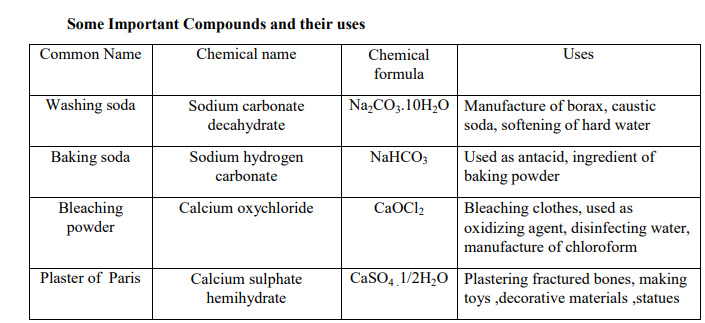
Ca(OH)2+Cl2 → CaOCl2+H2O
On heating, baking soda liberates CO2
2NaHCO3 →Heat Na2CO3 + H2O + CO2
Washing soda(Sodium carbonatedecahydrate)
Na2CO3 + 10H2O → Na2CO3.10H2O
Plaster of Paris
Preparation of plaster of Paris
CaSO42H2O 373K(Heat) CaSO4.1/2 H2O +1.1/2H2O
On mixing plaster of Paris with water,gypsum is obtained
CaSO4.1/2H2O +1 ½ H2O → CaSO4 .2H2O
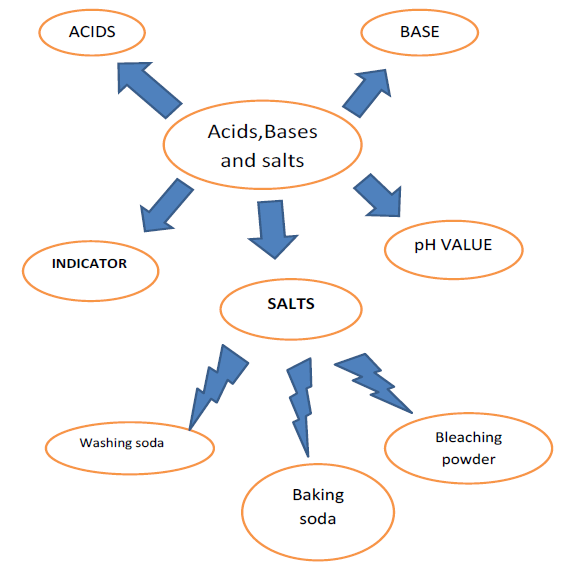
Please click the link below to download CBSE Class 10 Science-Acids, Bases And Salts.
Free study material for Science
Science Class 10 Exam Resources: Chapter 02 Acids Bases Salts
Essential Notes for Class 10 Science
Review targeted study resources for Chapter 02 Acids Bases Salts tailored for Class 10 learners. Utilizing these structured notes and quick-revision tools ensures complete alignment with current CBSE evaluation standards.
Verified Solutions for Class 10 Science
Designed around the official curriculum, these study guides guarantee standard compliance. Reviewing step-by-step solutions clarifies complex sub-topics within Chapter 02 Acids Bases Salts and demystifies standard marking schemes for Science evaluations.
Enhance Accuracy with Online Tests
Wrap up your chapter revision by testing your knowledge against standard objective question formats. Explore our full library of free, up-to-date sample papers and online assessments to secure top grades in your CBSE examinations.
FAQs
Our advanced study package for Chapter 02 Acids Bases Salts includes detailed concepts, diagrams, Mind Maps, and explanation of complex topics to ensure Class 10 students learn as per syllabus for 2026 exams.
The Mind Maps provided for Chapter 02 Acids Bases Salts act as visual anchors which will help faster recall during high-pressure exams.
Yes, teachers use our Class 10 Science resources for lesson planning as they are in simple language and have lot of solved examples.
Yes, You can download the complete, mobile-friendly PDF of the Science Chapter 02 Acids Bases Salts advanced resources for free.
Yes, our subject matter experts have updated the Chapter 02 Acids Bases Salts material to align with the rationalized NCERT textbooks and have removed deleted topics and added new competency-based questions.