

Advanced Study Material for Class 10 Science: Chapter 04 Carbon and Its Compound
Explore structured advanced study materials through the CBSE Class 10 Science Carbon and its compound Sure Shot Questions Set 02. Tailored for Class 10 learners, utilizing these Science resources ensures thorough preparation and strengthens foundational knowledge before final CBSE evaluations.
Practice Class 10 Science Resources: Chapter 04 Carbon and Its Compound
Access the complete useful resource PDF for Class 10 Science below. Regular practice with these targeted academic notes builds familiarity with complex topics and helps secure higher marks in final school evaluations.
CBSE Class 10 Science Carbon and its compound Sure Shot Questions B. There are many more useful educational material which the students can download in pdf format and use them for studies. Study material like concept maps, important and sure shot question banks, quick to learn flash cards, flow charts, mind maps, teacher notes, important formulas, past examinations question bank, important concepts taught by teachers. Students can download these useful educational material free and use them to get better marks in examinations. Also refer to other worksheets for the same chapter and other subjects too. Use them for better understanding of the subjects.
CARBON AND ITS COMPOUND
1. Carbon exists in the atmosphere in the form of
(a) carbon monoxide only
(b) carbon monoxide in traces and carbon dioxide
(c) carbon dioxide only
(d) coal
2. Which of the following statements are usually correct for carbon compounds? These
(i) are good conductors of electricity
(ii) are poor conductors of electricity
(iii) have strong forces of attraction between their molecules
(iv) do not have strong forces of attraction between their molecules
(a) (i) and (iii) (b) (ii) and (iii)
(c) (i) and (iv) (d) (ii) and (iv)
3. A molecule of ammonia (NH3) has
(a) only single bonds
(b) only double bonds
(c) only triple bonds
(d) two double bonds and one single bond
4. Buckminsterfullerene is an allotropic form of
(a) phosphorus
(b) sulphur
(c) carbon
(d) tin
5. Oils on treating with hydrogen in the presence of palladium or nickel catalyst form fats.
This is an example of
(a) Addition reaction
(b) Substitution reaction
(c) Displacement reaction
(d) Oxidation reaction
6. In which of the following compounds, — OH is the functional group?
(a) Butanone (b) Butanol
(c) Butanoic acid (d) Butanal
7. Which of the following are correct structural isomers of butane?
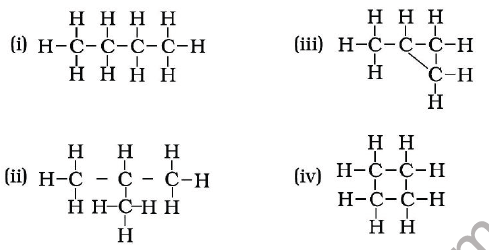
(a) (i) and (iii) (b) (ii) and (iv)
(c) (i) and (ii) (d) (iii) and (iv)
8. In the below given reaction, alkaline KMnO4 acts as
(a) reducing agent
(b) oxidising agent
(c) catalyst
(d) dehydrating agent
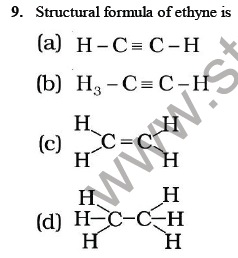
9. Structural formula of ethyne is
10. The soap molecule has
(a) hydrophilic head and a hydrophobic tail
(b) hydrophobic head and a hydrophilic tail
(c) hydrophobic head and a hydrophobic tail
(d) hydrophilic head and a hydrophilic tail
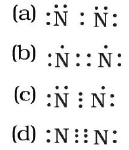
11. Which of the following is the correct representation of electron dot structure of nitrogen?
12. Identify the unsaturated compounds from the following
(i) Propane
(ii) Propene
(iii) Propyne
(iv) Chloropropane
(a) (i) and (ii)
(b) (ii) and (iv)
(c) (iii) and (iv)
(d) (ii) and (iii)
13. Chlorine reacts with saturated hydrocarbons at room temperature in the
(a) absence of sunlight
(b) presence of sunlight
(c) presence of water
(d) presence of hydrochloric acid
14. In the soap micelles
(a) the ionic end of soap is on the surface of the cluster while the carbon chain is in the interior of the cluster.
(b) ionic end of soap is in the interior of the cluster and the carbon chain is out of the cluster.
(c) both ionic end and carbon chain are in the interior of the cluster
(d) both ionic end and carbon chain are on the exterior of the cluster
15. Pentane has the molecular formula C5H12. It has
(a) 5 covalent bonds
(b) 12 covalent bonds
(c) 16 covalent bonds
(d) 17 covalent bonds
16. Ethanol reacts with sodium and forms two products. These are
(a) sodium ethanoate and hydrogen
(b) sodium ethanoate and oxygen
(c) sodium ethoxide and hydrogen
(d) sodium ethoxide and oxygen
19. Vinegar is a solution of
(a) 50% – 60% acetic acid in alcohol
(b) 5% – 8% acetic acid in alcohol
(c) 5% – 8% acetic acid in water
(d) 50% – 60% acetic acid in water
20. Mineral acids are stronger acids than carboxylic acids because
(i) mineral acids are completely ionised
(ii) carboxylic acids are completely ionised
(iii) mineral acids are partially ionised
(iv) carboxylic acids are partially ionised
(a) (i) and (iv)
(b) (ii) and (iii)
(c) (i) and (ii)
(d) (iii) and (iv)
21. Carbon forms four covalent bonds by sharing its four valence electrons with four univalent atoms, e.g. hydrogen. After the formation of four bonds, carbon attains the electronic configuration of
(a) helium
(b) neon
(c) argon
(d) krypton
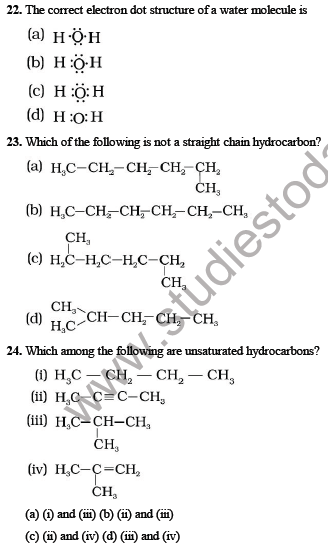
Please click the link below to download CBSE Class 10 Science Carbon and its compound Sure Shot Questions B.
Free study material for Science
Free CBSE Study Guides: Class 10 Science Chapter 04 Carbon and Its Compound
Comprehensive Study Resources for Chapter 04 Carbon and Its Compound
Review targeted study resources for Chapter 04 Carbon and Its Compound tailored for Class 10 learners. Utilizing these structured notes and quick-revision tools ensures complete alignment with current CBSE evaluation standards.
Understanding Marking Schemes
Each resource draws directly from authorized textbooks to maintain academic accuracy. Evaluating solved examples allows Class 10 students to master the formal presentation and answer-writing standards expected in upcoming school exams.
Complete Revision for Science
For peak performance in upcoming evaluations, integrate official Science sample papers directly into your study schedule. Follow up your revision by attempting online MCQ tests for Chapter 04 Carbon and Its Compound to refine calculation speed and precision.
FAQs
Our advanced study package for Chapter 04 Carbon and Its Compound includes detailed concepts, diagrams, Mind Maps, and explanation of complex topics to ensure Class 10 students learn as per syllabus for 2026 exams.
The Mind Maps provided for Chapter 04 Carbon and Its Compound act as visual anchors which will help faster recall during high-pressure exams.
Yes, teachers use our Class 10 Science resources for lesson planning as they are in simple language and have lot of solved examples.
Yes, You can download the complete, mobile-friendly PDF of the Science Chapter 04 Carbon and Its Compound advanced resources for free.
Yes, our subject matter experts have updated the Chapter 04 Carbon and Its Compound material to align with the rationalized NCERT textbooks and have removed deleted topics and added new competency-based questions.