

Advanced Study Material for Class 10 Science: Chapter 05 Life Processes
Explore structured advanced study materials through the CBSE Class 10 Science Life processes Sure Shot Questions Set 02. Tailored for Class 10 learners, utilizing these Science resources ensures thorough preparation and strengthens foundational knowledge before final CBSE evaluations.
Practice Class 10 Science Resources: Chapter 05 Life Processes
Access the complete useful resource PDF for Class 10 Science below. Regular practice with these targeted academic notes builds familiarity with complex topics and helps secure higher marks in final school evaluations.
CBSE Class 10 Science Life processes Sure Shot Questions B. There are many more useful educational material which the students can download in pdf format and use them for studies. Study material like concept maps, important and sure shot question banks, quick to learn flash cards, flow charts, mind maps, teacher notes, important formulas, past examinations question bank, important concepts taught by teachers. Students can download these useful educational material free and use them to get better marks in examinations. Also refer to other worksheets for the same chapter and other subjects too. Use them for better understanding of the subjects.
ASSIGNMENT QUESTIONS SET - 2 CHAPTER - 6 LIFE PROCESSES
1. Name the pore through which gaseous exchange takes place in older stems.
Answer: Lenticels.
Teacher's Note:
a) Lenticels are small pores in the bark of woody stems.
b) Stomata are found in young stems and leaves, not in the bark of older stems.
2. Why the blood is red ?
Answer: Blood is red because the red blood cells contain haemoglobin, an iron-containing pigment that carries oxygen.
Teacher's Note:
a) Haemoglobin binds oxygen in the lungs and releases it in the body tissues.
b) The colour depends on the iron in haemoglobin, not on the plasma.
3. What is the functional unit of kidney?
Answer: The nephron is the functional unit of the kidney.
Teacher's Note:
a) Each kidney contains about a million nephrons.
b) Filtration, reabsorption and secretion all take place in the nephron.
4. Define translocation.
Answer: Translocation is the transport of soluble products of photosynthesis (such as sugars) from the leaves to other parts of the plant through the phloem.
Teacher's Note:
a) Translocation uses the phloem tissue, not the xylem.
b) Students often confuse it with transpiration, which is the loss of water vapour.
5. Name the vessel that brings oxygenated blood from lungs to heart.
Answer: Pulmonary vein.
Teacher's Note:
a) The pulmonary vein is the only vein that carries oxygenated blood in the body.
b) The pulmonary artery carries deoxygenated blood from the heart to the lungs.
6. Why the colour of lymph is yellow?
Answer: Lymph is pale yellow because it contains fats absorbed from the intestine through the lacteals, and it has no red blood cells.
Teacher's Note:
a) Lymph lacks haemoglobin, so it does not look red.
b) The fat carried by lymph comes from the food we eat.
7. Name the reagent which is used to test the presence of starch.
Answer: Iodine solution.
Teacher's Note:
a) Starch turns blue-black in the presence of iodine.
b) Test a part of the leaf that has been boiled in alcohol to remove chlorophyll first.
8. Why walls of articles are thinner than ventricles?
Answer: The walls of the atria are thinner because they only pump blood into the nearby ventricles over a short distance. The ventricles have thicker walls because they pump blood to the lungs and to the whole body.
Teacher's Note:
a) The word "articles" in the question is a printing error for "atria".
b) Thicker ventricular walls generate the pressure needed to push blood through the whole body.
9. The mode of nutrition in which digestive enzymes are secreted out side the body.
Answer: Saprotrophic nutrition (saprophytic nutrition).
Teacher's Note:
a) Fungi and many bacteria feed this way, by releasing enzymes onto dead matter.
b) The digested food is then absorbed into the organism's body.
10. What is ATP?
Answer: ATP (adenosine triphosphate) is the energy-carrying molecule of the cell, often called the energy currency of the cell.
Teacher's Note:
a) ATP stores energy released during respiration in its high-energy phosphate bonds.
b) The energy is released when ATP is converted to ADP.
11. The diagram below represents urinary system in the human body. Identify the structure through which urine leaves the urinary bladder.
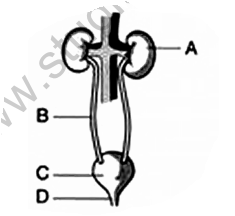
[Figure: Diagram of the human urinary system. A is the kidney (two kidneys shown with the adrenal region above). B is the ureter, a long tube from the kidney down to the bladder. C is the urinary bladder. D is the lowest tube below the bladder, through which urine leaves the body.]
Answer: D, the urethra.
Teacher's Note:
a) The urethra carries urine from the urinary bladder to the outside of the body.
b) The ureter (B) carries urine from the kidney to the bladder, not out of it.
12. Which activity is illustrated in the diagram of an Amoeba shown below?
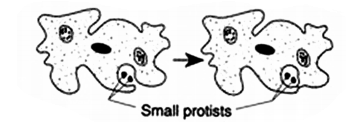
[Figure: Two drawings of an Amoeba joined by an arrow. In the first, the Amoeba is near several small protists (labelled "Small protists"). In the second, the Amoeba has surrounded one of the small protists with its pseudopodia and taken it into its cytoplasm.]
Answer: Phagocytosis, the process of engulfing and ingesting solid food (the small protists) by the Amoeba.
Teacher's Note:
a) The Amoeba extends pseudopodia around the food particle and forms a food vacuole.
b) Phagocytosis is a type of endocytosis, the intake of material into the cell.
13. Why is the rate of breathing in terrestrial animals slower than aquatic animals?
Answer:
1. Water contains much less dissolved oxygen than the same volume of air.
2. Aquatic animals must therefore pass a large amount of water over their gills to get enough oxygen.
3. Terrestrial animals breathe in air, which has about 21 per cent oxygen, so they breathe more slowly.
Teacher's Note:
a) Air has far more oxygen per unit volume than water, so air is a richer source.
b) Fish ventilate their gills continuously, which is why their breathing rate is high.
c) The lower oxygen content of water is the main reason for the difference.
14. A student covered a leaf from a destarched plant with a black paper strip and kept it in the garden outside his house in fresh air. In the evening, he tested the covered portion of the leaf for presence of starch. What the student was trying to show? Comment.
Answer:
1. The student was trying to show that light is necessary for photosynthesis.
2. The covered portion did not receive light, so it could not make starch.
3. The uncovered part, which received sunlight, would give a positive starch test, while the covered part gives no blue-black colour with iodine.
Teacher's Note:
a) The black paper prevents sunlight from reaching the leaf, which is the only variable being tested.
b) Destarching the plant first ensures that any starch found in the leaf was made during the experiment.
c) Photosynthesis needs light, carbon dioxide and chlorophyll, and this experiment tests the light requirement.
15. The parts shown as A and B in the given diagram are
[Figure: Diagram of two guard cells, kidney-shaped and meeting at the centre, with a small opening (stomatal pore) between them. Two arrows point outward to the right. Arrow A points to the outer epidermal cell surrounding the guard cells. Arrow B points to the opening (the stomatal pore) between the guard cells.]
A) A is epidermal cell, B is stomatal pore
B) A is guard cell, B is stomatal pore
C) A is epidermal cell, B is guard cell
D) A is guard cells, B is epidermal cell
Answer: (A) A is epidermal cell, B is stomatal pore
Teacher's Note:
a) The guard cells are the curved cells on either side of the pore, and they control its opening.
b) Epidermal cells cover the rest of the leaf surface and have no chloroplasts in most plants.
16. The kidneys in human beings are a part of the system for
(a) nutrition.
(b) respiration.
(c) excretion.
(d) transportation.
Answer: (c) excretion.
Teacher's Note:
a) The kidneys remove nitrogenous wastes such as urea from the blood.
b) They also regulate the water and salt balance of the body.
17. The xylem in plants are responsible for
(a) transport of water.
(b) transport of food.
(c) transport of amino acids.
(d) transport of oxygen.
Answer: (a) transport of water.
Teacher's Note:
a) Xylem carries water and minerals upward from the roots.
b) Food is carried by the phloem, not the xylem.
18. The autotrophic mode of nutrition requires
(a) carbon dioxide and water.
(b) chlorophyll.
(c) sunlight.
(d) all of the above.
Answer: (d) all of the above.
Teacher's Note:
a) Autotrophs use carbon dioxide and water as raw materials.
b) Chlorophyll captures the light energy that drives photosynthesis.
19. The breakdown of pyruvate to give carbon dioxide, water and energy takes place in
(a) cytoplasm.
(b) mitochondria.
(c) chloroplast.
(d) nucleus.
Answer: (b) mitochondria.
Teacher's Note:
a) Glycolysis splits glucose into pyruvate in the cytoplasm, but the later steps occur in the mitochondria.
b) Chloroplasts are the site of photosynthesis, not respiration.
20. Movement of food through oesophagus is due to
(a) Lubrication by saliva
(b) Peristalsis
(c) Gravitational Pull
(d) All of the above
Answer: (b) Peristalsis
Teacher's Note:
a) Peristalsis is the wave-like contraction of the muscles of the food pipe.
b) Saliva helps lubricate food, but it does not move the food along on its own.
21. Where is bile produced?
(a) Gall bladder
(b) Blood
(c) Liver
(d) Spleen
Answer: (c) Liver
Teacher's Note:
a) Bile is made in the liver and stored in the gall bladder.
b) Bile emulsifies fats in the small intestine.
22. In normal expiration, the diaphragm is
(a) Arched
(b) Flattened
(c) Perforated
(d) None of these
Answer: (a) Arched
Teacher's Note:
a) During expiration the diaphragm relaxes and moves up into a dome shape.
b) During inhalation it contracts and becomes flattened.
23. The correct pathway of blood in circulatory system is
(a) atria → ventricles → arteries → veins
(b) ventricles → atria → veins → arteries
(c) ventricles → veins → arteries → atria
(d) veins → ventricles → atria → arteries
Answer: (a) atria → ventricles → arteries → veins
Teacher's Note:
a) Blood enters the atria, passes to the ventricles, leaves through arteries and returns through veins.
b) The full path also passes through capillaries between the arteries and the veins.
24. Respiration is a process in which
(a) Energy is stored in the form of ADP
(b) Energy is released and stored in the form of ATP
(c) Energy is used up
(d) Energy is not released at all.
Answer: (b) Energy is released and stored in the form of ATP
Teacher's Note:
a) Respiration breaks down food and releases energy.
b) Part of the released energy is stored in ATP, which the cell uses for its work.
25. In Photosynthetic process, atmospheric carbon di oxide is _______ to carbohydrates
a) oxidised
b) Reduced
c) Neutralised
d) Burnt
Answer: b) Reduced
Teacher's Note:
a) Carbon dioxide gains electrons and hydrogen when it is converted to carbohydrate, which is reduction.
b) Oxidation is the reverse process, which happens during respiration.
26. When water enters the guard cells the stomata
a) Opens
b) Closes
c) Open or closes
d) No effect
Answer: a) Opens
Teacher's Note:
a) When guard cells take in water they swell and bend apart, opening the pore.
b) When they lose water and become flaccid, the pore closes.
27. Wastes concentrated in the tubules of Bowman's capsule are called ____.
(a) salts.
(b) juices
(c) urine
(d) amino acids
Answer: (c) urine
Teacher's Note:
a) The filtrate formed in Bowman's capsule is processed in the tubules and the final concentrated waste is urine.
b) Amino acids are reabsorbed into the blood, so they are not wastes.
28. On seeing good food our mouth waters. This fluid is actually
a) Water
b) Hormone
c) Enzyme
d) None of the above
Answer: c) Enzyme
Teacher's Note:
a) Saliva contains the enzyme salivary amylase, which begins starch digestion.
b) Saliva is also mostly water, but its digestive role is due to the enzyme.
29. The enzyme Pepsin is inactive in stomach without the presence of
a) Nitric Acid
b) Hydrochloric acid
c) Acetic acid
d) Butyric acid
Answer: b) Hydrochloric acid
Teacher's Note:
a) Pepsin is secreted as inactive pepsinogen, which is activated by hydrochloric acid.
b) The acid also provides the acidic medium that pepsin needs to work.
30. Villi present on the inner lining of the intestinal wall
a) Secretes enzymes for digestion
b) Secretes hormones
c) Decreases the surface area for absorption
d) Increases the surface area for absorption
Answer: d) Increases the surface area for absorption
Teacher's Note:
a) Villi are tiny finger-like projections that greatly increase the absorptive surface.
b) They have a rich blood supply and a lacteal, which take up the digested food.
31. During cellular respiration one molecule of glucose is first broken down into two molecules of ________
a) Acetic acid
b) Pyruvic acid
c) Lactic acid
d) None of the above
Answer: b) Pyruvic acid
Teacher's Note:
a) This first step, glycolysis, takes place in the cytoplasm.
b) Lactic acid is formed later, only during anaerobic respiration in muscles.
32. Rajib was absent in the class because of muscle pain which he claims to be due to excess physical exercise he had done yesterday. This pain is due to
a) Formation of lactic acid
b) Formation of acetic acid
c) Formation of Pyruvic acid
d) Formation of Hydrochloric acid
Answer: a) Formation of lactic acid
Teacher's Note:
a) During vigorous exercise muscles use anaerobic respiration when oxygen supply is short.
b) The lactic acid that builds up causes the cramps and muscle pain.
33. Right part of the human heart contains
a) Oxygenated blood
b) Mixed blood
c) Deoxygenated blood
d) No blood
Answer: c) Deoxygenated blood
Teacher's Note:
a) The right atrium and right ventricle receive blood returning from the body.
b) The left side of the heart carries oxygenated blood.
34. The transport of soluble products of photosynthesis is called translocation and it occurs in the part of the vascular tissue called
a) Xylem
b) Sclerenchyma
c) Phloem
d) Collenchyma
Answer: c) Phloem
Teacher's Note:
a) Phloem carries sugars in both directions, from the leaves to the rest of the plant.
b) Xylem carries water and minerals, and is not the tissue for translocation.
35. In human each kidney has large numbers of filtration units called ___
a) Neutrons
b) Neurons
c) Neptune
d) Nephrons
Answer: d) Nephrons
Teacher's Note:
a) Neurons are nerve cells, which is a different word.
b) Each kidney contains about a million nephrons.
36. Haemoglobin is a type of
(a) Carbohydrate
(b) Skin Pigment
(c) Vitamin
(d) Respiratory Pigment
Answer: (d) Respiratory Pigment
Teacher's Note:
a) Haemoglobin is a protein that carries oxygen in the blood.
b) It is not a skin pigment such as melanin.
37. If kidney fails to reabsorb water, the tissues would
(a) remain unaffected
(b) shrink to shrivel
(c) absorb water from blood
(d) take more oxygen from blood
Answer: (b) shrink to shrivel
Teacher's Note:
a) Without water reabsorption, the body loses too much water in urine.
b) Cells lose water to the blood and tissues dehydrate, so they shrink.
38. Name an organ which is part of two body systems.
Answer: Pancreas (it is part of the digestive system and the endocrine system).
Teacher's Note:
a) The pancreas releases digestive juice into the small intestine.
b) It also releases the hormones insulin and glucagon into the blood.
39. Why do raw bread taste sweeter on mastication?
Answer:
1. Bread contains starch.
2. Salivary amylase in the saliva breaks down starch into maltose, which is a sugar.
3. The sugar produced makes the bread taste sweet during chewing.
Teacher's Note:
a) Chewing mixes the food with saliva and increases the time the enzyme acts.
b) The sweetness is a sign that starch is being digested.
40. How are fats digested in our bodies? Where does this process take place?
Answer:
1. Bile from the liver emulsifies large fat globules into small droplets.
2. Pancreatic lipase then breaks the fats into fatty acids and glycerol.
3. This process takes place in the small intestine (mainly the duodenum).
Teacher's Note:
a) Emulsification increases the surface area for the enzyme to act.
b) Fatty acids and glycerol are absorbed by the villi of the small intestine.
c) Bile itself has no enzyme; its role is only to break fat into droplets.
41. What is the role of saliva in the digestion of food?
Answer:
1. Saliva moistens and softens the food, so it can be swallowed easily.
2. Saliva contains salivary amylase, which breaks down starch into maltose.
3. Saliva also helps in forming the food bolus for swallowing.
Teacher's Note:
a) The moistening effect is a physical role, while starch digestion is the chemical role.
b) Salivary amylase works best at neutral pH, which is the normal pH of the mouth.
42. Why will simple diffusion not meet the requirement of human beings?
Answer: Simple diffusion is too slow and covers only very short distances. Human beings have a large body with many cells far from the air, so oxygen and food must be carried by the blood.
Teacher's Note:
a) Diffusion works well over distances of only a few micrometres.
b) The circulatory system is needed to transport gases and nutrients over the whole body.
43. What criteria do we use to decide whether something is alive?
Answer:
1. Presence of life processes such as respiration and metabolism.
2. Growth, movement and response to stimuli.
3. Ability to reproduce.
Teacher's Note:
a) Non-living things do not carry out respiration or reproduction.
b) A living thing must show at least some of these features at some stage of its life.
44. After long running, you may experience cramps in your leg muscles. Whats the reason behind this?
Answer: During long running the muscles respire anaerobically because oxygen supply is insufficient. This produces lactic acid, which accumulates in the muscles and causes cramps.
Teacher's Note:
a) Anaerobic respiration in muscles produces lactic acid, not alcohol.
b) Rest and oxygen supply help remove the lactic acid from the muscles.
45. What processes would you consider essential for maintaining life?
Answer:
1. Nutrition, to obtain food and energy.
2. Respiration, to release energy from food.
3. Transportation, to carry materials around the body.
4. Excretion, to remove wastes.
5. Control and coordination, to respond to changes in the environment.
Teacher's Note:
a) These are the basic life processes found in all living organisms.
b) Growth and reproduction also support life, but they are not needed every moment.
46. How do villi enhance absorption of food in the intestine?
Answer:
1. Villi increase the surface area of the intestinal wall many times.
2. The walls of the villi are thin, so absorption is quick.
3. Each villus has a rich network of blood capillaries and a lacteal, which take up the digested food.
Teacher's Note:
a) A larger surface area means more food can pass into the blood at one time.
b) The lacteal absorbs fats, while the capillaries absorb sugars and amino acids.
47. Why bile juice is considered important even though it does not contain any digestive enzymes?
Answer:
1. Bile breaks large fat globules into small droplets, which is called emulsification.
2. This increases the surface area of the fat, so the enzyme lipase can act on it faster.
3. Bile is also alkaline, so it neutralises the acidic food coming from the stomach.
Teacher's Note:
a) Emulsification is a physical change, not a chemical one.
b) Without bile, fat digestion would be very slow and incomplete.
48. Which organs secrete the following enzymes:
(i) Trypsin
(ii) Pepsin
Answer:
1. (i) Trypsin is secreted by the pancreas.
2. (ii) Pepsin is secreted by the stomach.
Teacher's Note:
a) Trypsin is part of the pancreatic juice and acts in the small intestine.
b) Pepsin is secreted by the gastric glands of the stomach wall as pepsinogen.
49. Name the factors that affect photosynthesis.
Answer:
1. Light intensity
2. Carbon dioxide concentration
3. Temperature
4. Water supply
5. Amount of chlorophyll
Teacher's Note:
a) Photosynthesis slows down when any one of these factors is in short supply.
b) Light and carbon dioxide are usually the most important limiting factors.
50. Name the vestigeal part of human alimentary canal?
Answer: Vermiform appendix.
Teacher's Note:
a) A vestigial organ is a reduced organ that has lost most of its original function.
b) The word "vestigeal" in the question is a spelling error for "vestigial".
51. What is the name given to rhythmic wave like manner occurring in alimentary canal?
Answer: Peristalsis.
Teacher's Note:
a) Peristalsis moves food forward through the food pipe, stomach and intestines.
b) It is caused by alternate contraction and relaxation of the circular and longitudinal muscles.
52. The bark of woody plants is dead but the inner layers inside the bark are living. How do they get oxygen and release carbon dioxide?
Answer: Gases are exchanged through lenticels, the small pores in the bark. Oxygen diffuses in and carbon dioxide diffuses out through these pores into the living tissues beneath.
Teacher's Note:
a) Lenticels are the pores in the outer bark of woody stems.
b) Gas exchange in woody stems takes place by simple diffusion.
53. What are lenticels?
Answer: Lenticels are small pores in the bark of woody stems and roots through which gaseous exchange takes place.
Teacher's Note:
a) Lenticels appear as small raised spots on the bark.
b) They are the gas exchange pores of woody plants, while stomata are on leaves and young stems.
54. How does photosynthesis occur?
Answer:
1. Chlorophyll in the leaves absorbs sunlight.
2. Carbon dioxide from the air enters the leaf through the stomata, and water is absorbed from the soil by the roots.
3. Using light energy, water and carbon dioxide are converted into glucose, and oxygen is released.
4. Carbon dioxide + water → glucose + oxygen (in the presence of sunlight and chlorophyll).
Teacher's Note:
a) The main product of photosynthesis is glucose, which is later converted to starch.
b) The oxygen released comes from the water molecules, not from carbon dioxide.
55. Name the mode of nutrition in an organism that uses simple substances like CO2 and water to prepare food inside its body?
Answer: Autotrophic nutrition.
Teacher's Note:
a) Green plants are the main autotrophs and use photosynthesis.
b) Autotrophs form the base of every food chain.
56. What are the differences between autotrophic nutrition and heterotrophic nutrition?
Answer:
| Point of difference | Autotrophic nutrition | Heterotrophic nutrition |
|---|---|---|
| Source of food | Food is made by the organism itself from simple substances | Food is taken from other organisms |
| Raw materials | Carbon dioxide and water | Ready-made organic food |
| Energy source | Light energy, captured by chlorophyll | Chemical energy stored in food |
| Examples | Green plants, some bacteria | Animals, fungi, most bacteria |
Teacher's Note:
a) Autotrophs are producers, while heterotrophs are consumers in a food chain.
b) Heterotrophic nutrition can be holozoic, saprotrophic or parasitic.
57. Read following statements from A to E and identify the relevant life process from the following word list.
growth, transport, synthesis, regulation, nutrition
A. A butterfly sucking the nectar from the flowers in a garden.
B. A boy shouts with excitement when his school team wins the match on the last ball.
C. After finishing lunch, Mohan's blood distributes the food molecules to different cells of his body.
D. Green plants prepares starch (complex substance) from simpler chemicals.
E. Radha finds her height has increased by 4 cm since her last birthday.
Answer:
1. A: nutrition
2. B: regulation
3. C: transport
4. D: synthesis
5. E: growth
Teacher's Note:
a) Sucking nectar is taking in food, which is nutrition.
b) Shouting in response to an event is a response controlled by the nervous system, which is regulation.
c) Making starch from simple chemicals is synthesis, and the increase in height is growth.
58. What is osmoregulation?
Answer: Osmoregulation is the control of the amount of water and salts in the body so that the concentration of body fluids stays constant.
Teacher's Note:
a) Osmoregulation is a part of homeostasis.
b) In humans the kidneys carry out osmoregulation.
59. What are the different ways in which glucose is oxidized to provide energy in various organisms?
Answer:
1. Aerobic respiration: glucose is completely oxidised in the presence of oxygen to carbon dioxide, water and energy.
2. Anaerobic respiration in yeast: glucose is broken down into alcohol and carbon dioxide.
3. Anaerobic respiration in muscles: glucose is broken down into lactic acid.
Teacher's Note:
a) Aerobic respiration releases much more energy than anaerobic respiration.
b) Yeast is used in bread and wine making because it produces carbon dioxide and alcohol.
c) Lactic acid builds up in muscles during heavy exercise, which causes cramps.
60. Which organ of the plant body helps in osmo-regulation?
Answer: Roots.
Teacher's Note:
a) The root hairs absorb water and minerals from the soil by osmosis.
b) Leaves also help by regulating water loss through the stomata.
61. Which organelle of the cell in animals helps in osmo-regulation?
Answer: Contractile vacuole, found in unicellular animals such as Amoeba and Paramecium.
Teacher's Note:
a) The contractile vacuole collects excess water and pumps it out of the cell.
b) In multicellular animals, the kidneys carry out this function.
62. How does transpiration pull help in ascent of sap?
Answer:
1. Water is lost from the leaves by transpiration through the stomata.
2. This creates a suction force (pull) in the leaves, which pulls water up from the roots.
3. Water molecules stay in a continuous column in the xylem because of cohesion, so the sap rises to the top of the plant.
Teacher's Note:
a) The transpiration pull is the main force for water movement in tall plants.
b) Cohesion and adhesion keep the water column unbroken in the xylem.
63. In what form excretion takes place in plants?
Answer:
1. In gaseous form, through stomata and lenticels (oxygen and carbon dioxide).
2. In liquid form, as water vapour lost by transpiration.
3. In solid form, as wastes stored in old leaves, bark and fallen leaves, and as gums and resins.
Teacher's Note:
a) Plants do not have a special excretory organ like the kidney.
b) Many plant wastes are stored in cells, which is why they are not removed as liquid.
64. What are the components of the transport system in highly organised plants?
Answer:
1. Xylem, which transports water and minerals from roots to the other parts of the plant.
2. Phloem, which transports food (sugars) from the leaves to the other parts of the plant.
Teacher's Note:
a) Xylem moves water upward, while phloem can move food in both directions.
b) Together these two tissues form the vascular tissue of the plant.
65. What is meant by double circulation? Mention its advantages.
Answer:
1. Double circulation means that the blood passes through the heart twice in one complete cycle: once through the pulmonary circulation (heart to lungs and back) and once through the systemic circulation (heart to body and back).
2. Advantages: oxygenated and deoxygenated blood do not mix, so oxygen supply to the body is efficient.
3. It maintains a high blood pressure for the body tissues and supports a high rate of metabolism, which keeps the body warm.
Teacher's Note:
a) Birds and mammals have double circulation.
b) Separation of the two kinds of blood is what makes this circulation efficient.
c) A high metabolic rate needs a high rate of oxygen supply, which double circulation provides.
66. Who has longer small intestine tiger or cow?
Answer: Cow has a longer small intestine than the tiger.
Teacher's Note:
a) The cow is a herbivore, and plant material such as cellulose needs a longer intestine to digest.
b) The tiger is a carnivore, and meat is easier to digest, so its intestine is shorter.
67. Leaves of a healthy potted plant are coated with Vaseline to block the stomata. Will this plant remain healthy for long? State three reasons to support your answer.
Answer: No, the plant will not remain healthy for long.
1. Carbon dioxide cannot enter the leaves, so photosynthesis stops and the plant cannot make food.
2. Oxygen released in respiration and photosynthesis cannot leave the leaves, so the gas exchange needed for respiration is disturbed.
3. Transpiration stops, so the leaves cannot cool down and the transpiration pull that lifts water from the roots is lost.
Teacher's Note:
a) Stomata are the main openings for gas exchange in leaves.
b) Blocking them stops the plant's water and food supply within a few days.
c) Without transpiration, the plant also loses its main method of moving water up the stem.
68. Outline inhalation-exhalation cycle.
Answer:
1. Inhalation: the diaphragm contracts and flattens, and the ribs move up and outward. The chest cavity becomes larger, the pressure inside the lungs falls, and air rushes in.
2. Exhalation: the diaphragm relaxes and moves up into a dome shape, and the ribs move down and inward. The chest cavity becomes smaller, the pressure inside the lungs rises, and air is pushed out.
Teacher's Note:
a) Air always moves from a region of higher pressure to lower pressure.
b) Inhalation is an active process, while normal exhalation is passive.
69. What are the components of the transport system in human beings? What are the functions of these components?
Answer:
1. Blood: carries oxygen, digested food, hormones and wastes around the body.
2. Heart: pumps the blood through the blood vessels.
3. Blood vessels (arteries, veins and capillaries): carry blood from the heart to all parts of the body and back.
4. Lymph: carries fats and helps in the defence of the body.
Teacher's Note:
a) The plasma in blood carries dissolved food and wastes.
b) Red blood cells carry oxygen, while white blood cells protect against infection.
c) Platelets help in clotting of blood at a wound.
70. Why is it necessary to separate oxygenated and deoxygenated blood in mammals and birds?
Answer: Separating the two kinds of blood keeps the oxygen supply to the body high. This allows mammals and birds to maintain a high metabolic rate and a constant body temperature.
Teacher's Note:
a) If the two bloods mixed, less oxygen would reach the body tissues.
b) Mammals and birds are warm-blooded, so they need a high rate of energy release.
71. Why is there extra air in our lungs after exhaling?
Answer: Even after a normal exhalation, some air always remains in the lungs. This is called residual air. It keeps the alveoli open and allows gas exchange to continue.
Teacher's Note:
a) Residual air prevents the lungs from collapsing.
b) The lungs can never be emptied completely, which is why this air is always present.
72. Which cell are the site of exchange of gases?
Answer: The alveoli, which are the tiny air sacs of the lungs, are the site of exchange of gases.
Teacher's Note:
a) Alveoli are made of a single layer of thin cells, which allows quick diffusion.
b) Each alveolus is surrounded by a network of blood capillaries.
73. How are the lungs designed in human beings to maximize the area for exchange of gases?
Answer:
1. The lungs contain millions of alveoli, which give a very large surface area.
2. The walls of the alveoli are very thin, only one cell thick.
3. Each alveolus is covered with a dense network of blood capillaries.
Teacher's Note:
a) A large surface area increases the rate of diffusion of gases.
b) Thin walls shorten the distance the gases must cross.
c) The moist lining of the alveoli helps gases dissolve before diffusion.
74. Why blood is necessary for oxygen delivery to all parts of the body in larger animals?
Answer: In large animals, most cells are far from the air. Oxygen cannot diffuse over such long distances, so blood carries oxygen from the lungs to every part of the body.
Teacher's Note:
a) Diffusion is too slow to supply oxygen over large distances.
b) Haemoglobin in red blood cells carries most of the oxygen in the blood.
75. Define homeostasis.
Answer: Homeostasis is the maintenance of a constant internal environment in the body, despite changes in the external environment.
Teacher's Note:
a) Body temperature, blood sugar and water balance are kept constant by homeostasis.
b) The nervous and endocrine systems control homeostasis.
76. Name the organ systems that help us maintain homeostasis.
Answer:
1. Nervous system
2. Endocrine system
3. Excretory system (kidneys, skin and lungs)
Teacher's Note:
a) The nervous system gives quick responses through nerve impulses.
b) The endocrine system uses hormones, which act more slowly but for longer periods.
77. What in kidneys is analogous to alveloli in lungs?
Answer: Nephrons are analogous to alveoli. Each nephron is the basic filtering unit of the kidney, just as each alveolus is the basic unit for gas exchange in the lungs.
Teacher's Note:
a) The word "alveloli" in the question is a spelling error for "alveoli".
b) Both structures have a very large total surface area packed into a small organ.
78. State the role and function of lymph in human transport system.
Answer:
1. Lymph carries nutrients and oxygen from the blood to the tissues.
2. It returns the excess tissue fluid to the blood.
3. Lymph carries fats absorbed by the lacteals and contains lymphocytes that help fight infection.
Teacher's Note:
a) Lymph is formed from the tissue fluid that leaks out of capillaries.
b) Lymph nodes filter the lymph and trap harmful microbes.
79. What is the basic reason of urine production?
Answer: Urine is produced to remove nitrogenous wastes, such as urea, from the blood and to maintain the water and salt balance of the body.
Teacher's Note:
a) Urea is formed in the liver from the breakdown of excess amino acids.
b) Urine is formed in the nephrons by filtration, reabsorption and secretion.
80. State the role of kidneys in human transport system.
Answer:
1. The kidneys filter the blood and remove nitrogenous wastes such as urea.
2. They regulate the amount of water and salts in the blood.
3. They produce urine, which carries the wastes out of the body.
Teacher's Note:
a) Kidney function is part of both the excretory and the transport system.
b) If the kidneys fail, wastes build up in the blood.
81. Who discovered systemic blood circulation system in human body?
Answer: William Harvey described the circulation of blood in the body.
Teacher's Note:
a) Harvey published his work on blood circulation in 1628.
b) He showed that the blood moves in a circuit pumped by the heart.
82. What is pulmonary circulation and systemic circulation?
Answer:
1. Pulmonary circulation: blood moves from the heart to the lungs, where it gets oxygen, and then returns to the heart.
2. Systemic circulation: oxygenated blood moves from the heart to all parts of the body, and the deoxygenated blood returns to the heart.
Teacher's Note:
a) Pulmonary circulation carries deoxygenated blood to the lungs and oxygenated blood back to the heart.
b) Systemic circulation supplies oxygen and food to the body tissues.
83. Which fluid is also know as tissue fluid?
Answer: Lymph.
Teacher's Note:
a) Tissue fluid bathes the cells and is collected by the lymph vessels.
b) The word "know" in the question is a spelling error for "known".
84. What is sphygmomanometer?
Answer: A sphygmomanometer is an instrument used to measure blood pressure.
Teacher's Note:
a) It uses an inflatable cuff placed around the upper arm.
b) Blood pressure is recorded as two values, systolic and diastolic.
85. What is the function of ureter?
Answer: The ureter carries urine from the kidney to the urinary bladder.
Teacher's Note:
a) There is one ureter for each kidney.
b) Urine is moved along the ureter by peristaltic contractions.
86. Assertion and Reason Type
Assertion: Bile is essential for fat digestion
Reason: Fats cannot be digested without emulsification
Use the following Key to choose the appropriate answer.
(a) Both Assertion & Reason are True & Reason is a correct explanation of the Assertion.
(b) If both Assertion & Reason are True but Reason is not a correct explanation of the Assertion.
(c) If Assertion is True but the Reason is False.
(d) If both Assertion and Reason are False
Answer: (a) Both Assertion & Reason are True & Reason is a correct explanation of the Assertion.
Teacher's Note:
a) Bile breaks fat into small droplets, which is emulsification.
b) Emulsification increases the surface area so that lipase can digest the fat.
87. Chyme is ____.
(a) Digestive enzyme secreted by stomach.
(b) Hormone secreted by islets of Pancreas
(c) food which enters into intestine from stomach.
(d) Part of bile juice which stores in gall bladder.
Answer: (c) food which enters into intestine from stomach.
Teacher's Note:
a) Chyme is the semi-liquid, partly digested food that leaves the stomach.
b) Chyme enters the small intestine, where most digestion is completed.
88. What is the nature of Chyme? Acidic or Basic or Neutral?
Answer: Chyme is acidic, because it contains hydrochloric acid secreted by the stomach.
Teacher's Note:
a) The acidity of chyme is neutralised by bile and pancreatic juice in the small intestine.
b) This acidity also stops the action of salivary amylase.
89. During daytime transpiration and photosynthesis are interlinked. What do you mean by this statement?
Answer: Both processes depend on the stomata. The stomata open in the daytime to let carbon dioxide in for photosynthesis, and at the same time water vapour is lost through them by transpiration. So the opening of the stomata links the two processes.
Teacher's Note:
a) Carbon dioxide enters and oxygen leaves through the same stomatal pores.
b) At night the stomata are mostly closed, so both processes slow down.
90. 'Sweating in animals' is equivalent to what in plants?
Answer: Transpiration.
Teacher's Note:
a) In both cases water is lost from the body or plant surface to cool it down.
b) In plants, the water is lost as vapour through the stomata.
91. What factor contribute to rate of transpiration?
Answer:
1. Temperature: higher temperature increases the rate of transpiration.
2. Humidity: low humidity outside the leaf increases the rate of transpiration.
3. Wind speed: wind carries away the water vapour around the leaf, so transpiration increases.
4. Light and the number of open stomata, and the water supply to the roots.
Teacher's Note:
a) Transpiration is faster on hot, dry, windy and sunny days.
b) Water loss stops when the stomata close, for example at night.
92. How does transpiration help plants?
Answer:
1. It creates the transpiration pull that helps raise water and minerals from the roots to the leaves.
2. It cools the plant surface on a hot day.
3. It helps in the absorption and movement of minerals in the plant.
Teacher's Note:
a) The transpiration pull is the main force behind the ascent of sap.
b) Cooling by transpiration protects the leaves from heat damage.
93. Name the mineral required for healthy growth of teeth.
Answer: Calcium.
Teacher's Note:
a) Calcium is the main mineral in tooth enamel and dentine.
b) Vitamin D helps the body absorb calcium.
94. Name the chemical used to detect presence of starch.
Answer: Iodine solution.
Teacher's Note:
a) A blue-black colour appears when iodine is added to starch.
b) The test is the same as the one used in question 7.
95. What is the function of mucus secreted in stomach during digestion?
Answer: The mucus protects the lining of the stomach from the strong hydrochloric acid and from the digestive enzyme pepsin.
Teacher's Note:
a) Without this mucus, the stomach wall could be damaged, which causes ulcers.
b) The mucus also lubricates the food in the stomach.
96. What is the optimum temperature for photosynthesis?
Answer: About 30 degrees Celsius for most plants (the optimum range is roughly 25 to 35 degrees Celsius).
Teacher's Note:
a) Enzymes that drive photosynthesis work best within this range.
b) Above about 40 degrees Celsius the rate falls because the enzymes start to denature.
97. Differentiate between Blood and Lymph
Answer:
| Point of difference | Blood | Lymph |
|---|---|---|
| Colour | Red | Colourless or pale yellow |
| Red blood cells | Present | Absent |
| Platelets | Present | Absent |
| White blood cells | Present (neutrophils, lymphocytes and others) | Mainly lymphocytes |
| Proteins | Plasma contains many proteins | Fewer proteins than blood |
| Flow | Flows in arteries, veins and capillaries | Flows in lymph vessels towards the heart in one direction |
Teacher's Note:
a) Lymph is formed from tissue fluid that leaks out of the blood capillaries.
b) The absence of red blood cells is the main reason lymph is not red.
98. How does diaphragm help in inhalation?
Answer:
1. The diaphragm contracts and moves down, becoming flattened.
2. This increases the volume of the chest cavity, so the pressure in the lungs falls.
3. Air rushes into the lungs from outside because of the lower pressure.
Teacher's Note:
a) The diaphragm is a dome-shaped muscle that separates the chest from the abdomen.
b) Inhalation with the diaphragm is an active process that needs muscle energy.
99. Which activity is basic to living?
Answer: Respiration, the breakdown of food to release energy.
Teacher's Note:
a) Energy from respiration is needed for all other life processes.
b) Every living cell carries out respiration all the time.
100. Give one term-science that deals with life processes.
Answer: Physiology.
Teacher's Note:
a) Physiology studies the functions of living organisms and their parts.
b) Biology is the wider science, and physiology is one of its branches.
101. What is the similarity between chlorophyll and haemoglobin?
Answer: Both are pigments with a similar ring-shaped structure at their core. Chlorophyll has a magnesium atom at the centre, and haemoglobin has an iron atom at the centre.
Teacher's Note:
a) Chlorophyll absorbs light energy, while haemoglobin carries oxygen.
b) The metal atom at the centre of each pigment is the key difference between them.
102. Define Chemosynthesis.
Answer: Chemosynthesis is the process by which some bacteria prepare food from carbon dioxide, using the energy released by oxidation of inorganic substances instead of sunlight.
Teacher's Note:
a) Sulphur and iron bacteria are common examples of chemosynthetic organisms.
b) Chemosynthesis does not need chlorophyll or light.
103. What is photolysis of water? What are its products?
Answer:
1. Photolysis of water is the splitting of water molecules by light energy during the light reaction of photosynthesis.
2. Its products are oxygen, hydrogen ions (protons) and electrons.
Teacher's Note:
a) The oxygen released in photosynthesis comes from this reaction.
b) The hydrogen ions and electrons are used later in forming NADPH and ATP.
104. What are the important enzymes of pancreatic juice and their function?
Answer:
1. Trypsin: breaks down proteins into smaller peptides.
2. Pancreatic amylase: breaks down starch into maltose.
3. Pancreatic lipase: breaks down fats into fatty acids and glycerol.
Teacher's Note:
a) Trypsin is secreted as an inactive form, trypsinogen, which is activated in the intestine.
b) Pancreatic juice is alkaline, so it neutralises the acid from the stomach.
105. Give reasons of dental caries in people.
Answer:
1. Bacteria in the mouth act on sugary food left on the teeth and produce acids.
2. The acids dissolve the calcium salts of the enamel, which makes holes in the teeth.
3. Poor brushing and cleaning allow food particles to stay on the teeth for longer.
Teacher's Note:
a) Frequent eating of sweets and chocolates increases the risk of caries.
b) Regular brushing and flossing help to remove the food particles.
106. With schematic diagram explain double circulation in man.
[Figure: Schematic diagram of double circulation. Deoxygenated blood from the body enters the right atrium, passes to the right ventricle, and is pumped through the pulmonary artery to the lungs. Oxygenated blood returns from the lungs through the pulmonary veins to the left atrium, passes to the left ventricle, and is pumped through the aorta to all parts of the body. Blood from the body returns to the right atrium through the vena cava. Diagram to be added.]
Answer:
1. Deoxygenated blood from the body returns to the right atrium through the venae cavae.
2. The right atrium pushes it into the right ventricle, which pumps it to the lungs through the pulmonary artery (pulmonary circulation).
3. In the lungs the blood gets oxygen, and the oxygenated blood returns to the left atrium through the pulmonary veins.
4. The left atrium pushes it into the left ventricle, which pumps it through the aorta to all parts of the body (systemic circulation).
5. Thus the blood passes through the heart twice in one complete cycle, which is called double circulation.
Teacher's Note:
a) The left ventricle has a thicker wall because it pumps blood to the whole body.
b) The valves in the heart stop the backflow of blood.
c) Oxygenated and deoxygenated blood do not mix in the human heart.
107. Explain mechanism of urine formation.
Answer:
1. Ultrafiltration: blood enters the glomerulus at high pressure, and water, glucose, salts, urea and amino acids are filtered into Bowman's capsule.
2. Selective reabsorption: useful substances such as glucose, amino acids, most of the water and some salts are reabsorbed into the blood in the tubules.
3. Tubular secretion: some extra wastes and excess ions are actively added to the filtrate in the tubules.
4. The remaining filtrate, which contains urea and excess water and salts, passes to the collecting duct as urine.
Teacher's Note:
a) Proteins and blood cells are too large to pass through the filter and remain in the blood.
b) The amount of water reabsorbed depends on how much water the body needs.
108. Why is diffusion insufficient to meet oxygen requirement of multicellular organisms like us?
Answer:
1. Diffusion is slow and works only over very short distances.
2. In multicellular organisms many cells are far from the source of oxygen, so diffusion cannot supply them in time.
3. A large body needs a transport system, such as blood, to carry oxygen to all cells.
Teacher's Note:
a) Diffusion of gases is useful only in single-celled organisms, where each cell is in contact with the air or water.
b) The circulatory system solves the problem of distance.
109. Explain the role of HCl in our stomach.
Answer:
1. It makes the medium acidic, which is needed for the enzyme pepsin to work.
2. It kills most of the bacteria and other microbes present in the food.
3. It converts the inactive pepsinogen into the active enzyme pepsin.
Teacher's Note:
a) The acidic pH of the stomach is about 1.5 to 2.
b) HCl is secreted by the gastric glands of the stomach wall.
110. What is the advantage of terrestrial organisms over aquatic organisms for obtaining oxygen for respiration?
Answer: Air contains about 21 per cent oxygen, while water contains much less dissolved oxygen. So terrestrial organisms can get oxygen more easily and breathe more slowly than aquatic organisms.
Teacher's Note:
a) Oxygen diffuses much more slowly in water than in air.
b) The air is also easier to move over the respiratory surface.
111. How are lungs designed to maximize area for gaseous exchange?
Answer:
1. The lungs contain millions of thin-walled alveoli, which give a very large surface area.
2. The alveoli are surrounded by a dense network of blood capillaries.
3. The walls of the alveoli and capillaries are very thin, so diffusion takes place quickly.
Teacher's Note:
a) The total surface area of the alveoli in an adult is about 70 square metres.
b) The moist lining helps gases dissolve before they diffuse.
112. Describe fat digestion in human body and the organ where it occurs.
Answer:
1. Bile, from the liver and stored in the gall bladder, is released into the small intestine and emulsifies large fat globules into small droplets.
2. Pancreatic lipase breaks the emulsified fats into fatty acids and glycerol.
3. The intestinal juice completes the digestion, and the products are absorbed by the villi.
4. This process takes place in the small intestine.
Teacher's Note:
a) Bile does not contain any enzyme, so emulsification only prepares the fat for digestion.
b) Fatty acids and glycerol are absorbed into the lacteals and capillaries of the villi.
113. How are water and minerals transported in plants?
Answer:
1. Water and minerals are absorbed from the soil by the root hairs.
2. They move upward through the xylem vessels.
3. This upward movement is caused by root pressure at the base and by transpiration pull at the top.
Teacher's Note:
a) Transpiration pull is the main force, especially in tall trees.
b) The xylem is made of dead cells with hollow tubes for easy flow.
114. How are food and other substances transported in plants?
Answer:
1. Food, mainly sugars made in the leaves during photosynthesis, is transported through the phloem.
2. This transport is called translocation and it uses energy from ATP.
3. The food moves from the leaves to the storage organs and growing parts of the plant.
Teacher's Note:
a) Phloem can move food up and down the plant.
b) Hormones and amino acids can also be moved in the phloem.
115. Give labeled Diagrams for the following.
a.Digestive system of man.
b.Respiratory system of man.
c.Structure of Nephron.
d.Structure of Stomata.
e.Structure of Heart.
f.Parts of Brain.
g.Reflex action and reflex arc.
Answer:
1. a. Digestive system of man: [Figure: diagram to be added] Labels: mouth, pharynx, oesophagus, stomach, liver, gall bladder, pancreas, small intestine, large intestine, rectum and anus.
2. b. Respiratory system of man: [Figure: diagram to be added] Labels: nostrils, nasal cavity, pharynx, larynx, trachea, bronchi, bronchioles, alveoli, lungs and diaphragm.
3. c. Structure of nephron: [Figure: diagram to be added] Labels: Bowman's capsule, glomerulus, proximal convoluted tubule, loop of Henle, distal convoluted tubule and collecting duct.
4. d. Structure of stomata: [Figure: diagram to be added] Labels: guard cells, stomatal pore, epidermal cells and chloroplasts in guard cells.
5. e. Structure of heart: [Figure: diagram to be added] Labels: right atrium, right ventricle, left atrium, left ventricle, aorta, pulmonary artery, pulmonary veins, venae cavae and valves.
6. f. Parts of brain: [Figure: diagram to be added] Labels: cerebrum, cerebellum and medulla oblongata.
7. g. Reflex action and reflex arc: [Figure: diagram to be added] Labels: receptor, sensory neuron, spinal cord (relay neuron), motor neuron and effector.
Teacher's Note:
a) Draw each diagram neatly with a pencil, and label each part with a single straight line.
b) For a reflex arc, the impulse passes from the receptor to the effector through the spinal cord.
116. Due to availability of less water, how does the plant cope up with lack of water in desert conditions?
Answer: Desert plants reduce water loss in several ways: their leaves are reduced to spines, the stem is green and does photosynthesis, the surface has a thick waxy cuticle, and the stomata are sunken and open mainly at night.
Teacher's Note:
a) Reduced leaves have a smaller surface area for transpiration.
b) Opening the stomata at night reduces water loss in the hot daytime.
117. After a vigorous exercise, you may experience cramps in your leg muscles. Why does this happen?
Answer: During vigorous exercise the muscles need more energy than the oxygen supply can provide. The muscles then respire anaerobically and produce lactic acid, which accumulates and causes cramps.
Teacher's Note:
a) Anaerobic respiration in muscles gives less energy than aerobic respiration.
b) Massage and rest help to remove the lactic acid and relieve cramps.
118. What will happen if carbon monoxide combines with haemoglobin?
Answer: Carbon monoxide binds to haemoglobin much more strongly than oxygen. This forms carboxyhaemoglobin, so less oxygen is carried in the blood, and the body tissues can suffocate.
Teacher's Note:
a) Carbon monoxide is a colourless and odourless gas found in smoke from vehicles and stoves.
b) Even a small amount of carbon monoxide can be fatal in a closed room.
119. Food moves down the gut by peristalsis. Which region of brain controls peristalsis?
Answer: The medulla oblongata, which is the lowest part of the brain stem, controls peristalsis.
Teacher's Note:
a) The medulla controls involuntary activities such as heartbeat, breathing and swallowing.
b) Peristalsis is an involuntary movement, so it is not under conscious control.
120. Name the pigment present in plants, which can absorb solar energy.
Answer: Chlorophyll.
Teacher's Note:
a) Chlorophyll is found in the chloroplasts of the leaves.
b) The energy absorbed is used to make food during photosynthesis.
121. Name the respiratory organs of (i) fish (ii) mosquito (iii) earthworm.
Answer:
1. (i) Fish: gills
2. (ii) Mosquito: tracheae (a network of air tubes)
3. (iii) Earthworm: moist skin
Teacher's Note:
a) Gills have many thin filaments that take oxygen from water.
b) The earthworm's skin must always stay moist for gas exchange.
122. Which of the four chambers of the human heart has the thickest muscular walls?
Answer: The left ventricle.
Teacher's Note:
a) The left ventricle pumps blood to the whole body, which needs high pressure.
b) The right ventricle pumps blood only to the lungs, so its wall is thinner.
123. What will be the outcome if a farmer floods his field everyday?
Answer: The air spaces in the soil are filled with water, so the roots get very little oxygen. Root respiration becomes anaerobic, the roots are damaged, and the crop may die.
Teacher's Note:
a) Roots need oxygen for aerobic respiration to release energy for absorbing minerals.
b) Soil that is always waterlogged also lacks the oxygen needed by soil microbes.
124. Which part of visible spectrum is absorbed by chlorophyll pigments?
Answer: Chlorophyll absorbs mainly the red and the blue (violet) parts of the visible spectrum.
Teacher's Note:
a) Chlorophyll reflects green light, which is why leaves look green.
b) Red and blue light are the most useful wavelengths for photosynthesis.
125. How does respiration in plants differ from that in animals?
Answer:
1. Plants have no specialised respiratory organs; gases enter and leave through stomata, lenticels and general body surface, while animals have lungs, gills or skin for gas exchange.
2. Plants respire all the time, but photosynthesis takes place only in daytime.
3. Plants do not have a separate transport system for oxygen, and gases move mainly by diffusion within the plant tissues.
Teacher's Note:
a) Both plants and animals release energy from glucose in respiration.
b) Gas exchange in plants is slow because no organ pumps air or blood through the tissues.
126. Name the cartilaginous flap which closes the glottis to check the entry of food into it during swallowing.
Answer: Epiglottis.
Teacher's Note:
a) The epiglottis covers the glottis, the opening of the larynx, during swallowing.
b) When we breathe, the epiglottis stays open so that air can pass.
127. Which equipment is used to facilitate breathing during serious breathing problems?
Answer: A ventilator (an artificial respirator), which pushes air into the lungs and can supply extra oxygen.
Teacher's Note:
a) Ventilators are used in hospitals for patients who cannot breathe on their own.
b) An oxygen cylinder or mask is used for milder breathing problems.
128. Chloroplast are called energy convertors. Explain.
Answer: Chloroplasts convert light energy into chemical energy. The light energy captured by chlorophyll is used to make ATP and to build glucose, which stores the energy in chemical bonds.
Teacher's Note:
a) Chloroplasts contain chlorophyll, which absorbs light.
b) The glucose made by chloroplasts is later used by mitochondria to release energy.
129. Why is the rate if breathing much faster in aquatic organisms than those of terrestrial organisms?
Answer: Water contains much less dissolved oxygen than air. Aquatic organisms must therefore pass a large volume of water over their gills to get enough oxygen, which makes their breathing rate faster.
Teacher's Note:
a) The word "if" in the question is a typing error for "of".
b) Fish in fast flowing water breathe more easily because more oxygenated water passes over the gills.
130. Why are glomeruli considered as dialysis bags?
Answer: The glomerulus is a network of capillaries with thin walls, and blood pressure forces small molecules such as water, glucose, salts and urea out through the walls into Bowman's capsule. Large molecules such as proteins and blood cells stay in the blood, just as a dialysis bag keeps large molecules inside.
Teacher's Note:
a) Glomerular filtration works like a dialysis membrane that lets small molecules pass.
b) This is the first step in urine formation.
131. Autotrophs synthesise food for the living world. Justify this statement in one sentence only interconnecting autotrophs and heterotrophs.
Answer: Autotrophs, such as green plants, make food by photosynthesis, and this food passes along the food chain to heterotrophs, which depend on the autotrophs for their food.
Teacher's Note:
a) Autotrophs are the producers that begin every food chain.
b) Heterotrophs are the consumers, and they get energy indirectly from sunlight.
132. Veins and arteries carry blood. Which of these carry blood?
a) Away from the heart?
b) Back to the heart?
Answer:
1. (a) Away from the heart: arteries.
2. (b) Back to the heart: veins.
Teacher's Note:
a) Arteries have thick, elastic walls because they carry blood under high pressure.
b) Veins have valves that stop the backflow of blood.
133. Which of the organs perform the following functions in humans?
1. Absorption of food.
2. Absorption of water
Answer:
1. Absorption of food: small intestine.
2. Absorption of water: large intestine.
Teacher's Note:
a) The small intestine has villi that absorb most of the digested food.
b) The large intestine absorbs most of the water left in the food.
134. Name the areas in a woody stem through which respiratory exchange of gases take place.
Answer: Lenticels.
Teacher's Note:
a) Lenticels are pores in the outer bark of woody stems.
b) This is the same as the answer to question 1 of this set.
135. Tooth enamel is one of the hardest substances in our body. How does it undergo damage due to eating chocolates and sweets?
Answer:
1. Bacteria in the mouth feed on the sugar left on the teeth.
2. They produce acids as they break down the sugar.
3. These acids dissolve the calcium phosphate of the enamel, which forms cavities in the teeth.
Teacher's Note:
a) Enamel does not repair itself once it is damaged.
b) Brushing after meals and avoiding frequent sugary snacks help to protect the enamel.
136. A certain tissue in a green plant somehow get blocked and the leaves wilted. What was the tissue that got blocked?
Answer: Xylem tissue, which carries water and minerals to the leaves.
Teacher's Note:
a) When xylem is blocked, water cannot reach the leaves, so they lose turgor and wilt.
b) Phloem carries food, and a blockage in phloem would not cause wilting in the same way.
137. Write one feature which is common to each of the following pairs of the term/organs.
i) glycogen and starch
ii) chlorophyll and haemoglobin
iii) gills and lungs
iv) arteries and veins.
Answer:
1. (i) Glycogen and starch: both are polysaccharides made of many glucose units and are used for storage.
2. (ii) Chlorophyll and haemoglobin: both have a ring-shaped core with a metal atom at the centre.
3. (iii) Gills and lungs: both are surfaces for gas exchange with thin walls and a rich supply of blood or moisture.
4. (iv) Arteries and veins: both are blood vessels that carry blood.
Teacher's Note:
a) Glycogen is the storage form of carbohydrate in animals, while starch is the storage form in plants.
b) The metal atom is magnesium in chlorophyll and iron in haemoglobin.
138. Why doesn’t the lungs collapse even after forceful expiration?
Answer:
1. Even after forceful expiration, a large volume of air called residual air remains in the lungs.
2. The pleural membranes and the thin pleural fluid between them hold the lungs against the chest wall, so the lungs stay expanded.
Teacher's Note:
a) The residual air keeps the alveoli partly open.
b) The pleural fluid reduces friction when the lungs move during breathing.
139. The two openings of the pharynx, one leading to trachea and the other leading to oesophagus, lie very close to each other. Yet food we swallow normally does not enter into our trachea. Why?
Answer: During swallowing the epiglottis moves down and closes the glottis, which is the opening of the trachea. So food passes into the oesophagus and not into the trachea.
Teacher's Note:
a) The epiglottis is a flap of cartilage at the top of the larynx.
b) Food going into the windpipe causes coughing, which shows how important this protection is.
140. How would it affect the digestion of proteins and carbohydrates if the duodenum of man if there is a blockade in the pancreatic duct?
Answer:
1. Pancreatic juice cannot reach the duodenum, so the enzyme trypsin cannot act on proteins, and protein digestion will be incomplete.
2. Pancreatic amylase cannot reach the duodenum, so the digestion of starch (carbohydrates) will be incomplete.
3. Pancreatic lipase is also absent, so fats will not be fully digested, which affects the overall nutrition of the body.
Teacher's Note:
a) The pancreatic duct carries the pancreatic juice from the pancreas to the duodenum.
b) Intestinal enzymes can digest only small amounts of protein and starch without pancreatic juice.
c) A blockade of this duct can cause inflammation of the pancreas (pancreatitis) in serious cases.
Free study material for Science
Science Class 10 Exam Resources: Chapter 05 Life Processes
Core Study Kit: Class 10 Science Chapter 05 Life Processes
Access comprehensive study material for Chapter 05 Life Processes, including revision notes, concept maps, and high-probability questions. These resources are designed in alignment with the latest 2026 CBSE syllabus for Class 10 Science to support effective exam preparation.
NCERT-Aligned Solutions for Chapter 05 Life Processes
Each resource draws directly from authorized textbooks to maintain academic accuracy. Evaluating solved examples allows Class 10 students to master the formal presentation and answer-writing standards expected in upcoming school exams.
Next Steps in Your Exam Preparation
For peak performance in upcoming evaluations, integrate official Science sample papers directly into your study schedule. Follow up your revision by attempting online MCQ tests for Chapter 05 Life Processes to refine calculation speed and precision.
FAQs
Our advanced study package for Chapter 05 Life Processes includes detailed concepts, diagrams, Mind Maps, and explanation of complex topics to ensure Class 10 students learn as per syllabus for 2026 exams.
The Mind Maps provided for Chapter 05 Life Processes act as visual anchors which will help faster recall during high-pressure exams.
Yes, teachers use our Class 10 Science resources for lesson planning as they are in simple language and have lot of solved examples.
Yes, You can download the complete, mobile-friendly PDF of the Science Chapter 05 Life Processes advanced resources for free.
Yes, our subject matter experts have updated the Chapter 05 Life Processes material to align with the rationalized NCERT textbooks and have removed deleted topics and added new competency-based questions.