

Download CBSE Class 10 Science Useful Resources
Review targeted academic resources with the CBSE Class 10 Science Management Of Natural Resources. Built according to official CBSE standards for the 2026-27 term, these downloadable Class 10 Science study materials support effective daily practice and deeper conceptual understanding for Chapter 16 Sustainable Management of Natural Resources.
Access CBSE Study Guides and Summaries
Access the complete useful resource PDF for Class 10 Science below. Regular practice with these targeted academic notes builds familiarity with complex topics and helps secure higher marks in final school evaluations.
CBSE Class 10 Science-Management Of Natural Resources. There are many more useful educational material which the students can download in pdf format and use them for studies. Study material like concept maps, important and sure shot question banks, quick to learn flash cards, flow charts, mind maps, teacher notes, important formulas, past examinations question bank, important concepts taught by teachers. Students can download these useful educational material free and use them to get better marks in examinations. Also refer to other worksheets for the same chapter and other subjects too. Use them for better understanding of the subjects.
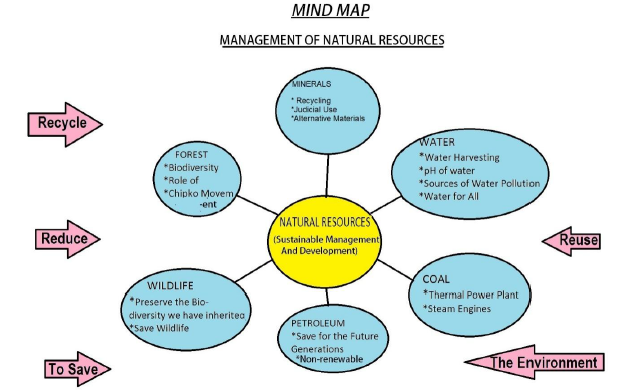
MANAGEMENT OF NATURAL RESOURCES
Natural resources include total natural environment that support human life and contribute to the production of necessities and comforts to mankind. So natural resources are the components of atmosphere, hydrosphere and lithosphere.
On the basis of abundance and availability, the natural resources are of two types:
(a) Inexhaustible
(b) Exhaustible.
We need to manage our natural resources because of the following reasons:
1. The resources of the earth are limited .
2. The proper management of natural resources to prevent exploitation of natural resources
3. The proper management can ensure equitable distribution of natural resources so that all the people can benefit from the development of these resources.
4. The proper management will take into consideration the damage caused to the environment during the ‘extraction’ or ‘use’ of the natural resources and find ways and means to minimize this damage.
Conservation of Wildlife
It is very important to conserve wild-life to maintain the ecological balance in nature and to
preserve the gene pool.
1. Stringent laws to prevent poaching or capturing of animals.
2. Preservation of habitat of wild animals preserved by establishing National Parks and sanctuaries
3. Regular survey by Forest Department to learn about the population of all species of wild animals and plants
4. Special attention should be paid to the conservation of endangered species of wild animals and birds to prevent their extinction altogether.
Conservation of water:
Advantages of Dams:
1. Regular and round the year water supply to fields
2. Continuous water supply to nearby human settlements
3. Generation of electricity.
Disadvantages of Dams:-
1. Social problems // 2. Environmental Problems// 3. Economic Problems
Conservation of Forests:.
1. Afforestation // 2. Reforestation// 3. Separation of Commercial Forestry//4. Grazing
Effects of Deforestation:- Removal, decrease or deterioration of the forest cover of an area is called deforestation. It is caused by excessive felling of trees, overgrazing, monoculture, fragmentation and clearing of forests.
Deforestation causes.
1.Soil Erosion.// 2. Desertification. //3. Floods/ /4. Destruction of wildlife//5. Climatic changes.
Chipko Movement:-
Chipko-Movement was born in Nineteen seventees in a small hilly village of the upper reaches of Himalayas. Tribal people of Tehri-Garhwal district of U.P realized the importance of the forests and decided against giving its products to the people of other areas. They stood against the ruthless butchery of nature and the axes of greedy contractors
Rainwater Harvesting:-
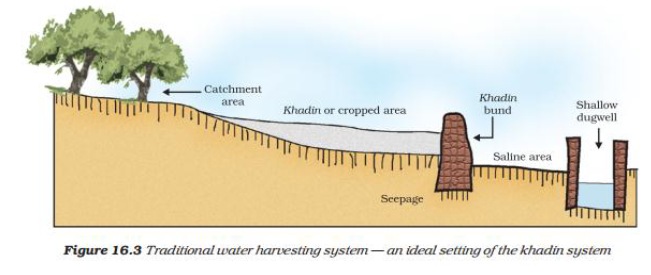

Water harvesting is capturing, collection and storage of rain water and surface run off for filling either small water bodies or recharging ground water so that water continues to be available in non-rainy seasons.
2 Soil is the ____ of the earth's surface.
3 Natural resources that can be replaced are called
4 Non-domesticated animals and uncultivated plants are…
5 To use up a supply or abundance of something is called…
6 Sustainable agriculture requires ____ of natural processes.
7 Many people utilize wildlife resources for ____.
8 The ability to maintain something at a certain rate or level is
9 Substances washing into water sources is called…
10 Preserving and protecting the natural environment is…
11 The loss of soil to wind or water is called…
Please click the link below to download CBSE Class 10 Science-Management Of Natural Resources.
Free study material for Science
Science Class 10 Exam Resources: Chapter 16 Sustainable Management of Natural Resources
Core Study Kit: Class 10 Science Chapter 16 Sustainable Management of Natural Resources
Explore essential learning tools for Class 10 Science Chapter 16 Sustainable Management of Natural Resources. This curated collection features in-depth notes and targeted practice questions built around the active 2026 curriculum to streamline your daily revision.
NCERT-Aligned Solutions for Chapter 16 Sustainable Management of Natural Resources
Each resource draws directly from authorized textbooks to maintain academic accuracy. Evaluating solved examples allows Class 10 students to master the formal presentation and answer-writing standards expected in upcoming school exams.
Next Steps in Your Exam Preparation
Wrap up your chapter revision by testing your knowledge against standard objective question formats. Explore our full library of free, up-to-date sample papers and online assessments to secure top grades in your CBSE examinations.
FAQs
Our advanced study package for Chapter 16 Sustainable Management of Natural Resources includes detailed concepts, diagrams, Mind Maps, and explanation of complex topics to ensure Class 10 students learn as per syllabus for 2026 exams.
The Mind Maps provided for Chapter 16 Sustainable Management of Natural Resources act as visual anchors which will help faster recall during high-pressure exams.
Yes, teachers use our Class 10 Science resources for lesson planning as they are in simple language and have lot of solved examples.
Yes, You can download the complete, mobile-friendly PDF of the Science Chapter 16 Sustainable Management of Natural Resources advanced resources for free.
Yes, our subject matter experts have updated the Chapter 16 Sustainable Management of Natural Resources material to align with the rationalized NCERT textbooks and have removed deleted topics and added new competency-based questions.