

Official CBSE Study Materials for Class 10 Science
Access comprehensive study materials and useful resources for Chapter 14 Sources of Energy using the CBSE Class 10 Science-Sources of Energy. Designed to align with the 2026-27 CBSE academic guidelines, these advanced resources help Class 10 Science students reinforce core concepts beyond standard textbooks.
Advanced Resources for Science
View or download the dedicated CBSE Class 10 Science-Sources of Energy resource below. Engaging with these advanced study guides under focused conditions ensures continuous academic progress and mastery of the 2026-27 curriculum for Chapter 14 Sources of Energy.
CBSE Class 10 Science-Sources of Energy. Please refer to the examination notes which you can use for preparing and revising for exams. These notes will help you to revise the concepts quickly and get good marks.
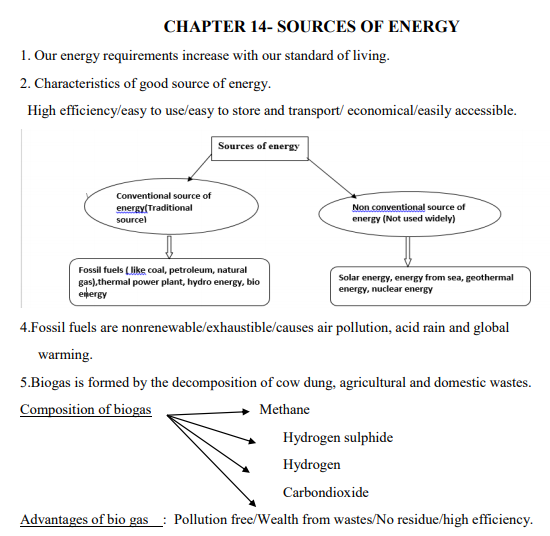
6.Wind energy : Kinetic energy of the wind is used to do the useful work .
Advantages: Renewable/inexhaustible/pollution free/no residue.
Disadvantages :-High cost of installation/minimum wind speed 15km/h/ maintenance cost high/requirement of large area of land.
7.Solar cells are devices which convert light energy into electric energy.
Advantages :-inexhaustible/pollution free/used in artificial satellites/can be used in remote areas/ low cost of maintenance.
Disadvantages:-Requirement of special grade of silicon/high cost of installation/moderate efficiency.
8. In nuclear power plants, nuclear energy is used for the production of electricity.
Advantage :-Very high efficiency
Disadvantage:-Radio active emissions/fear of nuclear power plant accidents/disposal of Radio active wastes.
Please click the link below to download pdf file of CBSE Class 10 Science-Sources of Energy.
Free study material for Science
Useful Resources and Notes for Class 10 Science Chapter 14 Sources of Energy
Core Study Kit: Class 10 Science Chapter 14 Sources of Energy
Access comprehensive study material for Chapter 14 Sources of Energy, including revision notes, concept maps, and high-probability questions. These resources are designed in alignment with the latest 2026 CBSE syllabus for Class 10 Science to support effective exam preparation.
NCERT-Aligned Solutions for Chapter 14 Sources of Energy
Each resource draws directly from authorized textbooks to maintain academic accuracy. Evaluating solved examples allows Class 10 students to master the formal presentation and answer-writing standards expected in upcoming school exams.
Next Steps in Your Exam Preparation
Maximize your grade potential by utilizing Class 10 Science practice papers in tandem with these structured notes. All printable assignments and interactive mock tests on our platform are updated for the 2026 session and available free of charge.
FAQs
Our advanced study package for Chapter 14 Sources of Energy includes detailed concepts, diagrams, Mind Maps, and explanation of complex topics to ensure Class 10 students learn as per syllabus for 2026 exams.
The Mind Maps provided for Chapter 14 Sources of Energy act as visual anchors which will help faster recall during high-pressure exams.
Yes, teachers use our Class 10 Science resources for lesson planning as they are in simple language and have lot of solved examples.
Yes, You can download the complete, mobile-friendly PDF of the Science Chapter 14 Sources of Energy advanced resources for free.
Yes, our subject matter experts have updated the Chapter 14 Sources of Energy material to align with the rationalized NCERT textbooks and have removed deleted topics and added new competency-based questions.