

Official CBSE Study Materials for Class 10 Science
Review targeted academic resources with the Class 10 Science Excretion Exam Notes. Built according to official CBSE standards for the 2026-27 term, these downloadable Class 10 Science study materials support effective daily practice and deeper conceptual understanding for Chapter 05 Life Processes.
Advanced Resources for Science
View or download the dedicated Class 10 Science Excretion Exam Notes resource below. Engaging with these advanced study guides under focused conditions ensures continuous academic progress and mastery of the 2026-27 curriculum for Chapter 05 Life Processes.
Excretion
Excretion is the elimination of metabolic waste products from the body.
Waste Products
- Nitrogenous Waste Products. They are the major waste products which are formed during breakdown of extra amino acids, nucleic acids and alkaloids. The important nitrogenous waste products are urea, uric acid, creatine, creatinine and ammonia.
- Non-nitrogenous Waste Products - Oxalic acid, lactic acid.
- Excess Chemicals - Excess minerals, drugs, pigments, vitamins, hormones, cholesterol, etc.
- Bile Pigments - Bilirubin, biliverdin and urochrome.
- CO2
- Excess water.
Excretion In Human Being
A pair of kidney is the main excretory organ in human.
Structure and Function of Kidney in Human :
- There are two bean shaped, dark red coloured kidney placed just below the stomach, one on each side of the mid dorsal line.
The depression is called hilus from where the ureter originates and the renal artery and renal vein go in and out here.
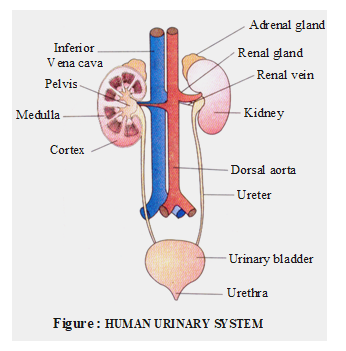
Ureter entering through hilus expands. Medula on inner side has cone like structure called renal pyramids. Each kidney contains about one million nephrons. The functional unit of the kidney is the nephron.
Ø STRUCTURE OF NEPHRON
Each nephron consists of a round malpighian body formed by Bowman’s capsule filled with capillary net work afferent and efferent arterioles. Afferent means incoming, Efferent means outgoing called Glomerulus or Malpighian corpuscles. The malpighian tubule is divided into 3 parts forming a shaped convoluted tubule.
(A) The proximal tubule - Nearest Bowman’s capsule.
(B) Henle loop - It is a 'U' shape thin tube like structure.
(C) Distal tubule - Join collecting tuble.
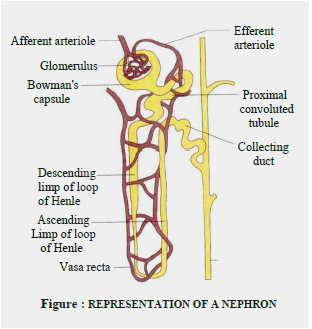
The ascending limb of Henle’s loop again gives second convoluted tubule opening into collecting tubule and finally into lager tubule known as duct of Bellini, which opens into the pelvis of ureter at the apex of renal pyramids. The entire kidney tubule is surrounded by blood capillaries called vasa recta.
Ø MECHANISM OF URINE FORMATION
It has four steps - ultra filtration, selective reabsorption, secretion and concentration.
(i) Ultra Filtration. Blood flows inside glomerulus under pressure due to narrowness of efferent arteriole. As a result it undergoes pressure filtration or ultrafiltration. All small volume solutes (e.g., urea, uric acid, amino acids, hormones, glucose, ions, vitamins) and water are filtered out and enter the Bowmans' capsule. The product is called nephric or glomerular filtrate. Its volume is 125 ml/min (180 litres/day).
(ii) Reabsorption. Nephric filtrate is also called primary urine. It passes into proximal convoluted tubule. The same is surrounded by peritubular capillaries. The latter reabsorb all the useful components of nephric filtrate, e.g,
glucose, amino acids, vitamins C, calcium, potassium, sodium, chloride, bicarbonate and water (75%). Selective absorption also occurs in the region of distal convoluted tubule.
(iii) Secretion (Augmentation). It occurs mostly in the distal convoluted tubule which is also surrounded by peritubular capillaries. Smaller amount of tubular secretion also takes palce in the area of proximal convoluted tubule. Tubular secretion is active secretion of waste products by the blood capillaries. It cause removal of all the waste products from blood, viz. urea, uric acid, creatinine. Extra salts, K+ and H+ are also secreted into urinary tubule to maintain a proper concentration and pH of the urine.
(iv) Concentration of the Urine. 75% of water content of nephric filtrate is reabsorbed in the region of proximal convoluted tubule. Some 10% of water passes out of the filtrate through osmosis in the area of loop of Henle. It is because loops of Henle are immersed in hyper-osmotic interstitial fluid. Further concentration takes place
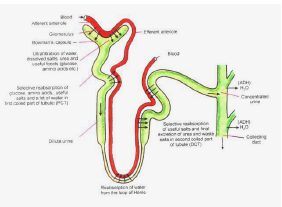
in the area of collecting tubule in the presence of hormone called antidiuretic hormone (ADH) or vasopressin. Absence of Antidiuretic hormone produces a dilute urine. Hormone action, therefore, maintains osmotic concentration of body fluids. Deficiency of ADH causes excessive, repeated dilute urination (diabetes insipidus).
The process of passes urine in called Micturition.
Ø EXCRETION IN PLANTS
Plants do not produce nitrogeneous wastes like urea and uric acid because extra amino acids and nucleotides are not formed. They produce other types of waste products, called secondary metabolites, e.g., alkaloids, tannins, aromatic oils. (i) Nitrogenous Waste Products. They are byproducts of general metabolism. The common ones are alkaloids, e.g., quinine, morphine, atropine.
(ii) Organic Acids. They are metabolic intermediates. Some of them are without any other use. Rather on accumulation they may prove toxic, e.g., oxalic acid.
(iii) Tannins. They are complex aromatic compounds which are formed as secondary metabolites.
(iv) Latex. It is an emulsion of varied composition which is exereted by special tubular cells called laticifers.
(v) Resins. They are oxidation products of aromatic oils. (vi) Gums. They are degradation products of cell wall.
Mechanism of Excretion in Plante:
Plants do not have any mechanism to collect, transport and throw out their waste products. They have adopted varied strategies to protect their living cell from waste products.
(i) Old Leaves. Waste products are stored in older leaves which soon fall off.
(ii) Old Xylem. Resins, gums, tannins and other waste products are deposited in the old xyem which soon becomes nonfunctional e.g. Hard wood.
(iii) Bark. Bark consists of dead cells which is peeled off periodically. Tannins and other wastes are deposited in the bark. Incidentally, tannins are raw material for dyes and inks.
(iv) Central Vacuole. Most plant waste products are stored in central vacuole of their cells. They are unable to influence the working of cytoplasm due to presence of a selectively permeable membrane called tonoplast.
(v) Root Excretion. Some waste substances are actually excreted by the plants in the region of their roots.
(vi) Detoxification. The toxi oxalic acid is detoxified by formation of calcium oxalate which gets crystallized into needles (raphides), prism (prismatic crystals), stars (sphaeraphides) and crystal sand. Excess of calcium is also precipitated as calcium carbonate crystals, e.g. cystolith.
(vii) Salt Glands. They excrete excess salts obtained from the habitat.
Question. Which of the following parts of a kidney contains the lowest concentration of urea ?
(A) Loop of Henle
(B) Branches of renal vein
(C) Bowman’s capsule
(D) Glomerulus
Answer : B
Question. The process of tubular secretion in nephron takes place in
(A) Glomerulus
(B) Ascending loop of henle
(C) Loop of Henle
(D) Distal convoluted tubule
Answer : D
Question. Urea is transported through
(A) RBCs
(B) WBCs
(C) Plasma
(D) lymph
Answer : C
Question. Major function of contractile vacuole is
(A) excretion
(B) circulation
(C) osmoregulation
(D) phagocytosis
Answer : C
Question. Which one is an accessory excretory organ ?
(A) Liver
(B) Stomach
(C) Intestine
(D) Heart
Answer : A
Question. Ammonia is converted into urea in
(A) kidney
(B) spleen
(C) liver
(D) nephron
Answer : C
Question. Uriniferous tubules of a kidney are concerned with formation of
(A) glucose
(B) amino acids
(C) hormones
(D) urine
Answer : D
Question. Plants excrete their excretion in form of -
(A) Solid
(B) Liquid
(C) Gaseous
(D) All of these
Answer : D
Question. Nitrogenous wastes are formed from the breakdown of :
(A) NH
(B) Fat
(C) Amino acids
(D) Water
Answer : C
Question. Functional unit of kidney is
(A) Nephron
(B) Nephritis
(C) Neuron
(D) Loop of Henle
Answer : A
Question. Technique which is used for purification of blood is known as :-
(A) Chromatography
(B) Dialysis
(C) ELISA
(D) None of these
Answer : B
Question. Excretion is removal of
(A) CO2
(B) metabolic wastes
(C) nitrogenous waste
(D) all of these
Answer : D
Question. Urine is always fluid except in :
(A) Birds
(B) Humans
(C) Amphibians
(D) Mammals
Answer : A
Question. Osmoregulation is control over :
(A) Removal of nitrogen from the body
(B) Concentrations of salt and water in the body
(C) Osmotic properties of cell membrane
(D) pH of the blood
Answer : B
Question. In Amoeba, osmoregulation is carried out by :
(A) Food Vacuole
(B) Plasma membrane
(C) Contractile vacuole
(D) None of these
Answer : C
Question. The filterate from the glomerulus contains :
(A) Urea and uric acid
(B) Urea, uric acid and ammonia
(C) Urea, uric acid, ammonia and water
(D) Urea, uric acid, glucose and water.
Answer : D
Question. Frog’s tadpole are
(A) ureotelic
(B) ammonotelic
(C) uricotelic
(D) none of these
Answer : B
Question. Function of loop of Henle is
(A) conservation of water
(B) formation of urine
(C) filtration of blood
(D) passage of urine
Answer : A
Question. Solid waste of plant is -
(A) Raphides
(B) Sandal oil
(C) CO2
(D) None of these
Answer : A
Question. Nitrogenous waste products are eliminated mainly as :
(A) Urea in tadpole and ammonia in adult frog
(B) Ammonia in tadpole and urea in adult frog
(C) Urea in both tadpole and in adult frog
(D) Urea in tadpole and uric acid in adult frog
Answer : B
Question. Which one of the following glands does not help in excretion ?
(A) liver
(B) sweat glands
(C) pancreas
(D) both (A) and (C)
Answer : C
Question. Excretion is a continous process but urine is not passed out continuously because of :
(A) Urinary bladder
(B) Cloaca
(C) Rectum
(D) Ureter
Answer : A
Question. If Henle’s loop is absent from mammalian nephron, which one of the following is to be expected ?
(A) Hardly any change in quality and quantity of urine formed
(B) Urine will be more concentrated
(C) Urine will be more dilute
(D) No urine formation
Answer : C
Question. Among which one of the following are part of nephron ?
(A) Cortex
(B) Medulla
(C) Bowman’s capsule
(D) Collecting duct
Answer : C
Question. Which blood vessel contains the least amount of urea?
(A) Hepatic vein
(B) Renal vein
(C) Hepatic portal vein
(D) Renal artery
Answer : B
Question. Diameter of the renal afferent vassel is
(A) Same as that of efferent
(B) Smaller than that of efferent
(C) Larger than that of efferent
(D) There is no efferent vessel
Answer : C
Please click on below link to download pdf file for Class 10 Science Excretion Exam Notes
Free study material for Science
CBSE Class 10 Science Study Material: Chapter 05 Life Processes
Core Study Kit: Class 10 Science Chapter 05 Life Processes
Access comprehensive study material for Chapter 05 Life Processes, including revision notes, concept maps, and high-probability questions. These resources are designed in alignment with the latest 2026 CBSE syllabus for Class 10 Science to support effective exam preparation.
NCERT-Aligned Solutions for Chapter 05 Life Processes
Designed around the official curriculum, these study guides guarantee standard compliance. Reviewing step-by-step solutions clarifies complex sub-topics within Chapter 05 Life Processes and demystifies standard marking schemes for Science evaluations.
Next Steps in Your Exam Preparation
For peak performance in upcoming evaluations, integrate official Science sample papers directly into your study schedule. Follow up your revision by attempting online MCQ tests for Chapter 05 Life Processes to refine calculation speed and precision.
FAQs
Our advanced study package for Chapter 05 Life Processes includes detailed concepts, diagrams, Mind Maps, and explanation of complex topics to ensure Class 10 students learn as per syllabus for 2026 exams.
The Mind Maps provided for Chapter 05 Life Processes act as visual anchors which will help faster recall during high-pressure exams.
Yes, teachers use our Class 10 Science resources for lesson planning as they are in simple language and have lot of solved examples.
Yes, You can download the complete, mobile-friendly PDF of the Science Chapter 05 Life Processes advanced resources for free.
Yes, our subject matter experts have updated the Chapter 05 Life Processes material to align with the rationalized NCERT textbooks and have removed deleted topics and added new competency-based questions.