

Class 10 Science Study Guide: CBSE Class 10 Science Life processes Notes
Explore structured advanced study materials through the CBSE Class 10 Science Life processes Notes. Tailored for Class 10 learners, utilizing these Science resources ensures thorough preparation and strengthens foundational knowledge before final CBSE evaluations.
Download Chapter 05 Life Processes Study Material PDF
View or download the dedicated CBSE Class 10 Science Life processes Notes resource below. Engaging with these advanced study guides under focused conditions ensures continuous academic progress and mastery of the 2026-27 curriculum for Chapter 05 Life Processes.
CBSE Class 10 Science Life processes Notes. There are many more useful educational material which the students can download in pdf format and use them for studies. Study material like concept maps, important and sure shot question banks, quick to learn flash cards, flow charts, mind maps, teacher notes, important formulas, past examinations question bank, important concepts taught by teachers. Students can download these useful educational material free and use them to get better marks in examinations. Also refer to other worksheets for the same chapter and other subjects too. Use them for better understanding of the subjects.
LIFE PROCESSES
LIFE PROCESS
The maintenance of living organisms must go on even at the conditions, when they are not physically active. Even when we sit idle and during sleeping, this maintenance job through cells functioning has to go on. The life process includes the activities performed by the different organs to maintain the body.
Some of the life processes in the living beings are described below:
* Nutrition
The process of obtaining energy through consumption of food is called as nutrition.
* Respiration
The process of acquiring oxygen through breathing and make it available to cells for the process of breaking down of organic substances into simpler compounds is called as respiration.
* Transportation
Transportation is the process by which the food and oxygen is carried from one organ to other organs in the body.
* Excretion
It is the process by which the metabolic waste by-products are removed from the different organs and released out from the body.
Question 1: Why is diffusion insufficient to meet the oxygen requirements of multicellular organisms like humans?
Answer : Multicellular organisms such as humans possess complex body designs. They have specialised cells and tissues for performing various necessary functions of the body such as intake of food and oxygen. Unlike unicellular organisms, multicellular cells are not in direct contact with the outside environment. Therefore, diffusion cannot meet their oxygen requirements.
Question 2: What criteria do we use to decide whether something is alive?
Answer : Any visible movement such as walking, breathing, or growing is generally used to decide whether something is alive or not. However, a living organism can also have movements, which are not visible to the naked eye. Therefore, the presence of life processes is a fundamental criterion that can be used to decide whether something is alive or not.
Question 3: What are outside raw materials used for by an organism?
Answer : An organism uses outside raw materials mostly in the form of food and oxygen. The raw materials required by an organism can be quite varied depending on the complexity of the organism and its environment.
Question 4: What processes would you consider essential for maintaining life?
Answer : Life processes such as nutrition, respiration, transportation, excretion, etc. are essential for maintaining life.
NUTRITION
The process by which an organism takes food and utilizes it is called nutrition.
NEED OF NUTRITION
Organisms need energy to perform various activities. The energy is supplied by the nutrients. Organisms need various raw materials for growth and repair. These raw materials are provided by nutrients.
NUTRIENTS
Materials which provide nutrition to organisms are called nutrients. Carbohydrates, proteins and fats are the main nutrients and are called macronutrients. Minerals and vitamins are required in small amounts and hence are called micronutrients.
TYPES OF NUTRITION:
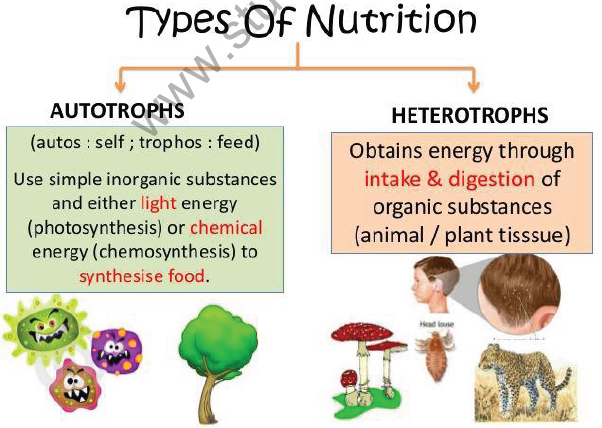
• Autotrophic Nutrition: The mode of nutrition in which an organism prepares its own food is called autotrophic nutrition. Green plants and blue-green algae follow the autotrophic mode of nutrition.
• Heterotrophic Nutrition: The mode of nutrition in which an organism takes food from another organism is called heterotrophic nutrition. Organisms; other than green plants and blue-green algae follow heterotrophic mode of nutrition.
AUTOTROPHIC NUTRITION
Autotrophic organisms are able to produce organic matter from simple inorganic materials.
They consequently create their own food—but require a source of energy to do this.
• Photoautotrophs harvest energy from light to produce organic matter.
• Chemoautotrophs use energy from inorganic reactions in the environment to drive the creation of organic matter.
HETEROTROPHIC NUTRITION
Heterotrophic nutritrion is typical of animals. These organisms eat organic matter in other organisms—either alive (as hunters) or dead (as scavengers).
Saprotrophic organisms are the decay organisms. They digest dead materials using enzymes that they secrete externally. Fungi and many bacteria are saprotrophes.
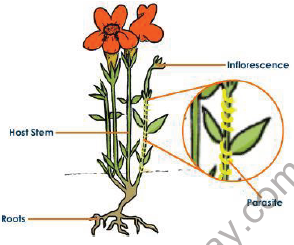
Parasites (biotrophs) feed on living organisms without killing them.
Heterotrophic nutrition can be further divided into two types, viz. saprophytic nutrition and holozoic nutrition.b
o Saprophytic Nutrition: In saprophytic nutrition; the organism secretes the digestive juices on the food. The food is digested while it is still to be ingested. The digested food is then ingested by the organism. All the decomposers follow saprophytic nutrition. Some insects; like houseflies; also follow this mode of nutrition.
o Holozoic Nutrition: In holozoic nutrition; the digestion happens inside the body of the organism, i.e. after the food is ingested. Most of the animals follow this mode of nutrition.

PLANT NUTRITION
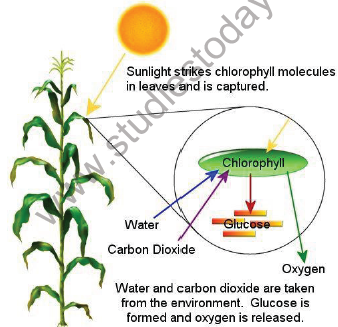
Green plants prepare their own food. They make food in the presence of sunlight. Sunlight provides energy, carbon dioxide and water are the raw materials and chloroplast is the site
where food is made.
PHOTOSYNTHESIS: The process by which green plants prepare food is called photosynthesis. During this process; the solar energy is converted into chemical energy and carbohydrates are formed. Green leaves are the main sites of photosynthesis. The green portion of the plant contains a pigment chloroplast; which contains chlorophyll. The whole process of photosynthesis can be shown by following equation:
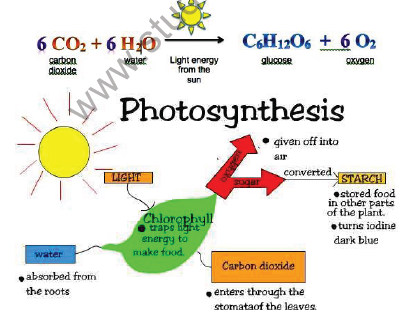
STEPS OF PHOTOSYNTHESIS:
• Sunlight activates chlorophyll; which leads to splitting of water molecule.
• The hydrogen; released by splitting of water molecule is utilized for reduction of carbon dioxide to produce carbohydrates.
• Oxygen is the byproduct of photosynthesis.
• Carbohydrate is subsequently converted into starch and is stored in leaves and other storage parts.
• The splitting of water molecules is part of the light reaction.
• Other steps are part of the dark reaction during photosynthesis.
HOW DO RAW MATERIALS FOR PHOTOSYNTHESIS BECOME
AVAILABLE TO THE PLANT?
• Water comes from soil; through the xylem tissue in roots and stems.
• Carbon dioxide comes in the leaves through stomata.
SIGNIFICANCE OF PHOTOSYNTHESIS:
• Photosynthesis is the main way through which the solar energy is made available for different living beings.
• Green plants are the main producers of food in the ecosystem. All other organisms directly or indirectly depend on green plants for food.
• The process of photosynthesis also helps in maintaining the balance of carbon dioxide and oxygen in the air.
ANIMAL NUTRITION
Heterotrophic Nutrition: When an organism takes food from another organism, it is called heterotrophic nutrition. Different heterotrophic organisms follow different methods to take and utilize food. Based on this, heterotrophic nutrition can be divided into two types:
• Saprophytic Nutrition: In saprophytic nutrition, the digestion of food takes place before ingestion of food. This type of nutrition is usually seen in fungi and some other microorganisms. The organism secretes digestive enzymes on the food and then ingests the simple substances. Saprophytes feed on dead materials and thus help in decomposition dead remains of plants and animals.
Please click the link below to download CBSE Class 10 Science Life processes Notes.
Free study material for Science
Useful Resources and Notes for Class 10 Science Chapter 05 Life Processes
Core Study Kit: Class 10 Science Chapter 05 Life Processes
Explore essential learning tools for Class 10 Science Chapter 05 Life Processes. This curated collection features in-depth notes and targeted practice questions built around the active 2026 curriculum to streamline your daily revision.
NCERT-Aligned Solutions for Chapter 05 Life Processes
Designed around the official curriculum, these study guides guarantee standard compliance. Reviewing step-by-step solutions clarifies complex sub-topics within Chapter 05 Life Processes and demystifies standard marking schemes for Science evaluations.
Next Steps in Your Exam Preparation
For peak performance in upcoming evaluations, integrate official Science sample papers directly into your study schedule. Follow up your revision by attempting online MCQ tests for Chapter 05 Life Processes to refine calculation speed and precision.
FAQs
Our advanced study package for Chapter 05 Life Processes includes detailed concepts, diagrams, Mind Maps, and explanation of complex topics to ensure Class 10 students learn as per syllabus for 2026 exams.
The Mind Maps provided for Chapter 05 Life Processes act as visual anchors which will help faster recall during high-pressure exams.
Yes, teachers use our Class 10 Science resources for lesson planning as they are in simple language and have lot of solved examples.
Yes, You can download the complete, mobile-friendly PDF of the Science Chapter 05 Life Processes advanced resources for free.
Yes, our subject matter experts have updated the Chapter 05 Life Processes material to align with the rationalized NCERT textbooks and have removed deleted topics and added new competency-based questions.