

Official CBSE Study Materials for Class 10 Science
Review targeted academic resources with the Class 10 Science Light Refraction Exam Notes. Built according to official CBSE standards for the 2026-27 term, these downloadable Class 10 Science study materials support effective daily practice and deeper conceptual understanding for Chapter 09 Light Reflection and Refraction.
Advanced Resources for Science
View or download the dedicated Class 10 Science Light Refraction Exam Notes resource below. Engaging with these advanced study guides under focused conditions ensures continuous academic progress and mastery of the 2026-27 curriculum for Chapter 09 Light Reflection and Refraction.
Class 10 Science Light Refraction Exam Notes. Please refer to the examination notes which you can use for preparing and revising for exams. These notes will help you to revise the concepts quickly and get good marks.
Refraction Of Light
Definition : When light rays travelling in a medium are incident on a transparent surface of another medium they are bent as they travel in second medium
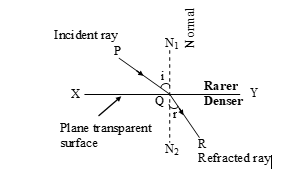
Fig. Refraction of light from a plane transparent denser surface.
some associated terms
Transparent surface : The plane surface which refracts light, is called transparent surface. In diagram, XY is the section of a plane transparent surface.
Point of incidence : The point on transparent surface, where the ray of light meets it, is called point of incidence. In diagram, Q is the point of incidence.
Normal : Perpendicular drawn on the transparent surface at the point of incidence, is called normal. In diagram, N1QN2 is the normal on surface XY.
Incident ray : The ray of light which strikes the transparent surface at the point of incidence, is called incident ray in diagram PQ is the incident ray.
Refracted ray : The ray of light which travels from the point of incidence into the other medium, is called refracted ray. In diagram, QR is the refracted ray.
Angle of incidence : The angle between the incident ray and the normal on the transparent surface at the point of incidence, is called the angle of incidence. It is represented by the symbol i. In diagram, angle PQN1 is the angle of incidence.
Angle of refraction : The angle between the refracted ray and the normal on the transparent surface at the point of incidence, is called angle of refraction. It is represented by symbol r. In diagram angle RQN2 is the angle of refraction.
♦ Plane of incidence : The plane containing the normal and the incident ray, is called plane of incidence. For the diagram, plane of book page is the plane of incidence.
♦ Plane of refraction : The plane containing the normal and the refracted ray, is called plane of refraction. For the diagram, plane of book page is the plane of refraction.
LAW OF REFRACTION OF LIGHT
♦ First Law : The incident ray, the normal to the transparent surface at the point of incidence and the refracted ray, all lie in one and the same plane.
♦ Second Law : The ratio of sine of angle of incidence to the sine of the angle of refraction is constant and is called refractive index of the second medium with respect to the first medium.
As refractive index is the ratio of two similar physical quantities, so it has no unit and dimension.
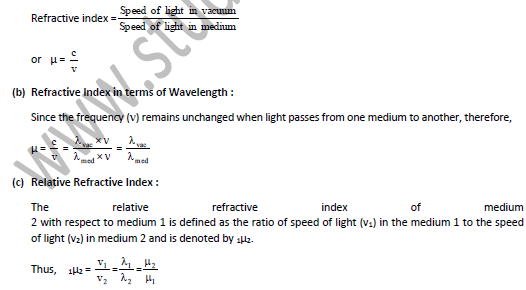
As refractive index is the ratio of two similar physical quantities, so it has no unit and dimension.
FACTORS ON WHICH THE REFRACTIVE INDEX OF A MEDIUM DEPENDS ARE :
(i) Nature of the medium.
(ii) Wavelength of the light used.
(iii) Temperature
(iv) Nature of the surrounding medium.
It may be noted that refractive index is a characteristic of the pair of the media and also depends on the wavelength of light, but is independent of the angle of incidence.
REFRACTION THROUGH GLASS SLAB
(a) Refraction through a rectangular glass slab and principle of reversibility of light :
Consider a rectangular glass slab, as shown in figure. A ray AE is incident on the face PQ at an angle of incidence i. On entering the glass slab, it bends towards normal and travels along EF at an angle of refraction r. The refracted ray EF is incident on face SR at an angle of incidence r'. The emerged ray FD bends away from the normal at an angle of refraction e.
Thus the emergent ray FD is parallel to the incident rays AE, but it has been laterally displaced with respect to the incident ray. There is shift in the path of light on emerging from a refracting medium with parallel faces.
Lateral shift :
Lateral shift is the perpendicular distance between the incident and emergent rays when light is incident obliquely on a refracting slab with parallel faces.
Factors on which lateral shift depends are :
(i) Lateral shift is directly proportional to the thickness of glass slab.
(ii) Lateral shift is directly proportional to the incident angle.
(iii) Lateral shift is directly proportional to the refractive index of glass slab.
(iv) Lateral shift is inversely proportional to the wavelength of incident light
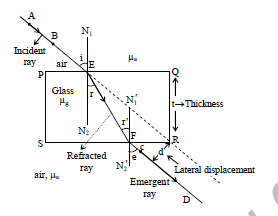
Proof for i = e
For light going from air to glass at point E.
μa sin i = μg sin r ..... (1)
Case-II :
For light going from glass to air at point F.
μg sin r = μa sin e .....(2)
From (1) & (2) we can say that i = e
incident & emergent rays are parallel to each other.
SPHERICAL LENS
Types : There are two types of spherical lenses:
(i) Convex or Converging Lenses : These are thick in the middle and thin at the edges.

(a) Double Convex Lens : It has both the surfaces convex.
(b) Plano–Convex Lens : It has one surface plane and the other surface convex.
(c) Concavo–Convex Lens : It has one surface concave and the other surface convex.
(ii) Concave or Diverging Lenses : These are thin in the middle and thick at the edges.
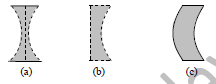
(a) Double Concave Lens : It has both the surfaces concave. (Fig.)
(b) Plano–Concave Lens : It has one surface plane and the other surface concave. (fig.)
(c) Convexo–Concave Lens : It has one surface convex and the other surface concave. (fig.)
SOME ASSOCIATED TERMS :
(i) Centre of curvature (C) :
The centre of curvature of the surface of a lens is the centre of the sphere of which it forms a part, because a lens has two surfaces, so it has two centres of curvature. In figure (a) and (b) points, C1 and C2 are the centres of curvature.
(ii) Radius of curvature (R) :
The radius of curvature of the surface of a lens is the radius of the sphere of which the surface forms a part. R1 and R2 in the figure (a) and (b) represents radius of curvature.
(iii) Principal axis (C1 C2) : It is the line passing through the two centres of curvature (C1 and C2) of the lens
Please click on below link to download pdf file for Class 10 Science Light Refraction Exam Notes.
Free study material for Science
Free CBSE Study Guides: Class 10 Science Chapter 09 Light Reflection and Refraction
Quick Revision Material for Chapter 09 Light Reflection and Refraction
Explore essential learning tools for Class 10 Science Chapter 09 Light Reflection and Refraction. This curated collection features in-depth notes and targeted practice questions built around the active 2026 curriculum to streamline your daily revision.
Expert Notes and Solved Exam Questions
Each resource draws directly from authorized textbooks to maintain academic accuracy. Evaluating solved examples allows Class 10 students to master the formal presentation and answer-writing standards expected in upcoming school exams.
Additional Study Resources for Class 10
Maximize your grade potential by utilizing Class 10 Science practice papers in tandem with these structured notes. All printable assignments and interactive mock tests on our platform are updated for the 2026 session and available free of charge.
FAQs
Our advanced study package for Chapter 09 Light Reflection and Refraction includes detailed concepts, diagrams, Mind Maps, and explanation of complex topics to ensure Class 10 students learn as per syllabus for 2026 exams.
The Mind Maps provided for Chapter 09 Light Reflection and Refraction act as visual anchors which will help faster recall during high-pressure exams.
Yes, teachers use our Class 10 Science resources for lesson planning as they are in simple language and have lot of solved examples.
Yes, You can download the complete, mobile-friendly PDF of the Science Chapter 09 Light Reflection and Refraction advanced resources for free.
Yes, our subject matter experts have updated the Chapter 09 Light Reflection and Refraction material to align with the rationalized NCERT textbooks and have removed deleted topics and added new competency-based questions.